What stands behind a stamp?
10 · Europass and Open Badges
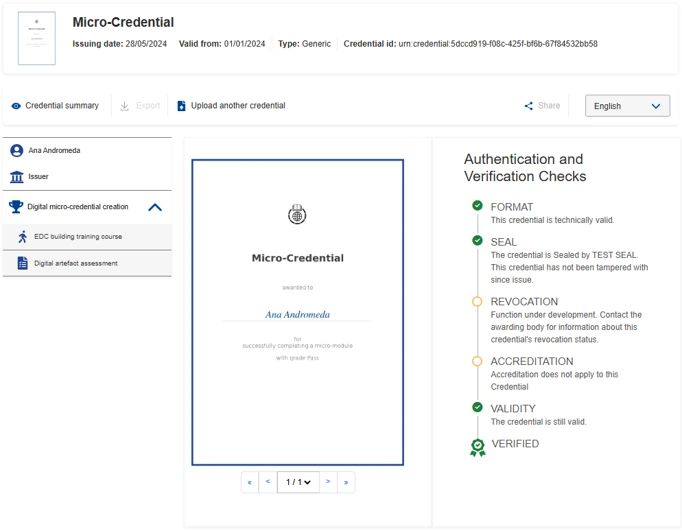
Open Badges describes a defined achievement associated with an earner, issuer, criteria and possible evidence. European Digital Credentials for Learning makes a learning credential’s content and electronic verification inspectable. These are credential mechanisms, not wellbeing diaries.
Journey: meet stated criteria → issuer prepares a credential → receive and store it → share it → a recipient verifies and decides what to recognise. Europass reported more than 35,000 credentials issued to its wallets in an October 2024 account. That is dated implementation evidence, not a November 2026 total. The Commission provides infrastructure; an issuer’s local implementation still needs resources. No IoV conformance or recognition agreement is established by displaying a passport or using the word “credential.”
11 · RSA Cities of Learning
Ufi’s programme account describes a network connecting learners, institutions, employers and local opportunities through digital badges and pathways. It names the RSA and the development of underlying technology by Navigatr. This is particularly relevant to Dhun: the institution is a network of people able to recognise something, not the book itself.
The RSA’s funding page names Ufi VocTech Trust and Garfield Weston Foundation and reports 600 organisations, seven cities/regions, 30,000 learners and 35,000 badges. The page does not establish when those cumulative counts were last refreshed. I retain them as provider-reported historical programme evidence, not current independent totals. Journey: find a local pathway → participate → meet criteria → receive recognition → use it towards another opportunity.
12 · Camino and National Parks
The Camino credential introduces a pilgrim and accumulates marks along a route under the relevant institution’s rules. The National Parks passport collects cancellations identifying a park and the date of a visit. They are grouped only because both make an accumulating journey tangible.
Journey: obtain the book → encounter a place → collect its mark → carry it onward. Neither example needs to claim that the person became better by collecting more stamps. The park programme sells books while cancellations are free; that is an operating model, not a venture-financing announcement. Current public guidance is available for both. Separate current programme budgets were not established. The lesson is restraint: a mark can be meaningful because its claim is small.
13 · Wellbeing Passport Australia
The Australian provider describes an employer-funded wallet through which employees choose support from a local service network. Its public page says it is piloting with organisations in the Hunter region and names partners.
Journey: employer funds access → employee chooses support → provider delivers it → the programme reports utilisation. This is a benefits/access meaning of passport. The employer-funded wallet is not evidence of external investment, a disclosed pilot budget or measured health improvement. We have not tested an account or verified a wider rollout. It is relevant to our incentive question precisely because the benefit is practical access, rather than collecting a more flattering score.