What should a wellbeing passport carry? · Full essay
01
The life between journeys
My travel passport has a precise memory. It remembers where a border officer let me through. It knows my name, nationality and date of birth. It can tell a stranger which country accepts responsibility for issuing it. The ink inside gives a journey an institutional witness.
It has almost nothing to say about the person who came home.
A familiar object, a different question · choose a view
The cover
The cover
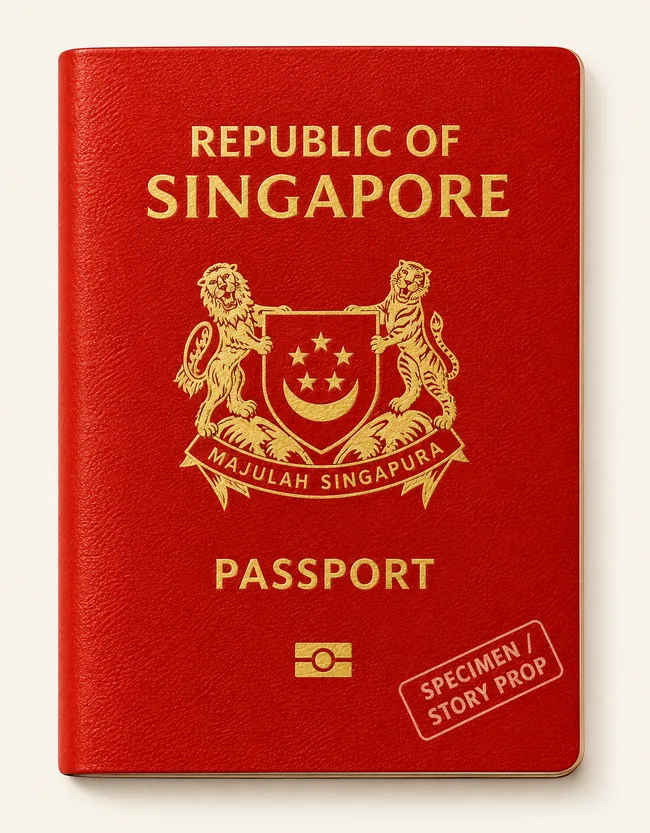
A country. A traveller. Permission to cross.
The particulars
The particulars
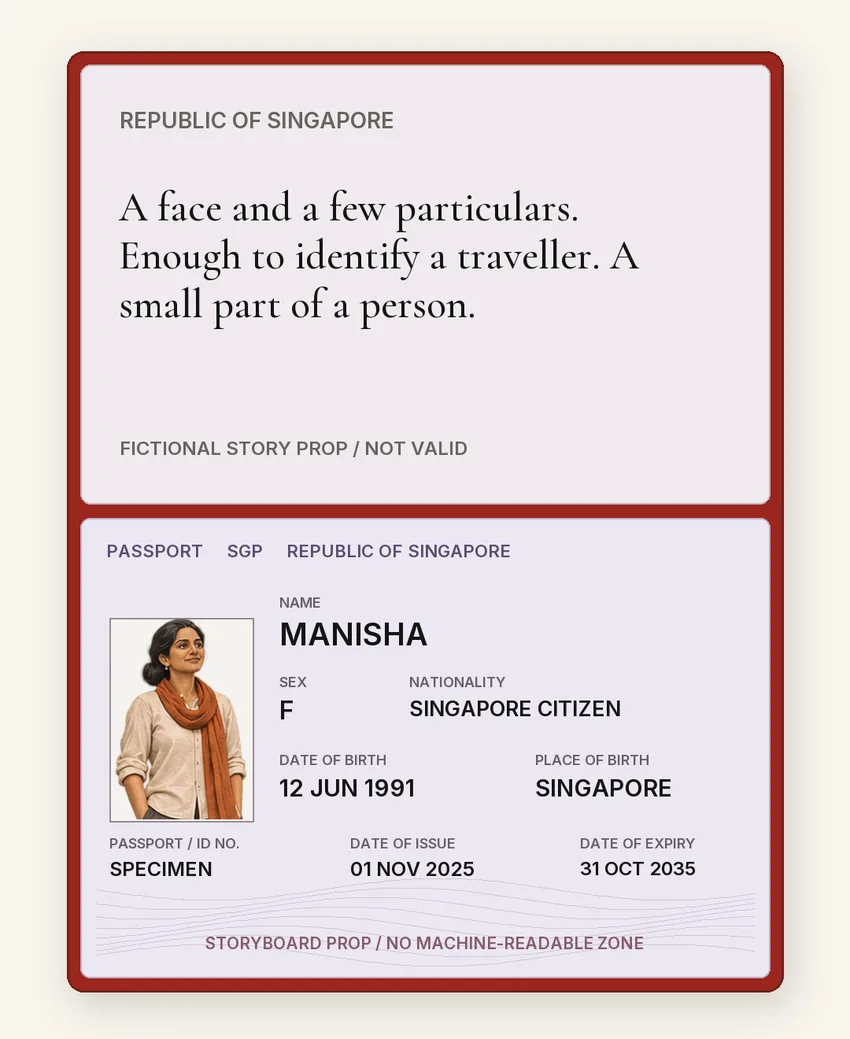
The journeys
The journeys
The person between them
The person between them
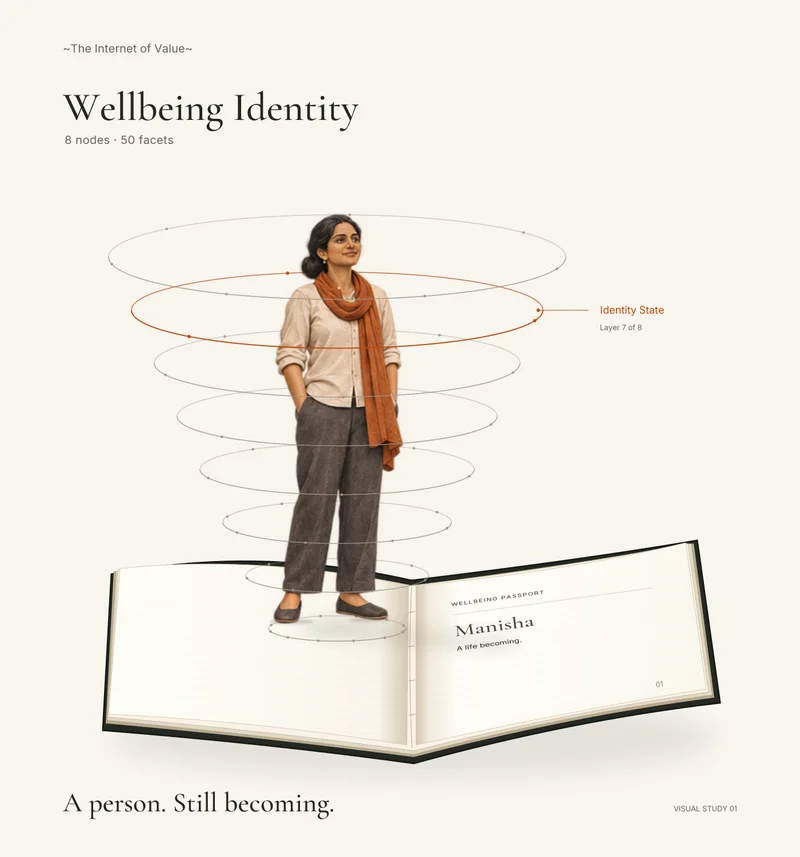
What helps us remember how we lived?
During my residency at Dhun, a conversation with Manvendra Singh Shekhawat gave a setting to an idea I had been working towards through The Internet of Value. What might a wellbeing passport carry? An experience, perhaps. A contribution. A moment someone noticed, and later understood differently. Something that survives the return from a retreat, a residency or an unusually good conversation.
This is my account of that conversation and the work it prompted. The proposal described here comes from Internet of Value Research Foundation. It is not an announcement of an agreed Dhun partnership.
A passport remembers where we went.
What helps us remember how we lived?
The question began as a visual metaphor. It quickly became a problem about meaning. If Manisha attends yoga, feels more at ease, helps inspect a water system and spends forty minutes in the comments, what exactly belongs on a page? Which parts can only be her account? Which can somebody else acknowledge? What would justify a change to a score? What should remain private?
We could answer all of those badly and still make an attractive book.
So this essay follows two journeys. One is through existing projects: support passports, daily journals, wearables, learning credentials and physical journey books. The other is our design evolution, from passport-shaped sketches to an existing Value Log reading interface and a dimensional proposal in which the person emerges from the page.
These projects are neighbours, not one market with one winner. Some help a young person communicate with a supporter. Some help someone notice a pattern. Some establish who issued an achievement. Their differences matter more than a row of ticks beside the word “passport.”
This is an unlisted review draft, researched on 11 November 2026. A current public page establishes what its publisher describes; it does not establish current deployment scale, clinical effectiveness, audited security or undisclosed funding.
Read the setting first in Dhun: When an Idea Chooses You and Field Station: where is your nose? The longer theoretical companion is Observer Attention Is All You Need. The concern with what gets counted also runs through The Invisible 24 Hours and I’m Not a Restaurant Menu, Deepinder.
02
What the word passport hides
I initially treated the passport as an answer. The research made it more useful as a question.
A support passport says, roughly, “Here is what you need to know to support me.” A journal asks, “What happened, and how did it feel?” A wearable asks a different question about measured signals. A credential says, “This issuer makes this claim about this recipient.” A park stamp says somebody encountered a place. These are all legitimate jobs. Combining their visual language does not combine their evidence.
For every case I therefore asked the same five questions: how does a person begin; what do they enter or experience; what interpretation follows; what travels to someone else; and what makes them return? The flows below are reconstructions from public documentation, not authenticated usability tests.
That distinction becomes especially important with screenshots. A provider’s illustration may show an older interface. A blank booklet reveals fields but cannot demonstrate a live permission system. A specimen credential shows how a claim is presented, without proving that any organisation will recognise it. I have labelled these separately from our actual demonstration captures and our proposal artwork.
The comparison is a targeted international scan, not an exhaustive census. It reaches UK support and employer programmes, an Australian workplace pilot, a self-guided digital service, personal tracking products, European credentials, UK place-based learning and Spanish and US journey books. It does not represent every country, language or tradition. Projects without a public English-language footprint may be particularly easy to miss.
Three evidence labels do much of the work. Documented means the publisher explicitly describes something. Observed means a public document, image or our implementation was actually inspected. Proposed describes the Dhun operation we would still need to agree and test. “Not established” means the reviewed evidence does not settle the question. It never means “the competitor cannot do it.”
I have also separated funding from adoption. A grant can fund development without proving routine use. A large financing round can support an entire company rather than the particular feature discussed here. An institutional programme may not have a venture round at all. The funding ledger records the named recipient and scope, not an invented total for a new category.
03
The person we keep trying to picture
At Field Station I used a set of images to ask a difficult question: what happens when we try to represent a person? A shape on stone, a cosmic body, a measured body and an imagined future human can look like steps in one story. They are not one theory. Their differences are precisely why I want them beside the passport.
A passport chooses what a border institution needs to know. A curriculum vitae chooses what an employer can quickly recognise. A retreat may invite someone to imagine who they could become. Each representation makes a different part of a person legible. Each also leaves something out. Our question is how to work with those partial views without mistaking any of them for a complete human being.
Different pictures of a person · choose a view
01 · Making a human visible
01 · Making a human visible
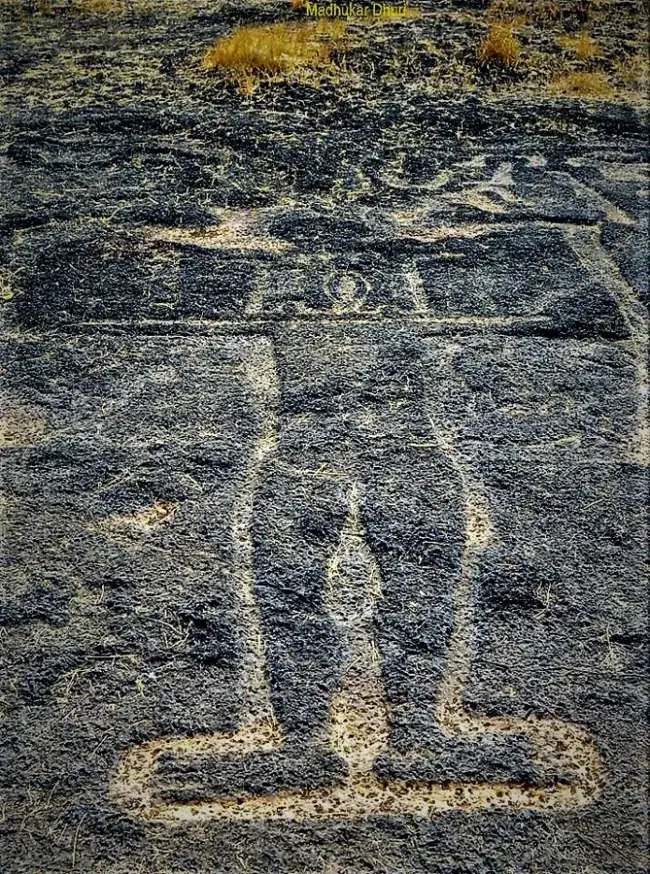

Rock art can preserve a human outline while leaving its maker’s meaning uncertain.
What does a representation leave out?
02 · Locating a human in a world
02 · Locating a human in a world
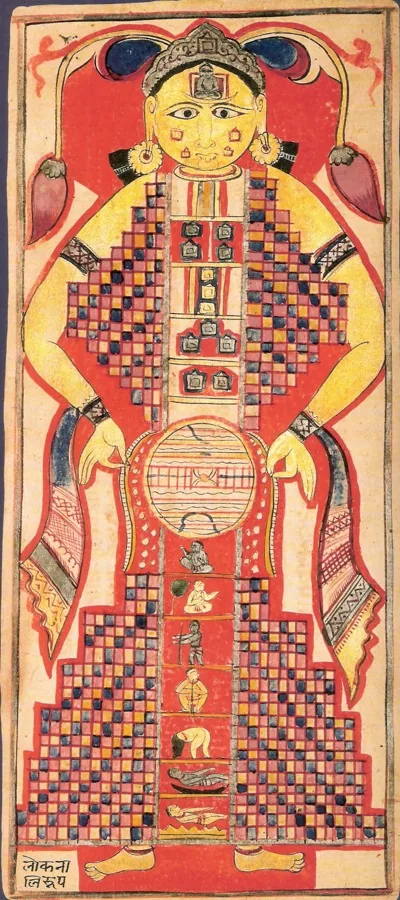

Lokapurusha is a cosmological use of a human form. Jain ideals of liberation raise a separate question about a cultivated life.
What is inherited—and what might be practised?
03 · Measuring a human body
03 · Measuring a human body
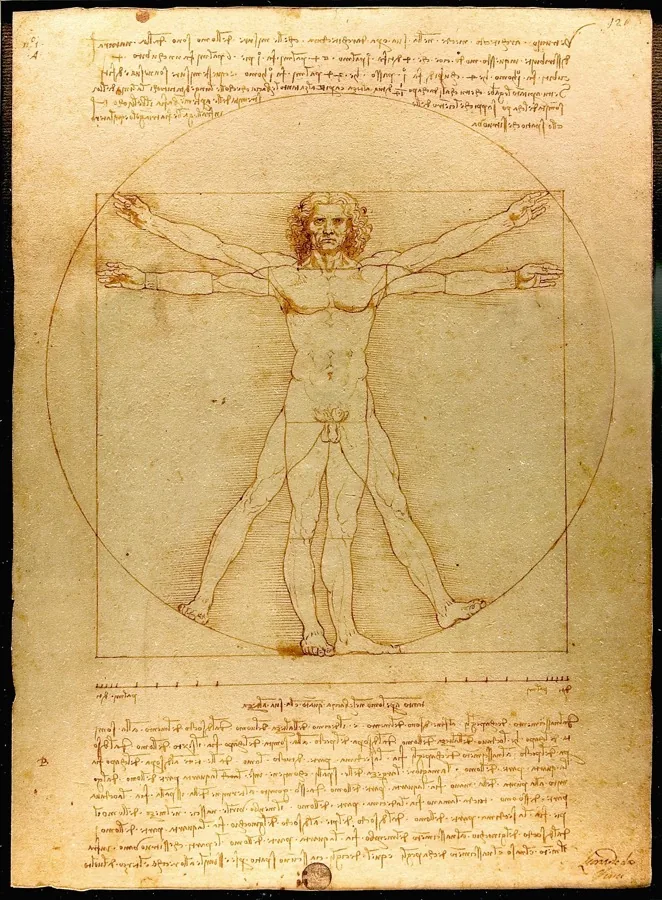

Leonardo studies proportions. The clarity of a geometric picture need not imply a complete account of a person.
What does the diagram measure, and what does it omit?
04 · Imagining a future self
04 · Imagining a future self
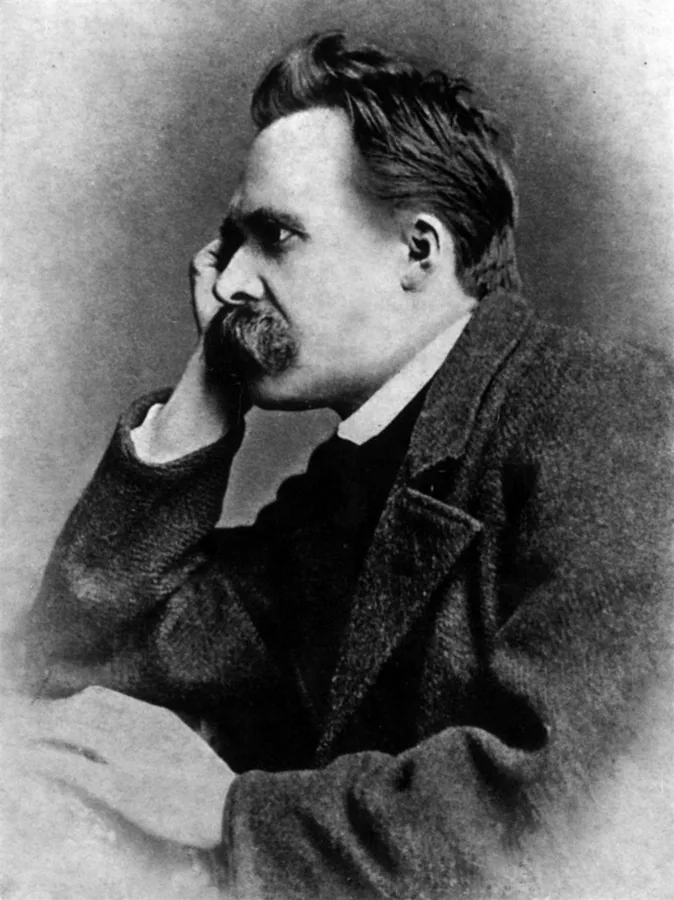

Nietzsche’s self-overcoming gives us a provocation, not a compulsory ideal for every participant.
Can becoming remain an invitation rather than a demand?
05 · Economics and opportunity
05 · Economics and opportunity
A resource, a capacity and an opportunity are different things. Sen’s capability perspective helps us ask what someone can actually pursue.
Can a community recognise a relevant contribution without demanding a whole life?
06 · A body in context
06 · A body in context
Biological and social timescales complicate a story about individual action. A narrative does not reveal a neurochemical measurement.
What context would change how we read this moment?
07 · Our curated model
07 · Our curated model
Eight identity nodes; fifty facets. A navigable research model, open to revision—not a universal inventory of a person.
Which questions are useful, optional, or better left unasked?
A mark is not yet a measurement
The Konkan image in the Field Station deck is rock art, not a modern psychometric diagram. India’s UNESCO Tentative List submission describes human and animal figures among the region’s geoglyphs. That source does not tell us what the maker of this particular figure thought about identity. Nor does it license a claim that this image predates language or depicts an early wellbeing system.
What I take from it is a design question of my own: when a person becomes a mark, what survives? The outline can persist while the maker’s intentions remain unknown. A digital observation has a related problem. A neat label may outlive the context in which someone chose it. Keeping the person’s words beside an interpretation helps a later reader see that gap.
A liberated person and a cosmic body are different ideas
The Lokapurusha image uses a human form to depict a Jain cosmos. It is not a portrait of a gigantic Tirthankara. Tirthankaras belong to a different part of the discussion: the Jain ideal of liberation and the possibility of radical transformation through a disciplined life. The Metropolitan Museum’s account of a Tirthankara in meditation explains the religious figure and its context. These are spiritual and cosmological meanings, not clinical descriptions.
For this proposal, the productive tension is between an inherited world and a cultivated life. Manisha arrives with circumstances she did not choose. She also has commitments she may wish to practise. Our Given Identity and Moral Compass categories let those questions sit beside one another. They do not translate liberation into a score, and they do not establish that Jain thought endorses these categories.
The measured body is also a selection
Leonardo’s Vitruvian drawing gives the body an extraordinary visual economy: a figure, a circle, a square and a set of proportions. The Gallerie dell’Accademia catalogue identifies it as a study of human proportions. Its usefulness here is as a reminder that even a powerful representation has a purpose. A drawing about proportions is not an account of someone’s loyalties, fears, skills or capacity to care.
Our rings borrow the clarity of a diagram. They must not borrow an authority the diagram has not earned. Eight rings can help someone navigate fifty facets. Their symmetry does not prove that human identity has eight natural compartments. Leaving a facet unknown should be as understandable as filling it in.
Becoming is an invitation—and can become a demand
In the Prologue and the self-surpassing passages of Nietzsche’s Thus Spake Zarathustra (Thomas Common translation), the human being is approached through possibility and self-overcoming. I read that as a provocation for this work, not a prescription everyone must accept. It asks whether the person can exceed a settled account of themselves.
For a wellbeing product, that provocation needs a counterweight. If every quiet evening becomes evidence of insufficient ambition, the interface has turned an invitation into a performance demand. A day with rest, doubt or unfinished work must still be a day worth noticing. The passport should make room for a revised intention, including the decision not to optimise something.
Economics asks what an institution can recognise
Amartya Sen’s own account of his work connects individual advantage with substantive freedoms and capabilities. That moves the question beyond possession of a resource towards what a person is able to do with it. In our setting, a listed skill, an opportunity to practise it and an institution willing to recognise a contribution are three different things.
The labour-market question is practical. A new team cannot readily inspect an entire life. It needs relevant evidence, expressed in a form it can understand. Can Manisha carry a reviewed water-inspection contribution into a later conversation without carrying her private evening reflection with it? Skills, earned context and disclosure rules are our design response to that question. Their benefit has to be tested in actual encounters, not inferred from the elegance of the schema.
The body and its context complicate the heroic individual
In a Stanford interview about Behave, Robert Sapolsky describes studying behaviour across biological and social timescales. The lesson I bring into product work is a question about context: what might an isolated action fail to reveal? It is not a claim that a spoken observation can disclose a neurochemical state.
The six Wellbecoming nodes give our observation model a vocabulary. They are not six stages that neuroscience has proved every experience must traverse in order. A late meeting might involve fatigue, irritation, a repeated interruption and useful work. The observation should preserve that overlap rather than force a tidy causal story.
What these lenses change in the product
They make us ask for a fuller starting point, a lighter daily burden and a narrower claim when someone else reviews a moment. They also keep the person’s right to silence within the design. An employer may need a contribution’s review status. That does not create an entitlement to a person’s story, beliefs, bodily context or private feelings.
The resulting eight-node, fifty-facet model is our curated research instrument. It can be challenged and revised. The historical images explain the questions that shaped it; the current registry defines the actual field names. Neither the art nor the philosophy establishes scientific validity for the exact model. At Dhun, one of the first tests is much more concrete: does a voluntary identity session help someone describe a direction for their life, and can the interface keep that direction useful without making disclosure compulsory?
04
A person should not have to start again
Follow a product journey · choose a view
IoV · the existing product
IoV · the existing product
Fictional fixture · authentic interface
- 01Identity
Chosen context, not a compulsory complete profile.
- 02Observe
Activity and personal account.
- 03Review
Only a scoped claim, where applicable.
- 04Read
A day, its details and evidence.
- 05Return
Revisit, rather than restart.
Inside Value Log · choose a view
Observe
Observe
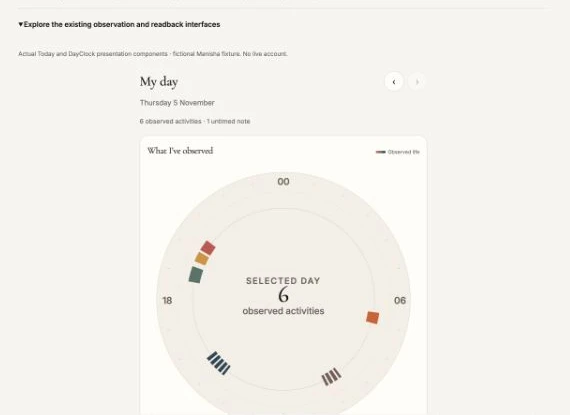
Speak or write, then inspect the interpreted activity. Personal observation does not become independent evidence merely by being entered.
Review
Review
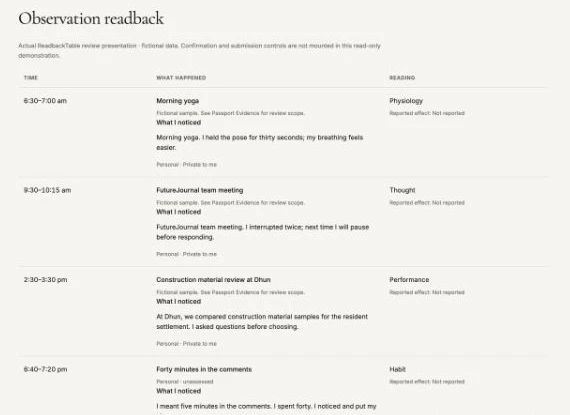
Inspect the actual reviewer, claim, method and state. Pending is not approved; not every moment needs a stamp.
Return
Return
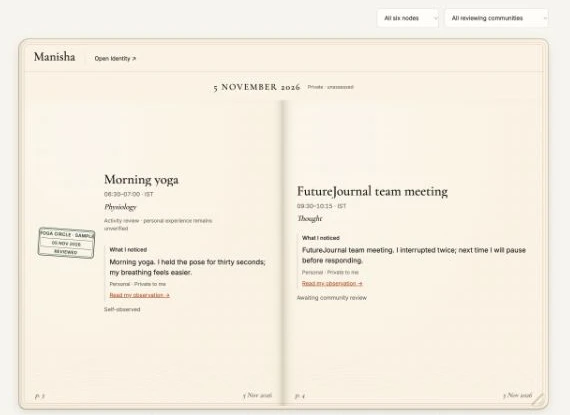
Select a day in Insights and open Passport. Inspect the entry and its provenance rather than treating a book illustration as evidence.
Tiny Medical Apps Wellbeing Passport
Tiny Medical Apps Wellbeing Passport
Direct wellbeing passport
- 01Begin
Create a personal passport.
- 02Observe / participate
Check in, journal or add helpful strategies.
- 03Understand
Read progress insights.
- 04Share / recognise
Choose material for a support conversation.
- 05Return
Continue daily check-ins.
A support journey, rather than a documented issuer-review chain.
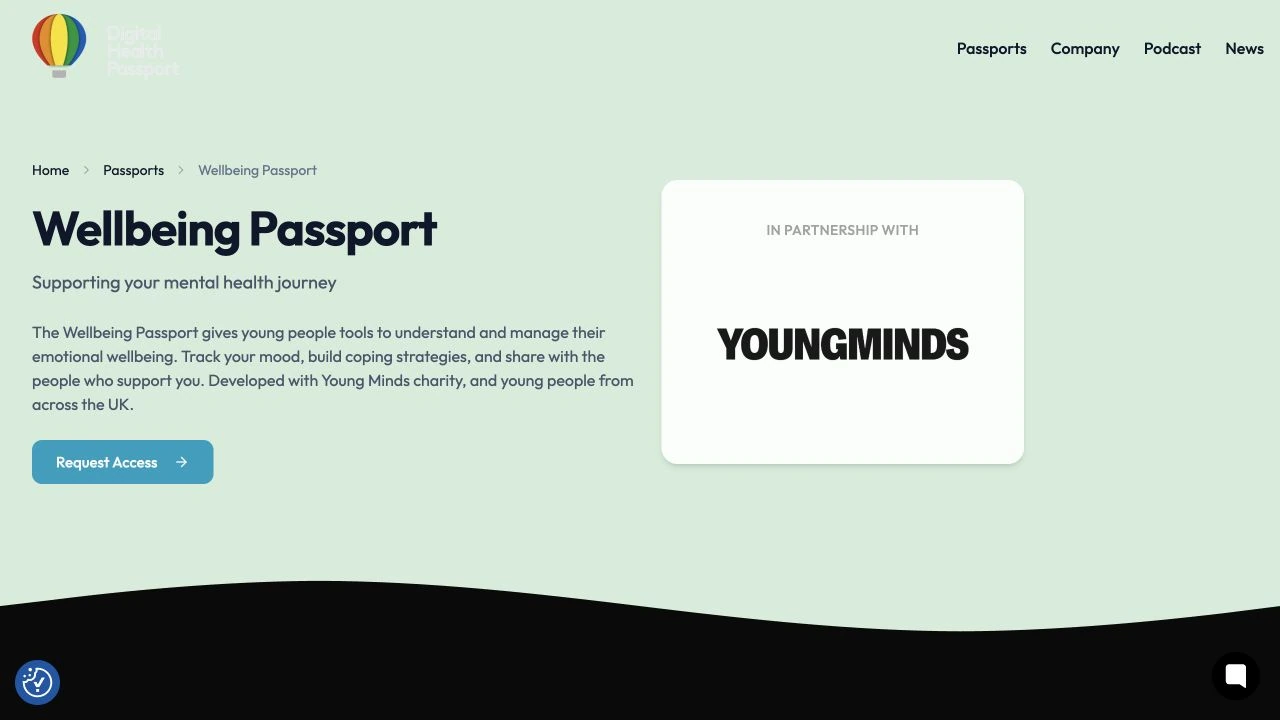
Documented journey reconstructed from primary material; not a hands-on usability test.
Mind.org.im Wellness Passports / Mindprint
Mind.org.im Wellness Passports / Mindprint
Direct digital passport and reflection
- 01Begin
Enter the private personal workspace.
- 02Observe / participate
Record context and before/after reflections.
- 03Understand
Read Mindprint patterns.
- 04Share / recognise
Choose Passport sections and expiry; share the complete link.
- 05Return
Continue reflection; revoke a link when appropriate.
Selected-context sharing overlaps our idea. Review authority and policy lineage need a demonstration.
No authenticated screen sequence is available in this evidence set. The journey below follows the linked public descriptions; it is not a substitute screenshot.
Documented journey reconstructed from primary material; not a hands-on usability test. Exact authenticated screen sequence not inspected; labels map primary descriptions.
Wellness Passports · Privacy policy · Mindprint · Trusted circle
Connect & Support UK
Connect & Support UK
Direct digital support passport
- 01Begin
Open the personal tools.
- 02Observe / participate
Use a journal or mood check-in.
- 03Understand
Read a mood summary.
- 04Share / recognise
Export the support-context Passport or a combined summary.
- 05Return
Return to the on-device record.
A support introduction and daily reflection already coexist.
No authenticated screen sequence is available in this evidence set. The journey below follows the linked public descriptions; it is not a substitute screenshot.
Documented journey reconstructed from primary material; not a hands-on usability test. Only the developer listing was inspected; no hands-on account/device test.
Wellbeing Passport Australia
Wellbeing Passport Australia
Workplace service-access passport
- 01Begin
Employer funds access.
- 02Observe / participate
Employee chooses a service.
- 03Understand
Provider supplies that service.
- 04Share / recognise
Programme reports utilisation.
- 05Return
Employee uses the network again.
The native journey concerns access to services; a daily reflection loop is not established.
No authenticated screen sequence is available in this evidence set. The journey below follows the linked public descriptions; it is not a substitute screenshot.
Documented journey reconstructed from primary material; not a hands-on usability test. Booking and reporting screens unavailable in this evidence set.
Lancashire and south Cumbria Wellbeing Passport
Lancashire and south Cumbria Wellbeing Passport
Direct wellbeing passport
- 01Begin
Introduce the young person.
- 02Observe / participate
Write relevant preferences and support context.
- 03Understand
Read the account together.
- 04Share / recognise
Carry chosen context to supporters or services.
- 05Return
Revisit the booklet as context changes.
Continuity can be valuable without a numerical score.

Documented journey reconstructed from primary material; not a hands-on usability test. A daily-entry and calculation flow is not established.
NHS and QEH workplace passports
NHS and QEH workplace passports
Workplace support records
- 01Begin
Begin a support conversation.
- 02Observe / participate
Record needs and agreed arrangements.
- 03Understand
Check the shared understanding.
- 04Share / recognise
Carry context to a new manager or assignment.
- 05Return
Review arrangements as needs change.
Workplace support continuity is a separate job from judging employee wellbeing.
No authenticated screen sequence is available in this evidence set. The journey below follows the linked public descriptions; it is not a substitute screenshot.
Documented journey reconstructed from primary material; not a hands-on usability test. Direct source access returned 403; indexed primary descriptions were used. No product-screen sequence inspected.
NHS health passport · A passport to better health and wellbeing
Daylio
Daylio
Personal diary
- 01Begin
Open the diary.
- 02Observe / participate
Choose mood, activities and optional context.
- 03Understand
Browse entries and statistics.
- 04Share / recognise
Export a document or chosen statistics.
- 05Return
Return through the calendar or list.
Benchmark the effort to capture and retrieve a day.
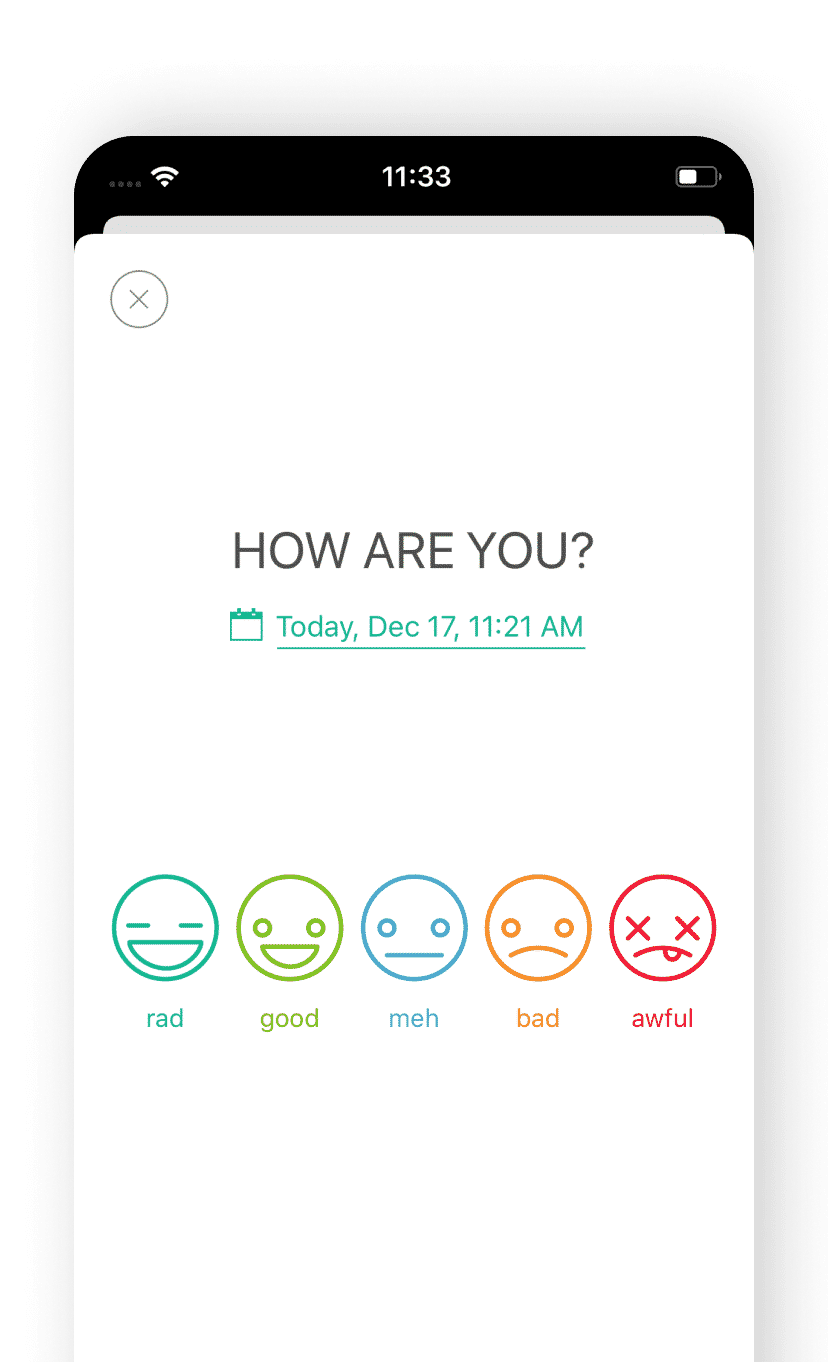
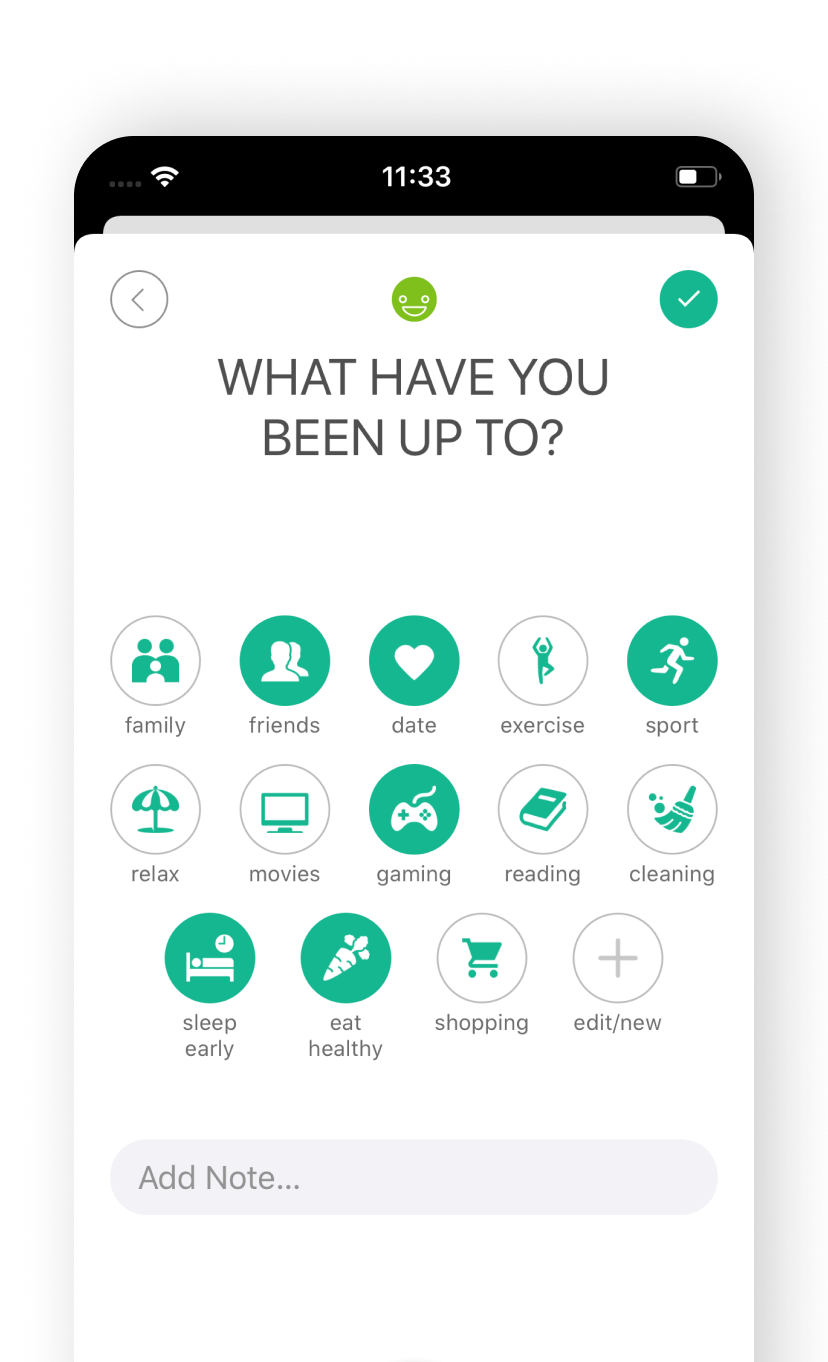
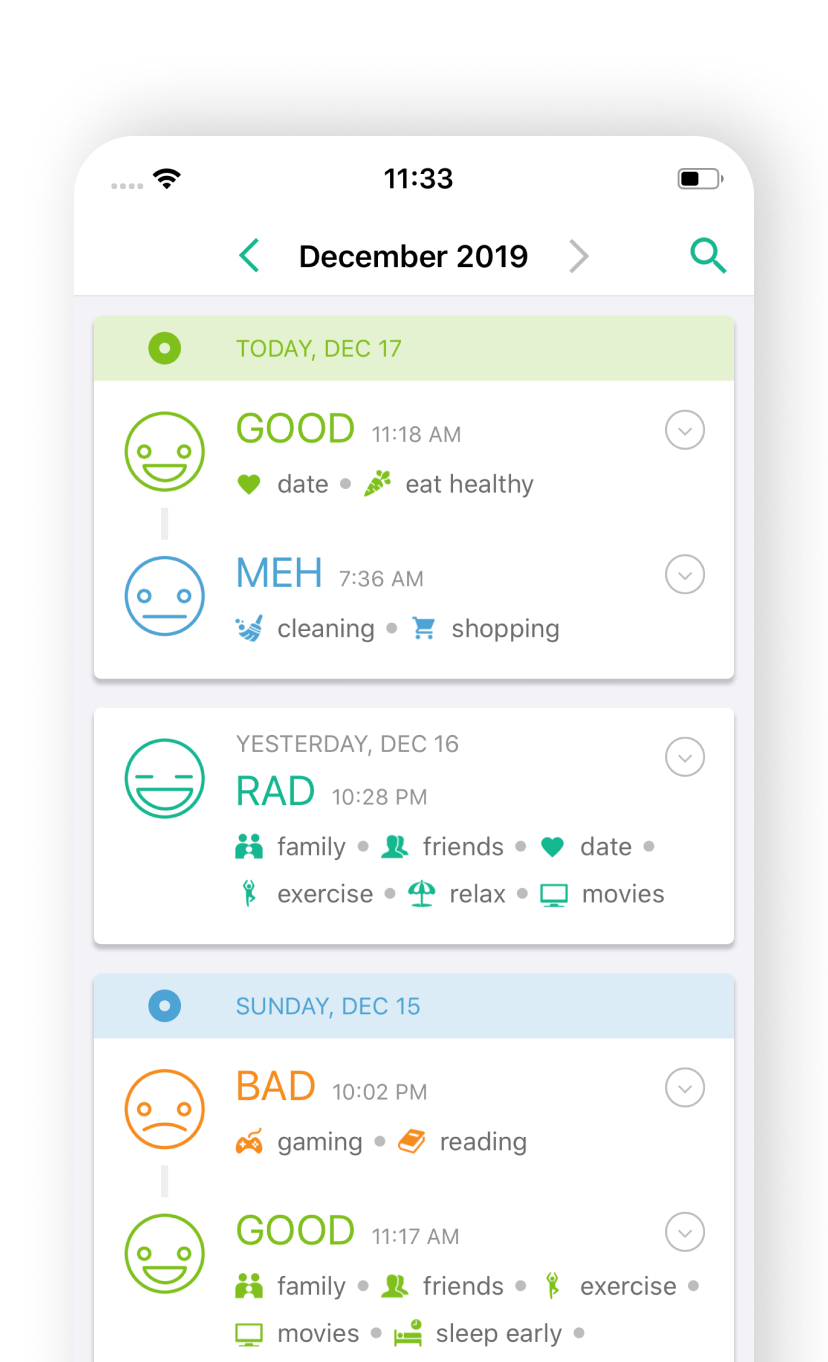
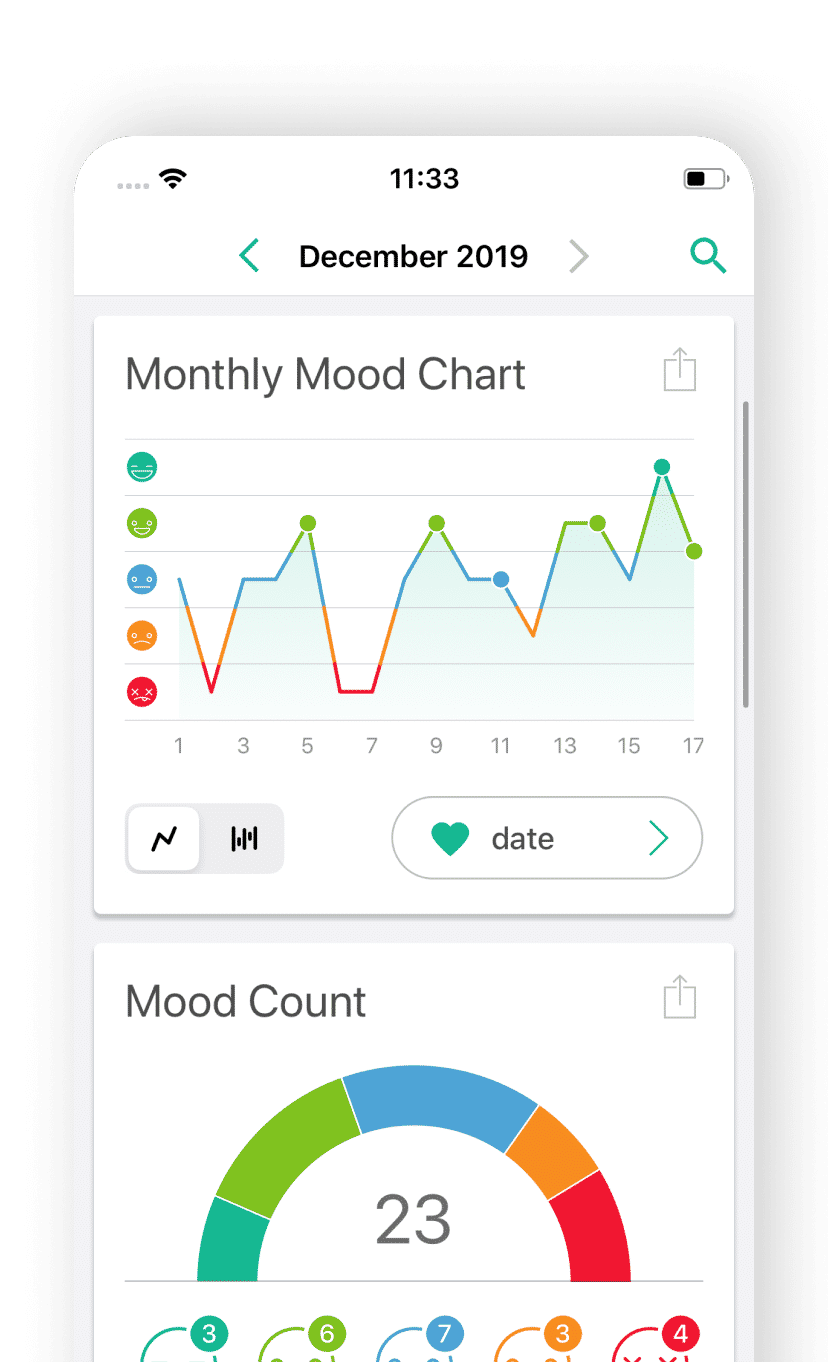
Documented journey reconstructed from primary material; not a hands-on usability test. Published examples have 2020 asset paths; current app appearance not certified.
Daylio · Data security · Can I use Daylio on multiple devices
Bearable
Bearable
Personal health journal
- 01Begin
Choose recording categories.
- 02Observe / participate
Log mood, symptoms and factors.
- 03Understand
Explore recorded associations in Insights.
- 04Share / recognise
Filter and export relevant history.
- 05Return
Return to a date or comparison window.
Learn from contextual history; an association is not evidence of causation.
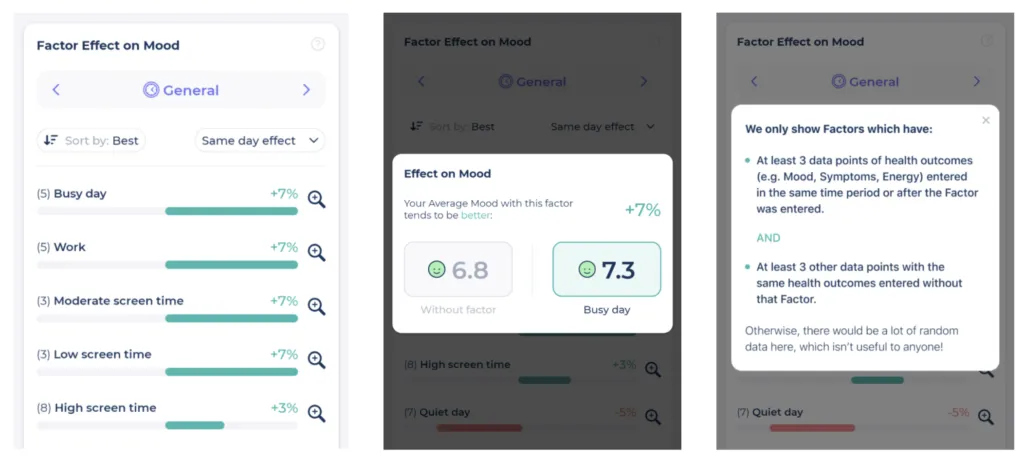
Documented journey reconstructed from primary material; not a hands-on usability test. Published help illustration; not our own account workflow.
Configure and enter data · The Factor Effect Report · Sharing with a medical team · Writing data to another app · Can you see what I enter
Oura
Oura
Sensor-based personal scores
- 01Begin
Set up membership and a ring.
- 02Observe / participate
Sync signals and add optional tags.
- 03Understand
Read scores and contributors.
- 04Share / recognise
Choose Circles scores or an export/report.
- 05Return
Return to trends and past readings.
Social sharing of readings is different from reviewing a particular contribution.
No authenticated screen sequence is available in this evidence set. The journey below follows the linked public descriptions; it is not a substitute screenshot.
Documented journey reconstructed from primary material; not a hands-on usability test. No ring/account test or step-by-step UI capture. Help documents current workflows; old marketing screens may differ.
Your Oura Readiness Score · Oura Circles · Export and share your Oura data · Importing electronic health records · Oura Membership
Unmind Wellbeing Tracker
Unmind Wellbeing Tracker
Workplace assessment
- 01Begin
Enter the assessment.
- 02Observe / participate
Respond to the instrument.
- 03Understand
Read domain results and explanations.
- 04Share / recognise
Use relevant support.
- 05Return
Return for another assessment.
An assessment cadence differs from event-by-event accounting.
No authenticated screen sequence is available in this evidence set. The journey below follows the linked public descriptions; it is not a substitute screenshot.
Documented journey reconstructed from primary material; not a hands-on usability test. Assessment documentation and instrument research inspected; authenticated product screens not captured. Instrument validity does not establish every deployment’s benefit.
Wellbeing Tracker key facts · Development and validation of the Unmind Index · Validation in USA Australia and New Zealand
Europass EDC and Open Badges
Europass EDC and Open Badges
Credential infrastructure
- 01Begin
Identify the learner and issuer.
- 02Observe / participate
Complete an achievement under criteria.
- 03Understand
Receive the structured credential.
- 04Share / recognise
Inspect content, issuer and verification.
- 05Return
Present the chosen credential elsewhere.
The key journey is issuance and verification; a wellbeing diary is not established.
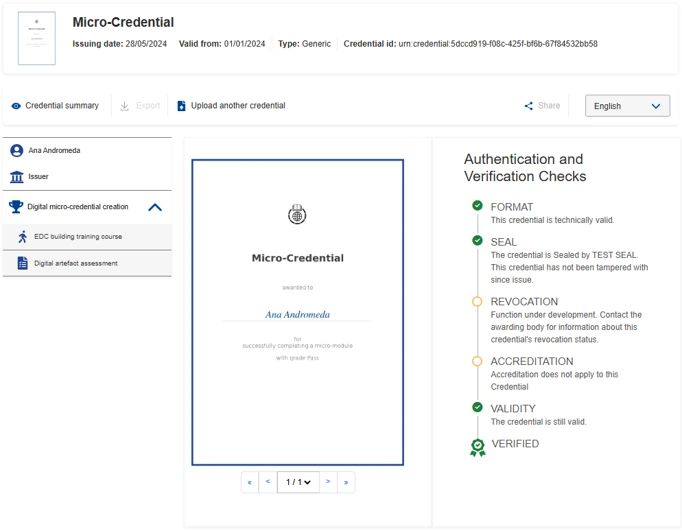
Documented journey reconstructed from primary material; not a hands-on usability test. Europass and Open Badges are grouped infrastructure references. TEST SEAL specimen is not a live credential or IoV integration.
European Digital Credentials for Learning · Open Badges · Verifiable Credentials Data Model 2.0
RSA Cities of Learning
RSA Cities of Learning
Place-based recognition
- 01Begin
Find a learning opportunity.
- 02Observe / participate
Participate in local learning.
- 03Understand
Receive recognition under the programme.
- 04Share / recognise
Carry badges through the learning ecosystem.
- 05Return
Continue with another opportunity.
Dhun would need agreed recognition criteria and issuer roles.
No authenticated screen sequence is available in this evidence set. The journey below follows the linked public descriptions; it is not a substitute screenshot.
Documented journey reconstructed from primary material; not a hands-on usability test. Overview-level reconstruction, not a complete tool walkthrough.
Camino credential and National Parks passport
Camino credential and National Parks passport
Journey records
- 01Begin
Acquire the programme booklet.
- 02Observe / participate
Visit a participating place.
- 03Understand
Receive a dated mark.
- 04Share / recognise
Present marks under that programme’s rules.
- 05Return
Continue to another place.
A mark can record an encounter without claiming wellbeing improvement.
No authenticated screen sequence is available in this evidence set. The journey below follows the linked public descriptions; it is not a substitute screenshot.
Documented journey reconstructed from primary material; not a hands-on usability test. Camino and National Parks have different rules; the shared accumulation pattern is compared.
01 · Lancashire and south Cumbria
The Wellbeing Passport booklet and card were developed with young people and supporters through a regional children’s mental-health transformation programme. A person fills in relevant information, with help if needed, and carries it into a conversation or a difficult moment. The compact card can carry one or two particularly important details.
Journey: introduce yourself → choose relevant information → complete the booklet/card → show it to a supporter or service → revise it when useful. The public site still offers downloads. That is evidence of available material, not a newly verified count of active users. A separately disclosed current passport budget was not established. The lesson is powerful without a score: continuity can mean not having to tell your story from the beginning.
02 · NHS and QEH workplace passports
The NHS health passport guidance, published in November 2022, provides an editable way to carry health-related context, barriers and workplace adjustments to a new line manager. Its job is continuity of support, not the valuation of a working day.
The QEH practitioner account describes a staff pilot that continued and a passport brought into management training. This is an account of an implementation and its challenges; it is not a controlled estimate of wellbeing improvement. Journey: prepare context → discuss support → agree relevant arrangements → carry them into a later management conversation. Current organisation-wide uptake and a ring-fenced passport budget were not verified. For Dhun, this is a reminder that manager understanding and operating authority are part of the product.
03 · Tiny Medical Apps
The Wellbeing Passport describes daily mood tracking, coping strategies, goals, a support network, journaling and progress insights, developed with YoungMinds and young people. Its public journey is create a passport → build a toolkit → check in daily → choose what to share with supporters.
The same page asks people to request access and commissioners to join development. I therefore describe the wellbeing product as publicly presented and seeking development partners, rather than claim universal availability. The provider’s related asthma and epilepsy work has stronger named implementation and grant evidence, examined separately in the funding chapter. That evidence must not be reassigned to this wellbeing product. A numerical composite method and community contribution-review process were not established by this product page.
04 · Mind.org.im
Wellness Passports is a close precedent for chosen-context sharing. Its provider describes selecting sections, encrypting a snapshot on the device, adding an expiry and sharing a complete private link. The holder of that link can open it; revocation cannot recall a retained copy. Those are provider statements, not an independent security audit.
Its companion Mindprint describes before-and-after reflection, personal patterns, sample sizes and uncertainty. The journey is already more than a static support sheet: reflect → try something → return → inspect patterns → share selected context if wanted. Current public documentation identifies Cloud OI (Pty) Ltd as provider. An independently verified deployment count or financing amount was not found in the selected sources. We should learn from this overlap rather than claim that combining reflection and a passport is new.
05 · Connect & Support UK
The developer’s App Store listing places a wellbeing passport alongside journals, mood check-ins and support tools. It describes local-device storage and export, and identifies Play North West CIC as the operator. The listing says an optional Premium tier helps fund the work; that is a revenue model, not proof of revenue or a disclosed investment round.
Journey: choose a support or reflection tool → add personal context → revisit it locally → export a selected account when useful. Store availability was visible; an authenticated journey and security controls were not tested. This is another direct reason to avoid saying that a passport is differentiated merely because it includes a journal. The harder question is which institution can stand behind which claim, when that is useful at all.
05
A day is not one kind of number
06 · Daylio
Daylio’s statistics documentation describes a familiar path: choose a mood and activities → build a history → inspect frequency and mood associations → return to specific entries. It also explains confidence levels and why entries with and without an activity matter for comparison.
The strength to borrow is the ease of returning. If our richer vocabulary makes ordinary observation laborious, a simpler journal may serve the person better. Public help remains available; active-user counts and a verified financing total were not established here. Optional notes, pictures and export are shown in the provider’s product/help material. A defined issuer workflow for contribution claims was not established by those sources.
07 · Bearable
Bearable’s Factor Effect Report explicitly presents correlations between entered factors and outcomes such as mood, symptoms and sleep. A person enters information, selects an outcome and time window, then compares patterns with and without a factor. Its guidance also cautions readers to question results and explains minimum entry requirements.
A pattern can help someone form a question without proving that an activity caused an improvement. That distinction applies equally to our own diagrams. Current help is public. SFC Capital’s portfolio lists Bearable App, establishing an investor relationship; a reliable amount was not established from that primary source. The article does not substitute a database estimate for a disclosed round.
08 · Oura
Oura’s Readiness documentation, updated in October 2026, describes a 0–100 reading informed by sleep, activity and body signals. The user’s path is largely sensor-supported: wear the ring → receive a daily interpretation → inspect contributors → adjust activity or recovery → return over time. That is a different input and question from a person’s account of a meeting.
Its current public documentation and product pages establish a commercial offering. They do not justify treating its score as interchangeable with a questionnaire or IoV W. Oura also has social and portability features; Circles is a reminder that wearables should not be caricatured as isolated numbers. Financing is treated separately below, with a date and company-level scope.
09 · Unmind
The 2022 development and validation paper for the Unmind Index is a useful measurement precedent. It investigates an assessment instrument rather than an event-by-event ledger of a person’s day. Evidence for an instrument must be read with its population, methods and limitations; it cannot simply be borrowed by another product.
Unmind’s current company description combines AI support, therapy, coaching, training and organisational services. Journey: access employer-provided support → assess or seek help → use appropriate services → return and assess again. This review did not sign into an employee account. Investment in that wider business is not a budget for a standalone wellbeing passport. For Dhun, its relevance is the institutional service around an interface, including how employees understand who can see what.
The measurement question remains separate from all nine products. A number needs a construct, a time window and a method. WHO-5, for example, asks about the preceding two weeks; it is not a rule for assigning a change to a single yoga session. It appears here as a measurement reference, not another competitor or a recommended instrument for this pilot.
06
What stands behind a stamp?
10 · Europass and Open Badges
Open Badges describes a defined achievement associated with an earner, issuer, criteria and possible evidence. European Digital Credentials for Learning makes a learning credential’s content and electronic verification inspectable. These are credential mechanisms, not wellbeing diaries.
Journey: meet stated criteria → issuer prepares a credential → receive and store it → share it → a recipient verifies and decides what to recognise. Europass reported more than 35,000 credentials issued to its wallets in an October 2024 account. That is dated implementation evidence, not a November 2026 total. The Commission provides infrastructure; an issuer’s local implementation still needs resources. No IoV conformance or recognition agreement is established by displaying a passport or using the word “credential.”
11 · RSA Cities of Learning
Ufi’s programme account describes a network connecting learners, institutions, employers and local opportunities through digital badges and pathways. It names the RSA and the development of underlying technology by Navigatr. This is particularly relevant to Dhun: the institution is a network of people able to recognise something, not the book itself.
The RSA’s funding page names Ufi VocTech Trust and Garfield Weston Foundation and reports 600 organisations, seven cities/regions, 30,000 learners and 35,000 badges. The page does not establish when those cumulative counts were last refreshed. I retain them as provider-reported historical programme evidence, not current independent totals. Journey: find a local pathway → participate → meet criteria → receive recognition → use it towards another opportunity.
12 · Camino and National Parks
The Camino credential introduces a pilgrim and accumulates marks along a route under the relevant institution’s rules. The National Parks passport collects cancellations identifying a park and the date of a visit. They are grouped only because both make an accumulating journey tangible.
Journey: obtain the book → encounter a place → collect its mark → carry it onward. Neither example needs to claim that the person became better by collecting more stamps. The park programme sells books while cancellations are free; that is an operating model, not a venture-financing announcement. Current public guidance is available for both. Separate current programme budgets were not established. The lesson is restraint: a mark can be meaningful because its claim is small.
13 · Wellbeing Passport Australia
The Australian provider describes an employer-funded wallet through which employees choose support from a local service network. Its public page says it is piloting with organisations in the Hunter region and names partners.
Journey: employer funds access → employee chooses support → provider delivers it → the programme reports utilisation. This is a benefits/access meaning of passport. The employer-funded wallet is not evidence of external investment, a disclosed pilot budget or measured health improvement. We have not tested an account or verified a wider rollout. It is relevant to our incentive question precisely because the benefit is practical access, rather than collecting a more flattering score.
07
Who funds it—and what is actually running?
A list of funding amounts can create a false sense of comparison. A grant for an epilepsy app, debt committed to an employer platform, public credential infrastructure and sales of a park booklet are not four valuations of the same idea.
I have therefore recorded the funding instrument alongside the object it funds. Amounts are in the source’s original currency. Announced financing is not cash available today. A commitment is not necessarily fully drawn. These are selected verified announcements, not a cap table, a current runway estimate or an exhaustive funding history.
Compare evidence, not valuations · choose a view
Lancashire / south Cumbria
Lancashire / south Cumbria
Booklet downloads available; current uptake unverified
Institutional co-development; ring-fenced budget not established
Evidence reviewed 11 November 2026. Announcement dates are not current deployment counts. Company rounds, debt commitments, grants, book sales and employer wallets are not comparable measures.
NHS / QEH
NHS / QEH
Guidance available; dated QEH account says pilot continued
Employer programme; passport-specific amount not established
Evidence reviewed 11 November 2026. Announcement dates are not current deployment counts. Company rounds, debt commitments, grants, book sales and employer wallets are not comparable measures.
Tiny Medical Apps
Tiny Medical Apps
Wellbeing page seeks access/development partners
£799,725 epilepsy award; £488,525 asthma award. Not wellbeing-product funding
Evidence reviewed 11 November 2026. Announcement dates are not current deployment counts. Company rounds, debt commitments, grants, book sales and employer wallets are not comparable measures.
Mind.org.im
Mind.org.im
Public passport and Mindprint features offered; uptake unverified
Free provider-described service; financing amount not established
Evidence reviewed 11 November 2026. Announcement dates are not current deployment counts. Company rounds, debt commitments, grants, book sales and employer wallets are not comparable measures.
Connect & Support UK
Connect & Support UK
App Store listing available; account not tested
CIC-operated; optional Premium described as supporting work; external funding unknown
Evidence reviewed 11 November 2026. Announcement dates are not current deployment counts. Company rounds, debt commitments, grants, book sales and employer wallets are not comparable measures.
Daylio
Daylio
Public product/help available; no current usage count verified
Freemium purchases; financing total not established
Evidence reviewed 11 November 2026. Announcement dates are not current deployment counts. Company rounds, debt commitments, grants, book sales and employer wallets are not comparable measures.
Bearable
Bearable
Public product/help available; no account test
SFC portfolio lists Bearable App; amount not established in primary source
Evidence reviewed 11 November 2026. Announcement dates are not current deployment counts. Company rounds, debt commitments, grants, book sales and employer wallets are not comparable measures.
Oura
Oura
Commercial offering documented; IPO-launch announcement dated Sep 2026
Company announced >$900m raise Oct 2025; completion/proceeds of IPO not established here
Evidence reviewed 11 November 2026. Announcement dates are not current deployment counts. Company rounds, debt commitments, grants, book sales and employer wallets are not comparable measures.
Unmind
Unmind
Company describes employer platform; no employee account tested
$35m Series C Jul 2025; separate $26m debt commitment Sep 2025, company-wide
Evidence reviewed 11 November 2026. Announcement dates are not current deployment counts. Company rounds, debt commitments, grants, book sales and employer wallets are not comparable measures.
Europass / Open Badges
Europass / Open Badges
Credential infrastructure; Europass adoption report dated Oct 2024
Commission infrastructure; 1EdTech standard. No comparable venture-round total
Evidence reviewed 11 November 2026. Announcement dates are not current deployment counts. Company rounds, debt commitments, grants, book sales and employer wallets are not comparable measures.
RSA Cities of Learning
RSA Cities of Learning
Named institutional deployments; cumulative provider counts undated
Ufi VocTech Trust and Garfield Weston Foundation named; current grant total unknown
Evidence reviewed 11 November 2026. Announcement dates are not current deployment counts. Company rounds, debt commitments, grants, book sales and employer wallets are not comparable measures.
Camino / National Parks
Camino / National Parks
Current guidance available for physical journey books
Institutional distribution / book sales; separate current budgets not established
Evidence reviewed 11 November 2026. Announcement dates are not current deployment counts. Company rounds, debt commitments, grants, book sales and employer wallets are not comparable measures.
Wellbeing Passport Australia
Wellbeing Passport Australia
Provider says Hunter-region pilot; wider rollout unverified
Employer-funded wallet; external financing and pilot budget unknown
Evidence reviewed 11 November 2026. Announcement dates are not current deployment counts. Company rounds, debt commitments, grants, book sales and employer wallets are not comparable measures.
IoV / proposed Dhun work
IoV / proposed Dhun work
Existing scoped product demo; new interactive is a proposal
No Dhun award, agreed fees or committed pilot budget asserted
Evidence reviewed 11 November 2026. Announcement dates are not current deployment counts. Company rounds, debt commitments, grants, book sales and employer wallets are not comparable measures.
| Case | What is established | Funding / operating evidence |
|---|---|---|
| Lancashire / south Cumbria | Booklet downloads available; current uptake unverified | Institutional co-development; ring-fenced budget not established |
| NHS / QEH | Guidance available; dated QEH account says pilot continued | Employer programme; passport-specific amount not established |
| Tiny Medical Apps | Wellbeing page seeks access/development partners | £799,725 epilepsy award; £488,525 asthma award. Not wellbeing-product funding |
| Mind.org.im | Public passport and Mindprint features offered; uptake unverified | Free provider-described service; financing amount not established |
| Connect & Support UK | App Store listing available; account not tested | CIC-operated; optional Premium described as supporting work; external funding unknown |
| Daylio | Public product/help available; no current usage count verified | Freemium purchases; financing total not established |
| Bearable | Public product/help available; no account test | SFC portfolio lists Bearable App; amount not established in primary source |
| Oura | Commercial offering documented; IPO-launch announcement dated Sep 2026 | Company announced >$900m raise Oct 2025; completion/proceeds of IPO not established here |
| Unmind | Company describes employer platform; no employee account tested | $35m Series C Jul 2025; separate $26m debt commitment Sep 2025, company-wide |
| Europass / Open Badges | Credential infrastructure; Europass adoption report dated Oct 2024 | Commission infrastructure; 1EdTech standard. No comparable venture-round total |
| RSA Cities of Learning | Named institutional deployments; cumulative provider counts undated | Ufi VocTech Trust and Garfield Weston Foundation named; current grant total unknown |
| Camino / National Parks | Current guidance available for physical journey books | Institutional distribution / book sales; separate current budgets not established |
| Wellbeing Passport Australia | Provider says Hunter-region pilot; wider rollout unverified | Employer-funded wallet; external financing and pilot budget unknown |
| IoV / proposed Dhun work | Existing scoped product demo; new interactive is a proposal | No Dhun award, agreed fees or committed pilot budget asserted |
Two distinctions are worth keeping in view. First, the £799,725 SBRI award names Tiny Medical Apps’ epilepsy project. The earlier £488,525 award names MYPASS, its asthma work. Neither establishes funding for the separately advertised Wellbeing Passport.
Second, Unmind’s $35 million Series C announcement of 31 July 2025 and Trinity’s $26 million debt-financing commitment of 11 September 2025 are different instruments. Adding them to a speculative lifetime total would conceal more than it explains.
Oura’s newsroom lists an October 2025 raise of more than $900 million and a September 2026 announcement of an IPO launch. This review does not infer that the IPO completed, its proceeds, or a current valuation from those headlines. The company-scale financing is relevant context for the resources in this neighbouring field; it is not funding for a wellbeing-passport project.
For several smaller projects, no financing amount was established in the selected primary material. “Unknown here” is the honest cell. It leaves room for public funding, founder support, service revenue or undisclosed investment without choosing one by guesswork.
The corresponding discipline applies to IoV. There is a working product demonstration, a public specification and an authored proposal. The Dhun engagement is not an awarded grant, a deployed cohort or a committed budget. We are asking for a setting in which to test the work, and for joint agreement on the resources it would require.
08
The passport became a way of reading
The idea changed shape · choose a view
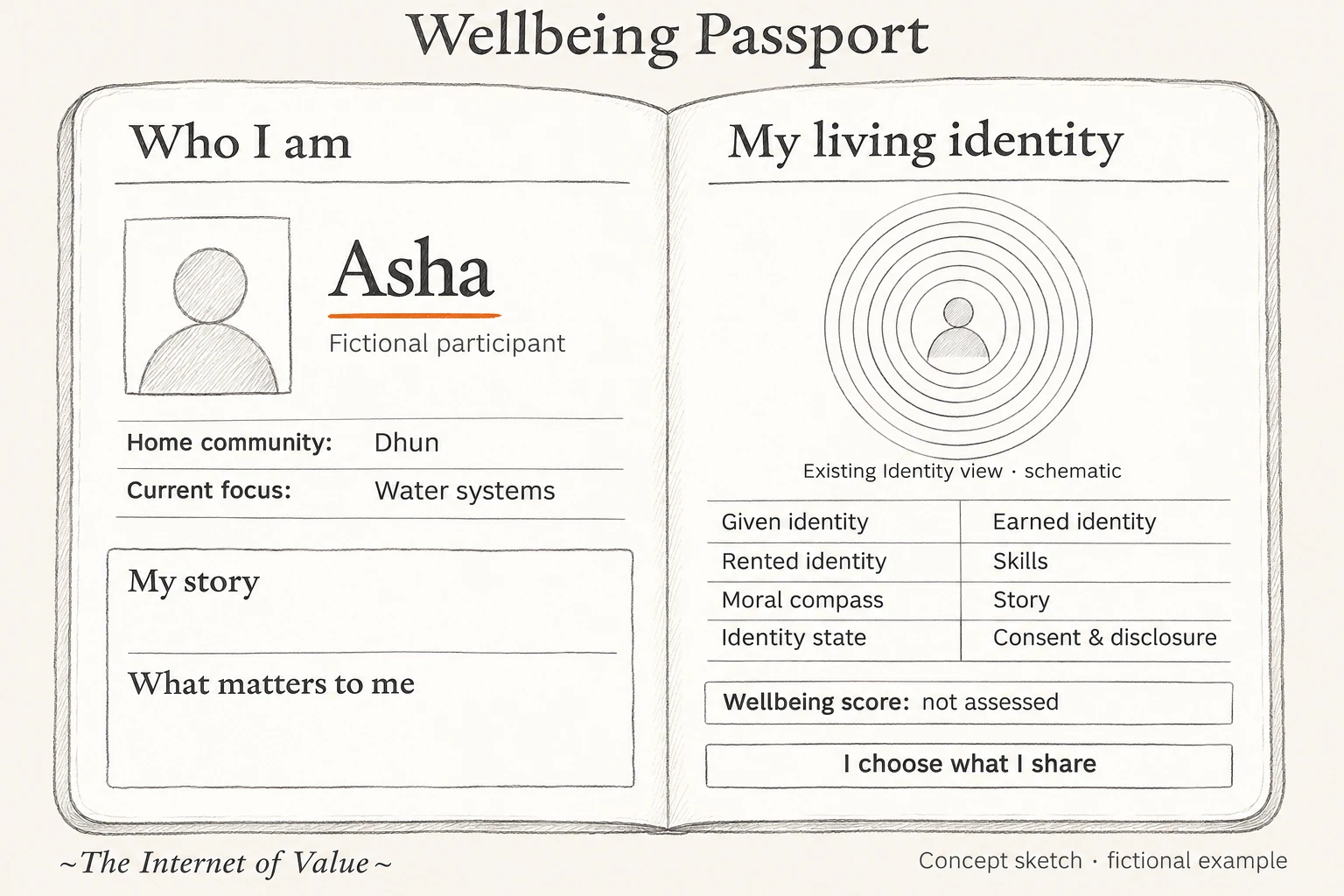
01 · A book-shaped identity
01 · A book-shaped identity
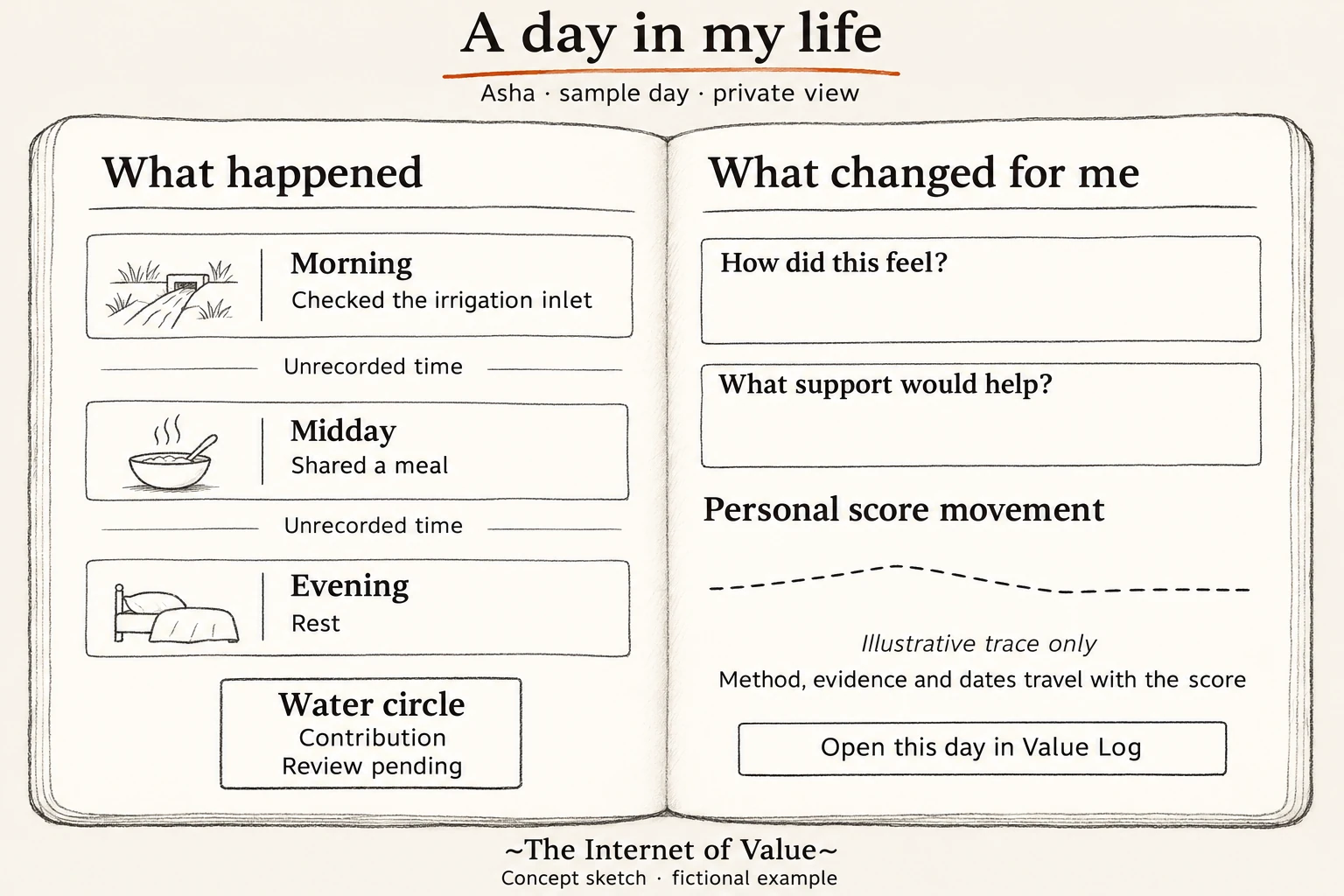
02 · An ordinary day
02 · An ordinary day
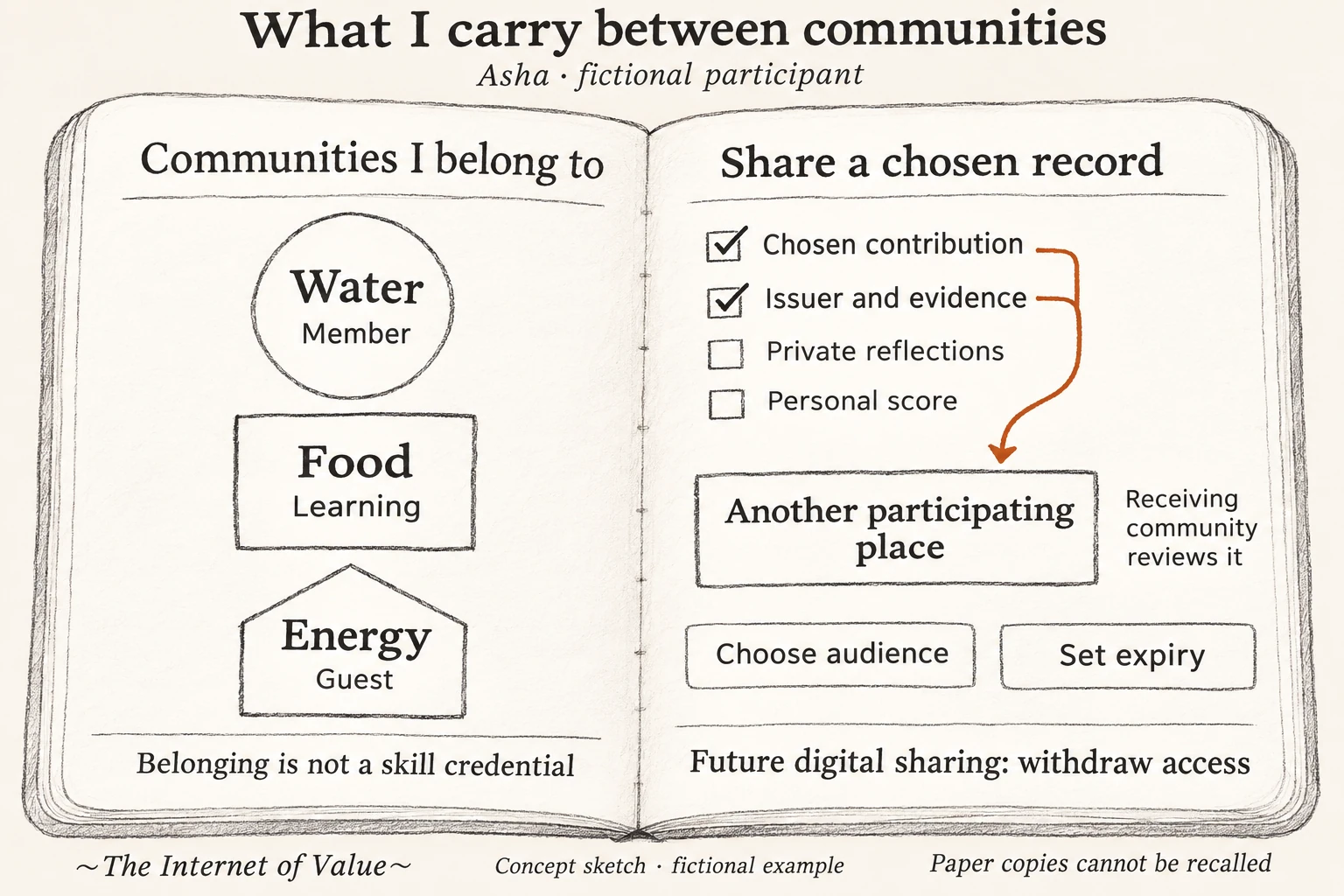
03 · What can travel?
03 · What can travel?
04 · Manisha enters
04 · Manisha enters
05 · Places within Dhun
05 · Places within Dhun
06 · Who stands behind the mark?
06 · Who stands behind the mark?
07 · The return from an experience
07 · The return from an experience
08 · Inside Insights
08 · Inside Insights
09 · Open the evidence
09 · Open the evidence
10 · A book on a phone
10 · A book on a phone
11 · A calendar becomes an entrance
11 · A calendar becomes an entrance
12 · Details below the page
12 · Details below the page
13 · A curled page
13 · A curled page
14 · The person emerges
14 · The person emerges
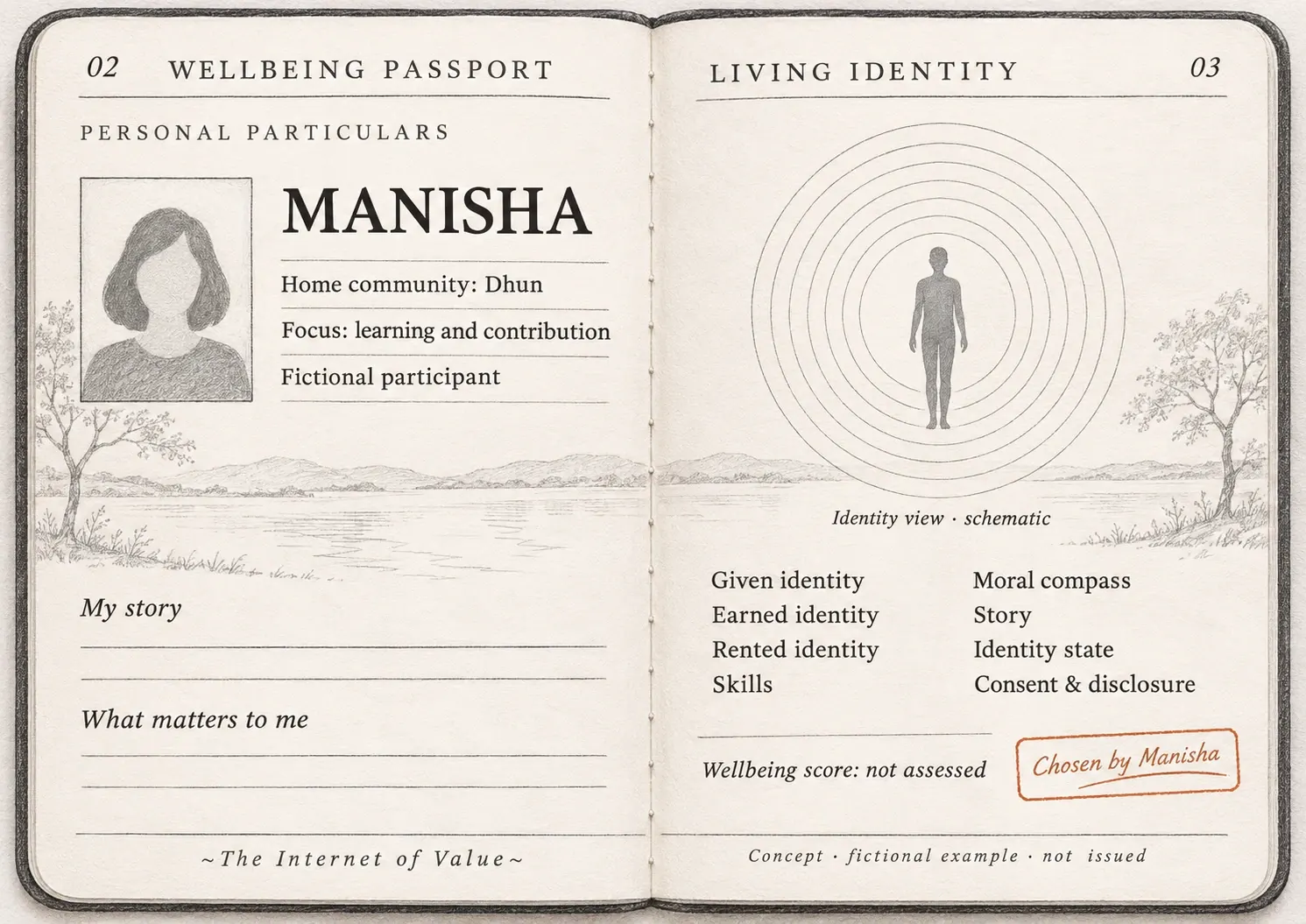
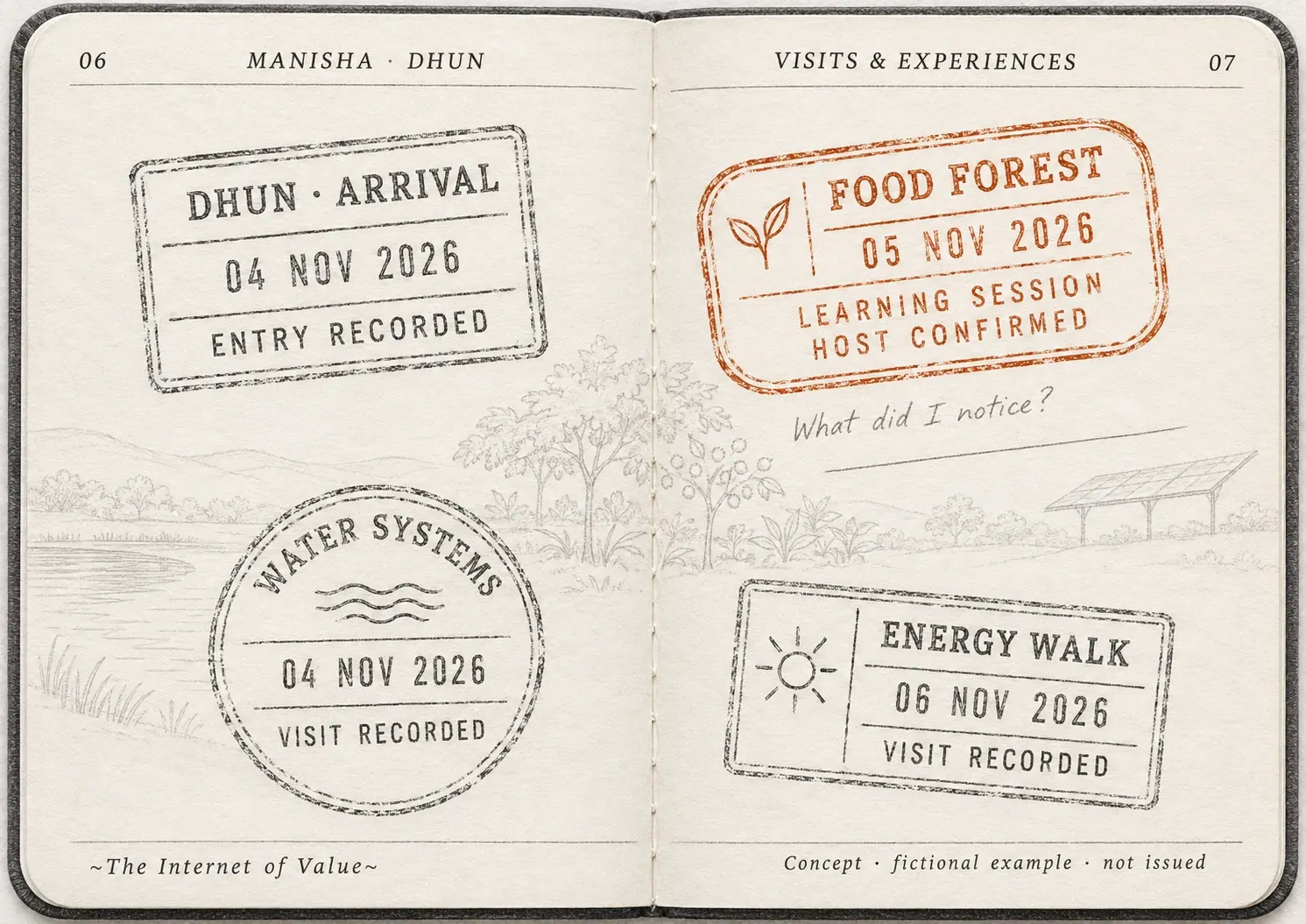
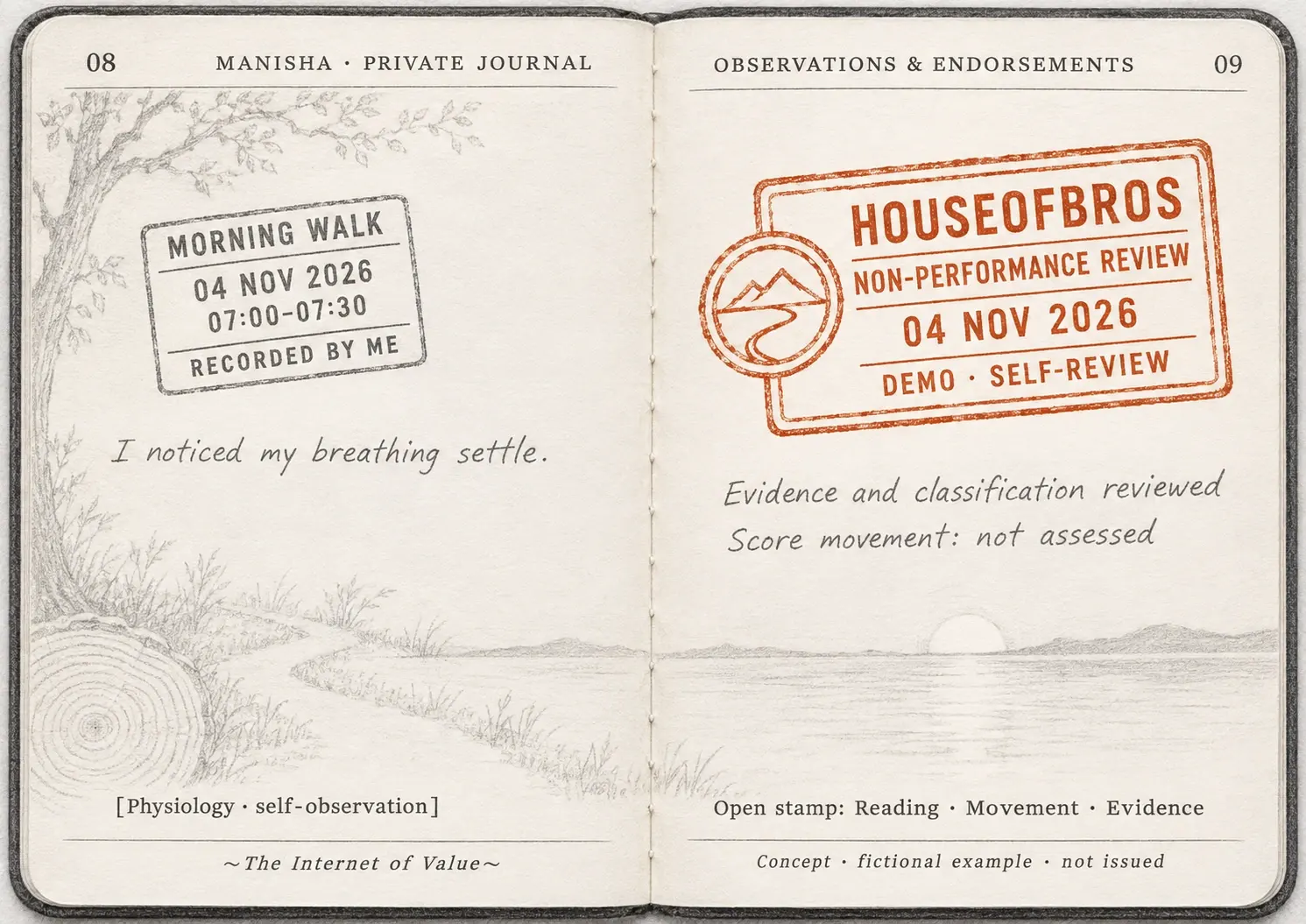
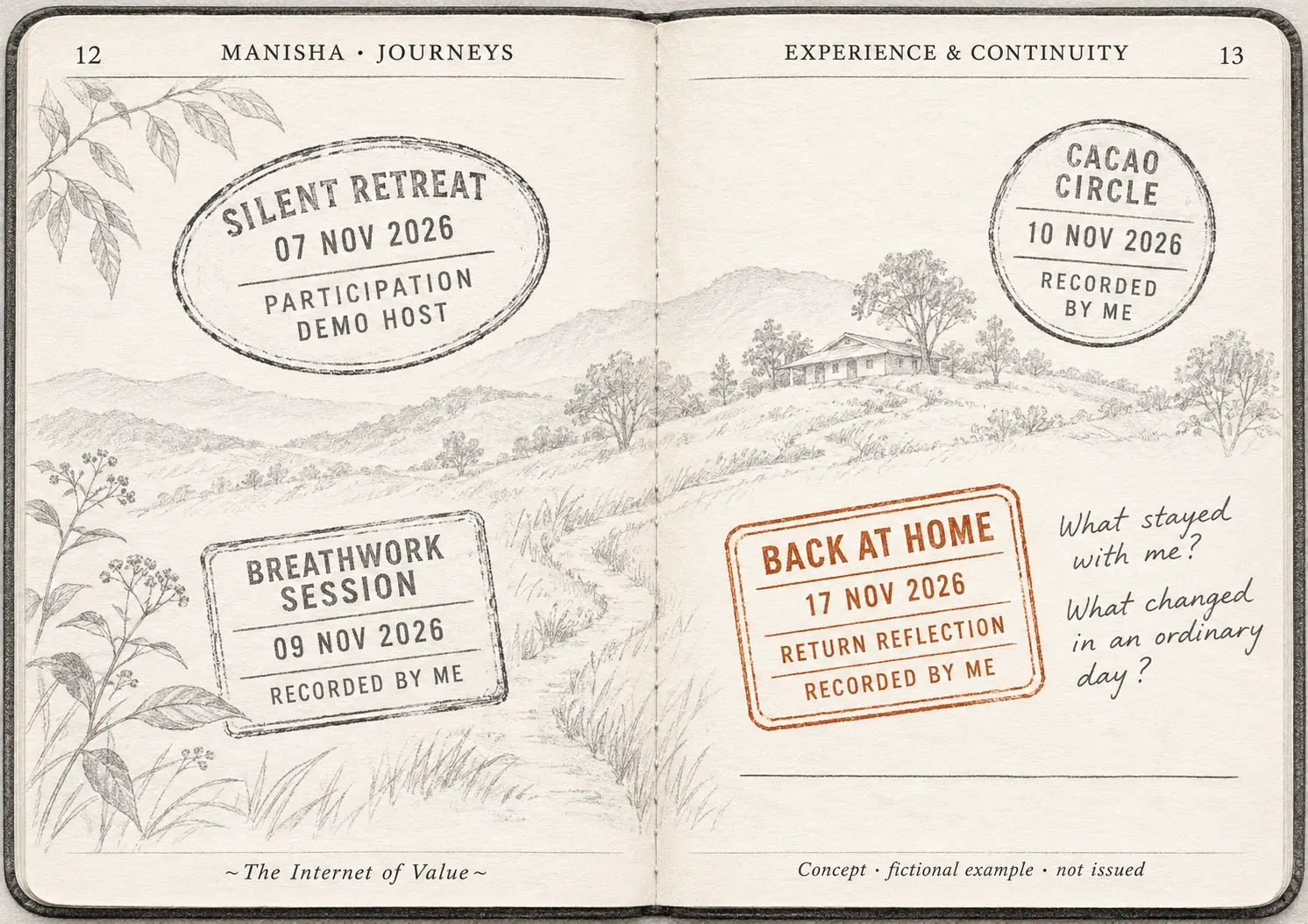
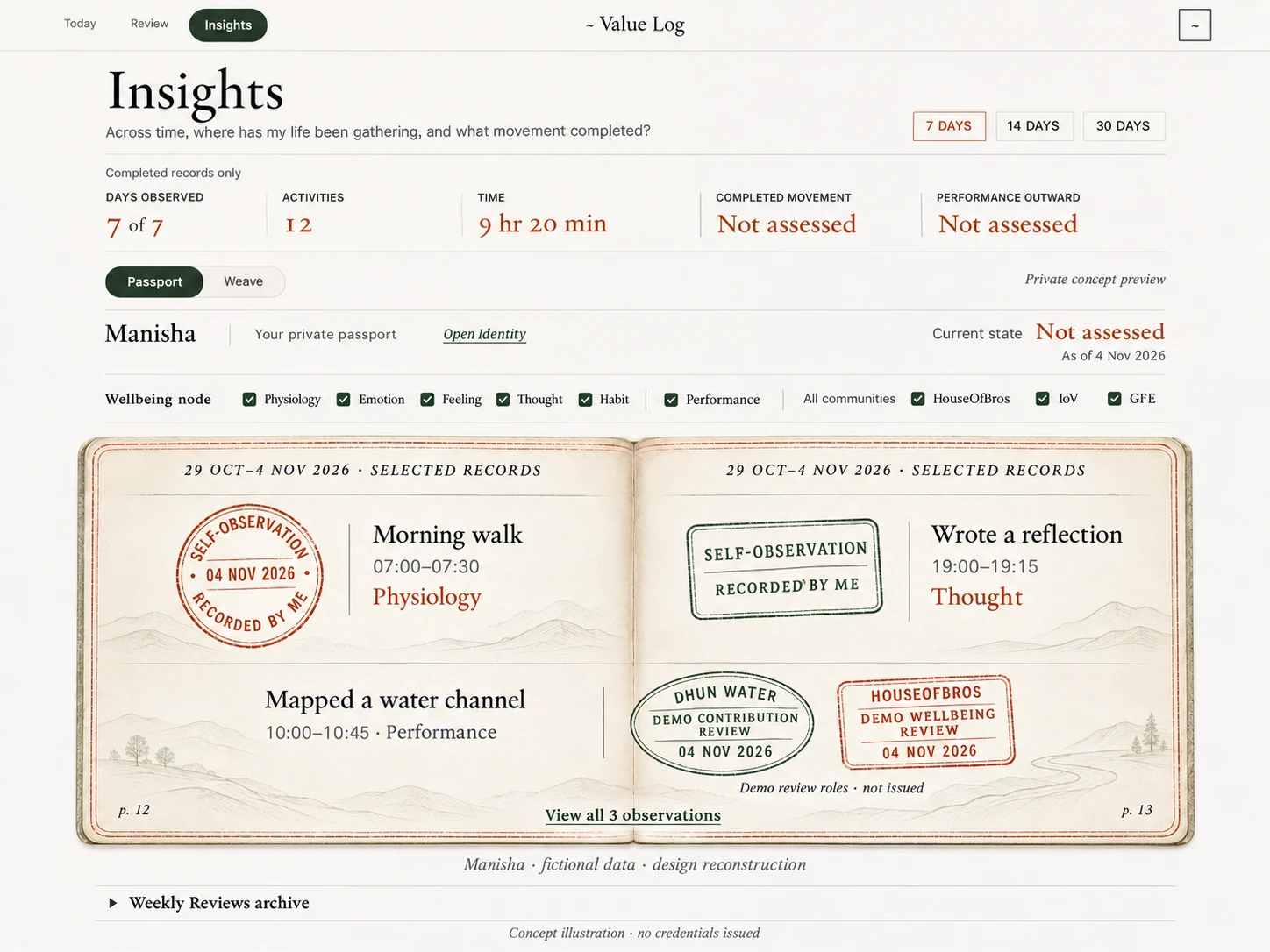
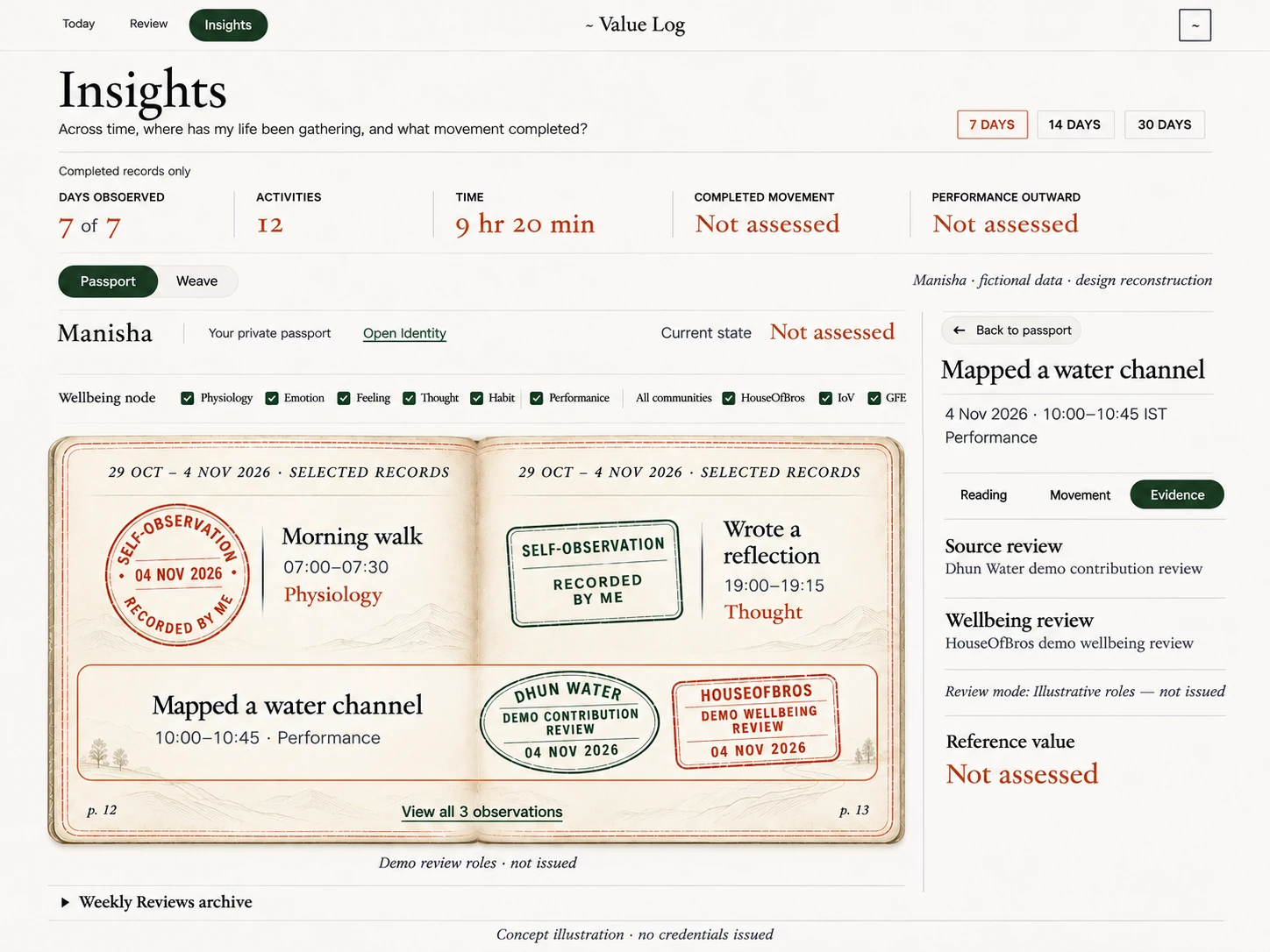
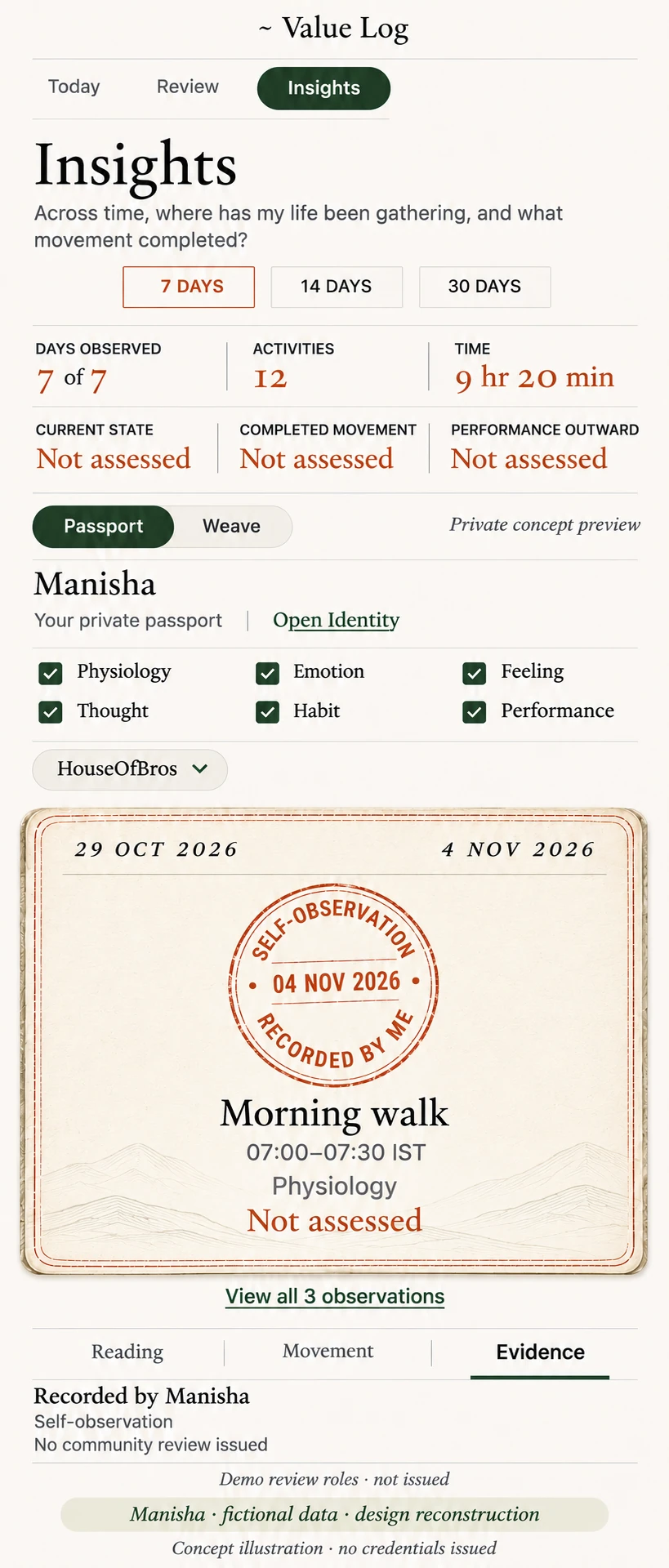
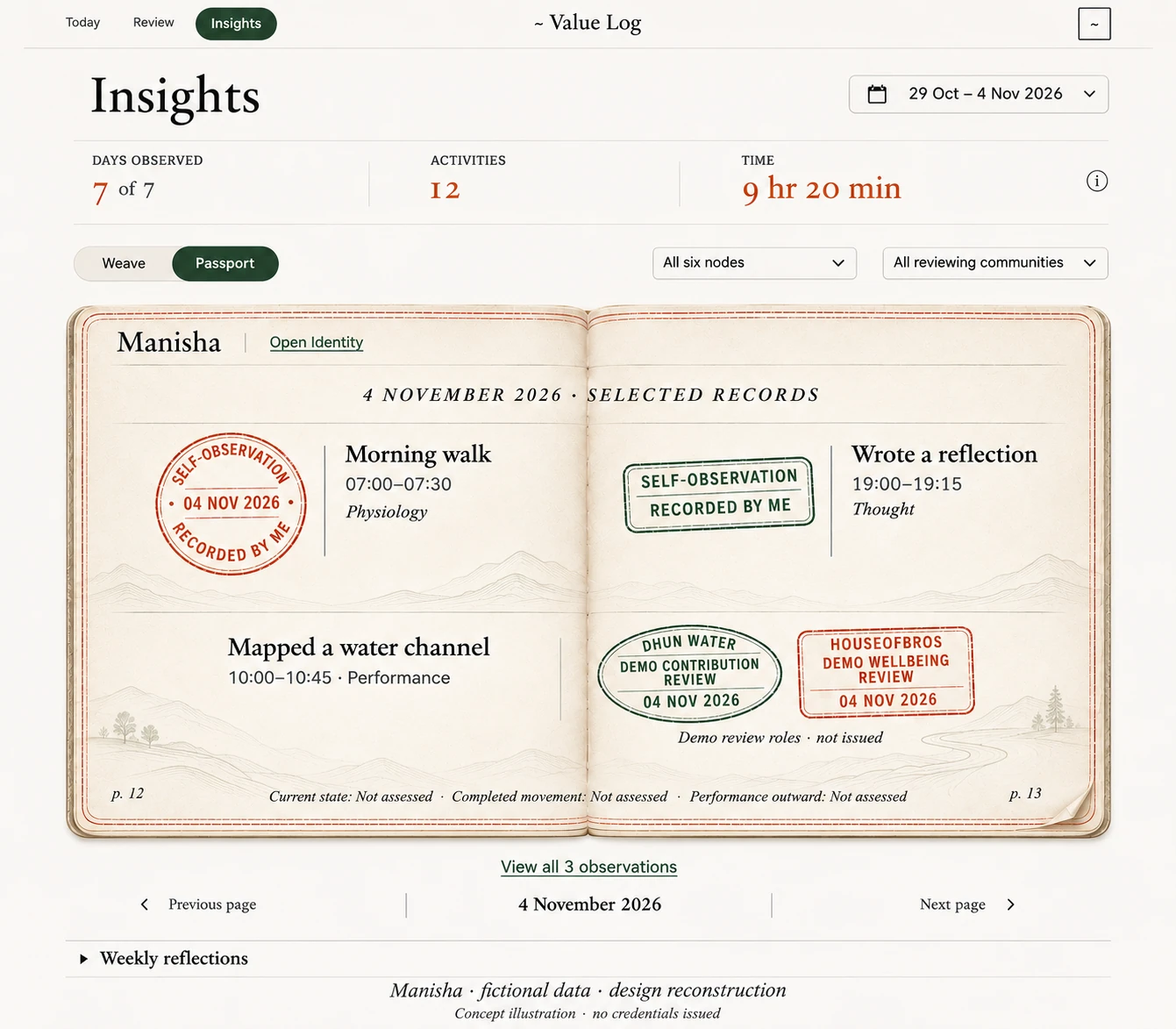
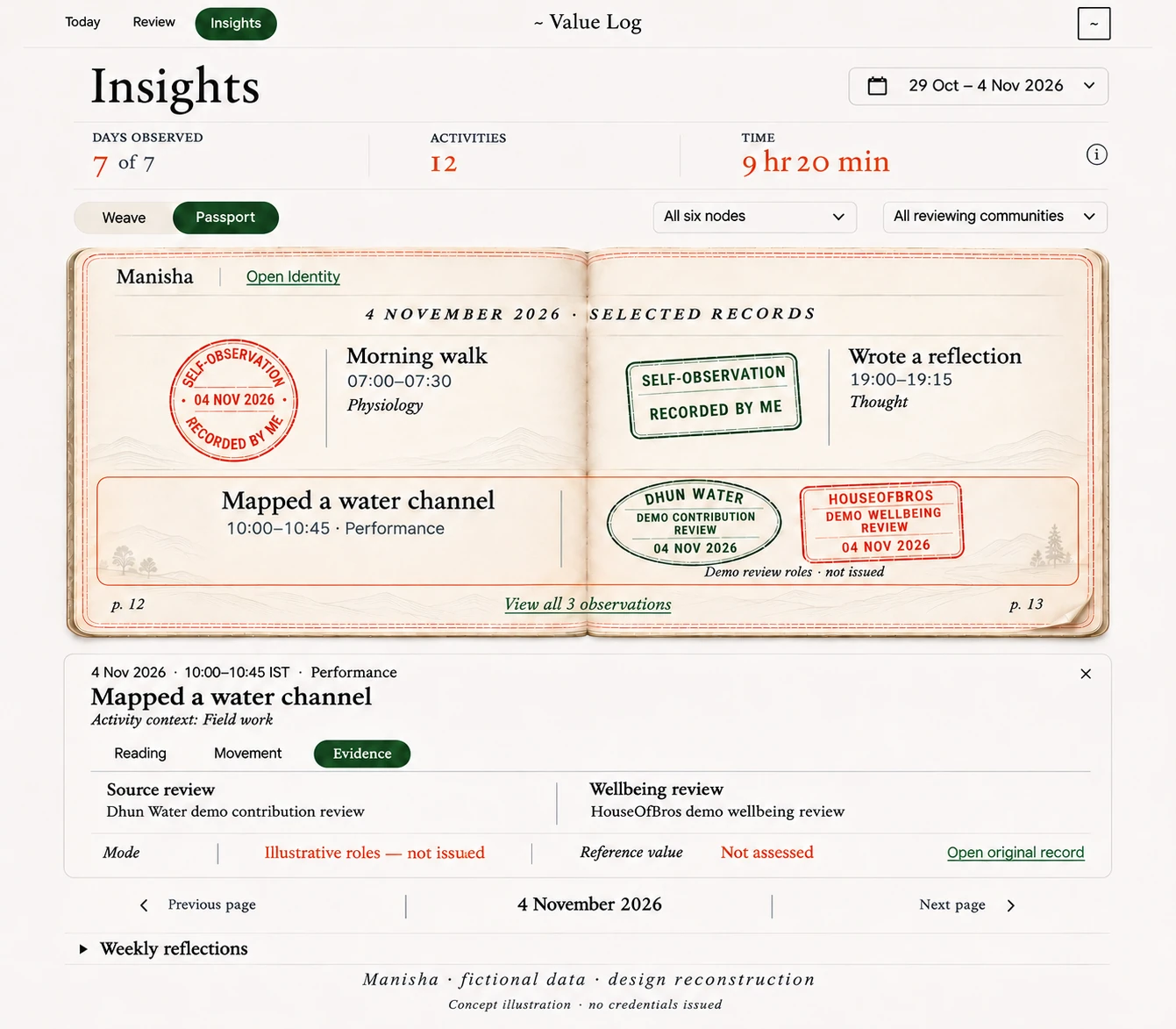
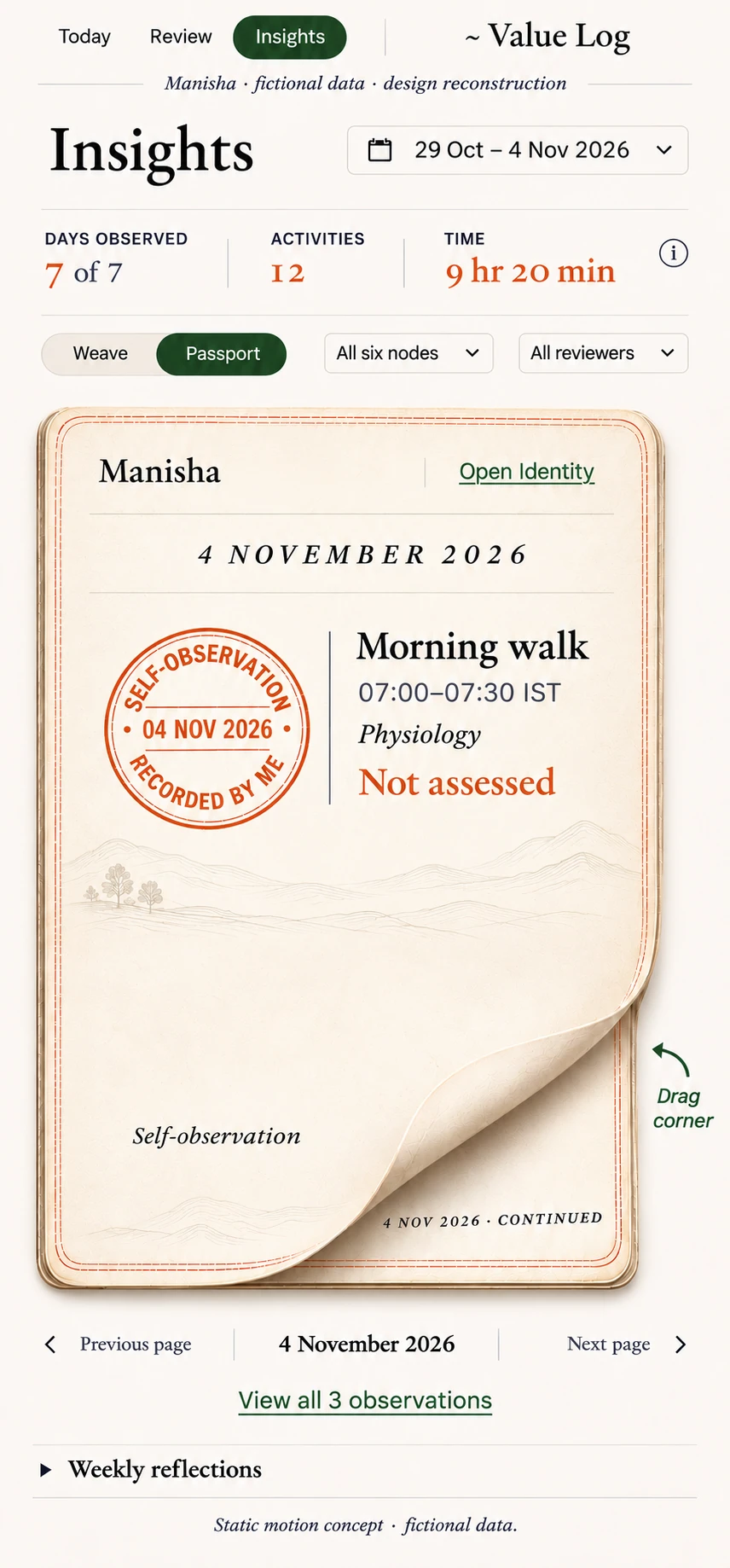
The first sketches were too literal and not literal enough. They borrowed a book outline but filled it with ordinary cards. Later versions looked more like a passport and still failed to answer what a stamp meant. We made an identity page, a day page, visiting-community pages and a wellness journal. Then the existing Insights calendar forced a useful decision: the passport could be a way into evidence, rather than a replacement for every screen.
That is where the product became more concrete. A calendar helps me find a day. A day ring makes time visible. An observation lets me say what I noticed. Review details let me inspect the scope of a claim. A passport page can bring these together without making me relearn how to navigate my life.
The public demonstration below uses the actual reviewed Value Log presentation components from source revision 8455a31, with a fixed fictional Manisha fixture. These are authentic interface captures of that demonstration. They are not screenshots of Manisha’s account, not today’s private founder ledger and not proof that Dhun has adopted it.
There are three useful acts here. Observe: give an experience a time, an activity and a personal account. Review: distinguish what was claimed, what evidence exists and which decision actually occurred. Return: open the earlier observation from Insights and see what remains pending, unassessed or complete.
The dimensional proposal takes a further step in explanation. Manisha emerges from the passport. Eight rings rise from her feet to her head. Touching a ring reveals its facets. The same person, carrying all eight layers, moves through the clock of an ordinary day. When a scoped review arrives, the relevant layer responds.
This sequence is a teaching device. It should make the relation between a person, a moment and its evidence easier to understand. It does not make the evidence stronger. A beautiful ring glow must never stand in for the review that supposedly caused it.
09
What we bring is the vocabulary and the relationship
Look inside the eight rings · choose a view
01 · Given Identity · 12 facets
01 · Given Identity · 12 facets
- Full Name
- National ID
- Birth Date
- Birth Place
- Sex
- Language
- Nationality
- Citizenship
- Religion
- Caste
- Genetics
- DID
Registry field labels, not disclosed values. Unknown and undisclosed are valid states.
02 · Earned Identity · 7 facets
02 · Earned Identity · 7 facets
- Schooling
- UG
- PG
- PhD
- Certifications
- Work Experience
- Portfolio
Registry field labels, not disclosed values. Unknown and undisclosed are valid states.
03 · Rented Identity · 8 facets
03 · Rented Identity · 8 facets
- X
- YouTube
- Substack
- GitHub
- Website Handles
Registry field labels, not disclosed values. Unknown and undisclosed are valid states.
04 · Skills · 5 facets
04 · Skills · 5 facets
- Hard Skills
- Soft Skills
- Skill Level
- Skill Evidence
- Skill Trajectory
Registry field labels, not disclosed values. Unknown and undisclosed are valid states.
05 · Moral Compass · 3 facets
05 · Moral Compass · 3 facets
- Virtues
- Values
- Ethical Boundaries
Registry field labels, not disclosed values. Unknown and undisclosed are valid states.
06 · Story · 5 facets
06 · Story · 5 facets
- Past
- Now
- Future
- Turning Points
- Vision
Registry field labels, not disclosed values. Unknown and undisclosed are valid states.
07 · Identity State · 3 facets
07 · Identity State · 3 facets
- Wellbeing Score
- Score History
- Protocol Convergence
Registry field labels, not disclosed values. Unknown and undisclosed are valid states.
08 · Consent And Disclosure · 7 facets
08 · Consent And Disclosure · 7 facets
- Disclosure Policy
- Selective Disclosure
- Facet Disclosure Rules
- Audience Scopes
- Consent Grant
- Consent Expiry
- Revocation State
Registry field labels, not disclosed values. Unknown and undisclosed are valid states.
The distinctive contribution I want to test is the connection between several kinds of continuity: a person who remains recognisable across settings; observations that remain intelligible across days; and community claims whose authorship and limits remain visible when they travel.
Our canonical vocabulary separates four protocols: ~WellbeingIdentity, ~ValueCaptureProtocol, ~WellbecomingProtocol and ~SAOcommons. The passport is a reading surface across them, not a fifth protocol. The website explains the system; the specification governs its meaning.
Wellbeing Identity represents eight nodes and fifty facets. Given, Earned and Rented Identity sit beside Skills, Moral Compass, Story, Identity State, and Consent and Disclosure. These are categories in our curated model, not a claim that the whole person has been measured. A person can leave information unknown, revisit it and choose what to disclose. Fifty facets must not become fifty compulsory answers.
We have drawn questions from economics, philosophy, embodiment, culture and self-direction. Labour-market friction makes legible skills and evidence interesting. Philosophical traditions ask how someone might live, what they value and what kind of person they hope to become. Biological and social context complicate any account of individual agency. These lenses motivate our curation. They do not prove that any tradition, philosopher or neuroscience finding derives this exact eight-node schema.
Through time, the separate Wellbecoming vocabulary is Physiology, Emotion, Feeling, Thought, Habit and Performance. It supplies an interpretation route for an observed moment. It should not be presented as a scientifically established, one-way causal chain that every human experience follows. A single experience may touch several nodes; a narrative alone does not establish a physiological measurement.
W: policy-defined wellbeing state.
Vcom: Value for the Commons.
The VC relation connects a declared W to Vcom. For an eligible time-valued contribution, the community side can involve an approved rate and validated hours under its rules. The person’s identity supplies context and baseline provenance; the eight identity nodes are not eight extra arithmetic components added to W. Valuation is also distinct from a decision to pay.
This creates a demanding implementation problem. A score without its method is hard to interpret. A contribution without a unit, rate authority and review scope is hard to carry. A correction without lineage can quietly change what a former reviewer appeared to approve. The useful package is therefore more than a number: it includes the relevant observation, method/version, issuer, claim, review state and permissions.
That is an interoperability ambition, not a claim of achieved universal interoperability. Another community may use different criteria and may decline recognition. A portable file is not an agreement. Existing standards such as Open Badges may be appropriate for a selected claim; we would need an explicit mapping and a test before declaring compatibility.
Nor have we established that our composite is clinically valid or comparable between people. A reproducible calculation answers “how was this result obtained?” It does not, by itself, answer “does this measure the thing we care about?” The Dhun research must keep that second question open.
10
She could write anything
Manisha’s fictional day is deliberately imperfect. Yoga does not inoculate her against interrupting colleagues. A useful water inspection does not prevent a lost stretch of scrolling. Dinner and bhajan can matter without becoming outputs. The point is to notice a life rather than manufacture an admirable one.
We follow yoga, a team meeting, water inspection, kitchen contribution, energy work, doomscrolling, a meal/bhajan and evening reflection. Selecting a moment reveals the activity first. Her personal observation comes next. Only after that do we ask whether a review exists and what it actually covers. The calmer sequence matters: showing everything at once made the person disappear beneath the explanation.
Then comes the awkward question. She could write anything. What is stopping her?
No stamp can solve that in general. A reviewer may witness participation, examine a contribution or assess particular evidence. They do not acquire direct access to another person’s feelings. Dhun Water might acknowledge a bounded inspection contribution. A proposed Dhun Food community might review kitchen work against agreed criteria. Dhun Energy may leave something pending. HouseOfSisters is an illustrative peer/practice role for non-Performance reflection, not a constituted Dhun institution or an external authority over private emotion.
In the interactive, reviewed sample wellbeing changes can rise, fall or hold. A contribution can add evidence to Skills without raising W. A pending review produces neither an approval stamp nor an earned glow. All displayed Manisha changes are authored fictional examples under an explicit sample policy. None is a result calculated from the real person who inspired the character.
That is why incentives need care. If participants learn that an honest difficult moment costs them status or access, the system will invite pleasing stories. If managers expect private reflection as proof of commitment, “opt-in” becomes fragile. If every stamp has the same attractive visual weight, a weak acknowledgement can borrow the authority of a strong one.
The practical incentive I would begin with is usefulness: being better understood, carrying selected evidence, receiving feedback that helps and avoiding unnecessary repetition. A community may separately agree how skills and contributions receive recognition or valuation. We should test whether that brings people back voluntarily, not assume that more points will create a better daily practice.
Privacy belongs in the journey, not only in a policy document. Before sharing, the person needs to know the recipient, fields and purpose. They need to understand what can expire or be withdrawn and what a recipient may retain. The public proposal is open to anyone with its URL; that is wholly different from a participant’s private diary. No private record becomes public because this demonstration is public.
11
The difference worth testing
Comparing the mechanisms makes the shared ground visible. Support, reflection, recognition and access are different jobs. The views below show the connection we want to test; the table keeps documented mechanisms beside the proposed Dhun operation.
The connection worth testing · choose a view
A private observation
A private observation
- 01Identity
- 02Observe
- 03Review
- 04Return
Manisha notices that her breathing feels easier after yoga. Her words remain her account; no stamp is required to make the observation worth keeping.
Daily journals are close neighbours here. We should learn from their low-friction return ritual.
A reviewed contribution
A reviewed contribution
- 01Identity
- 02Observe
- 03Review
- 04Return
A proposed Dhun Water Circle reviews a specific contribution under an agreed skill and rate policy. The stamp names the issuer and scope; it does not certify Manisha’s inner state.
Learning credentials are close neighbours here. Recognition across institutions still requires an agreement and explicit mapping.
A life revisited
A life revisited
- 01Identity
- 02Observe
- 03Review
- 04Return
She returns to earlier moments with her identity context, the relevant review state and the method behind any calculation. A correction can change the reading.
This connection is the research ambition: continuity between chosen identity, observed time, scoped community review and a later return. It is not a claim that no other product connects parts of it.
| Case | Personal / recipient context | Dated daily input | Return / interpretation | Named institutional mark / claim | Share, export or carry | W × Vcom relation |
|---|---|---|---|---|---|---|
| Lancashire / south Cumbria | ✓ | — | — | — | ✓ | — |
| NHS / QEH | ✓ | — | — | — | ✓ | — |
| Tiny Medical Apps | ✓ | ✓ | ✓ | — | ✓ | — |
| Mind.org.im | ✓ | ✓ | ✓ | — | ✓ | — |
| Connect & Support UK | ✓ | ✓ | ✓ | — | ✓ | — |
| Daylio | — | ✓ | ✓ | — | ✓ | — |
| Bearable | — | ✓ | ✓ | — | ✓ | — |
| Oura | — | ✓ | ✓ | — | ✓ | — |
| Unmind | — | — | ✓ | — | — | — |
| Europass / Open Badges | ✓ | — | — | ✓ | ✓ | — |
| RSA Cities of Learning | ✓ | — | — | ✓ | ✓ | — |
| Camino / National Parks | ✓ | — | — | ✓ | ✓ | — |
| Wellbeing Passport Australia | — | — | — | — | — | — |
| IoV existing scoped demo | ✓ | ✓ | ✓ | ✓ | — | — |
| Dhun proposed operation | ◇ | ◇ | ◇ | ◇ | ◇ | ◇ |
✓ Documented mechanism, with different meanings across cases. — Not established by the selected sources, not necessarily absent. ◇ Proposed/testable. A host visit mark is not a skill credential. “Daily input” can be entered or sensor-derived. The existing IoV row is a read-only fictional demonstration, not general Dhun issuance.
There are real overlaps. Mind.org.im already connects reflection with selected-context passports. Connect & Support combines a passport and a journal. Daylio and Bearable make returning to patterns practical. Oura brings passive signals and its own forms of sharing. Credentials make issuer, criteria and evidence explicit. Cities of Learning connects recognition to a place and its opportunities. We should not erase those capabilities to make our row look original.
What we are proposing is a particular relationship between a living identity, time-bounded observations, conditional review and a declared value relation. The research question is whether keeping those meanings together helps a person and a receiving community. A shared vocabulary is useful only when both can understand and use it. A composite is useful only when its interpretation survives scrutiny.
That leaves several possible outcomes. We may find that people want the reflection interface but no score. We may find that a simple visit stamp is sufficient for visitors, while staff want stronger contribution evidence. We may find that existing credential infrastructure can carry the institutional claim, while the personal journal remains elsewhere. We may find the passport metaphor memorable but slower than the calendar for ordinary use.
These are productive results. The engagement should not be designed so that every observation becomes a stamp, every stamp produces an increase and every participant proves the original concept right. A paper-first or narrower outcome can be the better answer.
The comparison therefore informs a build-versus-borrow decision. Use a support sheet where chosen context is the whole job. Use an established journal where the need is private return and pattern recognition. Investigate credential tooling where the job is an issuer’s recognised claim. Build the IoV connection only where its extra continuity earns the effort it asks of participants and reviewers.
12
Where we would begin
The proposal starts with the people who already work at Dhun. A new visitor has an encounter; staff have an ongoing life together. That makes an opt-in staff cohort the more useful first place to learn whether the passport remains helpful after the initial novelty.
Month 1: listen and onboard. Begin with interviews, field observation and voluntary self-leadership and Wellbeing Identity sessions for staff and leadership. Agree what problem people want solved, what they will not disclose, who coordinates locally and what participation actually asks of them. Identity is a starting conversation, not a compulsory data harvest.
Month 2: form the review communities. Choose a few bounded skills and practices. Agree who may acknowledge participation, who can assess a contribution, what evidence they need and how someone can question a decision. Test the vocabulary on paper before requiring a digital workflow.
Month 3: work in the real setting. Run the agreed staff pilot around actual activities. Add a bounded visitor/resident encounter only if the hosts and participants are ready. A proposed water, food or energy role becomes meaningful through a person accepting responsibility for its criteria, not through our naming a community on a screen.
Month 4: tighten the loop. Review how long observation and validation take, where a claim is ambiguous, what people return to and where they feel pressure to perform. Keep pending and disputed claims visible. Change the journey or reduce its scope when the evidence calls for it.
Month 5: prepare the handover. Train the people who will coordinate the cycle, rehearse corrections and withdrawal, and document the operating work. Test whether selected context is understandable to a later reviewer without exposing the rest of a private day.
Month 6: let Dhun run its own cycle. Observe an independently operated round, deliver findings and product/operating specifications, and make a continue/change/stop recommendation. An extension to another setting would be a separate decision, not an assumption built into the pilot.
The proposed team is me, Moses Sam Paul Johnraj, leading research and product work, with two embedded research associates. Internet of Value Research Foundation would undertake the engagement, subject to joint agreement. Cohort, access, staffing and commercial terms still need scoping. This version supplies no fees, financial model or guaranteed wellbeing outcome.
The first decision is smaller than an implementation contract: is this a question Dhun wants to explore with us for six months? The next conversation would name a sponsor/coordinator and settle the boundaries together.
The passport is the invitation.
The work is learning what deserves to travel.
Experience Manisha’s full journey ↗ Read the original proposal pack ↗
13
A name for a life still unfolding
There is a smaller question running underneath the architecture: what should we call the thing someone carries? Wellbeing Passport offers a familiar entrance. Wellbecoming Passport makes the movement explicit. Neither word settles what the product actually does.
“Wellbeing” could invite someone who wants room to notice their day. It could also suggest a certificate saying they are well. “Wellbecoming” could suggest a living, unfinished identity. It could also sound like an unfamiliar obligation to keep improving. A useful name has to survive the morning after the presentation, when a person decides whether to return.
An open naming question · real reader votes
Wellbeing or Wellbecoming?
Which name makes you want to understand—and return to—this passport?
Reader preferences
A self-selected review audience, not a representative survey. One remembered preference per browser; not verified unique people.
How the poll works
Opening the poll sets a random first-party browser cookie, kept for 90 days. We store its hash, your choice and an optional category—not your name, email or IP address as a ballot identity. No fingerprinting or login. Normal hosting logs and infrastructure abuse limits still apply; see our privacy notice.
You can change or withdraw a vote from this browser while its cookie remains. Ballots remain until withdrawn or the poll is retired; clearing the cookie loses that connection. Another browser or a cleared cookie can vote again, so these are browser preferences, not verified people. This review poll stops accepting new ballots at 5,000. Preview votes are isolated from production.
There are no seeded votes. Our imagined philosophical discussion is editorial work, and contributes nothing to these totals. No data is sent merely by reading this page.
We are asking for a preference, not asking readers to validate a protocol or a scientific measure. The naming vote will inform the next conversation. It will not silently rename the canonical Wellbeing Identity or Wellbecoming Protocol.
Before choosing, you can read What should a passport promise? — an unlisted VĀDA dialogue. It tests both names against an ordinary day, a difficult day, an employer’s expectations and the risk of turning becoming into a new competition.
14
Sources, limits and next research
This review extends the Foundation’s thirteen-case comparison of 5 November 2026 with a dated funding and status pass on 11 November. It uses provider documentation, institutional programme material, original research and funding announcements. The thirteen cases include grouped comparisons: NHS/QEH; Europass/Open Badges; and Camino/National Parks. WHO-5 is a measurement reference, not a fourteenth product case.
No paid research database, authenticated competitor account, private participant data, independent penetration test or clinical evaluation was used. A provider’s privacy claim is attributed to the provider. Availability of a page, download or store listing is described at that level; it does not prove a currently staffed deployment. Historical adoption counts retain their source date. No undisclosed budget, funding total or current financial condition is inferred.
Our existing public demonstration is a fixed fictional fixture using reviewed presentation components. The dimensional story is an explanatory proposal. Neither is a fresh end-to-end production audit of Value Log or Word Wallet. The original Manisha art is reused; its inspiration is not permission to publish any real person’s private identity or diary.
Before a procurement decision, the next evidence should come from demonstrations and conversations: confirm which nearby passports are actively onboarding, inspect actual sharing/export/revocation flows, ask what funding sustains each service and test whether receiving organisations accept their claims. Before a Dhun pilot, agree the participant/reviewer burden, data boundary and research questions. Before a cross-community recognition claim, test a concrete transport and recognition path.
The sources below deliberately include unresolved entries. A missing amount remains unknown. A pending rollout remains pending or unverified. This is the part of the essay that should change as evidence improves, while retaining the date and reason for each change.
Source of Truth (Specs)
Protocol claims are grounded in the IoV registry, the Wellbeing Identity specification, the Wellbecoming specification, the VC relation and SAOcommons community specification. ~WellbeingIdentity, WellbeingScore and ProtocolLinkId retain their canonical meaning. A diagram does not establish credential conformance or a new calculation regime.
Evidence ledger
- Context / sourcehttps://whc.unesco.org/en/tentativelists/6605/
- Original filehttps://commons.wikimedia.org/wiki/File:Barsu_(Ratnagiri_District)_Petroglyphs.jpg
- Licencehttps://creativecommons.org/licenses/by-sa/4.0/
- Wikimedia Commonshttps://commons.wikimedia.org/wiki/File:Lokapurusha_Cosmic_man.jpg
- Luc Viatour / Lucnix.behttps://lucnix.be
- Wikimedia Commonshttps://commons.wikimedia.org/wiki/File:Da_Vinci_Vitruve_Luc_Viatour.jpg
- Context / sourcehttps://www.gallerieaccademia.it/en/study-proportions-human-body-known-vitruvian-man
- Wikimedia Commonshttps://commons.wikimedia.org/wiki/File:Nietzsche1882.jpg
- Context / sourcehttps://www.gutenberg.org/files/1998/1998-h/1998-h.htm
- Read the source ↗https://www.nobelprize.org/prizes/economic-sciences/1998/sen/biographical/
- Read the source ↗https://news.stanford.edu/stories/2017/05/biologist-robert-sapolsky-takes-human-behavior-free-will
- Read the source ↗https://spec.theinternetofvalue.org/api/registry
- Metropolitan Museum’s account of a Tirthankara in meditationhttps://www.metmuseum.org/art/collection/search/38574
- Sourcehttps://digitalhealthpassport.co/passports/wellbeing
- Privacy policyhttps://digitalhealthpassport.co/privacy
- Wellness Passportshttps://mind.org.im/features/wellness-passports
- Privacy policyhttps://mind.org.im/privacy
- Mindprinthttps://mind.org.im/features/mindprint
- Trusted circlehttps://mind.org.im/features/trusted-friends
- Connect & Support UKhttps://apps.apple.com/gb/app/connect-support-uk/id6764421393
- Wellbeing Passporthttps://www.wellbeingpassport.com.au/
- Sourcehttps://wellbeingpassport.org.uk/
- Blank Wellbeing Passport booklethttps://wellbeingpassport.org.uk/wp-content/uploads/2019/10/Wellbeing-Passport-Digital-Booklet.pdf
- NHS health passporthttps://www.nhsemployers.org/publications/nhs-health-passport
- A passport to better health and wellbeinghttps://www.nhsemployers.org/articles/passport-better-health-and-wellbeing
- Sourcehttps://daylio.net/
- Data securityhttps://daylio.net/faq/docs/daylio-faq/about/how-secure-is-my-data/
- Can I use Daylio on multiple deviceshttps://daylio.net/faq/can-i-use-daylio-on-multiple-devices/
- Sourcehttps://bearable.app/support/howto/the-factor-effect-report/
- Configure and enter datahttps://bearable.app/support/howto/configure-and-enter-data-into-bearable/
- Sharing with a medical teamhttps://bearable.app/support/common-questions/how-to-share-data-with-a-doctor-therapist-or-other-medical-team-member/
- Writing data to another apphttps://bearable.app/support/common-questions/can-i-write-or-import-data-to-another-app-from-bearable/
- Can you see what I enterhttps://bearable.app/support/common-questions/can-you-see-what-i-enter-into-the-app/
- Your Oura Readiness Scorehttps://ouraring.com/blog/readiness-score/
- Oura Circleshttps://support.ouraring.com/hc/en-us/articles/15958088640147-Oura-Circles
- Export and share your Oura datahttps://support.ouraring.com/hc/en-us/articles/360025441594-Export-Share-Your-Oura-Data
- Importing electronic health recordshttps://support.ouraring.com/hc/en-us/articles/52351038396819-Importing-Electronic-Health-Records-EHR
- Oura Membershiphttps://support.ouraring.com/hc/en-us/articles/4409086524819-Oura-Membership
- Wellbeing Tracker key factshttps://assets.unmind.com/image/upload/v1729857861/Product%20Marketing/Unmind_Index_Key_Facts_1.pdf
- Development and validation of the Unmind Indexhttps://mental.jmir.org/2022/1/e34103/
- Validation in USA Australia and New Zealandhttps://journals.plos.org/plosone/article?id=10.1371/journal.pone.0287215
- Sourcehttps://europass.europa.eu/en/digital-tools/european-digital-credentials
- European Digital Credentials for Learninghttps://europass.europa.eu/en/european-digital-credentials-learning
- Open Badgeshttps://www.1edtech.org/standards/open-badges
- Verifiable Credentials Data Model 2.0https://www.w3.org/TR/vc-data-model-2.0/
- Cities of Learninghttps://www.thersa.org/design-for-life/prosperous-places/regions-of-learning/cities-of-learning/
- La Credencialhttps://oficinadelperegrino.com/peregrinacion/la-credencial/
- Passport FAQhttps://americasnationalparks.org/passport-to-your-national-parks/passport-faq/
- Daylio’s statistics documentationhttps://daylio.net/faq/docs/daylio-faq/about/activity-and-mood-statistics/
- SFC Capital’s portfoliohttps://portal.sfccapital.com/portfolio
- company descriptionhttps://unmind.com/blog/unmind-series-c
- WHO-5https://www.who.int/publications/m/item/WHO-UCN-MSD-MHE-2024.01
- October 2024 accounthttps://europass.europa.eu/fr/news/celebrating-3-years-european-digital-credentials-learning
- Ufi’s programme accounthttps://ufi.co.uk/voctech-directory/cities-of-learning/
- funding pagehttps://www.thersa.org/design-for-life/prosperous-places/regions-of-learning/cities-of-learning/fund-cities-of-learning/
- Inspect the named evidence ↗https://sbrihealthcare.co.uk/news/sbri-healthcare-awards-3m-to-accelerate-innovations-that-support-children-and-young-people-who-have-asthma-epilepsy-and-or-diabe
- Inspect the named evidence ↗https://daylio.net/faq/terms-of-use/
- Inspect the named evidence ↗https://ouraring.com/newsroom
- Inspect the named evidence ↗https://ir.trinitycap.com/news-releases/news-release-details/trinity-capital-inc-provides-26-million-growth-capital-unmind/
- £488,525 awardhttps://sbrihealthcare.co.uk/news/the-accelerated-access-collaborative-through-sbri-healthcare-awards-2-7-million-to-respiratory-disease-innovations/
- VC relationhttps://github.com/TheInternetOfValue/the-internet-of-value-spec/blob/main/specs/math/vc-equation.md
- Wellbeing Identity specificationhttps://github.com/TheInternetOfValue/the-internet-of-value-spec/blob/main/specs/protocols/wellbeing-identity/spec.md
- Wellbecoming specificationhttps://github.com/TheInternetOfValue/the-internet-of-value-spec/blob/main/specs/protocols/wellbecoming/spec.md
- SAOcommons community specificationhttps://github.com/TheInternetOfValue/SAOcommons-Community-Building-Spec
Read the earlier thirteen-case report, user-flow reconstructions and source ledger ↗