Of everything I learned in school biology, the sentence about mitochondria being the powerhouse of the cell has enjoyed an absurdly long life in my memory. Then I heard a chemistry professor give the job to Brownian motion. Mitochondria can keep the title. But the provocation got me to picture a different problem altogether. If a protein needs to find a particular stretch of DNA, how does it get there when nobody can give it directions?
I thought about this again while going through two setbacks from building The Internet of Value. In August, we prepared an event and got zero confirmed registrations. In October, people in a room at Dhun agreed to try Value Log and some ran into trouble getting in or keeping a complete account. Both days could fit under the word failure. If I had given the team the same instruction after each one, I would have sent us to fix the wrong thing at least once.
How does a protein find anything?
Put a tiny particle in a drop of water and watch it under a microscope. The water looks still, but its molecules keep hitting the particle. Their impulses balance on average in an ordinary still fluid. At any given moment the balance is imperfect, so the particle jostles around. Einstein’s 1905 paper showed how to predict the rate of spreading across many such particles. An individual path can be hard to predict while the population follows a measurable pattern. Einstein’s 1905 paper
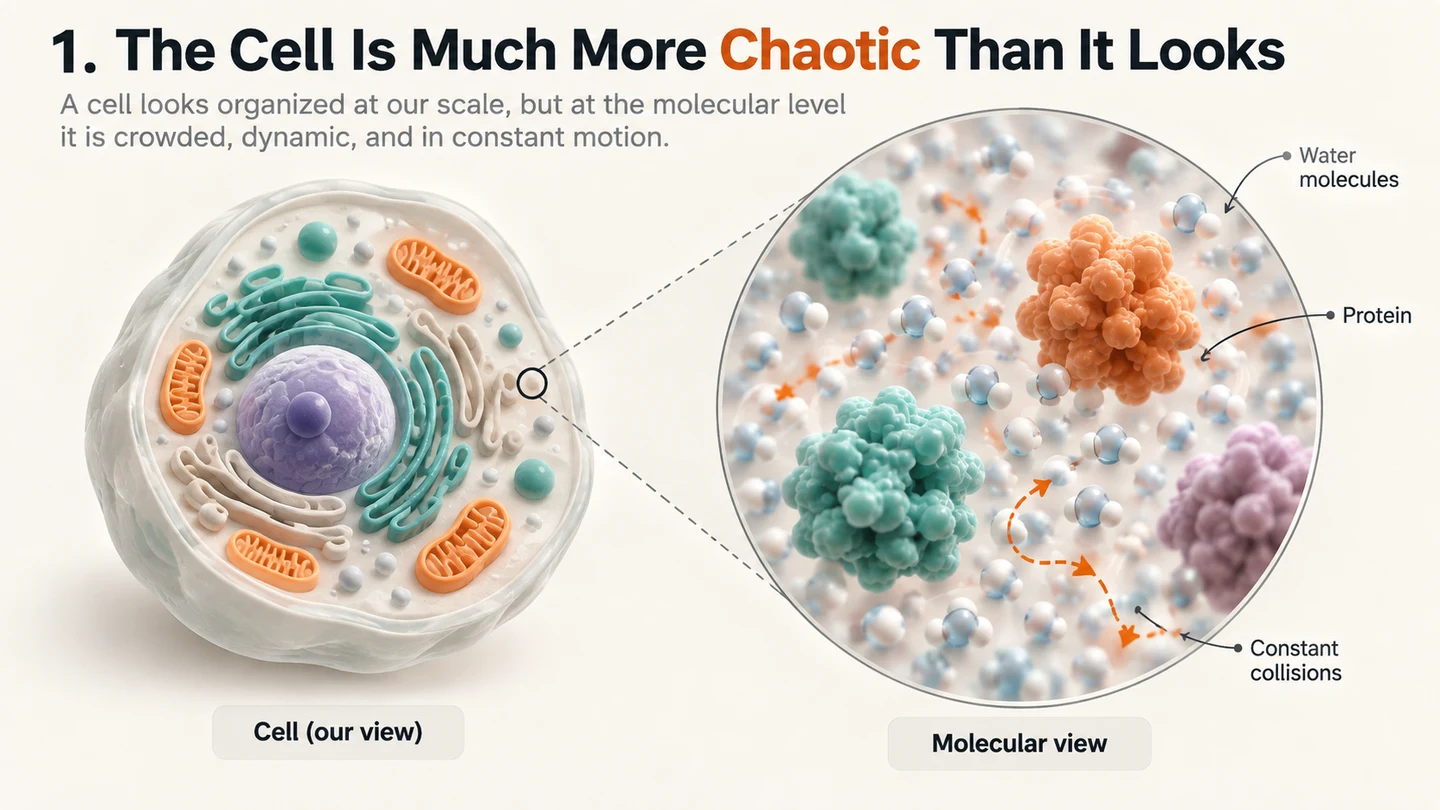
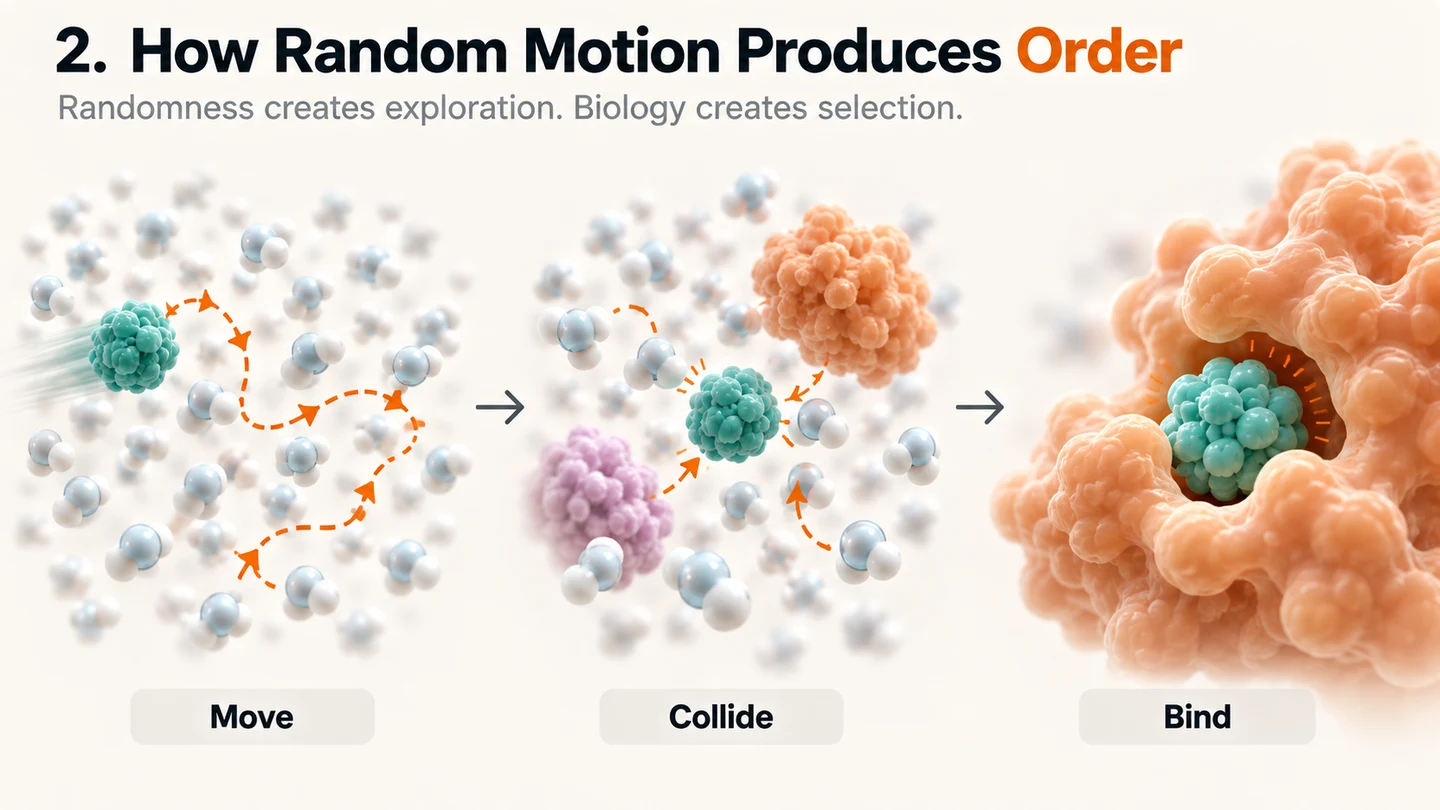
In a living cell, movement can bring molecules into contact. What happens next depends on their chemistry. In 2007, Johan Elf, Gene-Wei Li and X. Sunney Xie tracked a labelled gene regulator in living bacteria and observed it binding to a specific DNA site. The repressor spends time temporarily associated with other stretches of DNA during its search. Coming close and finding a match are two different events. Free energy and cellular machinery do work elsewhere in the process. The part I want to borrow is smaller. Contact makes an interaction possible, and the conditions at the encounter determine what can follow. Elf, Li and Xie, Science, 2007
When the problem comes without a question paper
In a school exercise, somebody has already decided what problem is worth solving and supplied enough information to solve it. You may have to be tremendously clever to reach the answer. You can usually trust that the question exists, that somebody will read what you wrote, and that there is some relationship between the quality of your work and the mark you receive. A founder can do excellent work on a problem the customer barely notices. The founder may also have picked a real problem and called the person who has no budget or authority to solve it. From the founder’s side, both can sound like “We’ll get back to you.”
That is the habit I’m interested in. The ability to make a convincing case can carry over from an environment with reliable feedback into one where the feedback needs to be investigated first. A clever person can write a persuasive explanation for why the pitch failed before finding out who received it. The same ability can help them design a better test. The difference lies in whether the explanation gives reality a chance to disagree with it.
Do smart people actually fail more often? To answer that we would need to define ability, decide what counts as a startup and compare outcomes per venture over a common period. Counting someone’s failed attempts across a career would answer a different question. In US survey data, Ross Levine and Yona Rubinstein found that people who became incorporated self-employed business owners had, on average, scored higher on a learning aptitude test as teenagers. Their study looked at who entered and what they earned. It leaves the comparative startup failure rate open. Intelligence has plenty of room to help, and this essay follows one way it can be misapplied. Levine and Rubinstein, NBER
An empty room and a room full of people
On 15 August I was supposed to be at the Takshashila Institution in Bengaluru for an Independence Dialogue about how we measure what matters in India. We had made a landing page and prepared the event. We cancelled after zero confirmed registrations. The account I kept of the two-hour slot describes breakfast, a walk and a conversation about travel. Later I spent three and a half hours trying to record the dialogue and finished without a version I was happy with. I could spend those hours improving what I had to say. I still had very little information about why the invitation had failed to bring people into the room. Two months of self-observation with Value Log
At the Logos × Zugrama Field Station in October, there were people in front of me. I had invited them to go back through the previous twenty-four hours in their heads and notice what they could remember. The next day, residents tried putting that account through Value Log. Some had trouble with access or sign-in. A returned table could look complete and still leave out part of what somebody had said. I could finally see where the invitation ended and the product began. A sensible first test after Dhun was whether someone new could save a complete account that they recognised as theirs. A sensible test after August would have started much earlier, by finding out who received the invitation and whether they understood why they might come. The Dhun account
The order matters. If a person never gets the invitation, their absence tells me very little about the event. If they try the product and cannot save, I know more about the path than about whether they would choose to return next week. And if they save once with the founder beside them, I still have a question about what they will do alone. Each of those outcomes makes a different claim assessable. Lumping them together makes it very easy to work hard on whatever explanation hurts least.
August · The invitation
Zero confirmed registrations. Which intended guests received and understood the invitation?
October · The first use
People tried it. Where did access, capture or saving break down?
What counts as another chance?
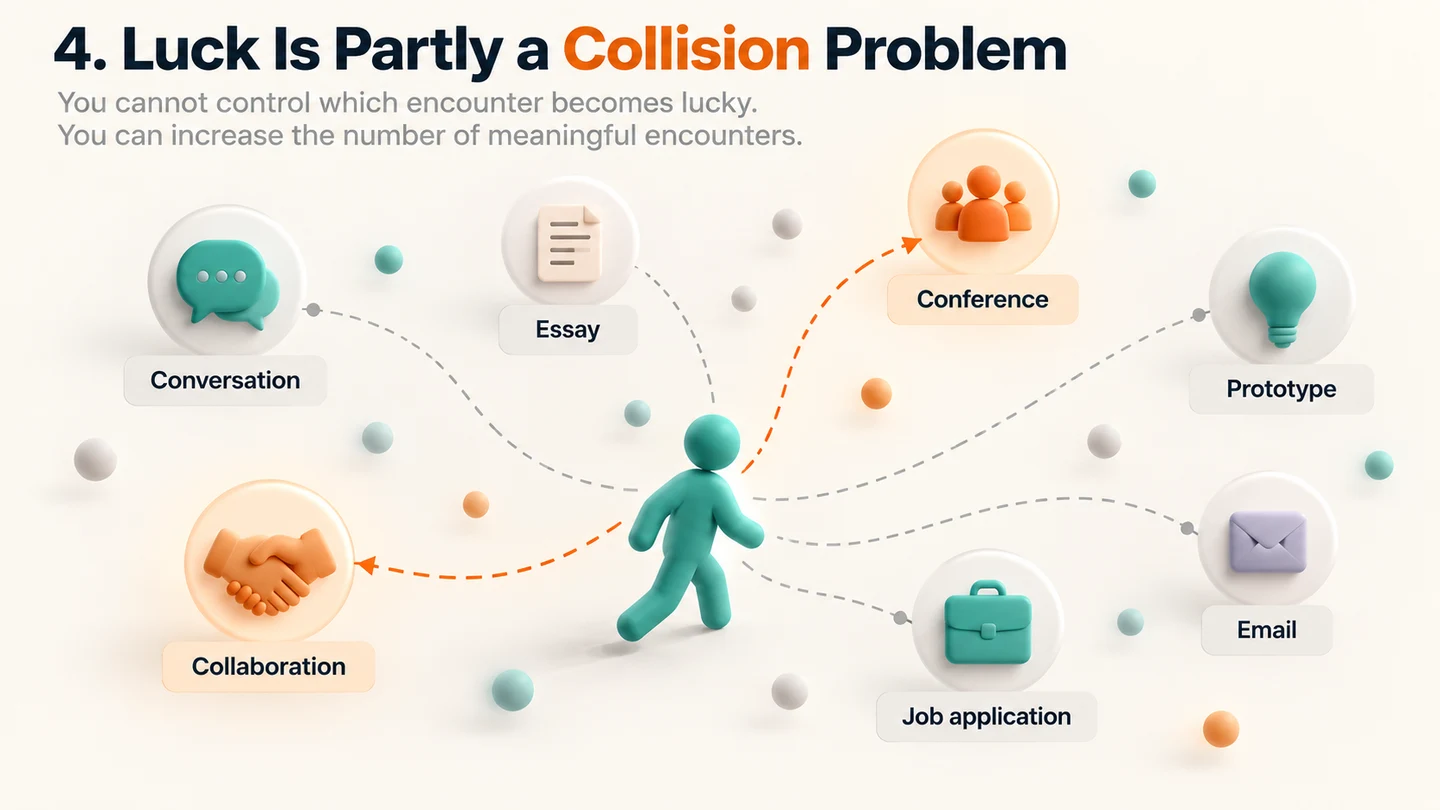
“Increase your surface area of luck” sounds like something printed on a tote bag. There is a serious claim hiding inside it. A founder can’t decide which conversation will reveal a problem worth working on. They can decide to put a rough prototype in front of a person with that problem and make it possible for the answer to surprise them. Showing it to someone who uses the existing workaround poses one question. Showing it to the person who controls the budget poses another. Sending a tenth version of the same pitch to the same circle may mostly give you ten readings of the same obstacle.
Here is a tiny model. Suppose each of ten attempts has a one-in-ten chance of producing a useful signal. You expect one useful signal on average. If the attempts are independent, you have about a 65% chance of getting at least one. Now suppose they all rely on the same gatekeeper, whose decision determines whether any attempt goes ahead. In the extreme case, you either get all ten opportunities or none, and your chance of getting at least one is back to 10%. The average count is still one. The difference is in how often you leave empty-handed.
Try the toy model
Each attempt has a 10% chance of yielding a useful signal. Both cases keep that same per-attempt probability.
See the calculation
With n attempts and probability 0.10 each, the expected count is n × 0.10 in both cases. With independent attempts, the chance of getting zero is 0.90 raised to the power n, so the chance of getting at least one is 1 − 0.90n. With a single shared outcome, all attempts succeed together 10% of the time.
Actual customers have no fixed ten-per-cent probability, and your next conversation can be better because of what the last person told you. The model earns its keep if it makes you ask what differs between one attempt and the next. If ten people are all waiting for one procurement decision, you have learned something about procurement. If people find the same obstacle through several routes, you have a better reason to work on that obstacle.
The week we spend perfecting the pitch
After a rejection, there is a great deal of legitimate work available to anyone who would rather postpone the next one. The deck can always be shorter. The positioning can always be sharper. There may be good reasons to do either. I would ask what the revision is supposed to teach us, and who will be able to tell us if it worked. If the answer is still the people who worked on the deck, we may have improved a presentation while leaving the question that bothered us untouched.
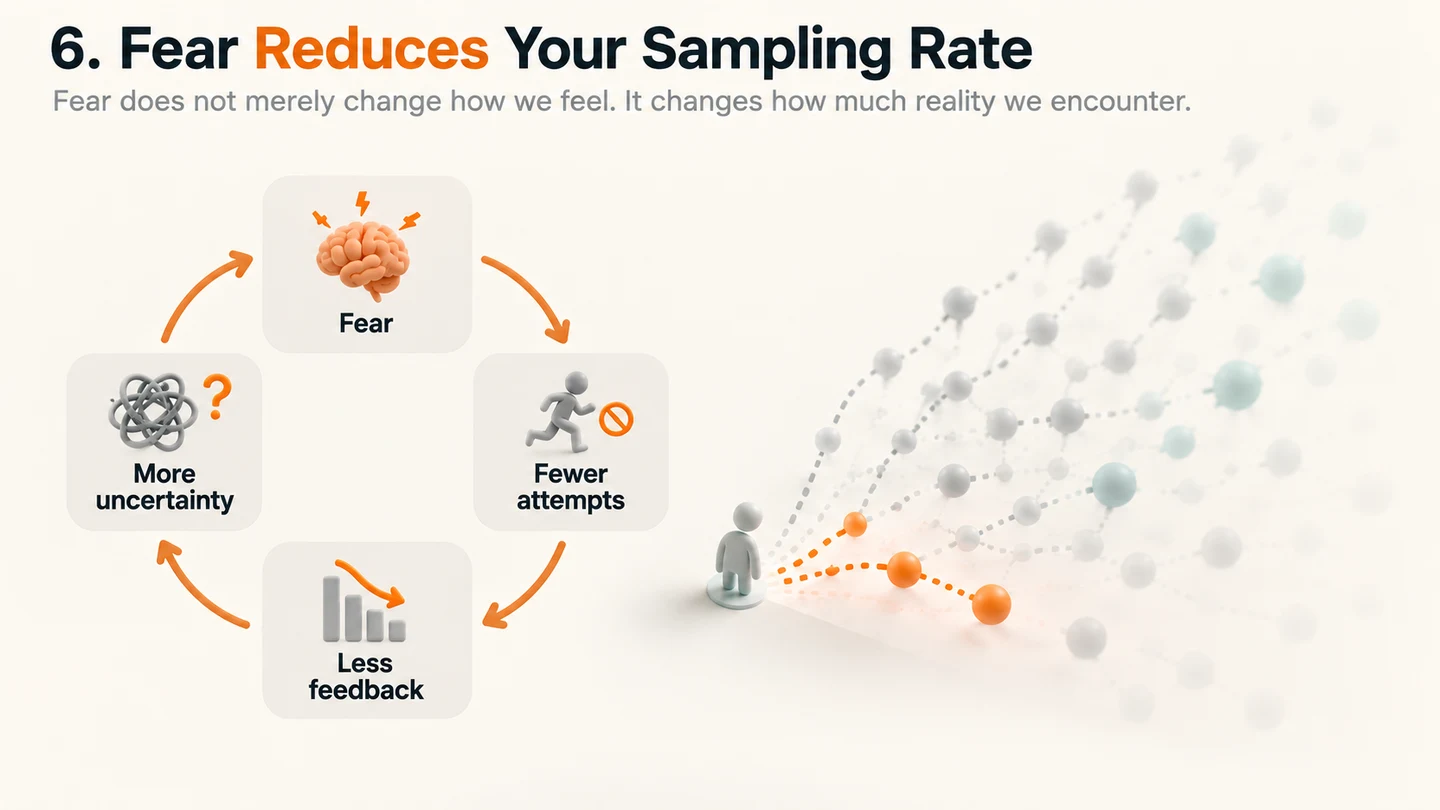
There are perfectly good reasons to go slowly. A team with six weeks of runway, a founder supporting a family and a group asking people to share private records face different costs for an unsuccessful test. Asking a friend to try a public landing page is a different commitment from asking a stranger to trust you with their day. Access is uneven too. In one study of venture capital firms, early wins were associated with better access to subsequent deals. A person who already has introductions or time to spare has more chances to recover from a poor draw. Any account of luck that leaves those conditions out will end up giving people credit for advantages they started with. Nanda, Samila and Sorenson, NBER
Experimentation can also mean getting out sooner. In a study of 759 firms across four randomised trials, Arnaldo Camuffo and colleagues found that training in a scientific approach increased the termination of ideas. Their results were also consistent with a shift toward a small number of major changes in direction over either no major changes or repeated ones. The interesting result is that teams given a way to question their assumptions stopped pursuing more ideas. A good test needs an outcome that can make you let go. Camuffo and colleagues, Strategic Management Journal, 2024
What survives the encounter?
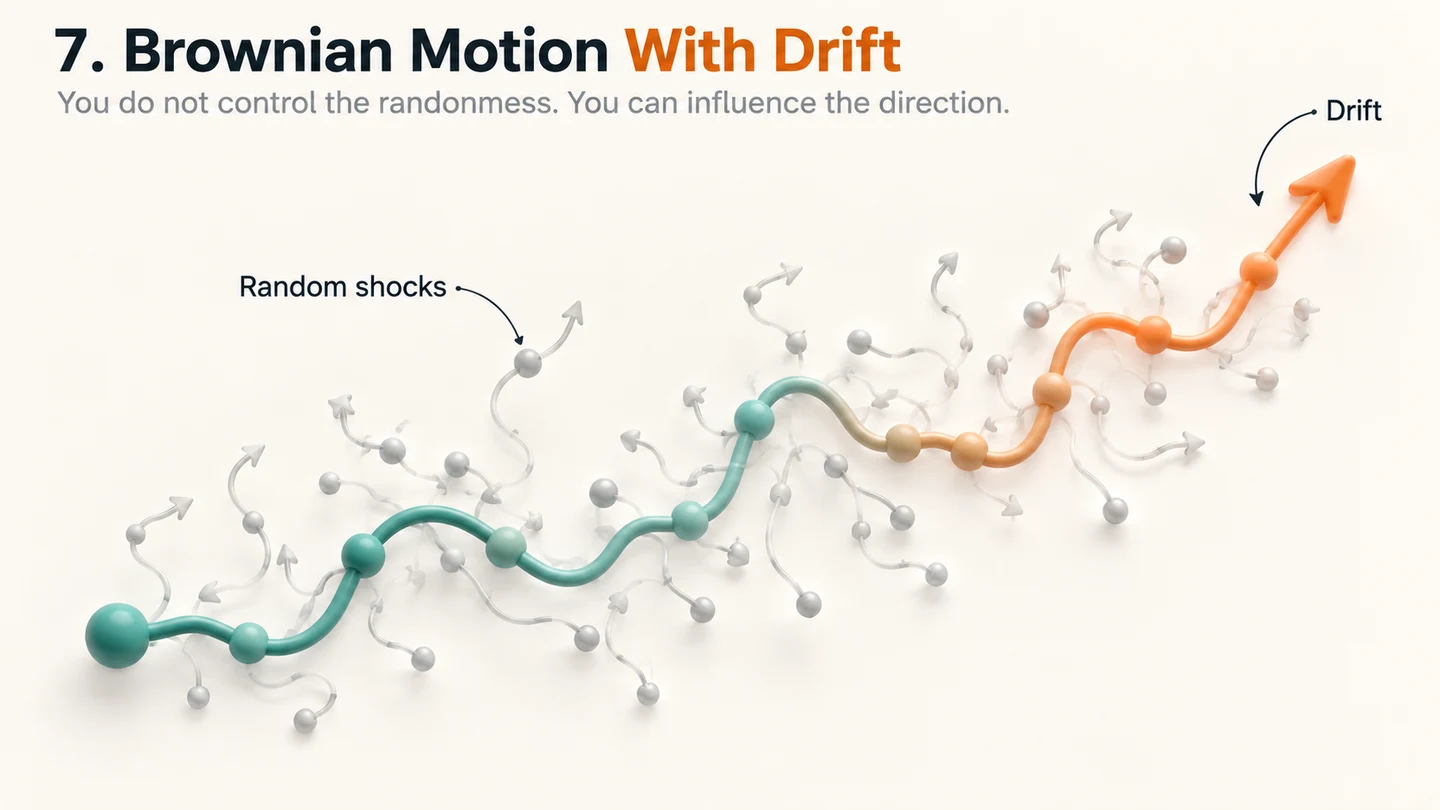
Take the wandering particle and add a weak current. Its path can still turn back on itself, but over many observations there is a tendency to move with the current. This is the intuition behind Brownian motion with drift. For a person or a company, the analogy gets interesting precisely where the physics runs out. We can remember why we went somewhere, change course and decide what to carry forward. We can also mistake a current that carried us once for a direction we chose.
After Dhun, the product work included safeguards around recording, timing and recovery. That is one way an encounter survives. A problem that was invisible during the founder’s own use becomes something the next version can account for. The work remains incomplete until another person can get through it. A repair in the changelog shows what we changed. A person returning a week later with a record they chose to keep would show something further. Value Log product history
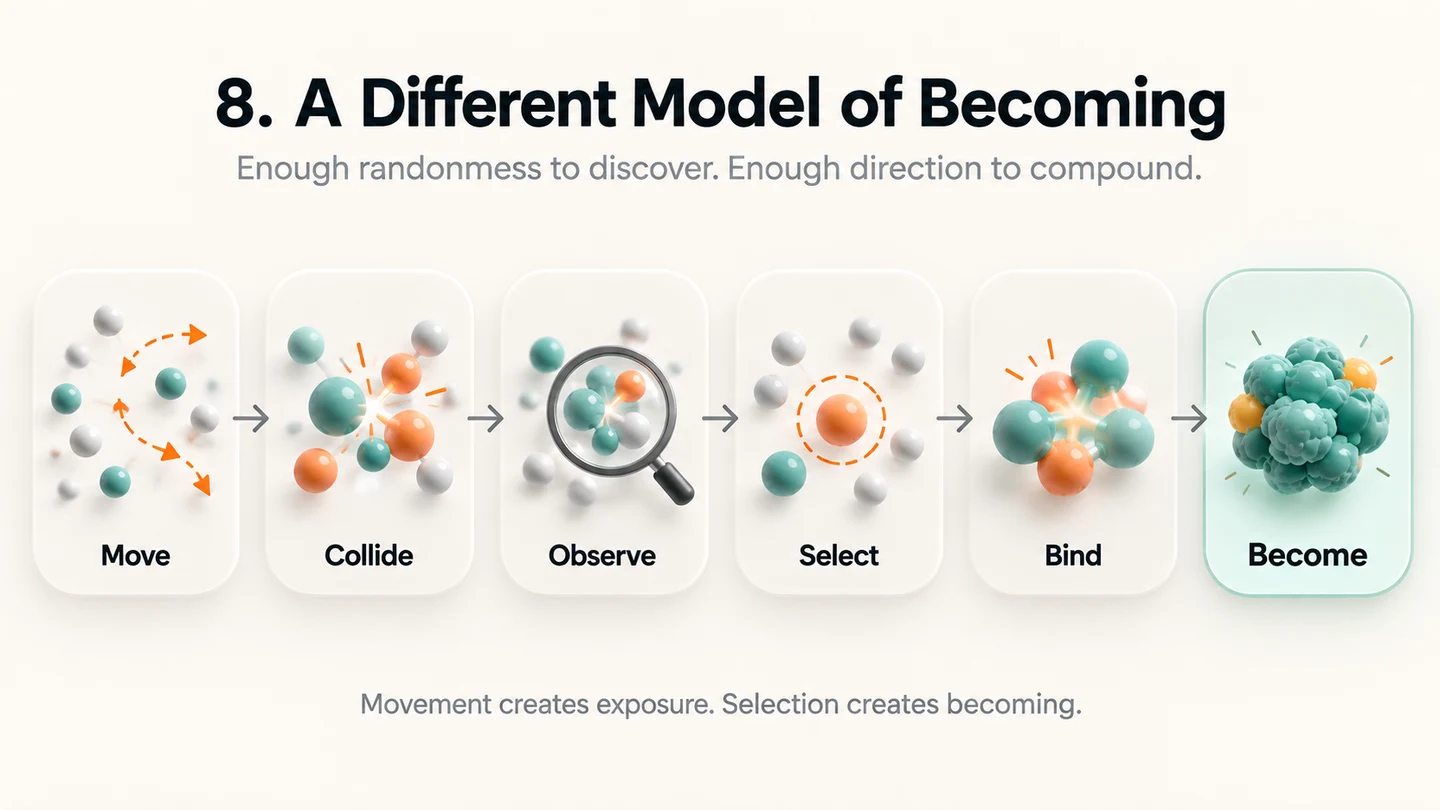
I would like to be able to read a few plain sentences before our next trial. Here is who we think has the problem. Here is what they will try without me explaining it. Here is what would make us change our mind. And afterwards I would like to keep both their action and their words. To take a hypothetical example, “She stopped before the save screen” tells me where to look. “I don’t want to keep this on a server” would take the investigation somewhere else. Keeping either one without the other would make it easier to finish the story I was already telling myself.
A last detour through belief
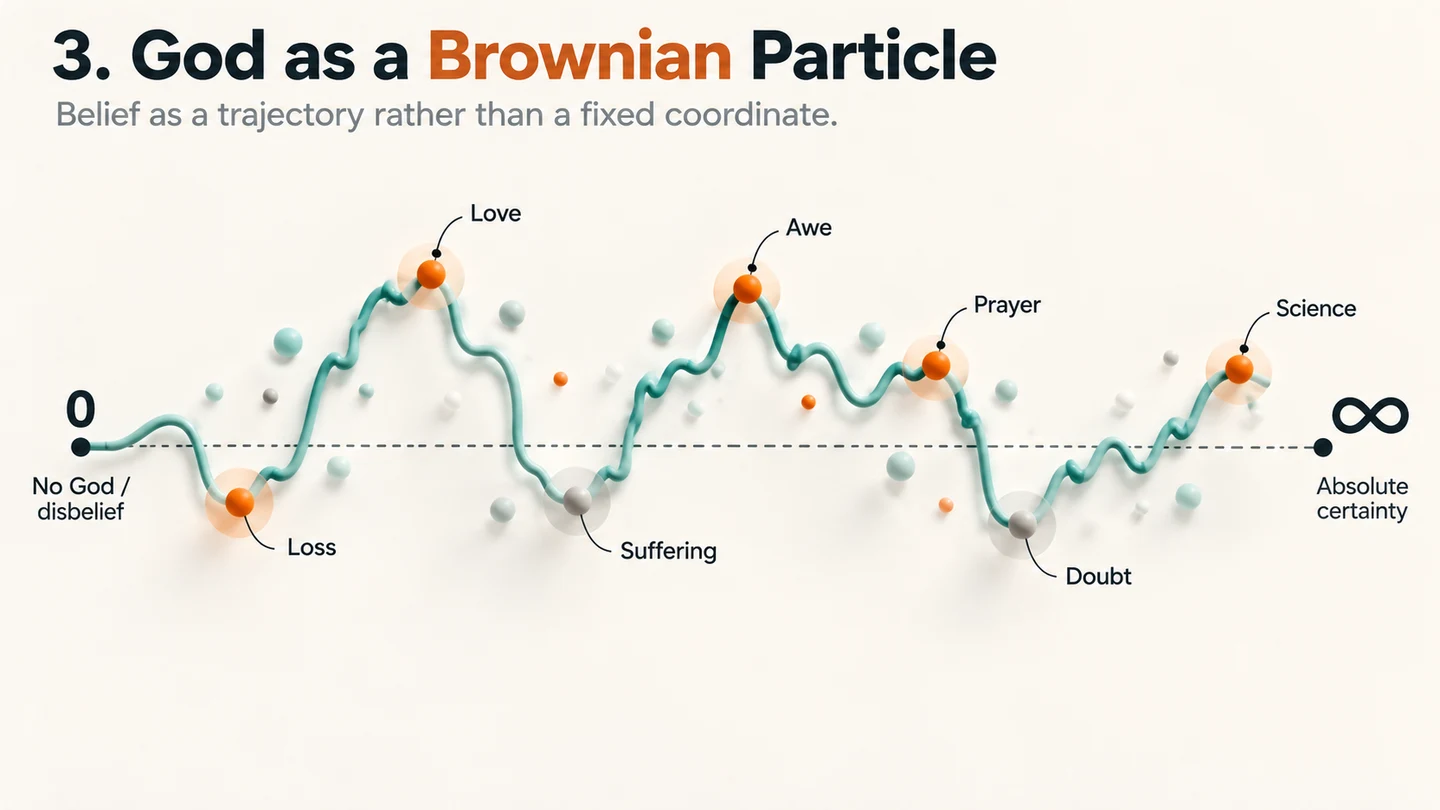
In a conversation with the physicist V. Balakrishnan, whom I know as Balki, I heard the image of God as a point undergoing Brownian motion on the positive number line. I took it as a way to think about the movement of conviction. Where would you put yourself on such a line before a loss and a year after it, before reading an argument and after living through something that complicates it? The line feels inadequate almost as soon as you draw it. Doubt, faith, grief and wonder can coexist. I like that the image can make room for a change of mind without requiring the person in the middle of it to supply a clean account of where they are going. Conversation with Balki
When I look back at the empty August slot, I can make it the opening scene of a neat story in which the room at Dhun makes everything worthwhile. The logs are more troublesome than that. I worked for hours to recover an event that never took place. Two months later people generously gave us their time and the software still lost parts of what they said. Those were two different chances to understand the work. The most useful thing my intelligence could do, in either room, was make it easier for someone or something outside my own head to change the next decision.