Two months of self-observation with Value Log
What you build builds you
Two rooms
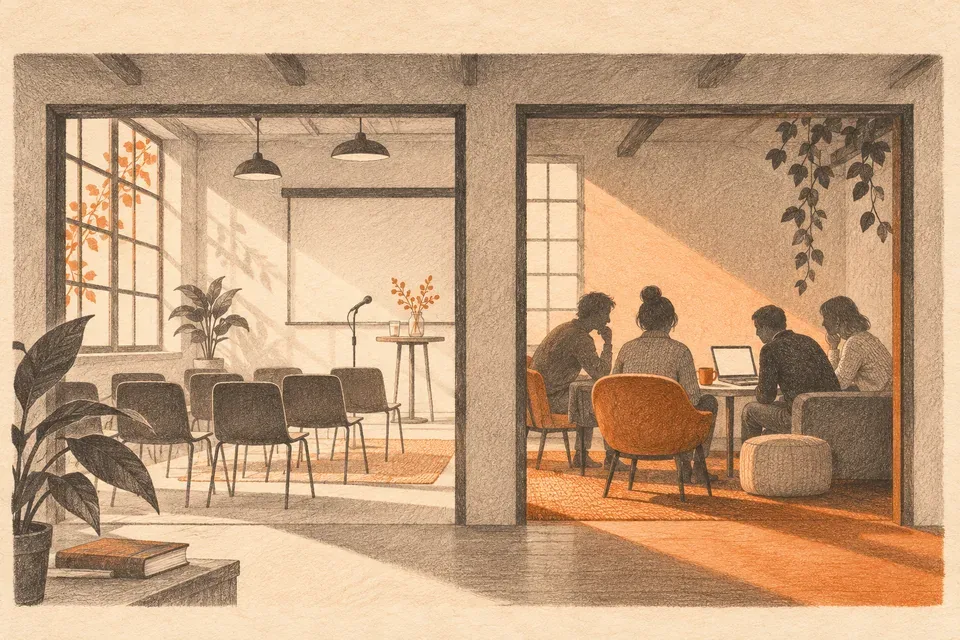
On 15 August, from nine to eleven in the morning, I was supposed to be at the Takshashila Institution in Bengaluru for an Independence Dialogue. I had planned to talk about how we measure what matters in India. The account I kept of those hours describes breakfast, a walk and a conversation about travel. The dialogue had been cancelled. We had no confirmed registrations.
I kept preparing that afternoon. Later I spent three and a half hours trying to record the dialogue. I came away without a version I was satisfied with. Between the preparation and the recording there was a walk and tea with a friend. That part of the day is in the record too. I could have told the story of 15 August without mentioning the walk. I might even have thought I was telling the whole story, because the cancelled event was the thing I had been measuring.
The scheduled room
The 9–11 am slot contains ordinary activities in the log. The founder reported cancelling the dialogue after zero confirmed registrations.
- Invitation
- Attention
- Registration · 0 reported
The room with people in it
Residents were invited to log their day and tried to sign in. The attempt exposed access and recording difficulties.
- Invitation
- Sign-in attempt
- Logging · blocked
The Mother of All Demos The Dhun account
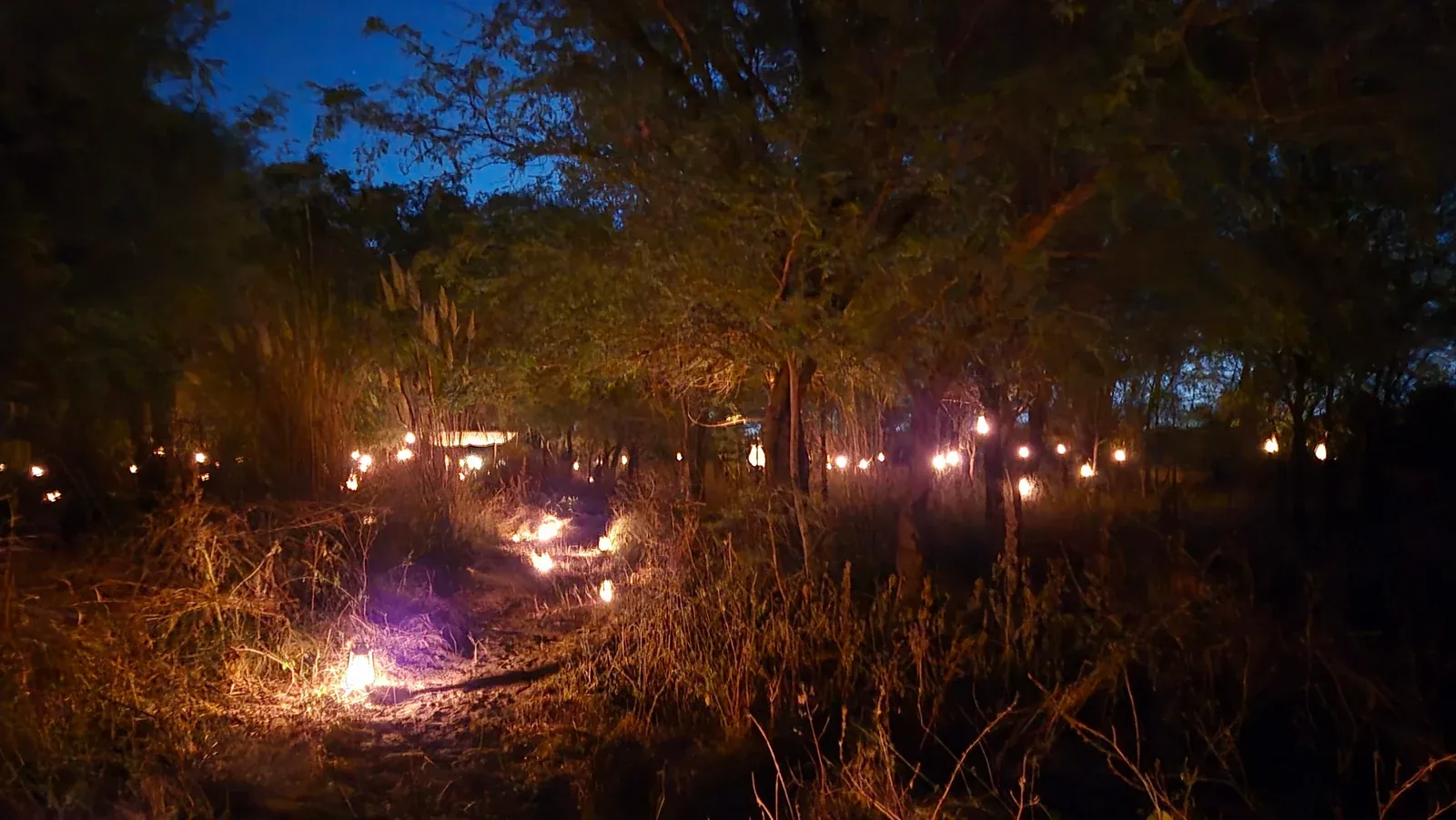
In October, at the Logos × Zugrama Field Station at Dhun, I invited a group of people to try the tool I had been using to keep these records. People made the attempt. There were sign-in and access problems. The recording path could also produce a table that left part of the account out. I had reached a room with people in it, and could see obstacles I had been unable to see in August. A person agreeing to try something and that person being able to use it were two different things.
The Dhun account · Value Log product history
Between those rooms I can follow two things. One is the development of a product. The other is a record of what occupied me while I was developing it. The records do not give me an answer to whether building Value Log changed me. They give me something to examine. In July I wanted a day I could come back to and recognise. By November I also wanted to know whether I could look at what I had recorded and change what I did next.
How July became August

The first entry is at 7:30 am on 3 July. I walked around the neighbourhood. Four days later I started imagining what we might do on Independence Day. I took the idea for a walk and turned it into a plan for Bengaluru. Later entries cover posters, a landing page and more work on the plan. There is yoga in the middle of it. It took one day to go from picturing an event to making things that gave it a date and a shape. As an activity record, the day contains all of that. As a campaign story, most of it would be reduced to a start date.
3 July record · sign-in required · 7 July record · sign-in required
Three days later my family gathered for my parents’ forty-eighth wedding anniversary. The log moves through breakfast, relatives arriving, lunch and cake. In the evening we took a long walk near the farmhouse. We talked, listened, sang and joked. I had classified the walk as ~~Feeling. The category is useful for finding it again. When I read the entry, the return comes from the verbs. The point of keeping the day was that there should still be enough there to remember what we did together.
10 July record · sign-in required
At the same time I was trying to explain The Internet of Value. I shared books and a white paper with trusted friends and worked on invitations with the PSG alumni network. On 18 July I showed people how the idea had evolved and demonstrated the ~WellbeingIdentity Explorer. Later that day a walk paused for tea in the rain and a conversation about ideas. Some of that contact was clearly relevant to the launch. The surviving material cannot tell me which recipients received the final event invitation or what they made of it. The distinction matters because an earlier extraction started on 20 July and missed 225 records from the first seventeen days. Leaving them out made the early months look less social and the campaign look as though it had begun later than it did.
The first logging period
First recorded day. A walk becomes a launch plan. Books and material go to trusted friends.
Alumni invitations and Custom GPT fixes. A two-hour walk with family and friends includes singing and joking.
Living Day, Becoming Weave and plans make the record easier to enter and inspect.
A friend sees a live demo. Weekly review work begins. Founder Genesis starts a new score series.
RSVP page, reels and late paid promotion. On the scheduled day the dialogue is cancelled. The log also records a positive walk and tea with a friend.
Demonstrations continue. A 25 August entry records a demo for a former colleague and subsequent GFE work-log ideas.
What reached the event
The day went on
- 9–11 am
- Breakfast, a walk and conversation in the scheduled event window.
- 1:30–3 pm
- Prepared the dialogue deck.
- 5–6:15 pm
- Walk and tea with a friend. The log describes a positive experience.
- 7–10:30 pm
- Repeated recording attempts, with no satisfactory final version.
In late July I was building ways to see the record again. The day became a clock face. Plans and completed time could sit on the same surface. Becoming Weave gave activities another arrangement across days. On 26 July I showed a friend the route from a conversation with a custom GPT, through a structured table, to Value Log and its trends. That evening I worked on weekly review because the existing view could not answer some questions I wanted to ask. The two entries sit hours apart. I can see the founder showing a product and the same person, later, asking that product for something more.
26 July record · sign-in required · The Living Day visual history
The latter part of July also forced a more basic decision. I needed to distinguish the state I was starting from from the movement attributed to subsequent records. Founder Genesis on 28 July established 771 as a baseline for this pilot series. Earlier July activities remain useful as a record of life and work, with their historical calculation method. The baseline let me trace changes under a declared rule. What I was choosing to count, whose assessment I was relying on and what I shared publicly were now decisions that had to be visible in the product.
A Daily Score Is Calculated. A Baseline Is Constituted. · Sign in with Wellbeing Identity
By 5 August the final RSVP path was ready in the repository. There had been calls, discussions about the venue and the offer, and work on pages and posters. On 12 August I reported publishing five reels. Paid promotion came very late. On the 14th I was rebuilding rejected ads and working on tracking. The ad report shows that some people reached a page and some started a messaging conversation. I could count those things. I could follow far fewer people from a specific invitation through a response to a decision about coming. That part of the work had a much thinner record than the software and creative output. There is enough evidence to say the event did not convert under the conditions we created. Demand under other conditions remains an open question.
August reconstruction and ad evidence
On the 17th there was another park walk. A draft about the experience of an automated journey came together. Ten days later there would be a gap in the daily archive, but before that, on 25 August, I demonstrated the GPT and structured-table workflow again to a former colleague. Later I worked on the idea of a separate work log for Growth Flow Engineering. The useful thing that survived August was a way to put something in front of another person and watch what happened next. In this case the log preserves the demonstration and my subsequent ideas. I do not have a record of the person coming back to use it.
17 August record · sign-in required · 25 August record · sign-in required
Which days can I compare?
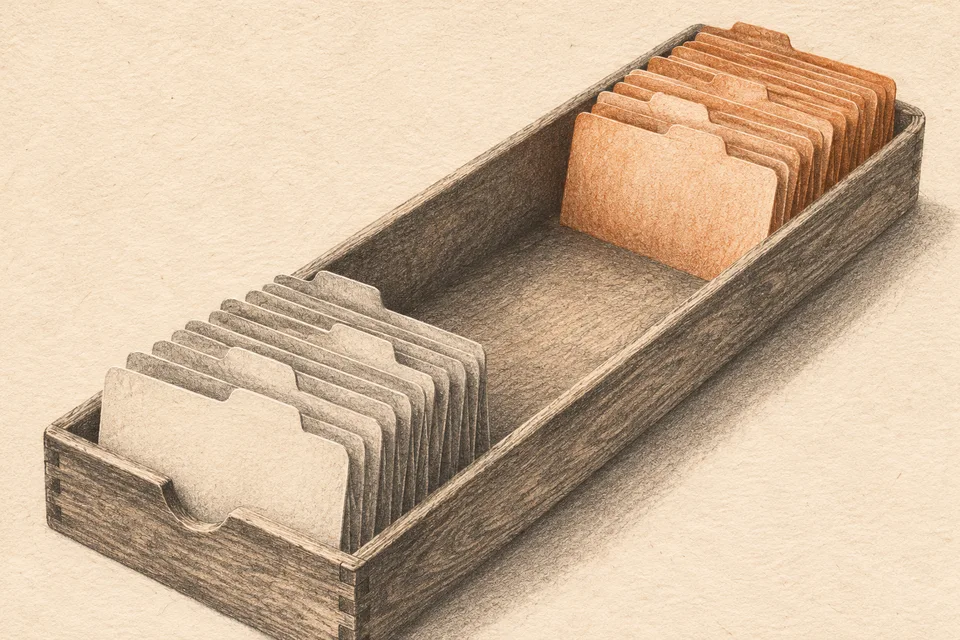
The early archive is longer than a month. It runs from 3 July to 28 August, with activity starting on 56 dates. For the side-by-side charts, I use the thirty consecutive dates from 28 July through 26 August and the full thirty-two-date window from 22 October through 22 November. The first window starts on the date of Founder Genesis. The second keeps the fieldwork, the return to Goa and the later product experiments together. The earlier July scenes are part of the story because that is where the logging practice and the launch took shape.
Detailed scopes and method How the July baseline was established
The later chart contains more recorded time and a larger share labelled ~~Performance. Some of the difference is easy to locate. The nine dates at Dhun average 9 hours 42 minutes a day under that label. When I take Dhun out and look at the November dates, the average drops to 6 hours 43 minutes, still above the 4 hours 33 minutes in the earlier comparison. Giving the windows the same number of dates still leaves a difference. Those checks make it harder to explain the whole change by saying the later sample was two days longer or that I had gone to a residency.
They also make me want to read the labels with more care. A talk, a guided session, a technical repair and a conversation over dinner can all appear under ~~Performance. Even early on, the 7 July walk where I planned the launch was labelled ~~Performance. A walk can also appear as the first ~~Physiology entry or as an evening spent with friends. Before I treat the bars as an account of a life getting busier, I want to be able to open the records and see what filled the time.
7 July record · sign-in required · Dhun records and context
The chart has a gap between the logging periods. A late-September VIT programme record and an early-October research page show some of what was being prepared in the intervening weeks. That evidence has dates of its own. I cannot put it on a daily timeline of what I felt or where my attention was. In the article I have kept that part of the calendar open. It is possible to hold an incomplete record and still ask precise questions of the parts one can see.
When the idea met the room

I arrived at Dhun on 23 October. Introductions gave way to conversations that left me curious and energised. That evening’s entry holds the people, the intellectual excitement and ideas I wanted to write about. The day after, I spoke with Dhun’s founder about identity, community and what makes a place livable. I came away with a less flattering description of my own presentation. It felt rushed, and I wondered whether I had asked for help clearly. The two entries sit next to one another. One gives me a reason I wanted to share the ideas. The other gives me a reason to change how I shared them.
Can Conversations Get You High? · Dhun episode study
On 25 October I tried a simpler invitation. Go back through the last twenty-four hours in your head. Notice what happened and see what kinds of experience you can name. A person could do that without a phone. The following day the invitation reached the software. Residents faced actual access and sign-in problems. Some of what users spoke could be missing from the prepared table. The group had reached the kind of first use that I could only speculate about from the August campaign. I had people offering to help look at the code. I also had a reason to be more careful about what I thought I knew about other people’s willingness to reflect.
Conversation felt energising. The first presentation felt rushed, and the request for help felt unclear.
Participants were invited to mentally replay and classify their day.
Residents tried the tool. Peers offered help, and fixes and further invitations followed.
More deliberate preparation, a positive response in the founder’s log, and uncertainty about what the audience understood.
From a spoken day to a checked record
July’s Custom GPT handoff helped the founder demonstrate a structured log. October brought narration into Value Log. The group attempt made the review step consequential. A person needed to be able to see whether the table had kept what they said.
Recording recovery and later timing repairs shipped. Completion for the affected group remains unresolved in the reviewed evidence.
Can Conversations Get You High? The residency and ceremony Value Log release history
The native recording feature was supposed to reduce the distance between saying something and seeing it in the log. At Dhun the difficult part turned out to be what happened after speaking. A neatly arranged record can give the impression that a system has listened accurately. If a part is missing, a user needs a way to notice it, correct it or decide to stop. Repair work added safeguards around capture, timing and recovery. For the people in the room, the relevant outcome would be a complete first save they recognised as their own. I have evidence of the failure, offers of help, repairs and further invitations. I do not have that outcome for each person.
By 30 October I had prepared a later presentation more deliberately. I felt positive afterwards and relaxed during the questions. I still wondered how much of what I intended had reached the audience. The surrounding days are full of responses that would have been easy to flatten. I recorded feeling down after critical comments on the 29th. I enjoyed comedy about me the following day after giving permission. I can read several plausible differences in those situations, including how I was approached and what I understood I could agree to. I have my account of them. That is enough to revisit a moment, and leaves room for another person to have a different account.
Coming home with a question
On 1 November I was back in Goa and spent part of the evening at a screen-free cacao ceremony. The description turns on things a product diagram would not have led with. There were elements and an intention. There was dancing and attention to what was happening as it unfolded. The record explicitly compares it with the conversations about AI and consciousness I had just come from. I can see the comparison being made in the account. That gives me a starting point for a question about setting and attention, even as the places, people and activities around me were changing too.
The Dhun residency and the ceremony
Goa also gave me material that stays close to the beginning of the story. On 4 November I described a sense of belonging in family prayer. There was bonding in a conversation with my sister the following day. On the 14th I recorded a strong positive experience during a walk at sunset. The July farmhouse walk gives me another way to read that material. I had been describing the value of company and unhurried time long before I tried to make observation into a ritual or design an interface around it. An article about the product should be capable of lingering on those moments for a paragraph. They were already part of the life the product was meant to help me see.
4 November record · sign-in required · 5 November record · sign-in required · 14 November record · sign-in required
The second logging period
Dhun arrival, first-use failure and repair work. The Passport comes up in a dinner conversation.
Back in Goa. A ceremony, family connection and bodily practices sit alongside the first Passport designs.
Proposal editions and calculation recovery. A sunset walk has an explicitly positive observation.
Research invitation, experiments with observation, and Mandrem and ThreeDosha proposal work.
Researcher invitations, a recovery plan, People and Mandrem development, and the Observe and Rings prototypes.
What became of the rest window?
Living an Aware Life The ceremony and the residency
On 21 November I made a plan that gave work ninety minutes. I left two hours in the afternoon open for rest. The log shows eight hours and fifty minutes of ~~Performance activity over the day. I did get to the garden and tried reading from 2:15 to 3. The 3 pm hour went to research, which carried on until 5. A long evening conversation also mattered. The following morning I worked on ideas and a People workspace connected with that conversation. There is value in being able to follow a conversation into something I made with it. There is also the question of when I want to let an experience end without giving it another job.
21 November record · sign-in required · 22 November record · sign-in required
The chart makes a small part of this plain. I could see planned rest and still choose to spend some of it working. The rest did not become better protected just because I had put it on the clock. The gap between those records is more informative to me than the neatness of either one. I can ask whether the work mattered enough to change the plan, and whether I would want to make that choice again.
What I was asking of other people
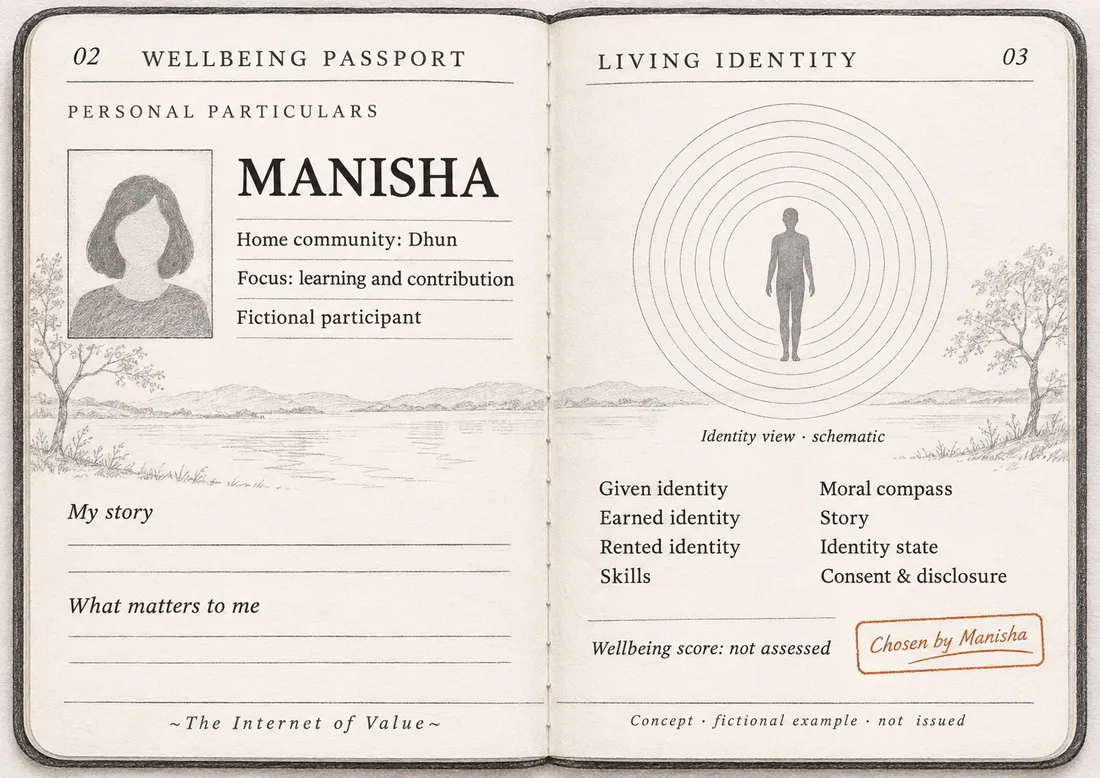
In July, the Identity made sense as something I could show through my own records. It let me ask questions about dates, the starting point for a score and what I might choose to share. The Passport took that thought into a different set of circumstances. A person visiting a place, reflecting on a morning, or bringing evidence to a teacher might want to keep parts of that experience close. They might want another part recognised. The useful design work began when I had to account for different choices by different people instead of presenting my own reading as a universal example.
Sign in with Wellbeing Identity
At Dhun, the Passport came up again at dinner on 30 October. I recorded interest from Dhun’s founder and a follow-up message. In November, the design moved through a page-turning prototype, comparison research and a proposal that could be walked through using a fictional person, Manisha. Her visits, records and choices let someone examine a proposal with a concrete example. The example also makes the unresolved parts easier to name. Who may see a record? Who can attest to it? What should remain private after that moment? An interested conversation, a walkthrough and a commissioned pilot are three distinguishable stages in that history.
How far did each track get?
Sign in with Wellbeing Identity Dhun proposal Why Communities Should Own Data Centres ThreeDosha Research invitation
Mandrem widened the question to local infrastructure, ownership and services. ThreeDosha asked for a different kind of conversation about research. Each proposal could be opened and evaluated on what it actually offered. At the cutoff, a published proposal or available workspace is something I can substantiate. An operating service, agreed commission and sustained participant use require evidence from the people or institutions involved. I want readers to be able to see the stage each project reached.
Why Communities Should Own Data Centres · ThreeDosha
On 15 November I had logged work on requests for collaboration, and a discussion in Goa led me to think about what a deliberate start to observation might look like. The research invitation asked where a person’s description of what they noticed ought to sit in ~ValueCaptureProtocol. I wanted to hear from people who could examine the method. The outreach that followed had a specific request for a twenty-five-minute conversation and a prepared example we could discuss. My records show twenty reported sends and one documented failure to deliver. They do not yet establish which invitations led to replies or a collaboration. That is farther along in the record of an invitation than I got with many of the July contacts. I can point to where evidence ends and know what I would need to look for next.
Entering a day again
The circular view I built in July began with a straightforward wish. I wanted a day to retain its shape when I returned to it. It helped to see a plan beside the time actually recorded, to follow an arc back to an activity and to look across days. In August another question surfaced in the display. A day with precisely zero movement needed to look different from one with a very small movement or one still waiting to be resolved. The interface was already asking me to explain what a mark meant. Late that month I discussed a clock idea in person again. The day as a thing that could be explored predates the gesture work by months.
His mum put a year in a circle. We put a day in one. · Value Log product history
In November I explored two directions. In the fire-led Observe prototype, I wondered whether there could be a moment of intention before speaking. In Time Travel, the question was what it would feel like to move from a month into a week and a day, and then reach for a single entry. Both experiments appear on 22 November. One concerns how I begin paying attention and the other how I return to something I have already recorded. The gesture prototype uses a camera, while the activity-pull clip in this draft shows the interaction with scripted pointer input on fictional practice data. The clips let me show how the design developed without asking anyone to take the usefulness of that design on trust.
22 November record · sign-in required · The Mother of All Demos
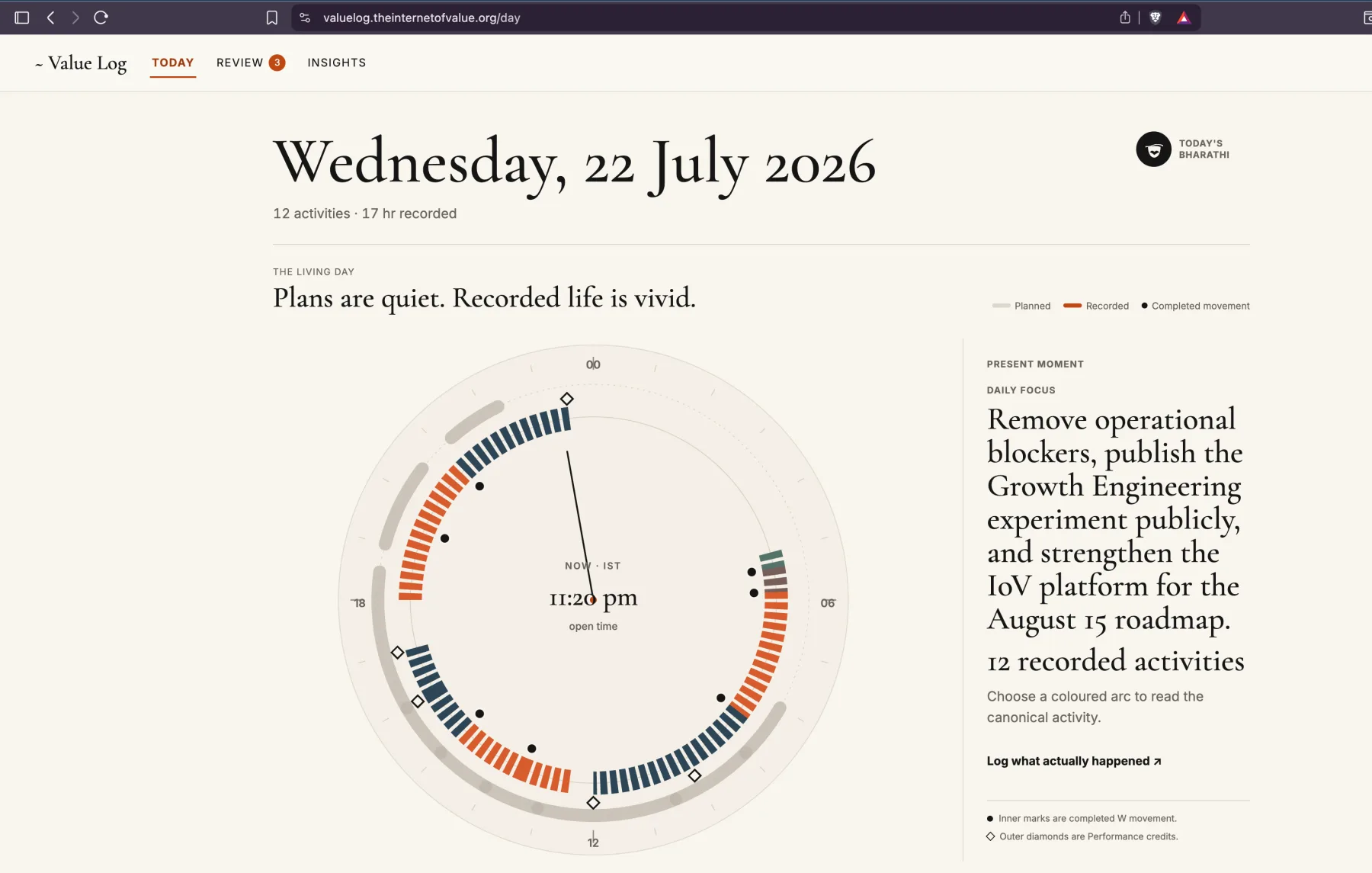
Read one day. Inspect a node across days.
Speak, inspect the table, then submit.
Browse day pages. Explore a deliberate start to logging.
Move through a month, week and day. Open a single record.
His mum put a year in a circle. We put a day in one. Value Log visual changelog 23 November release provenance
There is a test I can imagine giving both views. Find 21 November. See what I had meant to do between two and four, then find the work that happened in that window. Another is to ask someone to locate the week of 9–14 November and say whether it contains any records. A saved weekly report said zero. The current history has 109 across those dates. An old reader that fetched only its first 1,000 history rows could miss the relevant week. A more immersive route to an incomplete report would still lead someone to the wrong answer. The experience I want is being able to find and inspect the source, including where it is incomplete. The gesture is one way in.
23–24 November · Trying “Iron Man mode”
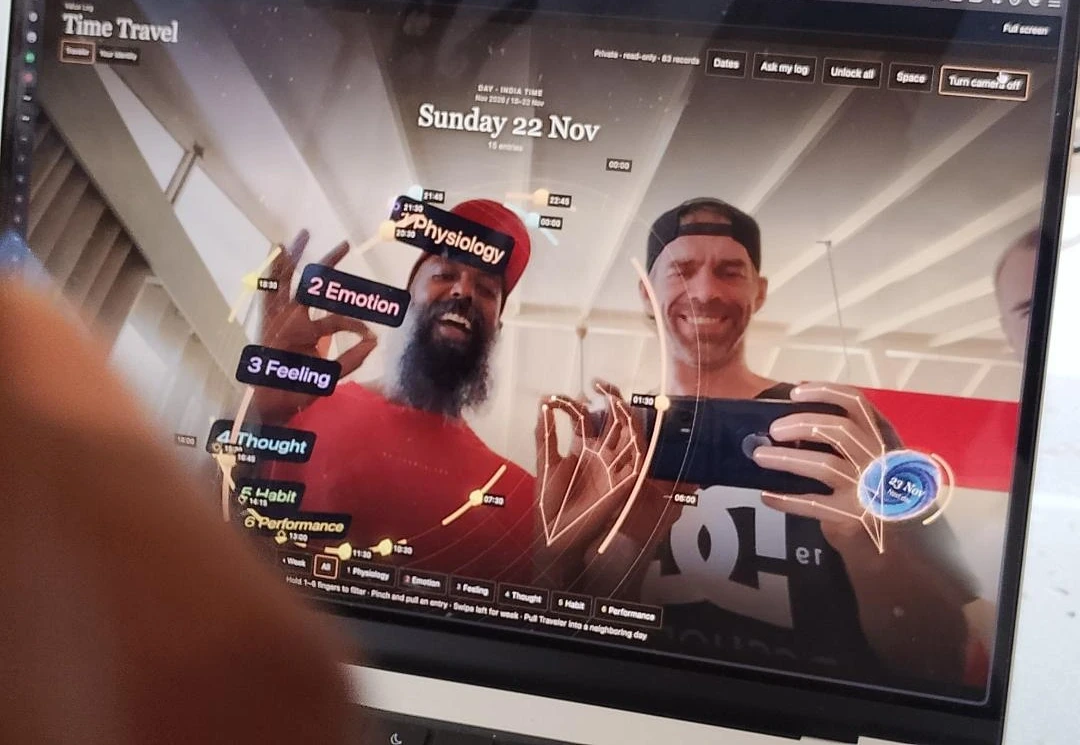
After the comparison window closed, the idea I called “Iron Man mode” became a way to explore actual entries. I had wanted a calendar I could move through. We had to learn what made that movement intelligible. One preview showed a single week under the name of the whole month. Showing the dates actually covered fixed a basic problem. Then the Traveler could be picked up at the month level, carried into a week and pulled directly from one day into the next. The portal showed a preview of the destination and its rim brightened when I could let go.
Showing someone the interface exposed a different problem. I had trouble applying a filter, and beads close together could be hard to pick. The later version shows the track it thinks I’m holding up my fingers for, keeps the chosen bead steady as I pull and tells me when to release. An entry can also be found by name and time in a list. The scene can be as elaborate as we like, but while I’m holding up a hand I need one basic answer. What is this thing about to do?
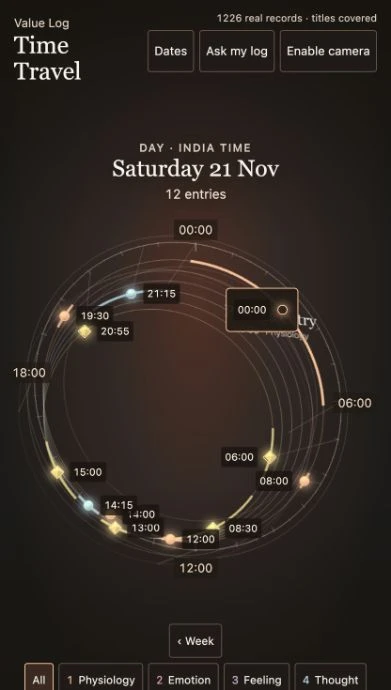
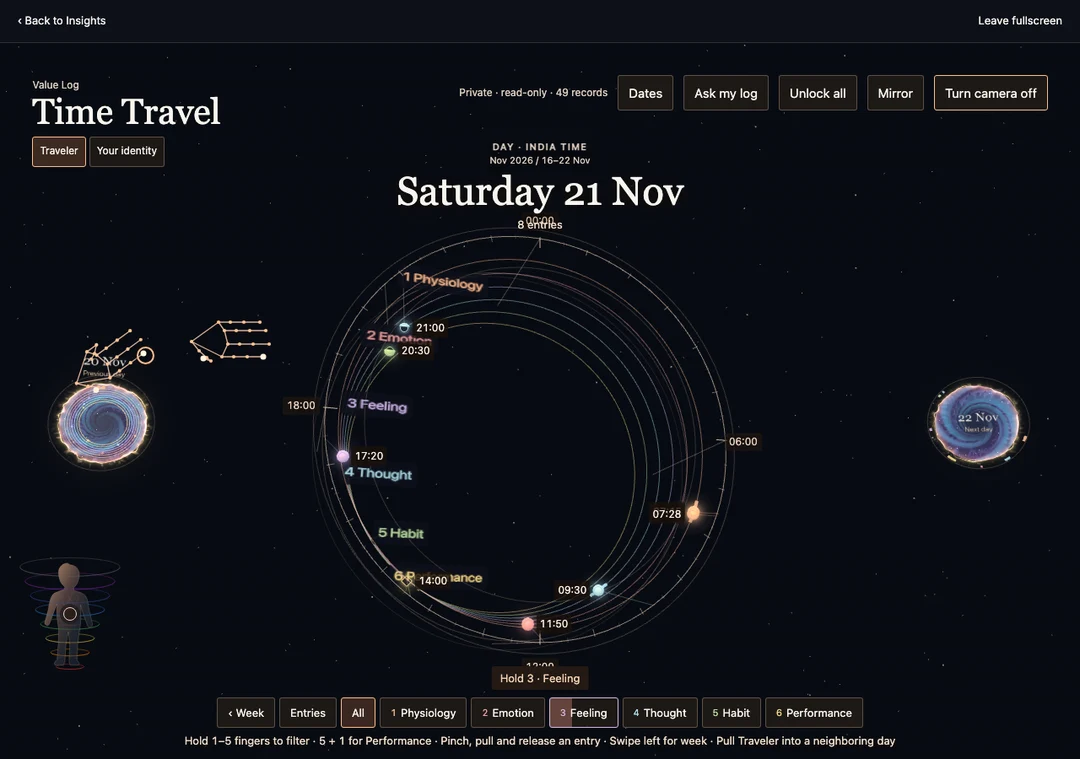
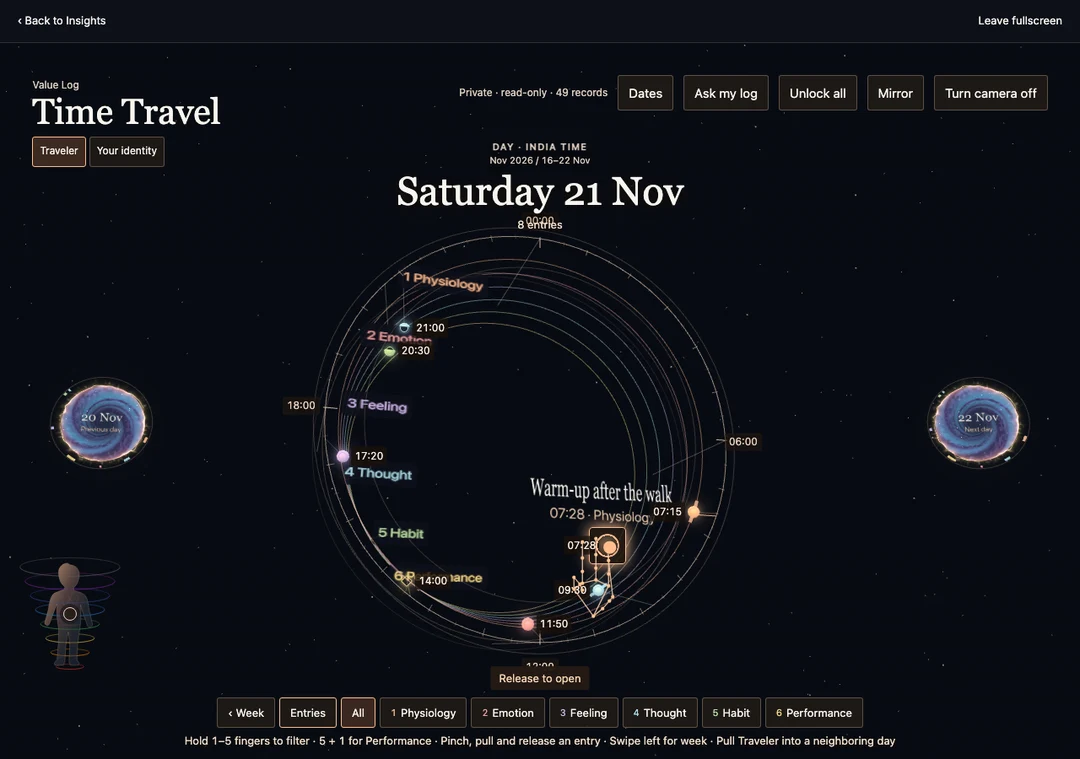
By 24 November the Traveler and those interaction changes had shipped, including eight named public Identity rings and the option to use a portrait for the session. The earlier still shows my entries with the camera off. The gesture stills and the released Traveler crossing clip show how the controls behave in a practice scene. The release checks used simulated hands. The photo above shows me trying the camera with my own records. What I want to learn from those sessions is whether I can reliably get back to the entry I had in mind.
What the work asked of me
I can bring the two months together in a number. In the current Founder series, the early comparison closes about 0.548 points above its Genesis reading and the later one gains about 0.243 within its own boundaries. I then have to look at what went into those values. Around ten percent of the earlier records outside ~~Performance were marked neutral. In the later period it was about sixty percent. All 169 later ~~Performance records have no declared wellbeing transition. That includes some descriptions where I sounded energised or pleased. A score gives a reader a way to ask which rules were applied and which experiences were rated. It cannot answer the question of how much the residency meant to me.
The rating mix changed
Movement in the model
Exact score boundaries
Earlier, 771.000000000000 → 771.547933926622. Later, 771.570157067230 → 771.813607204404. The pre-Genesis legacy score uses a separate method. Display values above are rounded from the stored promoted history.
Observer Attention Is All You Need Source notes and episode studies Insights catalogue
There are changes I can see without the score. In July I demonstrated a path I could work with myself. In October residents encountered that path under different conditions, and I had to take their difficulty seriously enough to repair it. In August I had a date, an offer and evidence of attention, with thin evidence about how specific invitations reached a decision. In November a smaller methods request left a better trail, even where delivery failed. Across both periods, I could usually find abundant evidence that I had made something. The question of what it did for someone else kept requiring a different kind of encounter.
There are repetitions I recognise too. On 15 August I spent the afternoon preparing a version of a dialogue that could no longer happen that morning. On 21 November I gave time reserved for recovering to another piece of research. Both days also hold company, a walk or a conversation, and things I would want to remember even if I made nothing out of them. I can find the empty room, the people who tried the tool, and the time I set aside and then changed. For now, that is what the record gives me. It lets me go back to a choice and ask whether I would make it again.
Sources and method
What the charts count
The comparison covers 28 July–26 August (30 dates, 373 records, 594 h 27 min) and 22 October–22 November (32 dates, 503 records, 697 h 56 min), India Standard Time, in 2026. Counts use the start date of each current record. Durations crossing midnight are allocated to each day. Superseded and reversed records are excluded. The wider July–August chronology includes the early July records outside the comparison chart. This is an account of one person’s logs. Unrecorded time and the interval between the windows remain unknown.
~~Performance includes mixed activities such as learning, presenting, discussion and product work. The earlier and later windows averaged 4 h 33 min and 7 h 40 min per date under this label. The first 30 dates of the later window averaged 7 h 35 min. These figures describe recorded and labelled activity. They cannot isolate changes in work, reporting or wellbeing. Value Log method
August dialogue reconstruction
The author’s time records, project history and the saved Meta report were read together. The 9–11 am event slot on 15 August contains a breakfast, walk and conversation. Cancellation and zero confirmed registrations come from the author’s account. The ad report shows 148 landing-page views and 22 messaging conversations without linking those measures to individual registrations. The full review begins on 3 July. A narrower early extract missed the first 17 dates.
Independence Dialogues in The Mother of All Demos
Dhun and the return to Goa
The Dhun case uses first-person records and the earlier residency inquiry. The 30 October setting photograph is credited to Aditya Singh. The description of an access or capture failure does not establish how every resident used the tool.
Dhun sources and methods · Research invitation and observation methods
The missing week and the score boundaries
A saved report for 9–14 November displayed zero activities. The current records have 109 activities over those dates. The report read from a limited historical query. The charts here use the current records. The early Founder ~~~WellbeingScore window starts at Genesis on 28 July. The later opening score comes from the last stored state before 22 October. Earlier July calculations remain in a separate historical series.
How the July baseline was established
Time Travel and image sources
Prototype work appears on 22 November. The release history on 23–24 November is a postscript outside the comparison. The author’s camera-on photograph is from 24 November and shows the 22 November day view. The practice stills and clips use fictional data, simulated hands or scripted pointers as captioned. The cover and chapter drawings are editorial illustrations.