The Internet of Value
His mum put a year in a circle. We put a day in one.
By Moses Sam Paul 2026-11-12T13:30:59+05:30
A circular family calendar meets Value Log’s Living Day: grey plans, coloured time slices, wellbeing dots and contribution diamonds, with the product’s evolution in screenshots.
Reading day: Tuesday, 10 November 2026. From This Is for Everyone: The Unfinished Story of the World Wide Web by Tim Berners-Lee.
The passage
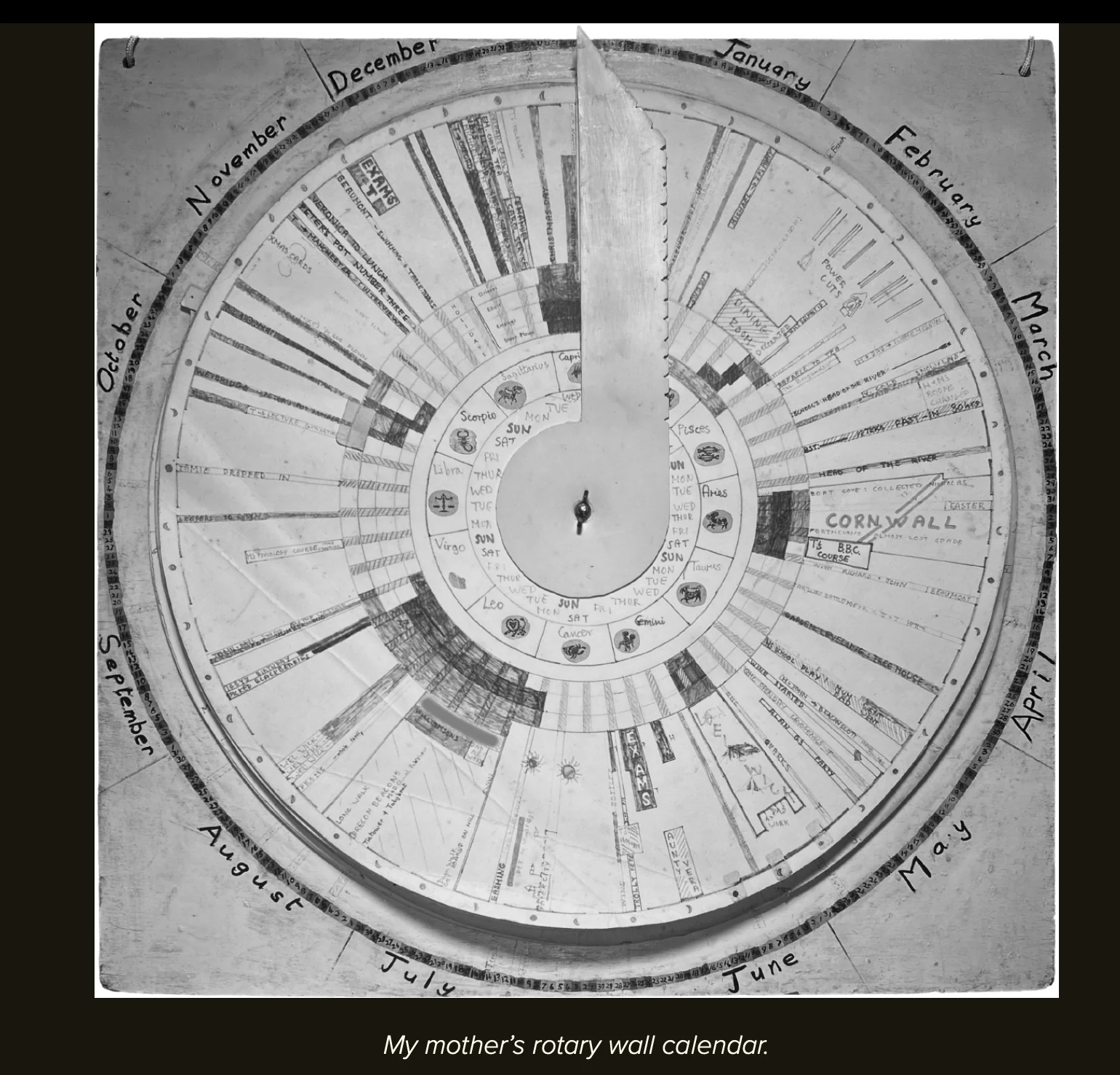
“Our household was a tremendous amount of fun. We were lightly supervised, following a parenting philosophy Mum termed ‘watchful negligence’. Mum would organize treasure hunts for special occasions, such as when we went camping. She hosted the best children’s parties, with fantastic themes – I remember one year, she attached astronaut footprints to the ceiling for a birthday party in space. She created her own calendar, a large circular dial with 365 days arranged along the perimeter, and each year made a new face of card on which to record the year. She would add the things coming up in the year – especially school holidays – so we could see how far away they were. As the dial moved, she’d record notable events on the days, and when the dial had completed its rotation, you could see your whole year at a glance. It was a brilliant invention, superior to the typical wall calendar in every way. To this day, I keep a copy of Mum’s circular calendar on the wall in my office, to remind myself of her, and to remember always to look for a different way of doing things. ”
Excerpt From
This Is for Everyone: The Unfinished Story of the World Wide Web
Tim Berners-Lee
This material may be protected by copyright.
Try a different way of seeing time
A year, written by hand.
A working interpretation of his mother’s rotary calendar. Move the pointer to a month and leave your own mark on the year.
Drag the red handle or tap a month. Arrow keys change months.
Under the pointer
November 2026
Example marks in November
Example labels are inspired by the supplied photograph; their dates and durations are illustrative, not a transcription of the family’s records. Your own notes stay separate. This is a contemporary interpretation, not an exact reconstruction or a validated Value Log record.
See his mother’s original rotary wall calendar
Quick Answer
Reading about Tim Berners-Lee’s mother’s circular calendar brought me back to our own Value Log product. Her calendar held a year; our Living Day represents 24 hours while keeping plans, observed activities and completed results distinct. The connection is visible in the product’s July design history.
I recognised our product
The connection I made was very specific: this looks like something we have been building in Value Log.
His mother put the year into a circle. We put the day into one. She could add what was coming up and record what had happened, then look at the whole year together. In Value Log, our Living Day brings planned time, logged activity and the results of reviewed activity into one circular view.
There are wider connections to memory, identity and seeing a life over time. But the starting point for me is the product itself: the grey arcs, the coloured slices, the dots and the diamonds. Those are decisions we have already worked through. Reading this passage brought that visual connection into focus.
This was recognition, not the origin of the design. Our product changelog records the Living Day clock on 22 July 2026, before this November reading.
His mother’s calendar
A year, held together.
365 days. Things to look forward to. Events added as life unfolds.
Our Value Log
A day, made readable.
24 hours. Intentions outside. Observed life inside. Distinct marks for completed results.
Before the circle, there was a list
Our changelog shows how we arrived at this. The planned day was once a row-based schedule: a sequence of blocks to read down the page. The move to the Living Day brought those blocks around one 24-hour instrument, with midnight at the top and time moving clockwise.
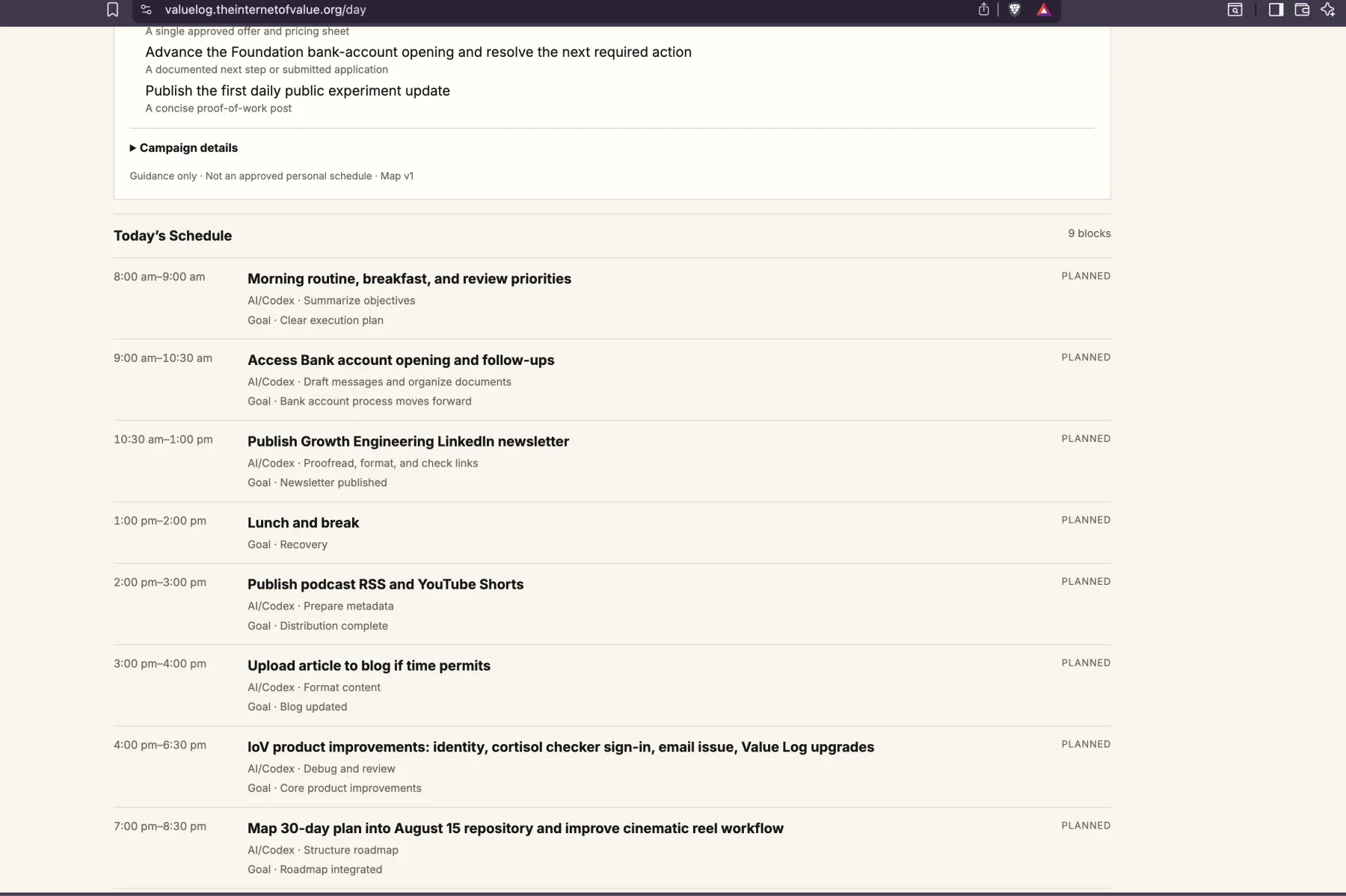
The change let the day become a composition you could see together. But putting everything into a circle would be useless if a plan looked the same as something that actually happened. The visual language had to keep those meanings separate.
Grey is what I intended
The quiet outer arcs are planned blocks. They show the shape I intended to give my day. They can exist before I have recorded a single activity.
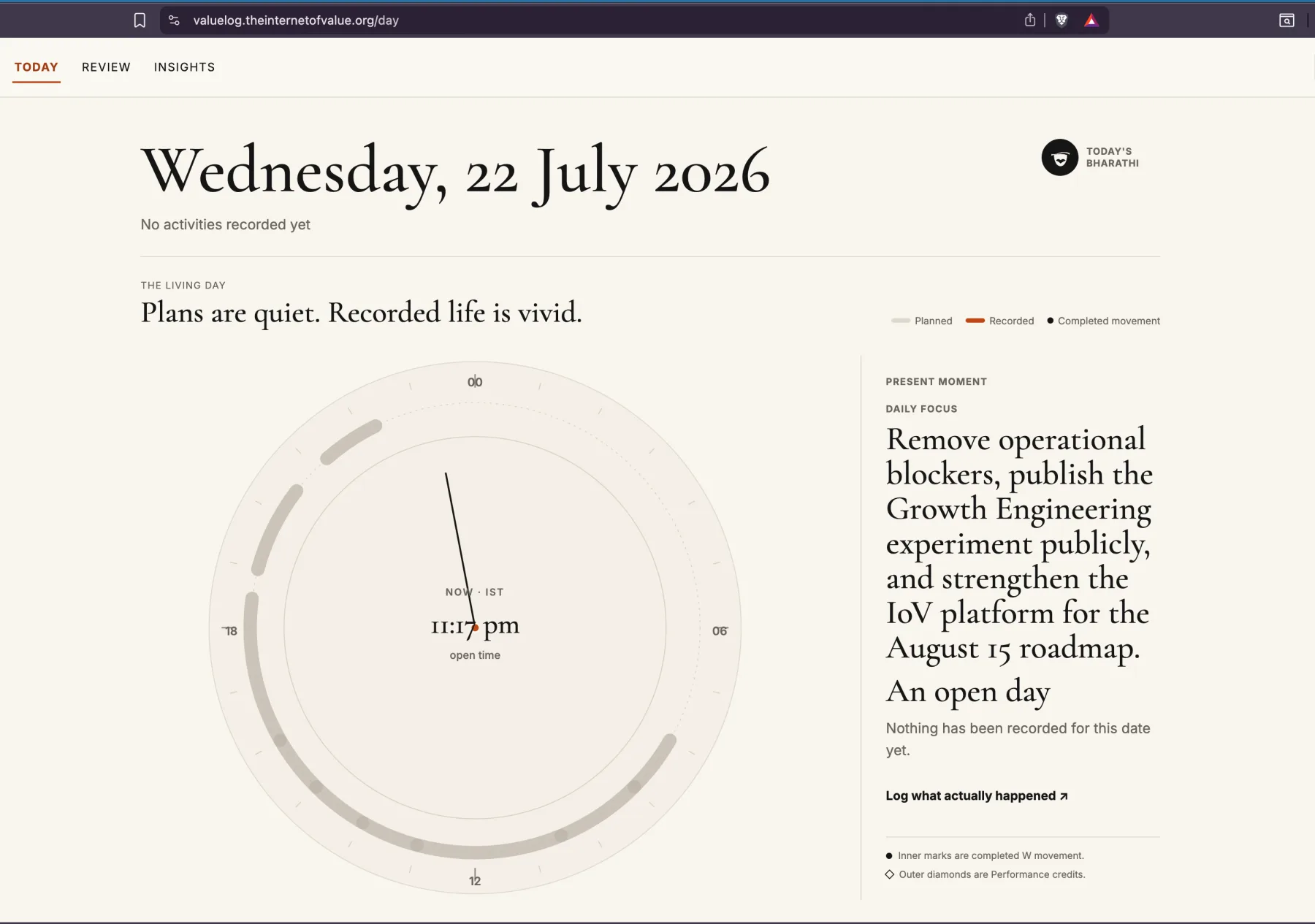
That is one part of the resemblance to his mother’s calendar: the future is visible alongside the space in which life will happen. In our product, the subdued appearance is deliberate. The plan gives orientation without pretending to be the lived day.
Colour is what I recorded
As activities are logged, coloured slices appear on the inner ring. Their positions and lengths represent where the activities sit in the day; their colours distinguish the associated nodes in ~WellbecomingProtocol.
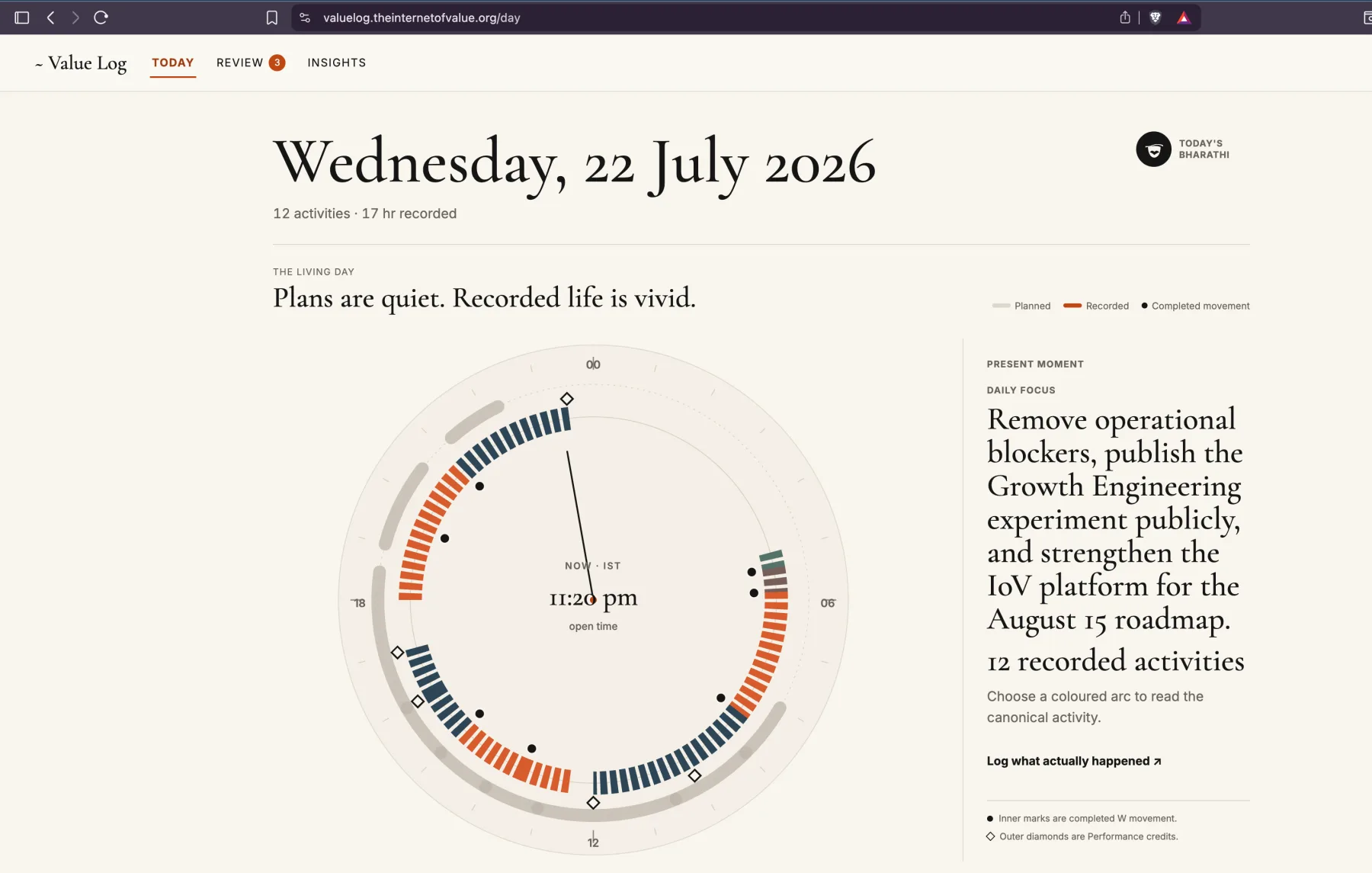
Now I can compare the shape I planned with the shape I recorded. A day is no longer only a set of appointments or a list of activities. Its distribution becomes visible.
There is an important distinction here: colour means recorded activity, not automatic validation or a completed calculation. An activity can already have a place on the circle while its result is still pending.
The dots and diamonds are different kinds of results
These small marks carry a lot of responsibility. In the Living Day view, an inner black dot identifies completed wellbeing movement. An outlined outer diamond identifies a separate ~~Performance credit result. They do not mean the same thing, and neither means that every coloured slice has been independently verified.
| What you see | What the product is saying |
|---|---|
| Grey outer arc | A planned block of time. |
| Coloured inner slice | An observed activity, coloured by its node. |
| Dashed activity slice | An activity that needs review in the current implementation. |
| Black inner dot | A completed wellbeing-movement result. |
| Outlined outer diamond | A separate ~~Performance credit result. |
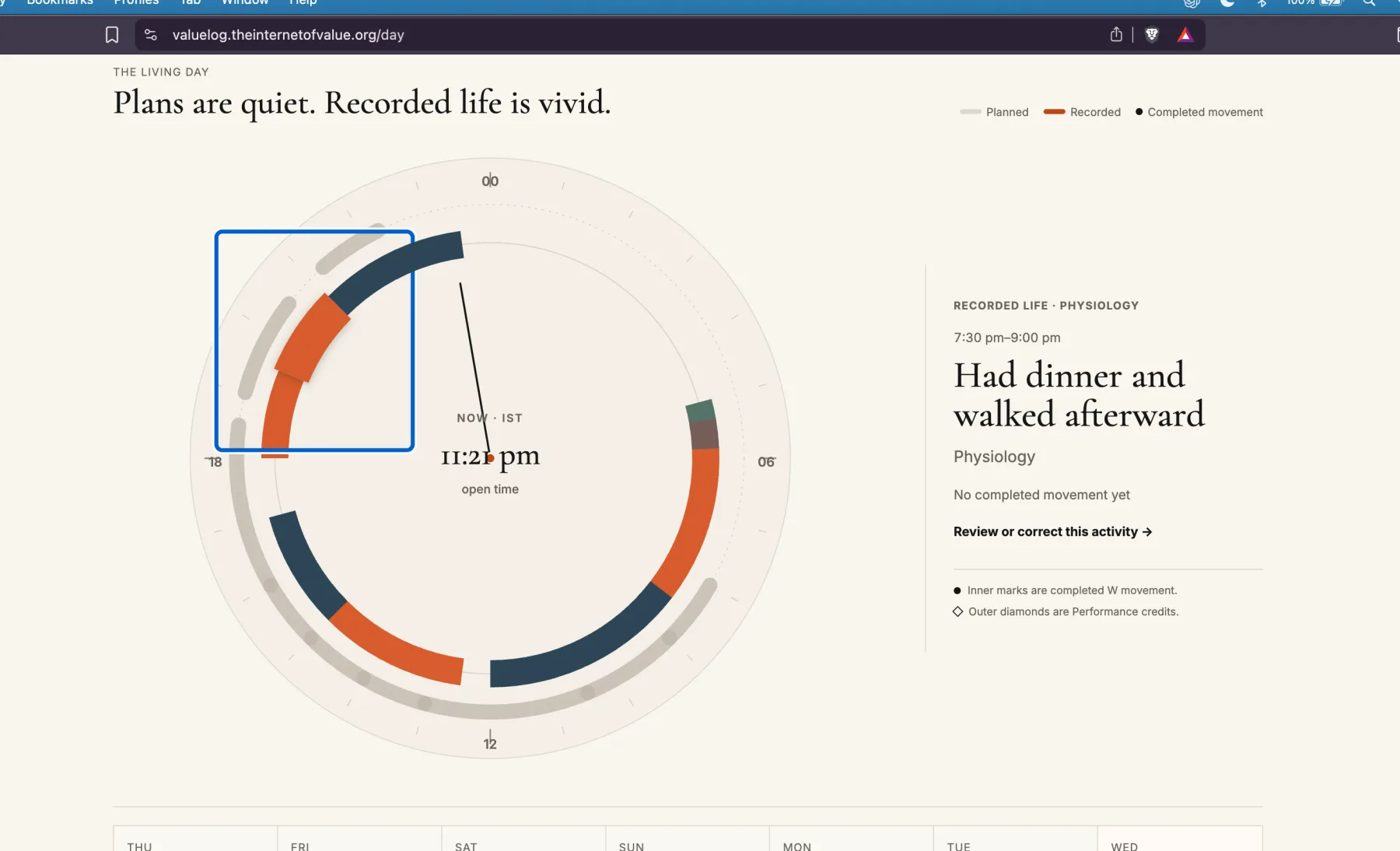
Selecting a slice lets the product explain that particular activity. This screenshot shows a ~~Physiology activity already present in colour while its reading says, “No completed movement yet.” That is a useful part of the design: absence of a result is allowed to remain visible.
The contribution reading has its own result. In this historical example, selecting a ~~Performance slice shows its credit result in the adjacent reading area. It remains separate from the wellbeing dots.
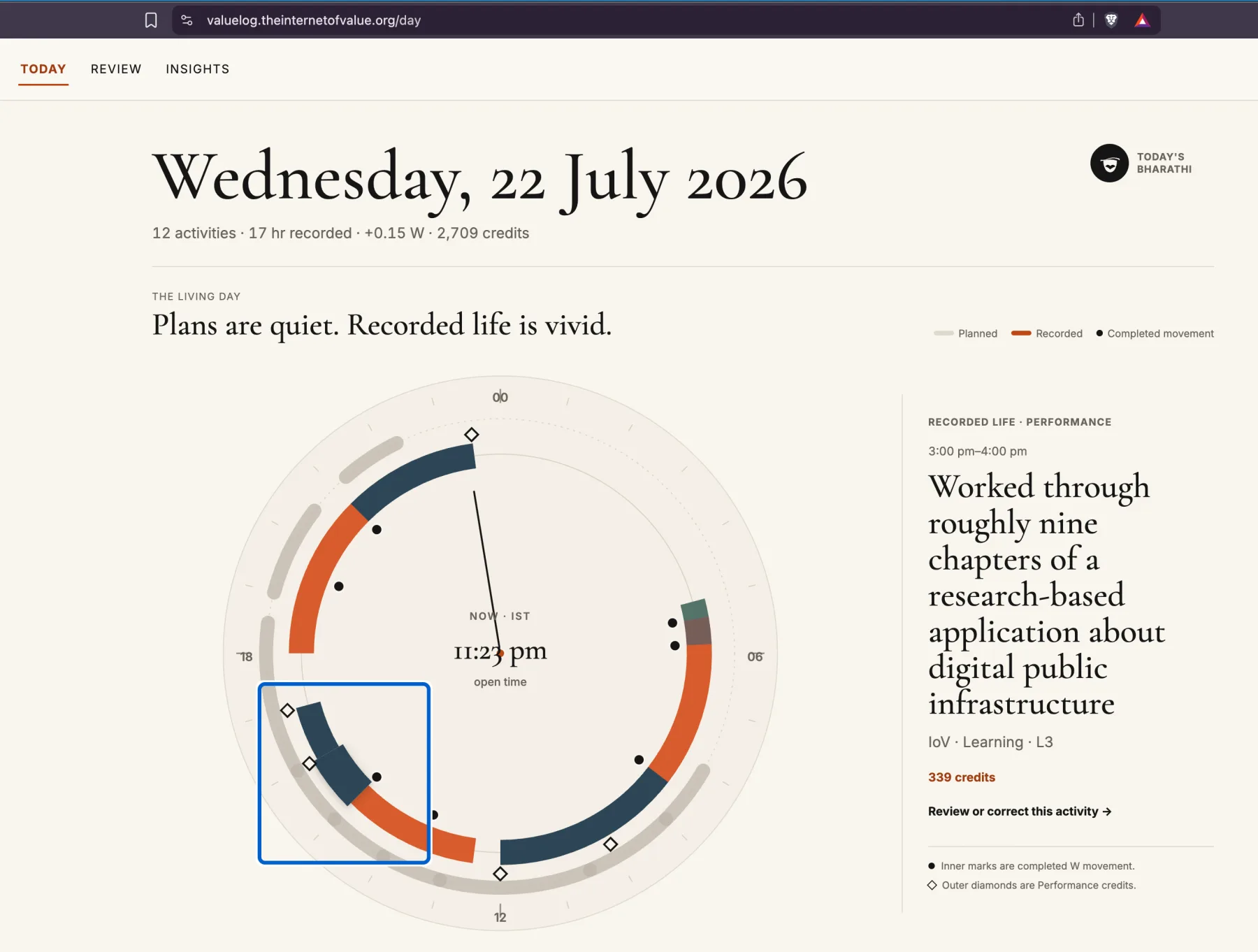
These are historical, owner-authorised product-evolution screenshots from the July pilot. Their W and credit values illustrate those recorded interface states; they are not current scores, representative outcomes or a universal human ranking. The earlier interface’s wording is preserved inside the images.
The connection is in the way we see time
His mother’s calendar made the whole year available to look at. The holidays ahead and the events already lived could share one surface. Value Log is working at the scale of a day, with additional distinctions between what I intended, what I observed and what has acquired a result.
Underneath our day view, ~ValueCaptureProtocol structures activity and time records. ~WellbecomingProtocol provides their wellbeing context. Qualifying ~~Performance can enter ~SAOcommons for institutional review and valuation. ~WellbeingIdentity is the living state shaped through the connected flows. The interface makes parts of that system readable without collapsing them into one mark or one number.
That is the connection I wanted to bring into this reading journal. Not simply that both objects are circular, but that a different representation of time can make its contents easier to understand.
His mother’s calendar was already there, on a wall, doing that for her family. Our own changelog shows us working through how to make a day legible on a screen. Reading the passage lets me put those two objects beside each other.
And then there is his last line: “to remember always to look for a different way of doing things.”
Product history and sources
- Value Log’s public changelog: the 22 July 2026 Living Day milestone.
- Value Log’s visual archive: the sequence from stacked surfaces to one living instrument.
- Open Value Log: the private product; signing in is required to view a personal day.
The screenshots above are preserved copies of the already public July product-evolution assets. Their dates describe the product history; 10 November is the reading date for this journal entry.