The Internet of Value
Living an Aware Life: Value Log Meets Micro-phenomenology
By Moses Sam Paul 2026-11-15
Value Log already records what I noticed. Where should that account belong in ~ValueCaptureProtocol? An open research invitation grounded in daily logging.

LIVE AWARE — Value Log × Micro-phenomenology. Conceptual cover art based on my public portrait; the clock and attention path are illustrative, not measurements. AI-generated for this essay.
My twenty-four-hour logging practice, micro-phenomenology, and an invitation to help shape an AI interviewer.
I have been logging my days in Value Log, trying to account for the full twenty-four hours: sleep, meals, work, conversations, movement, and the intervals I struggle to reconstruct.
The day becomes a circle. A stretch of time becomes an activity I can return to. But naming the activity opens another question.
What did I notice while I was living it?
In one native log, I described a walk at Mandram beach, watching the sunset. In the optional observation field, my words were: “So strong positive uh physiology and feelings I would say.” That is an ordinary, imperfect spoken account. I want it to have a place without needing to become a polished explanation.
It is also a starting point. If I choose to return to that walk, could a careful question help me describe a particular moment more precisely? Could it help me distinguish what I remember from what I am interpreting now?
I am building Value Log through the Internet of Value Research Foundation. This essay introduces the product, the contemplative intention behind my practice, and a research direction I would like to develop with practitioners and researchers in micro-phenomenology, human–computer interaction, attention, and contemplative studies.
I am also thinking aloud about a gap between the working product and our protocol. Value Log already gives me a place for “What I noticed.” Should that experiential account have a dedicated place in ~ValueCaptureProtocol, and if so, what should it preserve? I want to investigate that with collaborators before settling the representation.
Quick Answer
Value Log gives me a time-based account of my day and an optional place for what I noticed. That field exists in the application; it has no dedicated canonical node or facet in ~ValueCaptureProtocol. The central invitation is to investigate whether and how such an account belongs in the protocol, using micro-phenomenology to inform the inquiry. Seraphina, our proposed AI interviewer, is one possible interface to develop and evaluate within that work. No protocol change is being announced here.
Explore the working system
- Value Log — the application for observing and checking a day; its method and changelog explain the current product.
- Observer Attention Is All You Need — the wider research argument, including its methods and falsifiability limits.
- IoV Spec — the canonical definitions; the registry provides machine-readable names and levels.
- The ~WellbeingIdentity application — the connected identity product, with owner-controlled disclosure; its product history explains its evolution.
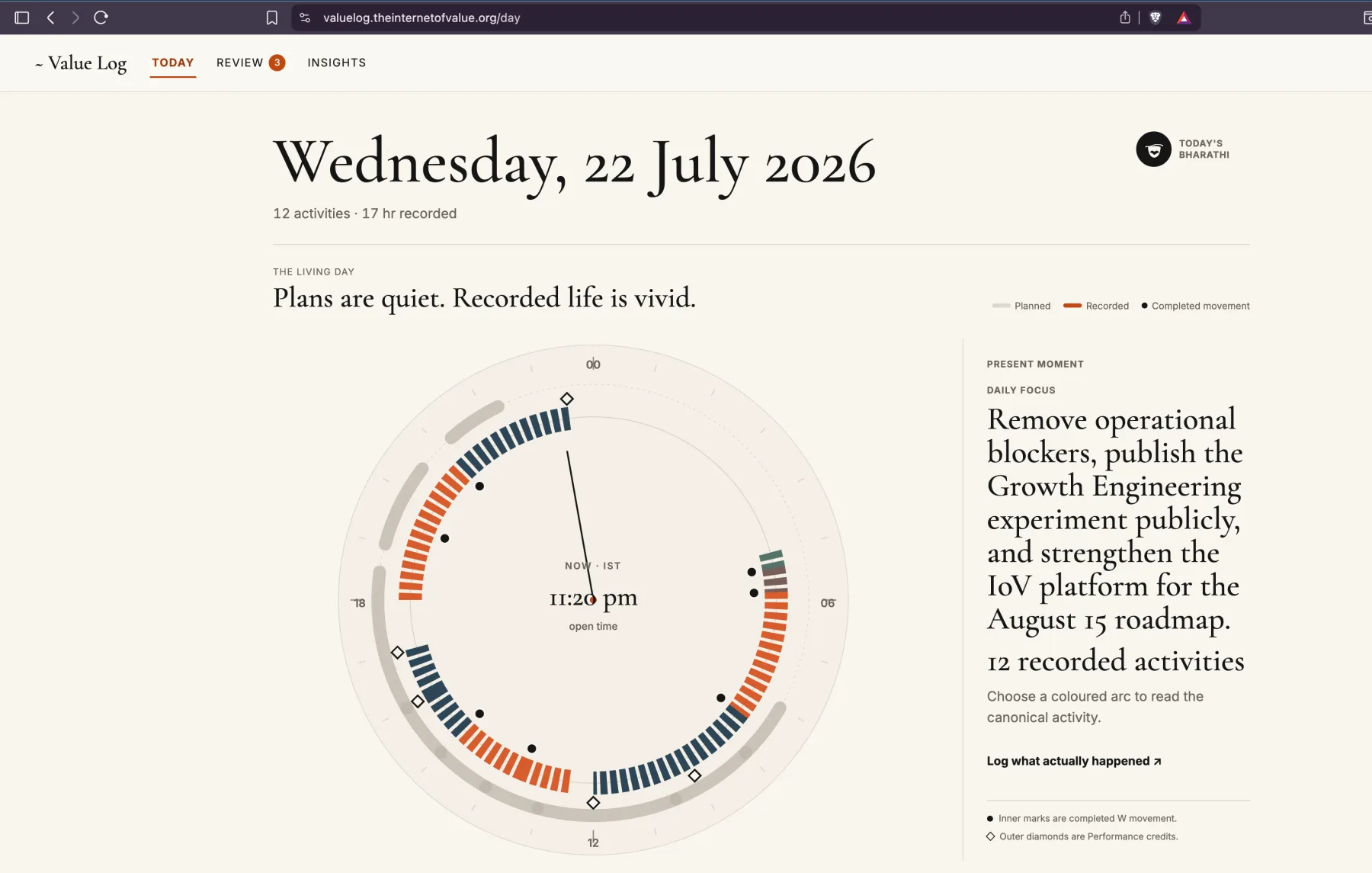
The day as a place to return to. This public product screenshot is dated 22 July 2026 and shows seventeen hours recorded. A twenty-four-hour frame does not establish complete coverage, continuous awareness, or an outcome. Public visual archive.
Start with a day someone has actually lived
Value Log lets a person speak or type an account of their day, check proposed activities, correct the account, and explicitly confirm the version they intend to keep. Its native journey is Observe → Check → Confirm. Current method.
The invitation is simple: what I did, roughly when, and what I noticed.
An activity needs enough temporal context to locate it. An observation can add something the label misses: a sound that caught my attention, a sentence repeating in my head, a change in effort, or the uncertainty of not knowing when something shifted.
This makes logging a possible occasion for returning attention to lived experience. Whether it actually helps people do that is a question we can investigate.
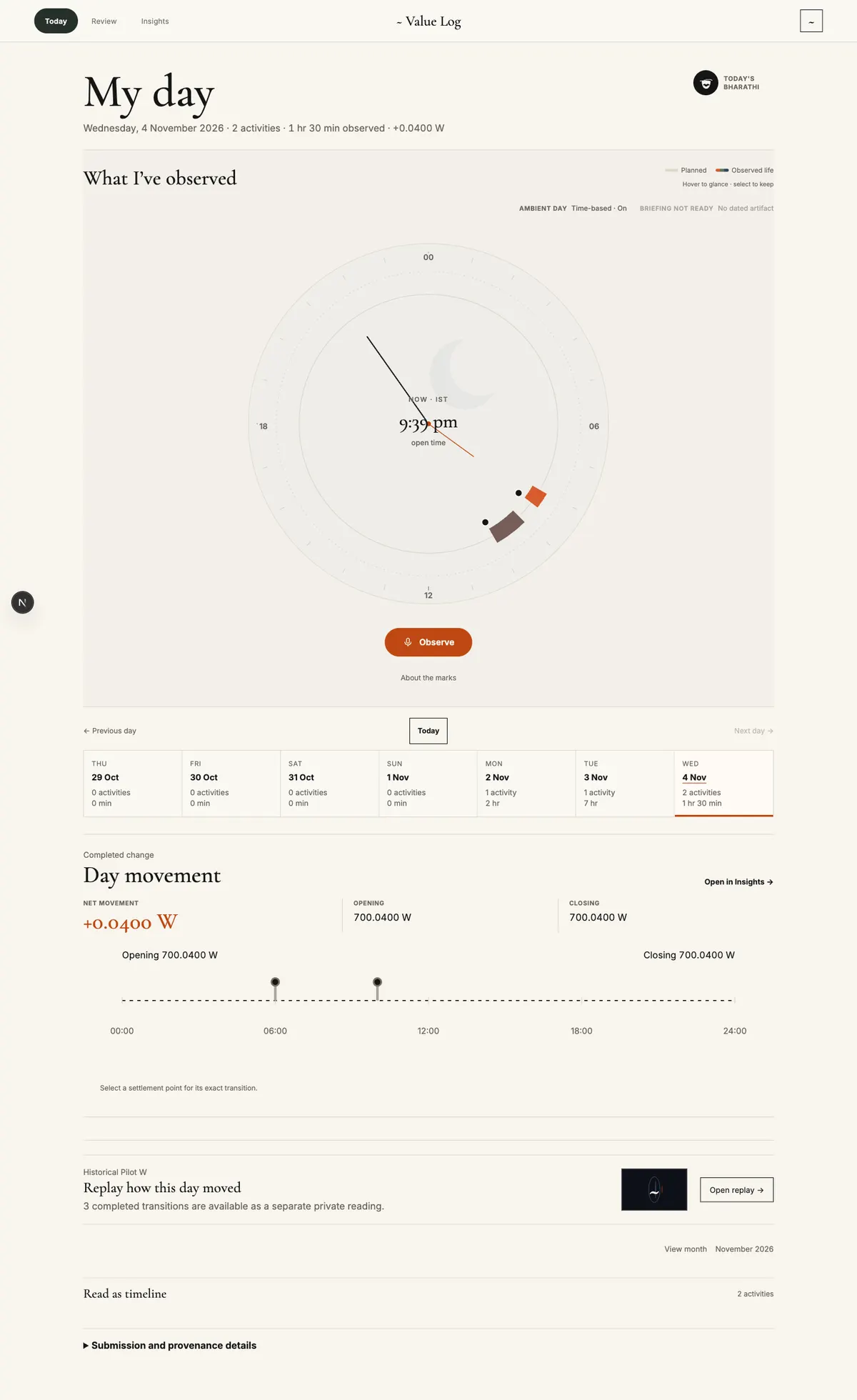
A later design view of My day, from the 4 November changelog evidence. Its entries and numerical readings are synthetic interface fixtures, not my personal results. Product evolution.
In my own practice, the twenty-four-hour frame matters because it includes the parts of life that easily disappear from a work summary. Sleep occupies time. Eating occupies time. A walk occupies time. A conversation can have an importance its duration does not explain.
Logging sleep does not mean I was consciously observing every moment of it. Leaving a gap means the record is incomplete. The clock gives me somewhere to begin recollection; it cannot supply the missing experience.
What ~ValueCaptureProtocol currently captures
Before asking what we might add, it helps to show what is already defined. The current ~ValueCaptureProtocol has five canonical nodes. These establish the activity record's structure; they are not a claim that every product entry has complete evidence. Canonical registry.
| Canonical node | What it captures |
|---|---|
~~TimeSlice | The activity's start, end, and duration |
~~Activity | The activity label, task type, declared intention, and downstream routing |
~~Proof | Evidence that the activity occurred, including supporting references and artifact type |
~~Attribution | The responsible actor, beneficiaries, and community, project, contributor, and validation context |
~~Integrity | Evidence quality, anomaly indicators, and fraud-risk metadata for the activity record |
This gives us a way to locate an activity, associate it with people and context, and distinguish the record from its supporting evidence. It does not provide a dedicated node or facet for the person's open-ended account of what they noticed while living it.
What I noticed already has a place in the product
The existing Check screen includes an editable “What I noticed · Optional” field. The product describes it as personal, private, and separate from evidence and community review. An optional “Return to one moment” pause supports recall; skipping it adds no requirement. Method and safeguards.
That separation is important. “Walked by the lake” describes an activity. “At first I kept thinking about work. Then I noticed the water” describes something about its unfolding.
The second sentence comes from the fictional Manisha example below. It is a demonstration of the actual interface, not participant testimony.
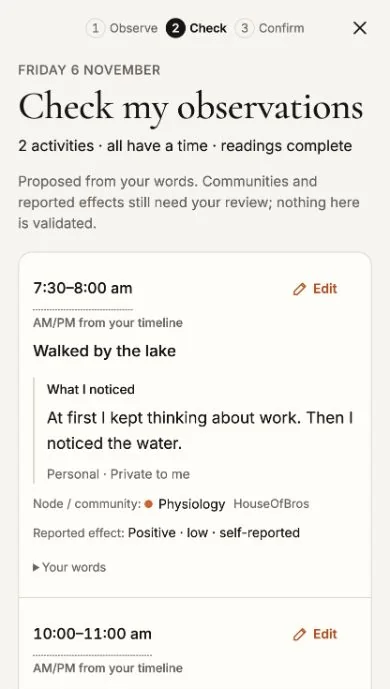
The existing observation layer in the actual app, using fictional Manisha content and synthetic storage. Personal words, proposed classification, and reported effect remain distinguishable. Public changelog demonstration.
A revision history might support that I edited a document. It cannot establish how the editing felt. My account can describe that experience, while remaining open to uncertainty and correction. Community review has a different task from deciding what my private experience must have been.
Confirmation therefore has a limited but meaningful purpose: I have checked the representation. It is not independent verification of every recollection, and it does not automatically authorise public disclosure.
The open question: where should that account belong?
The product has the field. The protocol question remains open. “What I noticed” is currently an application feature, not a newly established canonical node or facet. Its presence in Value Log does not by itself settle whether it should become part of ~ValueCaptureProtocol.
This is the thinking-aloud part of the essay. A person's description can connect an activity to its lived texture without becoming proof that an event occurred or an explanation of its cause. A feeling label or activity category cannot substitute for that whole description.
I would like collaborators to help us compare three possibilities:
- Keep the account as optional application data linked to the activity.
- Define an optional facet under an existing node, if its meaning and boundaries fit.
- Consider a separate node only if the account needs a distinct protocol role that the existing structure cannot express.
These are alternatives to investigate, not approved schema changes or proposed canonical names. We have not chosen a placement.
Before choosing, we need to ask what another application or researcher would need to understand faithfully: the person's original words, when the activity happened versus when it was recalled, the questions that shaped the account, and the person's corrections and uncertainty. We also need to ask what should remain private and what, if anything, the person chooses to share.
Micro-phenomenology can help us examine what such a description needs to preserve. Product trials can help us discover whether the representation is useful. Those findings should inform a later protocol proposal; this essay is an invitation to do that work together.
A vocabulary that can help without supplying the answer
The Internet of Value gives this practice a vocabulary through ~WellbecomingProtocol. Its six canonical nodes are ~~Physiology, ~~Emotion, ~~Feeling, ~~Thought, ~~Habit, and ~~Performance. Canonical protocol source.
I want those terms to help a person make distinctions they find useful. They should remain answerable to the account the person actually gives.
| Canonical node | What the vocabulary can help distinguish |
|---|---|
~~Physiology | Bodily activity and conditions, including movement, rest, diet, and breathwork |
~~Emotion | The protocol's emotion-linked physiological signals, where an appropriate measurement or explicitly supplied record exists |
~~Feeling | Subjectively reported feelings, expressed in the person's words |
~~Thought | Reported cognitive activity, reflection, and mental patterns |
~~Habit | A described cue, routine, reward, or pattern of consistency |
~~Performance | Concrete learning, earning, or organisation-building activity and outputs |
These are the protocol's distinctions; everyday language does not have to fit them neatly. In particular, the biochemical convention under ~~Emotion must not turn “I felt calm” into a claim about a neurotransmitter concentration.
The order matters. First let the person speak. Then offer distinctions for checking and correction. A vocabulary becomes less useful if the system tells a person which sensation they should have noticed.
For an interview, I would keep the experiential description available in its own words before asking what any classification might mean. That leaves room for a person to say: “None of those terms captures this.”
The contemplative question beneath my logging practice
My deeper intention is to make ordinary life an occasion for recognising awareness itself. I am drawn to what classical Yoga describes as the seer, or pure consciousness, and to the possibility of noticing changing experience without immediately identifying with every change.
A reflection supplied to me by Elton Ersch, dated 9 January 2026, brought the distinction between consciousness and directed awareness into focus. I take it as an interpretive prompt, and return to Patañjali's text for the philosophical connection. Ersch's public writing.
The opening sequence of the Yoga Sūtras places the stilling of mental activity beside the seer abiding in its own nature. The Sanskrit of 1.2 reads yogaś citta-vṛtti-nirodhaḥ; 1.3 follows with tadā draṣṭuḥ sva-rūpe '-vasthānam. My short English rendering is: yoga is the stilling of the mind's fluctuations; then the seer abides in its own nature. Yoga Sūtras 1.2–1.4, Sanskrit text.
For me, a daily account offers a modest point of contact with that inquiry. I can return to a particular activity, notice what I was attending to, and consider the difference between the changing contents of experience and the fact of experiencing.
This is my contemplative motivation. An activity log does not establish the Yoga Sūtras' metaphysics or demonstrate liberation. People can use Value Log, and participate in the research proposed here, without sharing that philosophical commitment.
The researchable question is smaller: does returning to specific episodes help people notice and describe aspects of their experience that a general summary misses?
From passing through a day to noticing it
I would describe the practical movement as unnoticed experience → deliberate attention → a description I can check. “Unnoticed” means that a detail escaped my attention or later recall; it does not mean I was unconscious.
Awareness does not require Value Log. A conversation, a notebook, contemplative practice, or a pause during a walk can provide an occasion for noticing. Value Log offers one structure: locate an activity in time, return to it if I choose, and give words to what I remember. It can support a practice; it cannot certify a level of consciousness.
The time boundary locates the episode. The vocabulary of ~WellbecomingProtocol offers distinctions I can accept, question, or correct. ~WellbeingIdentity provides the wider protocol context for representing a person's wellbeing, capabilities, and activity. Those representations remain partial; a recorded skill does not define the limits of what its owner can experience. Canonical specification.
My contemplative inquiry into pure consciousness remains a personal intention. The proposal we can test together concerns attention, recollection, and the quality of the resulting account.
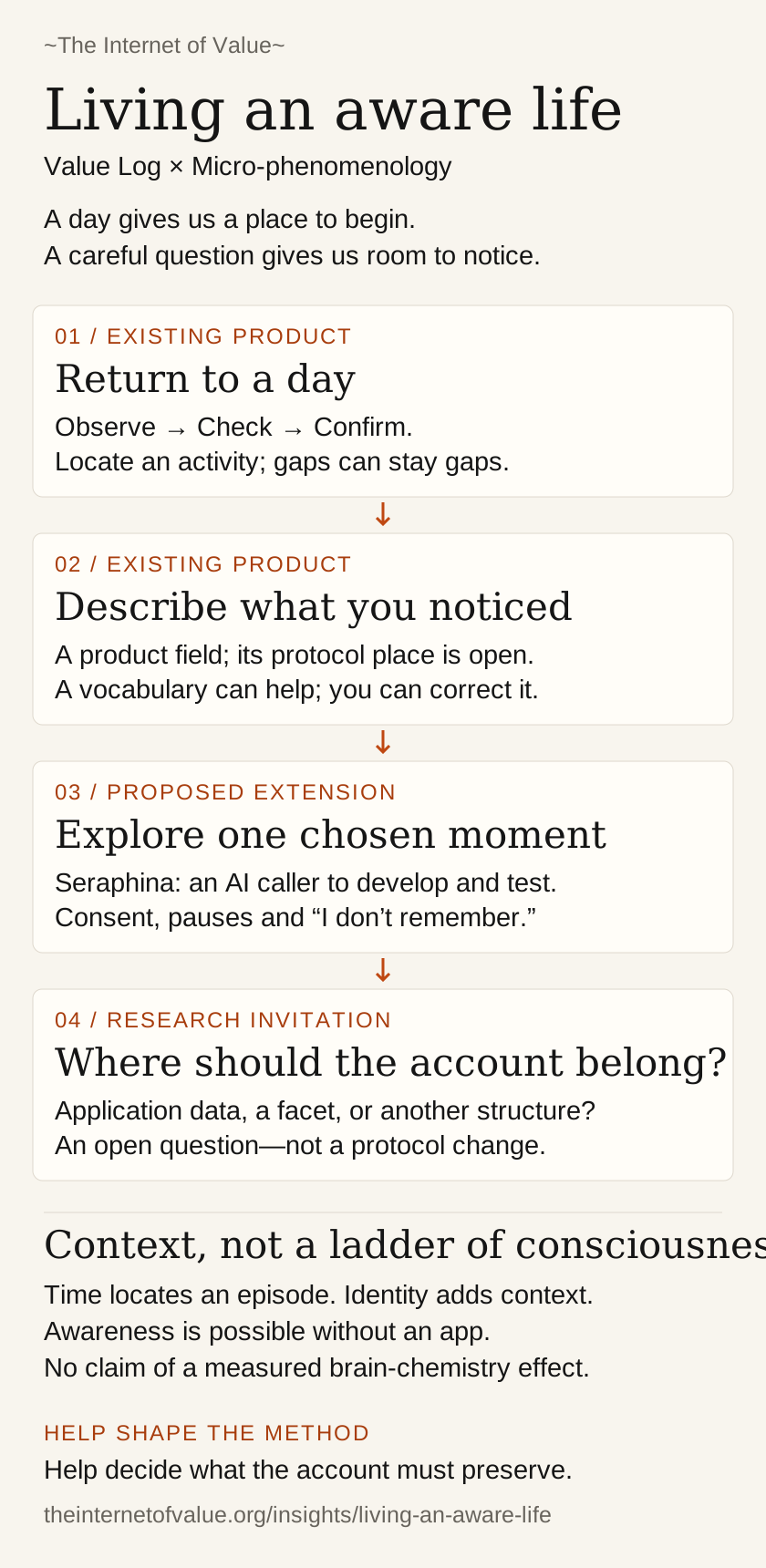
Why micro-phenomenology belongs in this conversation
Micro-phenomenology investigates particular lived episodes through interviewing and analysis. Claire Petitmengin's methodological work describes ways to explore how an experience unfolds, rather than relying only on a person's general explanations of what usually happens. Petitmengin, 2006.
The connection to Value Log is concrete. A temporal activity gives us a place to start. The optional observation gives us the person's initial words. A further, voluntarily chosen conversation could explore one short moment within that activity.
“I was distracted” might become a question about a particular transition: what happened just before I stopped reading? What do I remember happening next? The aim would be to follow the person's account without filling in its missing content.
The method distinguishes temporal unfolding from the aspects present together within a moment. It also includes systematic analysis; the work of Petitmengin, Anne Remillieux, and Camila Valenzuela-Moguillansky describes an iterative approach to studying individual descriptions and possible shared structures. Analysis method.
Those practices require expertise. A recap of an entire day, an optional recall pause, and a specialist micro-phenomenological interview have different purposes and demands. We want practitioners to help us determine where the proposed interface can be useful and where its boundaries should be.
Seraphina is the name for the caller we want to explore
Seraphina is our placeholder name for a proposed AI bot that could call or interact with someone, help collect their Value Log, and offer an optional micro-phenomenology-informed exploration of a selected episode.
The existing native logging product is the foundation. The caller described here is a proposed extension, not a claim that we already have a validated automated micro-phenomenological interviewer.
I imagine two invitations. First: would you like to walk back through your day? Then, only if the person wants: is there one particular moment you would like to explore?
The person should choose that moment. Seraphina should be able to accept a brief account, a pause, a correction, or “I don't remember” without pushing for a more interesting story.
A possible Seraphina conversation
This fictional exchange illustrates the proposed interaction. It is not research data or a validated instrument.
Seraphina: Would you like to walk through your day, or focus on one activity?
Person: Walk through it. I wrote in the morning, then had lunch and a client call.
Seraphina: Let’s start with the writing. About when was that?
Person: Ten to ten forty, I think.
Seraphina: I’ll keep those times approximate. Is there anything you noticed during it?
Person: I was stuck, then it got easier.
At this point, the ordinary logging flow could proceed to Check. The observation already belongs to the person. It need not become more elaborate.
Seraphina: Would you like to explore that change for a few minutes, or keep the observation as you said it?
Person: Explore it.
Seraphina: Can you choose a particular moment when something changed?
Person: When I deleted the opening paragraph.
Seraphina: Take your time returning to that moment. What do you remember?
Person: The document was open. I was looking at the same three lines.
Seraphina: What happened next?
Person: I selected the paragraph. Before deleting it, I thought, “But I spent so long on this.”
Seraphina: How was that thought present?
Person: Like words in my head.
Seraphina: And then?
Person: I deleted it, looked at the blank space, and wrote a different sentence.
Seraphina: You mentioned that it got easier. What do you remember of that change?
Person: I stopped going back over every sentence. I don’t remember exactly when.
Seraphina: Let me check the wording: “I kept looking at the same three lines. Before deleting the opening paragraph, I thought, ‘But I spent so long on this.’ After deleting it, I wrote a different sentence and stopped going back over every sentence. I don’t remember exactly when that changed.” What would you change?
Person: Say I reread them, not just looked at them.
Seraphina: I’ll make that correction. Do you want the longer observation saved privately, a shorter version, or neither?
That final choice is a requirement for the proposed caller. It needs real retention controls behind it. The exchange's useful result is the person's corrected description, including the uncertainty about when the change occurred. It does not establish a psychological breakthrough or its cause.
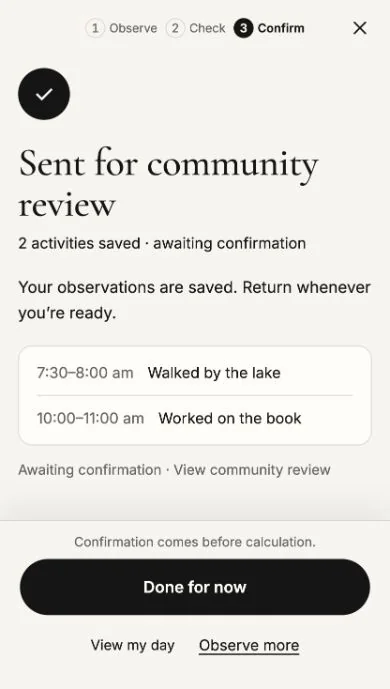
A current product demonstration shows how a visit can end with a clear receipt. Saving, community review, and completed calculation have different meanings. Fictional Manisha example; no study result. Changelog.
Attention, in human terms
Imagine arriving home after a walk. “I went out for forty minutes” is one account. “For the first part I was rehearsing a conversation; then the sound of the water caught my attention” is another. The second account follows a change in what stood out. This is an illustrative example, not a participant report.
That is the human question beneath my interest in attention: what becomes available when we slow down enough to notice it, and what can we still honestly remember later?
Andrew Huberman uses a helpful spotlight metaphor when discussing acetylcholine and attention in his episode How to Focus to Change Your Brain, particularly the section beginning at 40:18. It gives an accessible image for selection: some information comes into focus while other information recedes. A metaphor helps us picture the process; it is not a measurement of what happened in my brain during a walk.
Acetylcholine is a chemical messenger used by the nervous system. Its role in attention and learning has also been studied in people. In a small experiment with twelve healthy adults, participants practised telling whether patterns of moving dots travelled in the same direction. They completed training under a medicine that prolongs acetylcholine's action and under a placebo. Learning improved more under the medicine, especially for the movement direction and screen location they had practised. Rokem and Silver, 2010.
This is evidence about learning a particular visual task under controlled conditions. It does not establish that logging a day changes acetylcholine, makes a memory accurate, or brings someone closer to pure consciousness. We have not measured those effects in Value Log.
Animal studies add a useful caution. In one mouse experiment, manipulating acetylcholine-related signals helped the animals detect a cue when it was present, but could also make them respond as if a cue were present when it was absent. Gritton and colleagues, 2016. Better detection and mistaken detection both matter.
For our design, I take that as a question, not a biological explanation of the product: does a prompt help someone recall their experience, or encourage them to supply something they do not remember?
“What happened next?” leaves room for an answer. “Did you feel your shoulders relax?” supplies a sensation to look for. A compelling conversation can still produce an unreliable account. That is why Seraphina needs to be evaluated for what it introduces as well as what it helps someone describe.
Bringing experience and experiment into dialogue
Francisco Varela proposed neurophenomenology as a research programme in which disciplined experiential inquiry and cognitive science constrain and inform one another. Varela, 1996.
Lutz and colleagues gave one experimental example: during a visual task, experiential reports informed the grouping of trials for EEG analysis. That illustrates a relationship between reports and neural investigation, not a universal neural signature of a feeling. Original study, 2002.
This is the kind of dialogue I would like to work towards. The first-person account, the researcher's interpretation, and an independent recording should remain distinguishable. A later physiological study would need its own question, protocol, and measurement expertise.
The immediate opportunity is already substantial: investigate the quality of the account before adding sensors. We can compare ordinary Value Log use, a carefully specified Seraphina interaction, and an interview designed with a trained practitioner.
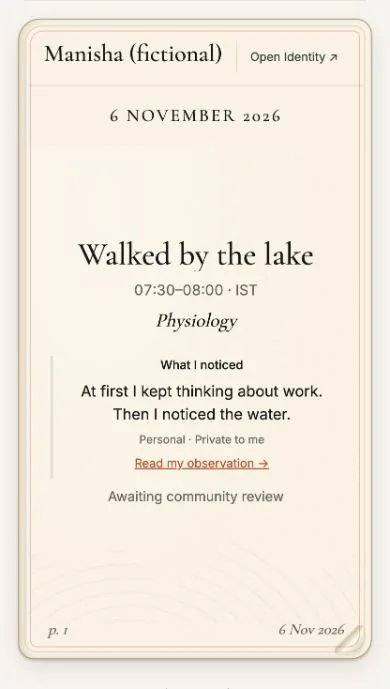
Returning to the account. The actual-app Passport demonstration carries personal words alongside their activity and a separate review status. Fictional content and synthetic storage. Public demonstration.
What I want collaborators to help us test
I want the study to ask whether the person recognises the account as their own, whether unsupported details have entered it, and whether the interaction was worth its demands on their attention.
Researchers already provide reasons to take experiential inquiry seriously. Høffding, Martiny, and Roepstorff defend the reliability and validity of properly conducted phenomenological interviews. Their argument concerns a particular approach; we should study its implications without treating it as validation of our caller. Their paper.
The interaction also has a relational dimension. An exploratory series of five interviews with experienced micro-phenomenology researchers identified interpersonal connection as one consideration in interview quality. Heimann and colleagues.
For the proposed system, a useful evaluation would examine:
- Faithfulness: whether the account preserves the person's words, sequence, uncertainty, and corrections.
- Influence: whether a prompt introduces sensations, explanations, or expectations the person did not supply.
- Control: whether someone can decline depth, stop, correct the record, and choose what to retain.
- Burden and access: whether the process is useful across different languages and ways of describing experience, including brief or incomplete accounts.
We can begin with fictional cases whose source words are known, then design a small feasibility study with methodological and ethical guidance. My own logging is a place to discover questions and failures. It is not independent evidence of efficacy, and participant agreement alone cannot establish historical accuracy.
The wider Observer Attention white paper asks how people can participate in observing, confirming, contesting, and governing representations of their lives. This project gives that agenda an assessable interface. It leaves the equation and the wider model open to their own independent tests.
Twenty one people we hope to learn from
We have identified the following people for prospective outreach. These are our reasons for selecting them and the questions we would bring. This is not a list of confirmed collaborators, advisers, or endorsements.
Interviewing and the status of experience
- Claire Petitmengin — Her foundational interviewing work makes her a central methods interlocutor. We would ask which parts of the proposed caller require practitioner training or supervision.
- Anne Remillieux — Her work on analysing experiential descriptions connects directly to our representation problem. What must survive when speech becomes a structured observation?
- Camila Valenzuela Moguillansky — Her work on bodily awareness and experiential methods informs our interest in movement and breathwork. How can an interviewer explore sensations without supplying them?
- Katrin Heimann — Her coauthored HCI research applies interviewing and analysis to digital experience. We would seek critique of the interface, its attentional demands, and its evaluation.
- Michel Bitbol — His work in neurophenomenology and the philosophy of experience offers an epistemic challenge. What can a person's report establish, and where does our framework overreach?
- Martijn van Beek — His work connects micro-phenomenology and contemplative experience. We would ask how to explore such episodes without importing a tradition's expected account.
- Simon Høffding — His coauthored defence of phenomenological interviews addresses reliability and validity. We would ask what participant confirmation can establish and what needs another form of assessment.
Embodied interaction and the voice interface
- Mirjana Prpa — Her work connects micro-phenomenology, HCI, and human–AI experience. We would ask how to evaluate the caller's influence on an account.
- Bruna Petreca — Her research connects human experience and materials. We would ask how an observation can describe texture, effort, and sensory qualities without becoming a mood category.
- Claudia Núñez-Pacheco — Her work explores bodily knowing and language in design. What should the interviewer do when experience is difficult to put into words?
- Courtney N. Reed — Her voice and musical-interaction research informs a central interface question: how might speaking, pacing, interruption, and silence shape what a person reports?
- Ekaterina R. Stepanova — Her embodied-experience and micro-phenomenology work is relevant to emotional interpretation. We would ask how to keep a reported sensation distinct from the system's emotion label.
- Laia Turmo Vidal — Her work uses first- and second-person design methods in sensitive bodily contexts. We would seek critique of consent, optional questions, and participant control.
Several people in this group share the same 2026 HCI workshop network. Their complementary perspectives are a reason to talk; their inclusion is not independent evidence that Value Log works.
Awareness and alternative ways of sampling a moment
- Suneetha Saggurthi — Her coauthorship on micro-phenomenology in HCI and humanistic-management work connect method with everyday working life. We would discuss language and context in an India-based feasibility study.
- Natalie Depraz — Her work on becoming aware and attention speaks to the essay's central distinction. What changes during recollection, and how should an interview represent that change?
- Jona Carmon — His coauthored 2026 preprint describes an AI interviewer developed around Descriptive Experience Sampling. We would compare interviewing rules and evaluation approaches while keeping DES distinct from micro-phenomenology. The cited work is a preprint.
- Russell T. Hurlburt — As the originator of Descriptive Experience Sampling, he offers a crucial comparison. What does an end-of-day reconstruction lose relative to sampling a particular moment?
- Annika Lübbert — Her work on embodied and interpersonal awareness, and coauthorship of the interview-quality study cited above, inform our relational question. Can the interaction support patient listening without pressure to perform?
Learning from applied qualitative research
- David Ranftler — His xelper work on AI-moderated interviews and qualitative analysis offers an applied comparison. We would discuss interview controls, source traceability, and the limits of automated interpretation.
- Paul Wesendonk — His xelper work on research partnerships makes a bounded feasibility collaboration worth exploring. We would coordinate this with the conversation with David, rather than send disconnected company approaches.
- Michael Winnick — His experience founding dscout offers a perspective on repeated, in-context research. We would ask how to make daily reflection useful without turning it into a reporting burden.
The shortlist brings together methods, criticism, design, and implementation experience. An initial conversation would help establish whether there is a useful shared question; it would not commit anyone to a study, podcast, or partnership.
A collaboration invitation: help us decide what belongs in the protocol
I am inviting micro-phenomenology practitioners, phenomenological interview researchers, HCI and voice-interface researchers, attention scientists, and scholars of contemplative practice to help shape this work.
The question I most want to work on together is: should a person's experiential account have a dedicated place in ~ValueCaptureProtocol, and what would that representation need to preserve? Keeping it in the application, adding a facet, and defining a separate node remain possibilities to assess. We are inviting investigation before a protocol decision.
The first invitation is a thirty-minute methods conversation around one demonstration: a time-bounded activity, the person's initial words, the questions asked, and the account after their corrections. What would be lost if we stored only a category? What might be distorted if we standardised the account too early? I would also welcome critique of where the interface helps, leads, rushes, or misrepresents the person.
From there, there are several possible collaborations:
- Compare whether an experiential account should remain application data or have a dedicated protocol representation, and identify the evidence needed to choose.
- Identify what must survive between tools: original words, recall context, interview prompts, corrections, uncertainty, and the person's sharing choices.
- Help design the episode-selection, prompting, and closing procedure, including what should remain with a trained human interviewer.
- Develop an evaluation comparing the existing logging flow with the proposed caller and practitioner-led interviews.
- Study the role of attention, recall, language, and participant control with an appropriate experimental design.
- Join a public dialogue or podcast about what AI should—and should not—do when asking people about lived experience. This would be a separate invitation from participating in research.
I would particularly value the methodological perspectives represented by Petitmengin, Remillieux, Valenzuela-Moguillansky, Heimann, and Høffding in the papers linked above. Naming their work expresses what we hope to learn; it does not imply participation or endorsement. Researchers using related approaches, including Descriptive Experience Sampling, are welcome to help us examine differences rather than collapse the methods together.
If this intersects with your work, write to moses@theinternetofvalue.org with what you think an experiential account must preserve—and whether it belongs in the protocol at all. You do not need to agree with the framework. A well-founded objection could be the most useful beginning.
I will bring the working product, the fictional demonstration, my own experience of logging a day, and an openness to changing the design. What I hope we can build together is a practice that gives people more room to notice their lives and better words for what they notice, while leaving them free to say, “That is as much as I remember.”
More of the product and the questions it raises
These further screenshots come from the public changelog's fictional Manisha demonstrations in the actual app. They show why a research interface also needs ordinary product reliability and privacy controls.

Selective visibility: a covered private entry in the demonstration. This is a visible interface control, not a promise that every storage copy has been deleted. Changelog.
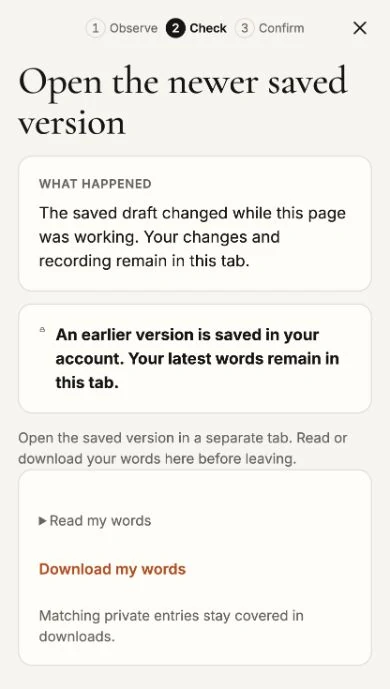
Recoverable words: when a newer saved version exists, the interface distinguishes it from the words and edits remaining in the original tab. Fictional demonstration. Changelog.
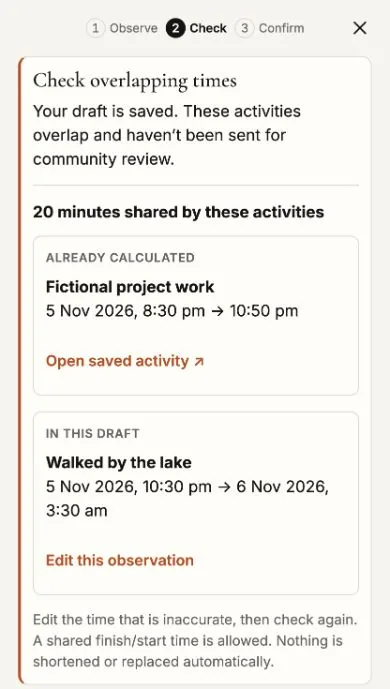
Correctable time: the interface exposes an overlap rather than silently shortening an activity. A faithful account needs an honest timeline as well as careful wording. Fictional demonstration. Changelog.
Questions this proposal leaves open
Is “What I noticed” already part of ~ValueCaptureProtocol?
It is an existing optional Value Log field. The current protocol has no dedicated node or facet for that open-ended experiential account. This essay asks whether it should gain one, and what that would mean; it does not change the specification or choose a placement.
Does awareness require Value Log?
No. The product provides a structure for a practice that is possible without it. We want to investigate whether that structure helps people describe their experience.
Is Seraphina already a validated interviewer?
No. Seraphina is the working name for the proposed caller. The native logging journey and optional observation field already exist; a validated automated micro-phenomenological interview is a research ambition.
Are the twenty one people collaborators?
They are prospective contacts selected for the reasons above. Listing them does not imply agreement, endorsement, or participation.
References
Protocol sources and image provenance
Protocol meaning comes from the hosted IoV registry, the ~ValueCaptureProtocol source, and the ~WellbecomingProtocol source. ~~TimeSlice supplies the temporal boundary and ~~~~ProtocolLinkId supplies event lineage. The optional observation field belongs to the application; it is not a newly established canonical node.
The current Value Log method and public changelog document the product. Screenshots retain their original wording, dates, and numerical fixtures; they are not edited to suggest results. The historical July screenshot and the later fictional demonstrations have different provenance, as their captions explain.
Scientific papers are linked beside the claims they support. The analysis paper's publisher abstract and notes support the broad account here; its full subscription text was not accessed for this essay. The white paper's methods and falsifiability chapter sets out the wider research limits. Ersch's supplied reflection is a philosophical stimulus, not a neuroscience source; the Sanskrit references and short English rendering are identified separately.