The Internet of Value
Why Communities Should Own Data Centres
By Moses Sam Paul 2026-11-16
From large data centres and LLMs to community-owned infrastructure and small language models: the case for a Mandrem pilot in Goa.
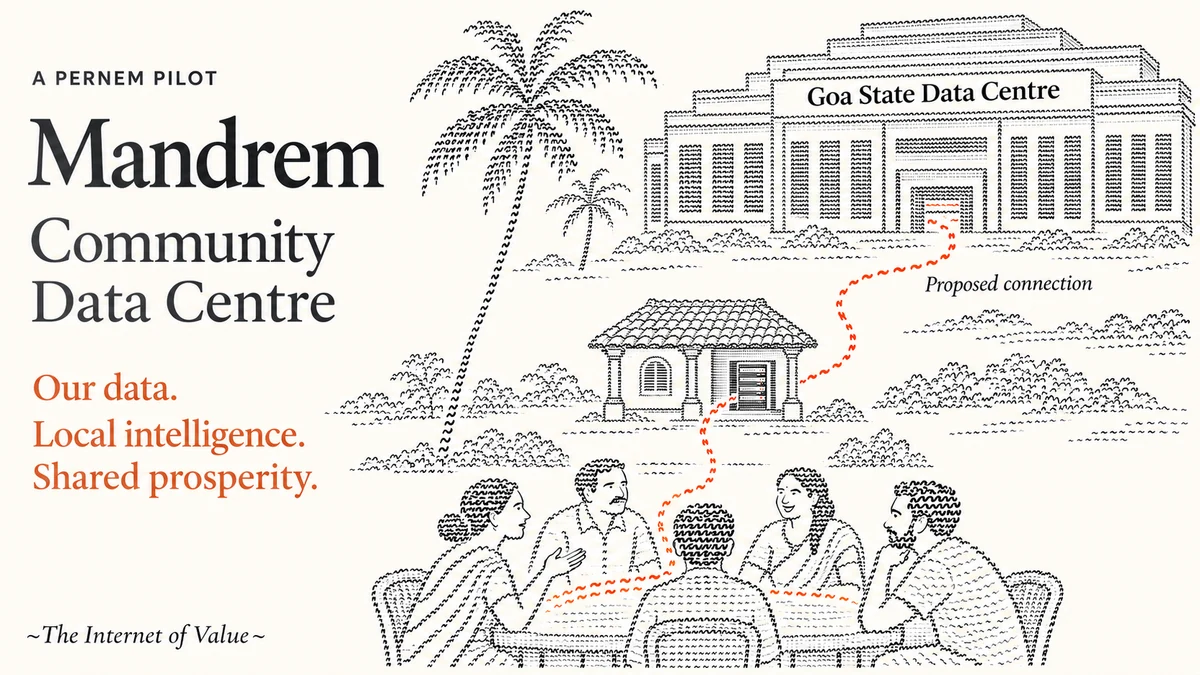
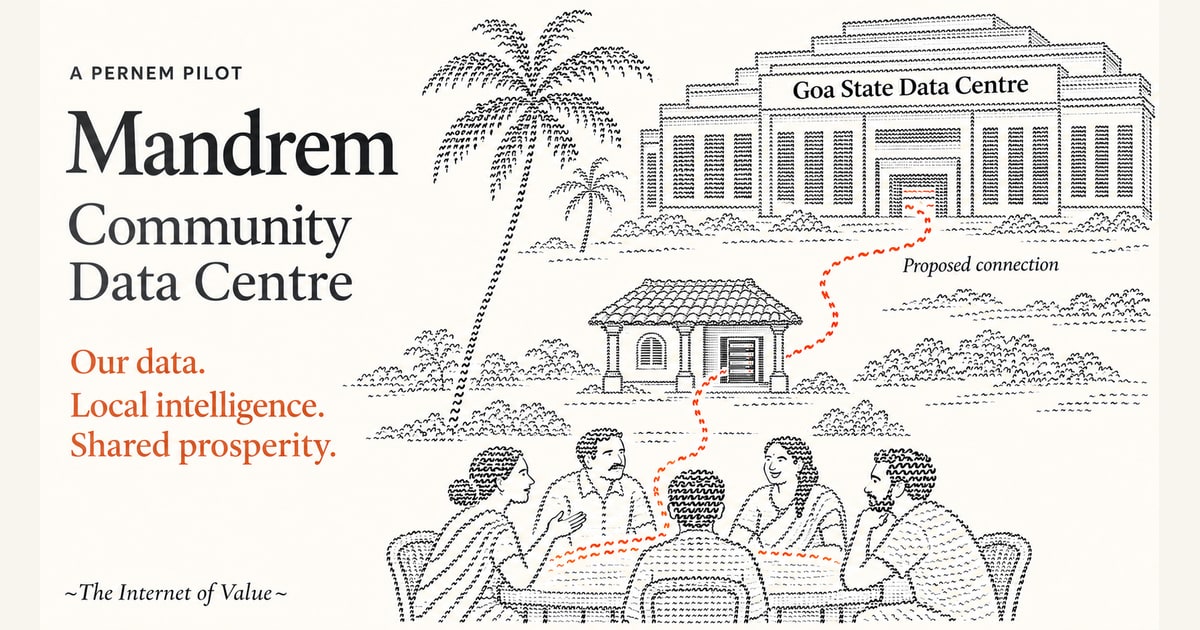
Research proposal · published 16 November 2026. This essay develops a case for a Mandrem pilot. It reports no completed local demand study, registered cooperative, operating facility, government partnership or tested language model.
A community should be able to own the computers that hold its records, govern the uses of those records, and benefit from the intelligence built around them.
That is the proposition behind a community-owned data centre in Mandrem, Goa. The starting question concerns infrastructure: as investment in large data centres and large language models accelerates, what would it take for a village or a network of communities to become an owner of digital capacity?
The proposed answer is a local installation that combines storage, computing, accountable operation and a small language model serving defined local tasks. Residents and participating organisations would own and govern the institution. The Internet of Value would supply a language for relating activity, lived experience, evidence and recognition within it. A person’s yoga practice is one example of data that could live there. The centre serves a much wider community purpose.
Quick Answer
A community-owned data centre would let residents and participating organisations own local storage and computing, govern distinct records, and provide useful services. The Mandrem proposal combines that institution with a small language model working from permitted local knowledge. IoV supplies the domain language; Mira’s yoga story illustrates one kind of hosted record. Ownership, service demand, costs and model quality remain to be tested in a proposed 90-day pilot.
1. The infrastructure question behind the AI boom
Large data centres enable useful services at enormous scale. They host business systems, public applications and the training and operation of powerful AI models. Their advantages include pooled expertise, purchasing power and sophisticated reliability engineering. Communities already depend on this capacity, and a serious local proposal should understand what it can learn from it.
Yet attracting a data centre to a region does not by itself give residents a governing share in it. Being a customer of an AI service does not determine who owns its equipment, chooses its model or controls its commercial terms. Those are institutional choices alongside engineering choices.
The physical stakes also matter. The International Energy Agency’s 2025 report estimated global data-centre electricity use at about 415 TWh in 2024, roughly 1.5% of the world’s total. Its 2026 analysis discusses pressure on grids, supply chains and local resources. These are global findings; they do not establish a Mandrem energy problem or prove that a small centre would be more efficient. They make questions of scale, siting and accountability material to the discussion. IEA, Energy and AI, IEA, Powering Artificial Intelligence.
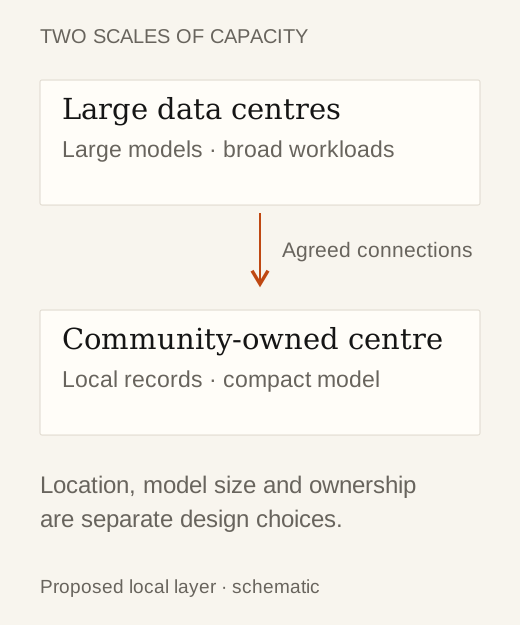
The opportunity is to give communities an additional position in this economy. They could own some of the infrastructure on which their daily digital work depends, decide which tasks it should perform and develop the capacity to operate it. The relevant measure becomes the usefulness of that capacity to its members, alongside its cost, reliability and resource use.
2. The argument began with data cooperatives
In December 2020, Joel John and I published Data Ownership and the Policy Environment. We separated privacy from ownership and argued for communities that could act on members’ behalf. The cooperative’s purpose was member benefit, with accountable governance and individual control over personal data.
Our April 2021 follow-up, Data Ownership and the Community Platform: Use Case, applied that institutional idea to workers’ records, community validation and portable reputation. It asked how a community platform could avoid reproducing the power of the platforms it sought to improve.
Those publications are the intellectual starting point for this proposal. They did not establish the viability of a Mandrem facility or a local AI service. Moving from a data cooperative to a community-owned data centre is the extension I am proposing here: collective authority would reach the equipment, operating contracts and computing choices as well as the handling of records.
The policy discussion in the earlier articles belongs to its time. Their treatment of India’s 2019 Bill is historical. A pilot would need a fresh assessment of the Digital Personal Data Protection Act, 2023 and the final 2025 Rules, including their phased commencement, rather than treat an old comparison as current compliance guidance. MeitY’s Act, Rules and enforcement-timeline materials.
Hardjono and Pentland also describe data cooperatives as institutions that can curate access and act for members. Their paper offers a design rationale for collective stewardship, not a tested Mandrem operating model. Data Cooperatives: Towards a Foundation for Decentralized Personal Data Management.
The economic question also has a useful research foundation. Jones and Tonetti model data as nonrival: use by one party need not prevent use by another. Their work examines how control and incentives affect privacy and sharing. It is a theoretical argument about allocations under a model, not evidence that any proposed cooperative will succeed. For this pilot, it motivates a practical question: can useful sharing happen under terms the people concerned can govern? Nonrivalry and the Economics of Data.
3. Why begin in Mandrem, with Pernem as a possible network?
A local institution needs a recognisable place, a membership and a set of relationships it can serve. Mandrem gives the proposal a bounded starting area. The pilot could investigate demand among residents, practice and learning communities, small organisations and local institutions, rather than begin with an abstract promise to serve everyone.
The administrative language should be precise. Mandrem is a village-panchayat area within Pernem taluka. Mandrem and Pernem are also the names of separate Assembly constituencies. A Mandrem pilot could later connect with other communities across Pernem; it should not describe those different boundaries as interchangeable. Goa’s panchayat and village directory, Chief Electoral Officer’s constituency profile.
There is a plausible case to investigate: a centre could combine trusted local assistance, organisation storage, community records and access to useful local knowledge. But plausibility is not demand. We still need to learn which records people want help managing, what existing services already do well, which languages matter for actual tasks, who would pay and who would be excluded by the proposed membership rules.
Locality makes accountability easier to locate only when the institution is designed for it. A neighbour operating a server can also misuse access. A locally powerful group can dominate membership. The pilot therefore needs clear responsibility, affordable participation, an appeal route and a way to leave with one’s records. The community’s authority must include scrutiny of its own operators.
4. What the community would actually own
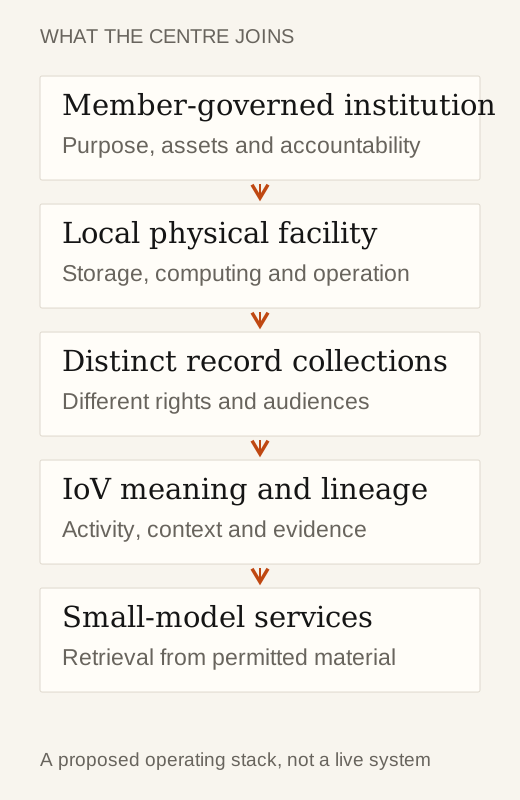
The proposed centre begins as a modest, secured installation in existing premises: application and inference computing, storage, networking, power protection, environmental management, backups, monitoring and trained operators. Its specification follows assessed workloads and local quotations. A small first installation should have an honest service level and recovery plan.
Ownership would need to be concrete. Who owns the equipment? Who controls the premises and administrative credentials? Who hires the operator? Who approves a model change or an external service agreement? Which decisions require member participation? Who can inspect the accounts and challenge a decision?
A cooperative is one possible vehicle. Goa’s Registrar of Cooperative Societies is the relevant registration authority under the state framework; classification, membership, capital, voting and surplus provisions require proper examination. A proposed board or membership share is not an adopted bylaw. Goa Department of Cooperation.
There is an existing service precedent worth studying. CommonsCloud describes a cooperative cloud service in which user-members and workers are co-owners, with paid services and an operating team. Its account also identifies grants and other contributions supporting sustainability. It shows that cooperative digital provision is an established organisational possibility. It does not supply a financial forecast or legal template for Goa. CommonsCloud’s own description.
The essential distinction is between ownership of the centre and authority over each record. Collective ownership of the equipment does not give every member access to another person’s account. The institution holds different records under different duties and permissions.
5. What kinds of data would it host?
The centre should begin with a permission map and useful services. Five candidate collections make the scope visible.
Personal records. A member might store files, accounts of activities and selected evidence. These remain in a personal workspace. Storage is a service to the person; membership does not make the collection available to everyone else.
Community learning and practice records. A group could hold agreed criteria, selected evidence, reviewer reasons and bounded attestations. Access follows the purpose of the review. A record of demonstrated practice differs from a person’s private interpretation of that practice.
Organisation workspaces. A shop, association or cooperative could hold its own documents, operational records and backups. Its staff permissions and commercial obligations remain separate from other organisations’ records.
Licensed local knowledge. Timetables, guides, histories or teaching material could enter an agreed collection when the relevant contributors permit it. Contributors should know whether a licence covers storage, retrieval, publication or model training; those are separate uses.
Authorised civic and environmental material. Public documents and properly authorised local observations could support useful services. Publication status, provenance, re-identification risk and the responsible institution still matter. A public-interest purpose is not a general permission to take government databases or disclose residents’ records.
These collections give the centre several possible sources of usefulness. A local assistant might help find a service, answer from an organisation’s approved documents or locate a licensed guide. A storage service might be valuable without an assistant at all. The first pilot should discover which combinations people actually need.
6. Where IoV supplies the language
Storing a file tells us little about what it means. Was an entry written by the person who lived the moment? Is it a suggestion from a model? What activity does it refer to? Who observed something, what were they qualified to judge, and what exactly did their judgment support?
The Internet of Value supplies a proposed grammar for keeping these relationships distinguishable. It connects four canonical protocols rather than treating every record as interchangeable training material.
- ~ValueCaptureProtocol describes a time-bounded activity, its evidence, attribution and integrity. Its five nodes are ~~TimeSlice, ~~Activity, ~~Proof, ~~Attribution and ~~Integrity. The same event can retain lineage as later records refer to it.
- ~WellbecomingProtocol provides routes for interpreting lived context and performance. A person’s account of feeling steadier stays distinguishable from a teacher’s observation or an automated interpretation.
- ~SAOcommons concerns the community institution. In this proposed learning use, eligible demonstrated ~~Performance can enter qualified review, with reasons, governance and dispute handling. An ordinary private practice does not automatically activate that process.
- ~WellbeingIdentity is the living state informed by permitted flows, with consent-governed disclosure. A chosen view can refer to relevant evidence without displaying a complete personal history.
The common ~~~~ProtocolLinkId can preserve the relationship among an activity, selected evidence and a later record. It does not make an unreviewed claim true. Nor does this language itself provide a database, encryption service, statutory entitlement or payment system.
capture specification, community linkage.
This is also a distinction between two senses of language. IoV supplies meaning, relationships and provenance for the domain. A language model processes natural-language questions and passages. Konkani, Marathi, Hindi or English performance still requires evaluation; a protocol mapping does not create translation ability or local cultural understanding.
7. Mira’s yoga practice: one record moving through the centre
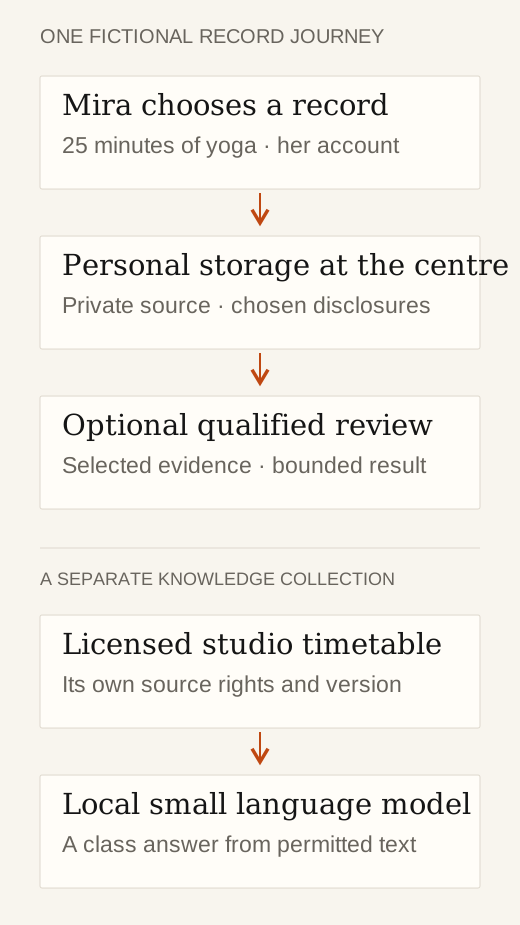
Consider a fictional example. Mira takes part in a 25-minute yoga practice and writes: “I arrived tense. By the end of the practice, I felt steadier.” This is an illustrative first-person account, not a clinical observation or evidence of a change in ~~~WellbeingScore.
Her chosen record is saved in her personal workspace at the local centre. Activity time and evidence references can be mapped through ~ValueCaptureProtocol. The original prose stays distinguishable from suggested interpretations. Its exact canonical placement remains an open Spec question, so the pilot should preserve it as application data rather than invent a new canonical node.
Mira may keep the record private. She could instead share one excerpt with a support circle. If she wants a learning review, she can separately select evidence of an eligible demonstrated routine for appropriately qualified reviewers. Their bounded judgment might concern what they observed under agreed criteria. It cannot certify her inner experience or establish mastery from one session.
A review record would be stored separately and linked to its evidence. A permitted return could inform ~WellbeingIdentity, and Mira would choose what to disclose. The source account, a shared excerpt, a reviewer’s reasons and an outward-facing view are different objects even when they refer to the same moment.
The studio’s class timetable is another object again. With appropriate permission, that timetable can join a local knowledge collection. A request for the next beginner class can be answered from it without consulting Mira’s private reflection.
That is why Mira belongs in an infrastructure proposal. Her example reveals what a local centre needs to store, how records acquire context and which permissions a useful service must enforce. It is one thread among the personal, organisational, community and civic uses the centre could support.
8. A small language model around local knowledge
A small language model is a compact model chosen for a bounded workload. The term has no single parameter threshold that settles its usefulness. Compact models can run in large facilities, and a sufficiently equipped local installation could run a larger model. Our proposal intentionally combines local governance, local storage and modest inference capacity because that combination is worth testing for these tasks.
The Phi-3 technical report offers a feasibility precedent: its authors describe a 3.8-billion-parameter model small enough to deploy on a phone. That result does not select a model for Mandrem, establish Konkani performance or guarantee acceptable service under concurrent demand. It shows why local inference is a practical research option rather than a requirement to build a frontier training cluster. Phi-3 technical report.
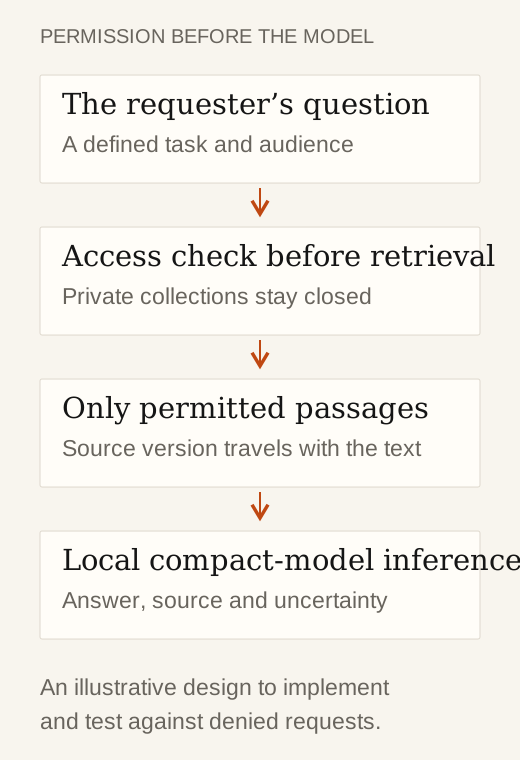
The first service should run an appropriately licensed pretrained model with retrieval from permitted local documents. The retrieval step selects material the requester may access before giving it to the model. A useful response points back to a source and its version, and acknowledges when the permitted material does not answer the question. The original RAG research motivates this separation between model parameters and retrievable information; access control is an additional responsibility of our implementation. Lewis and colleagues, Retrieval-Augmented Generation.
This matters for ownership. Members need a way to correct a timetable, withdraw a licence and inspect which sources supported an answer. Training every new record into model weights would make those operations harder. Research demonstrating extraction of memorised material from GPT-2 is a further reason to take training-data choices seriously, though it does not measure the risk of this unbuilt system. Carlini and colleagues, Extracting Training Data.
“Built around local data” can therefore mean local inference over governed, retrievable collections. Fine-tuning is a later, separately authorised choice requiring suitable rights, evaluation and a workable lifecycle. It should earn its place through an actual need.
9. How the centre could earn and relate to larger infrastructure
The proposed business sells useful capacity and accountable work: storage and backups, supported organisation workspaces, document services, licensed knowledge access and bounded local inference. Members could also benefit through paid operating work, useful services and any lawful allocation of a future surplus. Those benefits need transparent accounts; they are not guaranteed dividends.
An external institution might commission a defined service or receive an authorised output under an agreement. A larger data-centre operator is not automatically a buyer of community records. In a possible Goa State Data Centre relationship, the relevant department or authorised integrator would need to establish the mandate and procurement. The community centre might provide local support or an agreed service; it might purchase recovery capacity elsewhere. The direction of payment depends on the contract.
Goa’s 2021 IT Citizen Charter describes the State Data Centre as infrastructure for government applications. That official description establishes its intended public-service role, not an agreed interface with this proposal. An off-site recovery copy would also require an explicit exception to an absolute promise that every copy stays in Mandrem. Residents should know where backups, logs, indexes and external processors are located, and what each recipient can access. Goa IT Citizen Charter, section 17.
This gives local and large infrastructure a possible division of work. Training, specialist services and agreed recovery can draw on wider capacity. Day-to-day records, selected inference and accountable local services can have a member-governed home. Connections should follow defined purposes rather than make wholesale export the default.
10. The economics must support the institution
Our current planning allowance is ₹17.94 lakh for 90 days in existing premises: ₹7.20L for installation, ₹2.10L for readiness, ₹6.30L for three months of operation, and ₹2.34L contingency. These are unquoted design allowances. They exclude land acquisition, new construction and a large training cluster. Hardware, staffing, connectivity, taxes and service levels need local quotations before a funding request is finalised.
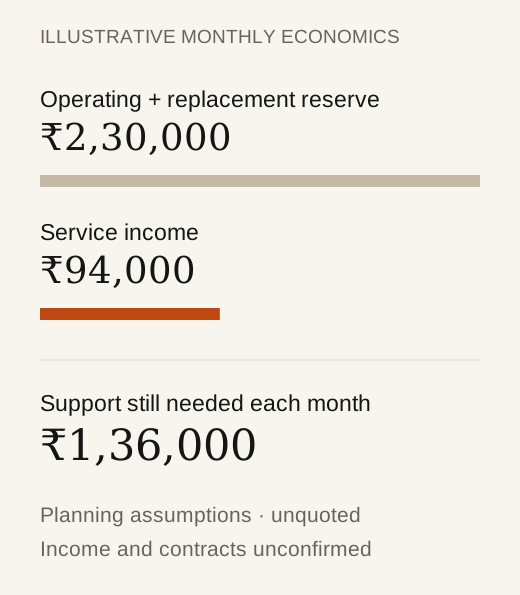
The illustrative monthly scenario has 20 organisation workspaces at ₹1,500, two anchor contracts at ₹20,000, 40 paid personal accounts at ₹100 and four service jobs at ₹5,000. It totals ₹94,000. Against ₹2.10L operating cash and a ₹20,000 equipment-replacement reserve, the ongoing requirement is ₹2.30L and the support gap is ₹1.36L per month. The first cash budget does not deduct hypothetical future collections.
That gap changes the decision. The starting scenario needs sustained support, a different operating design, stronger paid demand or some combination of these. Free resident data and unpaid operator labour should not be used to conceal it. Protocol valuations are distinct from invoiced services and bank receipts; they do not close a cash deficit.
11. What the first 90 days should establish
The first month should establish a community mandate, an accountable operator, a candidate site, a record-and-permission inventory, quotations and evidence of willingness to pay. The founding group should include people whose interests and access needs differ. The decision is whether there is a worthwhile local service to build together.
The second month should operate a deliberately small installation with separated workspaces and one useful paid service. It should exercise capture, export, correction, access withdrawal, operator access and restoration from backup. A review sample can test whether people distinguish a private account from selected evidence and a community judgment.
The third month should compare the local model with an appropriate larger-model service and a manual or search-only baseline on the same authorised tasks. Measure answer usefulness, source accuracy, refusal behaviour, language comprehension, latency, operator time, power use and total cost. Smallness is a design choice to evaluate, not a result to celebrate in advance.
The review must also test the institution. Can members understand the accounts and change a policy? Can someone challenge a reviewer or operator? Can a person decline sharing and still use essential services? Can they export and leave? Revocation should stop future authorised access, with clear retention and backup rules; it cannot magically recall an already downloaded copy.
Expansion should follow four kinds of evidence: a legitimate mandate, useful and enforceable data practices, paid or funded operating capacity, and services that perform well enough for their intended tasks. A failed test may call for redesign or a decision to stop.
12. A community can own a place in the data economy
The case for a Mandrem data centre rests on a different distribution of authority: members own digital capacity, govern its purpose and have a way to inspect what it returns to them. Physical infrastructure, records, domain language, models and institutional rules all contribute to that result.
The earlier data-ownership essays asked how people and communities could exercise meaningful control and obtain direct benefit. The next question is whether that authority can extend to a local place for storing records and operating intelligence. Mandrem is a proposed starting point for answering it carefully.
Mira’s account makes the stakes tangible. A community-owned centre would need to hold her record faithfully, distinguish it from someone else’s judgment and provide useful services without assuming that every part of her life is available for reuse. The same institution could serve a shop, a learning community and an authorised public-purpose project under their respective terms.
The immediate work is to convene a founding group, test the proposal with residents and organisations, price an initial service, inspect a site and establish who can responsibly operate it. Explore the Mandrem interactive proposal and its complete concept note for that discussion. The ambition is local data, local intelligence and community ownership that can be demonstrated in practice.
FAQ: Questions about the Mandrem proposal
What is a community-owned data centre?
A community-owned data centre is a proposed member-governed institution that owns or controls local storage and computing, operates useful services and accounts to its members. Collective ownership of equipment does not give members access to everyone’s private records.
Why combine a local centre with a small language model?
The proposed small language model would serve bounded tasks using an appropriately licensed pretrained model and retrieval from permitted local knowledge. It would not automatically train on residents’ personal records. Language quality, permissions, usefulness and full operating cost must be tested.
Is a Mandrem centre operating or connected to Goa State Data Centre?
No. Mandrem is the proposed starting area within Pernem taluka. No operating facility, registered member institution, government partnership or tested model is claimed. The state connection is a possible arrangement subject to authority and agreement.
How could members benefit financially?
The centre could charge for organisational workspaces, supported storage, backups and authorised local services. Any member distribution would depend on actual revenue, operating costs, reserves, the legal form and agreed governance. The pilot does not promise a dividend.
What would the first 90 days test?
The first 90 days would test a community mandate, rights and legal structure, site and supplier costs, paying demand, a small operational service, recovery and access controls, and the quality and cost of permitted local-model tasks. The result could be to expand, redesign or stop.
References
These sources support the historical argument, infrastructure context and proposed design. The protocol discussion was checked against registry version 0.7.0, production-candidate, on 16 November 2026. This essay describes an application proposal rather than a new protocol definition or deployed integration.
- Joel John and Moses Sam Paul, Data Ownership and the Policy Environment, 25 December 2020.
- Joel John and Moses Sam Paul, Data Ownership and the Community Platform: Use Case, 6 April 2021.
- International Energy Agency, Energy and AI and Powering Artificial Intelligence.
- Goa Directorate of Information Technology, Citizen Charter 2021, section 17.
- CommonsCloud cooperative services.
- Jones and Tonetti, Nonrivalry and the Economics of Data.
- Lewis and colleagues, Retrieval-Augmented Generation.
- Carlini and colleagues, Extracting Training Data from Large Language Models.
- Hosted canonical protocol registry and protocol definitions.
- ~ValueCaptureProtocol, ~WellbecomingProtocol, ~WellbeingIdentity and ~SAOcommons.