
Day 0 · Field Station · Dhun, Rajasthan
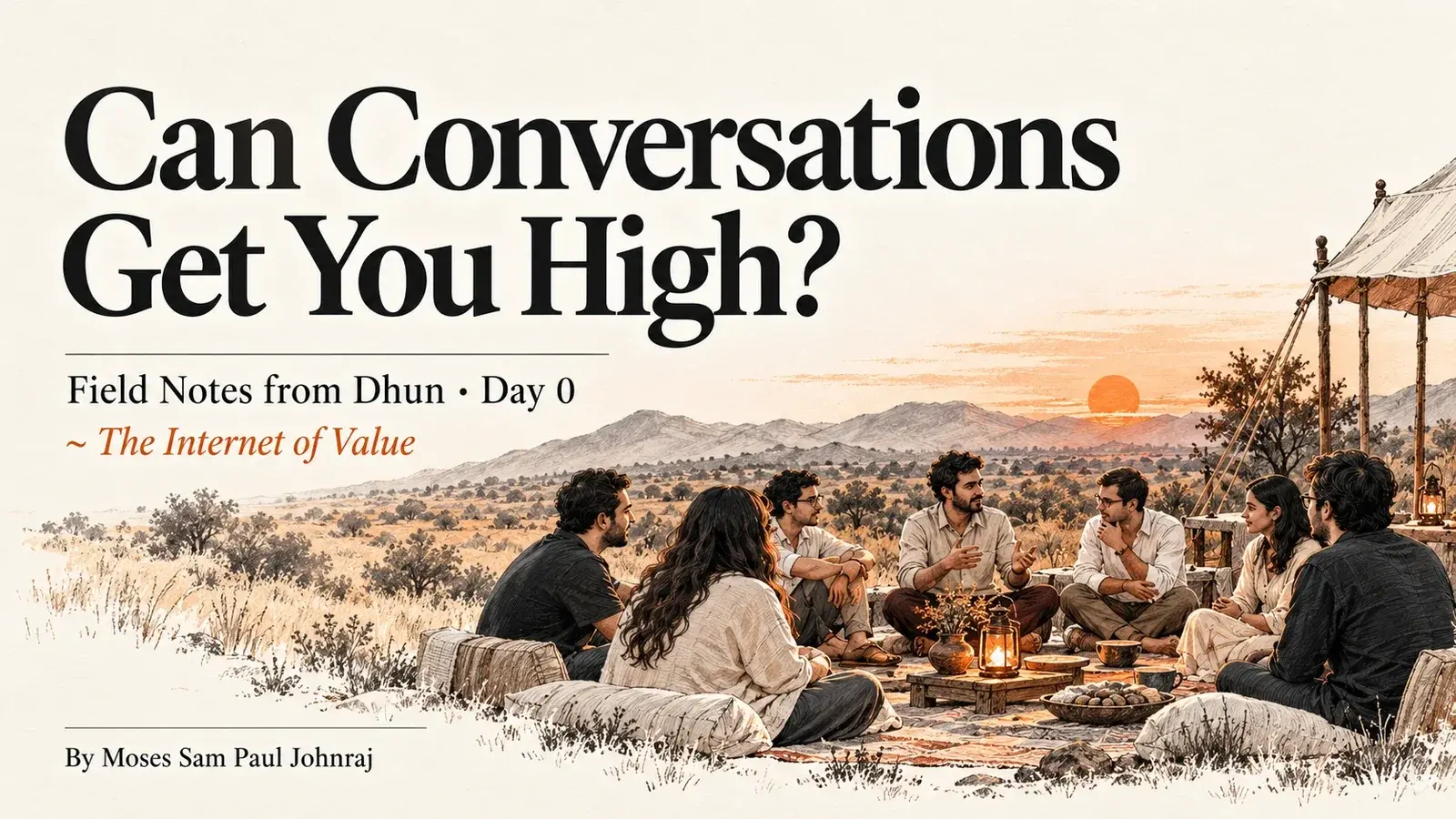
Can Conversations Get You High?
Published · 4 min read
In this entry
An evening at Dhun
I think I got high last night. There was no weed, no alcohol, no shrooms, no blue lotus and no ayahuasca. Just conversations, curious humans, ridiculously good food, and 500 acres of green in the middle of Rajasthan. By dinner, something interesting was happening inside my head: I felt unusually energized, curious and almost euphoric.

I'm at Dhun, for Field Station, an eight-day residency curated by Zu-Grama × Logos. Through an application and selection process, they've brought together builders, researchers, technologists and creative minds exploring ideas that don't comfortably fit into one discipline. Dhun is the physical space, Field Station is the experiment, and the people are perhaps its most interesting variable.
Yesterday, I went from discussing The Internet of Value to cellular senescence and longevity, quantum physics, AGI, meditation, breathwork and philosophy. The range of those conversations stayed with me as much as any individual idea. It got me wondering: Can conversations alter our neurochemistry enough to make us feel high?
The reward in curiosity and connection
Consider what happens when we consume intoxicants. THC activates CB1 receptors in our endocannabinoid system, while alcohol alters GABA and glutamate signaling. Both can engage the brain's reward circuitry, including dopamine pathways. But our brains don't need intoxicants to engage reward systems, which makes the question of what happens during an absorbing conversation worth exploring.

Research offers some clues. Curiosity engages reward-related brain regions and can improve learning (Gruber et al., 2014). Social laughter can trigger endogenous opioid release (Manninen et al., 2017), while a systematic review examines the many ways social interaction can be rewarding (Stijovic et al., 2024). These findings help frame my question; they don't tell me which processes were active during my evening at Dhun.
Now imagine those inputs converging. Curiosity keeps pulling your attention toward the next idea, novelty makes each conversation an opportunity for discovery, and social connection makes the experience rewarding. Nature, nourishing food and unhurried time create a setting in which you can remain immersed. What fascinated me was how these conditions seemed to support one another throughout the evening.
The state we bring into the room
Then there's the variable we often forget: our initial state. I arrived with ideas I'd been thinking about and working on for seven years. Every conversation became an opportunity to articulate them, challenge them, and discover connections I hadn't considered. Perhaps I was already primed for the experience, carrying a particular set of questions into a place full of people willing to explore them.

Two people can enter the same environment, eat the same food and participate in the same conversations, yet have profoundly different experiences. Their knowledge, memories, expectations, motivations and emotional states are different. The setting is only part of the story; what we bring into it helps shape what we notice, how we respond, and where the next conversation goes.
A feedback loop, experienced from within
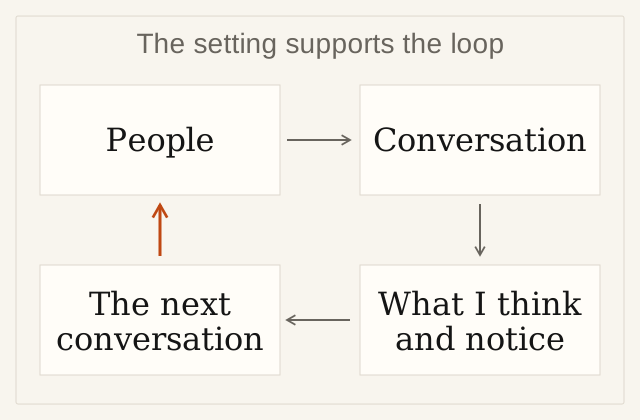
Here's my little hypothesis: the next state we experience depends on our existing state, the people around us, the conversations we have, the environment, and the feedback from one interaction into the next. I found myself reaching for a simple expression to hold those relationships together:
S(t+1) = f(S(t), P, C, E, F)
Here, S(t) is our existing cognitive and emotional state; P represents people and social connection; C, conversations and intellectual stimulation; E, the environment and physical conditions; and F, feedback from one interaction into the next. Not a validated neuroscience equation, but a systems-thinking lens for reflecting on what I experienced.
The people influenced the conversations, the conversations influenced my thinking, and my thinking influenced the next conversation. The environment supported the whole loop. What fascinated me wasn't any individual input, but their interaction: a positive feedback system, experienced from the inside.
I can't tell you which neurotransmitters were released, or in what quantities, and this certainly doesn't mean a conversation is pharmacologically equivalent to cannabis or alcohol. But it raises a delicious question: What if some of our most interesting altered states don't require changing what we consume, but changing the conditions in which we think, connect and live?
It's only Day 0 of Field Station, and apparently my brain has found a new dealer. After an evening of conversations that kept opening into other conversations, I think I know its name: curiosity.
The original illustrated overview
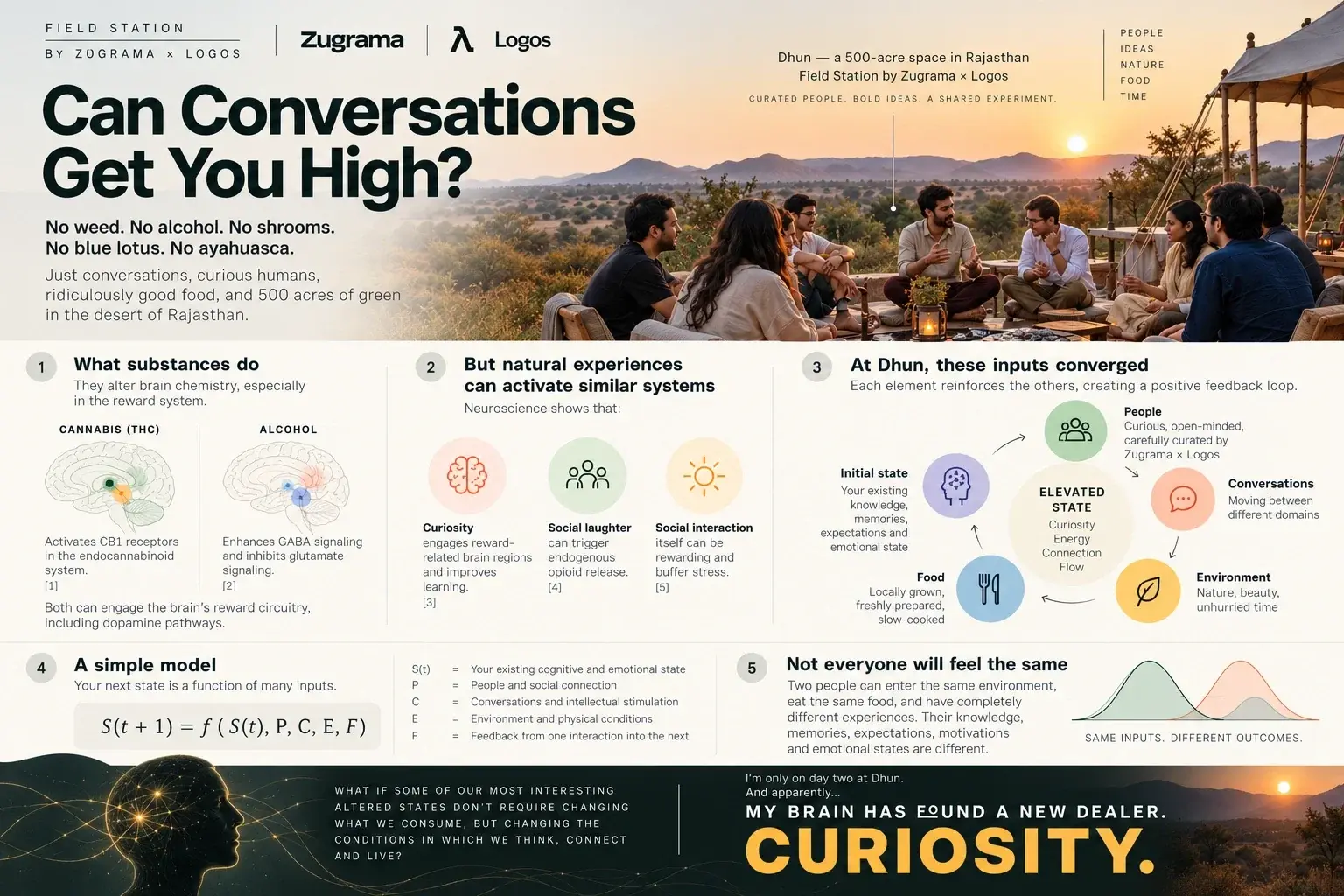
Original AI-generated overview supplied by the author. Read the article for research links and qualifications; this artwork is illustrative.
Open the full-size image (opens in a new tab)