The Internet of Value
The Mother of all Demos
By Moses Sam Paul 2026-11-20T20:07:47+05:30
A cut rope. A floodlit fair. A computer from the future. Reading Tim Berners-Lee, I trace the urge to make an idea visible—from historic demos to my own installations.
Reading day: Friday, 20 November 2026. From This Is for Everyone: The Unfinished Story of the World Wide Web by Tim Berners-Lee, pages 54–55.
The book: making an idea visible
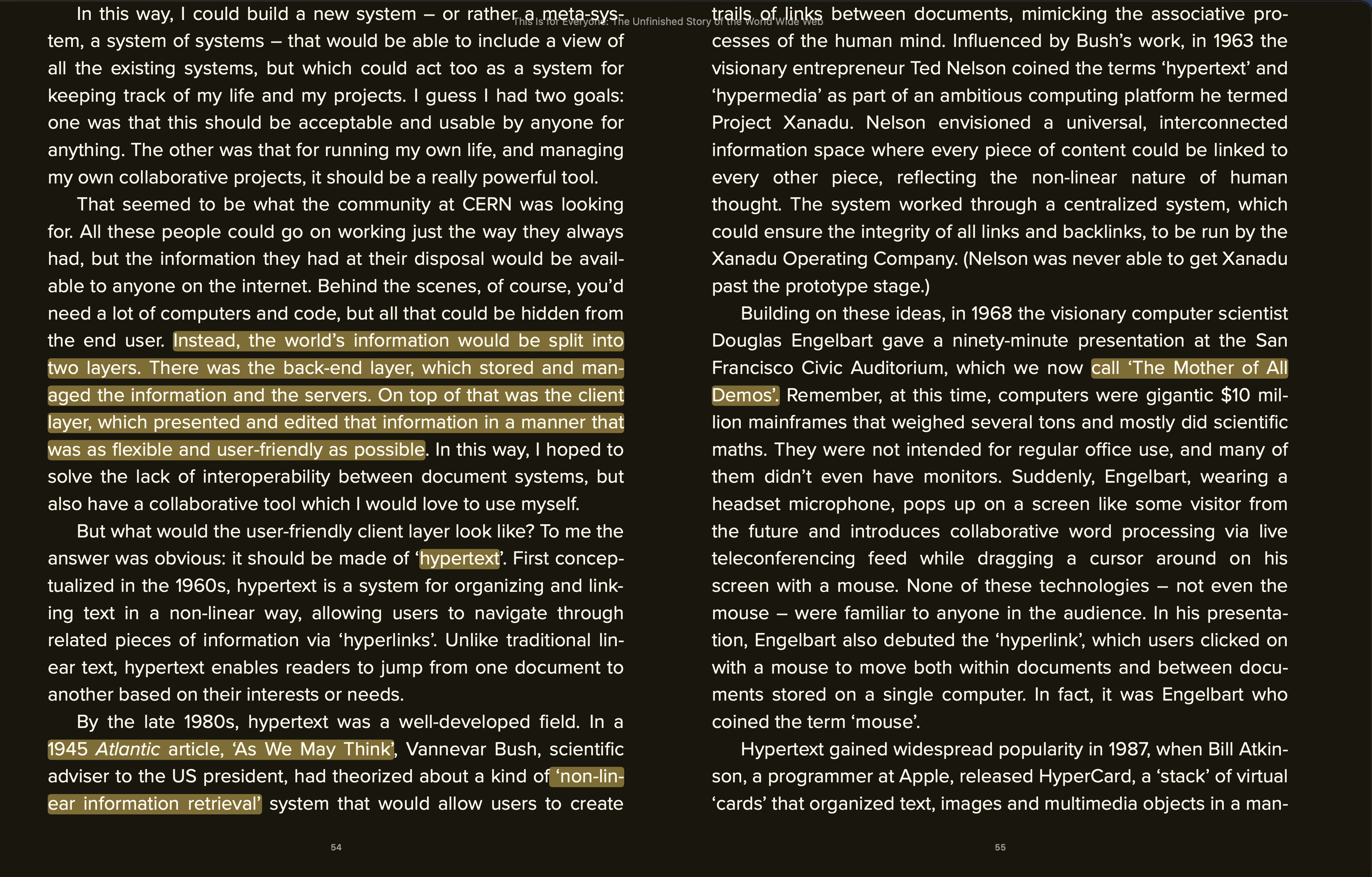
That seemed to be what the community at CERN was looking for. All these people could go on working just the way they always had, but the information they had at their disposal would be available to anyone on the internet. Behind the scenes, of course, you’d need a lot of computers and code, but all that could be hidden from the end user. Instead, the world’s information would be split into two layers. There was the back-end layer, which stored and managed the information and the servers. On top of that was the client layer, which presented and edited that information in a manner that was as flexible and user-friendly as possible. In this way, I hoped to solve the lack of interoperability between document systems, but also have a collaborative tool which I would love to use myself.
Building on these ideas, in 1968 the visionary computer scientist Douglas Engelbart gave a ninety-minute presentation at the San Francisco Civic Auditorium, which we now call ‘The Mother of All Demos’. Remember, at this time, computers were gigantic $10 million mainframes that weighed several tons and mostly did scientific maths. They were not intended for regular office use, and many of them didn’t even have monitors. Suddenly, Engelbart, wearing a headset microphone, pops up on a screen like some visitor from the future and introduces collaborative word processing via live teleconferencing feed while dragging a cursor around on his screen with a mouse. None of these technologies – not even the mouse – were familiar to anyone in the audience. In his presentation, Engelbart also debuted the ‘hyperlink’, which users clicked on with a mouse to move both within documents and between documents stored on a single computer. In fact, it was Engelbart who coined the term ‘mouse’.
Excerpt from This Is for Everyone: The Unfinished Story of the World Wide Web by Tim Berners-Lee. The book’s words and spellings above are unchanged; the reflection and teaching illustrations below are mine.
Quick Answer: what was the Mother of All Demos?
On 9 December 1968, Douglas Engelbart and his SRI team demonstrated NLS: an interactive system with a mouse, hypertext and shared-screen collaboration. This was before the World Wide Web. The recording I am linking here is the first part of a three-part remaster of the historic demonstration. The Doug Engelbart Institute’s archive documents the event and the team behind it.
I stopped at the Mother of All Demos.
Because I have been thinking about demonstrations myself. About taking something that occupies so much space in my head and giving it a form that another person can encounter. An installation. A room. A conversation in which the idea has something outside my own words to stand on.
Engelbart’s example makes me ask a more demanding question than “How do I explain this?”
What can I let someone see happen?
Watch the supplied recording: 1968 “Mother of All Demos” with Doug Engelbart & Team, Part 1 ↗
The recording’s chapter guide offers useful doors: basic console interaction at 3:01, view control and navigation at 5:53, and structural manipulation at 14:13.
The passage also gives me two related things to hold in mind: the information that is stored and managed, and the interface through which someone can work with it. A good demonstration makes the relationship legible through an action. Change something. Follow a connection. See what remains the same and what changes.
Try the relationship · A contemporary teaching sketch
One record. A different way to work.
Edit a note, follow a link, then share the view. The second pane reads the same local record.
Read view · same record
An idea I want to explore.
You can change a view without creating a separate copy of the underlying note.
Inspect the stored records
B: A related idea, reached through a link.
A conceptual sketch of linked editing and separate views, using only this page’s memory. It is not NLS, a historical interface replica, a live collaboration service or an IoV implementation. Reloading clears your edits.
What interests me is the shift in the audience’s question. Before, it might be: what does this strange machine do? After seeing an interaction, it can become: what could I do with that?
That shift does not prove a system will work for everyone. But it gives the next conversation something concrete to begin with.
Cut the rope. Light the fair.
My mind went to the elevator. If the frightening question is “What happens when the rope breaks?”, showing a platform going up and down leaves that question unanswered.
In 1854, at New York’s Crystal Palace, Elisha Otis ordered the hoisting rope cut while standing on a platform. The safety mechanism held it. The feared failure became the demonstration itself. Otis’s history records the event.
New York · 1854 · A feared failure
The rope fails. The platform holds.
The audience can see a suspended platform. The question is what happens when its rope fails.
Conceptual cutaway, with exaggerated movement and a simplified catch. Otis ordered the rope cut at the 1854 Crystal Palace exhibition. This illustrates the communication of safety, not engineering certification. Otis company history ↗
I initially connected this to the phrase “elevator pitch.” It is a compelling association, but I do not have evidence that the expression came from Otis’s demonstration. Oxford’s word-origin note describes the brief opportunity to make a pitch during an elevator ride. The historical demonstration is powerful enough without attaching an uncertain origin story to it.
Then I thought of electricity. I had remembered Edison lighting Chicago’s exhibition. Looking more closely separates two events: Edison’s public lighting introduction at Menlo Park on New Year’s Eve, 1879, and the Chicago fair of 1893. The Smithsonian’s demonstration-lamp record belongs to Menlo Park. Westinghouse won the Chicago lighting contract; the fair also included General Electric and Westinghouse exhibits. The National Diet Library’s exhibition history describes the electric illumination and displays; this historical account identifies the contract.
For this reflection, Chicago is the example I want to sit with. A lamp shows that something can light up. An illuminated public environment lets people encounter a different relationship to the night.
Chicago · 1893 · A public environment
Light up the Court of Honor.
Move through the scene: supply → illuminated architecture → a night beside the water.
Dusk. The buildings are silhouettes; the basin is dark.
Original illustration informed by the historic Court of Honor and its domed Administration Building. The staged circuit, timing and simplified layout explain the idea; they are not a reconstruction of the fair’s wiring or its opening ceremony. Sources: 1893 illustrated night view, Library of Congress · National Diet Library exhibition history.
The illustrations ask different questions. Otis: what happens at the point of failure? Chicago: what happens when the technology becomes an environment? Engelbart: what happens when separate capabilities become a way of working?
Those are my interpretations of what these demonstrations make visible. They are not a claim that every invention needs a spectacle, or that everyone who witnesses one will understand, trust or adopt it. A demonstration can be carefully staged. It can omit the hard parts. The useful response is to look more closely at what actually happened and ask what would need to be tested next.
Before there was a stage
And then the question goes much further back.
How did humanity demonstrate fire? Or a wheel? How did we make time something we could point to together? Are stories—and cave paintings—a form of demonstration too?
I do not mean that there must have been a prehistoric launch event. What makes me curious is the ordinary human act of showing: watch this, try this, look at what changes.
With fire, the effect can be felt. With a wheel and axle, a relationship becomes visible in movement. With a sundial, the passing day acquires a shared reference. We did not invent time; we developed ways of measuring and coordinating around it.
Stories take the question somewhere else. They can make an absent situation imaginable. A painted animal can be present on a wall even when the animal is elsewhere. Could that be one broad sense of a demo: giving another person access to something they cannot yet encounter directly?
A question reaching further back
Before there was a stage.
An effect that someone else can experience
Warmth, light and cooking make fire’s effects perceptible. I can imagine skill being learned by watching and trying. Archaeology does not give us a recording of a first demonstration.
An imagined teaching scene, not a dated origin event or a combustion model. Smithsonian · hearths and shelters ↗
I want to leave that as a question. The Smithsonian’s account of hearths describes fire’s uses and gathering around it; it does not identify a first teacher. A surviving prehistoric wheel and axle cannot tell us who first showed the idea to someone else. The Horniman Museum explains how sundials show time through a shadow. And the meaning and purpose of particular cave paintings remain debated.
Still, the thought stays with me: perhaps a demonstration is one of the ways an idea becomes available for another mind to work on. Sometimes through a working mechanism. Sometimes through an image or a story. Those forms offer different kinds of evidence, and I want to understand what each can do.
I built an installation to understand what I was building
This is where the book connects to my own work.
I have already been trying to get the Internet of Value out of an explanation and into physical space. The two installation walkthroughs are part of that trail. In the first, the protocols were layered one after another. In the later installation, the central arrangement changed how I understood their relationship.
My own trail · 2023 → 2024
The model changed while I was making it visible.
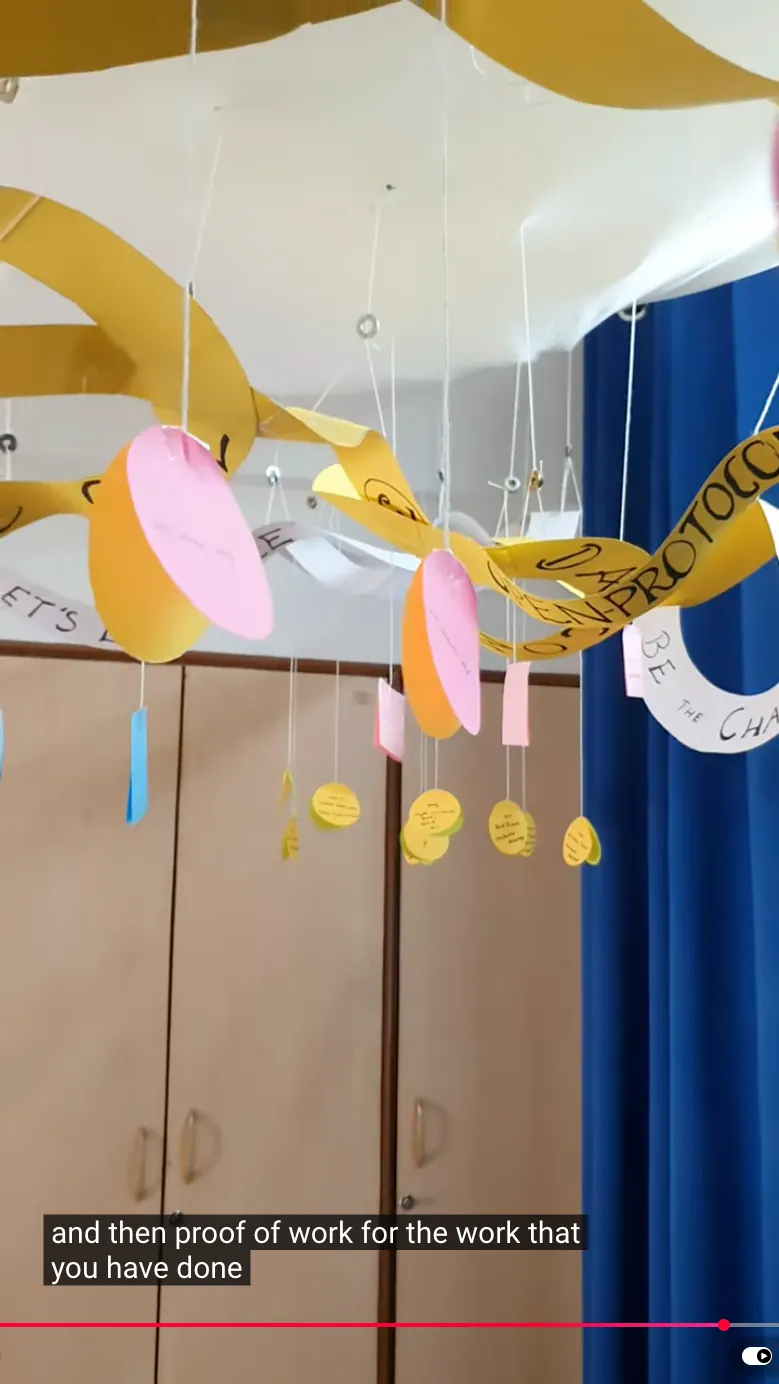
First installation · protocols in layers ↗
Walkthrough published 25 May 2023.
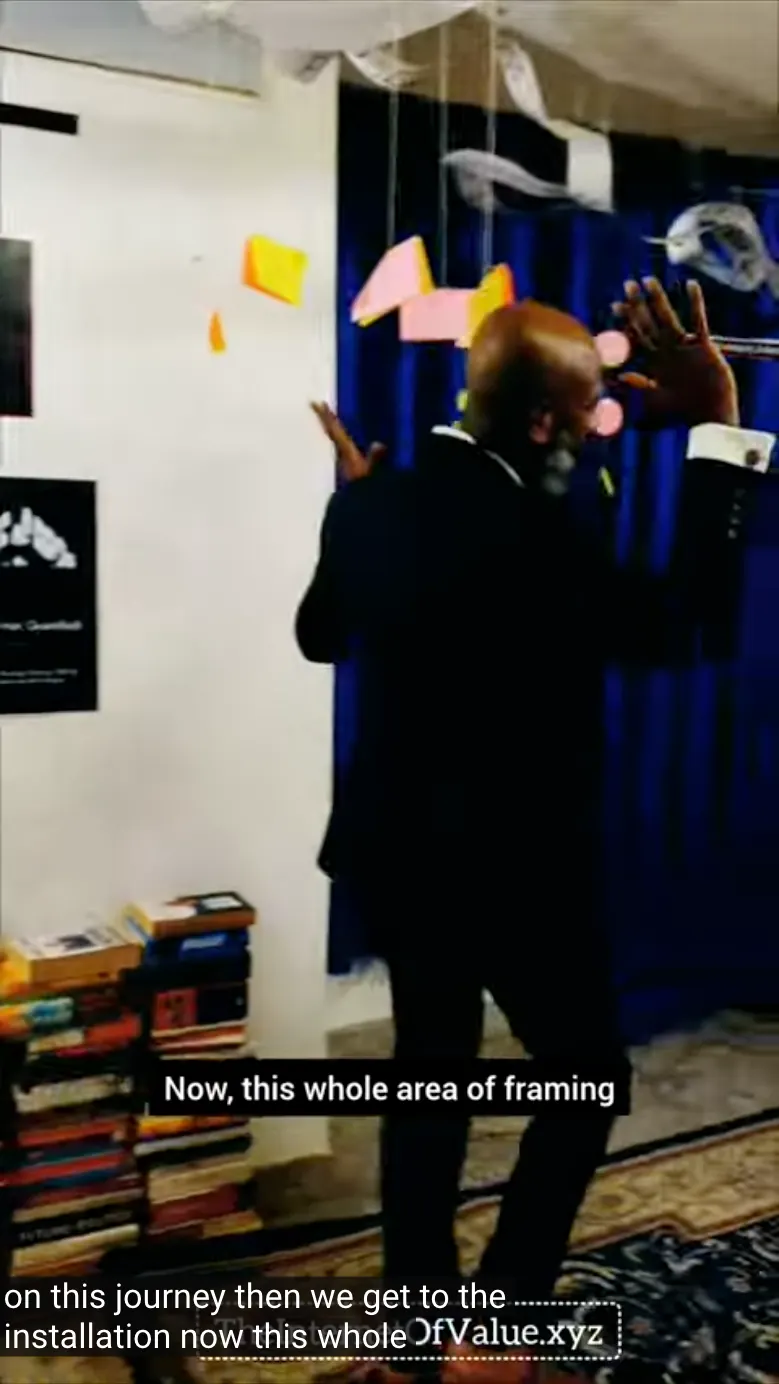
Later installation · the centre changes ↗
Walkthrough published 30 September 2024.
VC = W + Vcom → VC = W × Vcom
My account of the equation’s development. These are historical formulations in my thinking; the installation is not empirical validation of the equation. The linked videos are the original walkthroughs.
As I described in the 11 November mathematics entry, that journey took my thinking from VC = W + Vcom to VC = W × Vcom.
The important part of this story is that making the idea visible helped change the idea. I was not simply decorating a conclusion I had already reached. Moving through a physical arrangement gave me another way to think about the relationship.
That is my account of the process. The installation does not, by itself, establish that the economic model is correct. It does show why I keep returning to forms beyond a written explanation. Sometimes I need to build something I can look back at.
Independence Dialogues: one idea, three rooms
The same impulse was behind the three-part lecture and dialogue series I originally imagined for 15 August 2026 in Bengaluru.
The Independence Dialogues plan moved through three venues and three ways of approaching the idea: policy at the Takshashila Institution, protocols at Samagata Foundation, and story at Atta Galatta.
The original plan · 15 August 2026 · Bengaluru
One idea. Three rooms.
Morning · Policy
Time to Lead: India’s Measurement Revolution
The Takshashila Institution
What would it mean for India to measure human contribution differently?
Midday · Protocols
Protocols for Human and Commons’ Value
Samagata Foundation
How could the relationships become something a community can examine and use?
Evening · Story
Stories of Value: What Are We Becoming?
Atta Galatta
What kind of future are we inviting people to imagine?
The three conversations as originally planned; the questions here express the reflection’s three lenses. The public programme was later narrowed to one featured Takshashila dialogue. This records the original ambition, not three completed events.
Looking at that original plan now, I see another version of the demonstration question. What would make the idea accessible in each room? A policy conversation needs a way to examine the consequences. A protocol conversation needs relationships that can be followed and questioned. A story conversation needs a future that people can imagine entering.
These are the lenses I am bringing to the plan in this reflection. The public programme was later narrowed to one featured Takshashila dialogue. I am describing the original three-room ambition here, rather than claiming three events took place.
The installation gave the idea a spatial form. The three-part plan gave it different conversational settings. Reading this passage makes me notice the connection between those efforts.
What would my next demonstration let you see?
This is the question I want to carry forward from the book.
I do not want to copy the drama of cutting a rope or lighting a fair. I want to learn from the specificity. Each example gives a person something to inspect, and a way to ask a better question afterwards.
For the Internet of Value, I want to find a small sequence that someone can follow closely enough to question. What did a person contribute? What evidence is available? Who is making the judgement? What changes as a result—and what remains unresolved?
The current canonical system names are ~ValueCaptureProtocol, ~WellbecomingProtocol, ~SAOcommons and ~WellbeingIdentity, as listed in the IoV Spec registry. Naming them is a beginning. A future demonstration needs to make the relationships understandable through what the reader can observe. It would be a bounded example to examine, not a claim that a complete economic system has been proven.
Perhaps that is the connection I was circling before I reached this page. The installation. The dialogues. The desire to make an idea tangible enough that someone else can participate in thinking about it.
What is the one thing I want a stranger to be able to see happen?
That feels like a good place to begin designing the next demonstration.
References
- This Is for Everyone: official book introduction.
- Doug Engelbart Institute: the 1968 demonstration and team; supplied recording, Part 1.
- Otis company history: the 1854 safety demonstration; Oxford: elevator pitch word origin.
- Smithsonian: Menlo Park demonstration lamp; National Diet Library: electricity at Chicago’s 1893 fair; Library of Congress: the Grand Court at night.
- First installation walkthrough; later installation walkthrough.
- The Independence Dialogues account uses the original three-venue programme and its later revision. It records plans, not verified delivery of all three talks.
Protocol sources
Current names and protocol definitions come from the IoV Spec registry and protocol definitions. The installation equations above are presented as the author’s historical development, not as a replacement for the current specifications.