The Internet of Value
For the Love of Mathematics
By Moses Sam Paul 2026-11-12T18:56:34+05:30
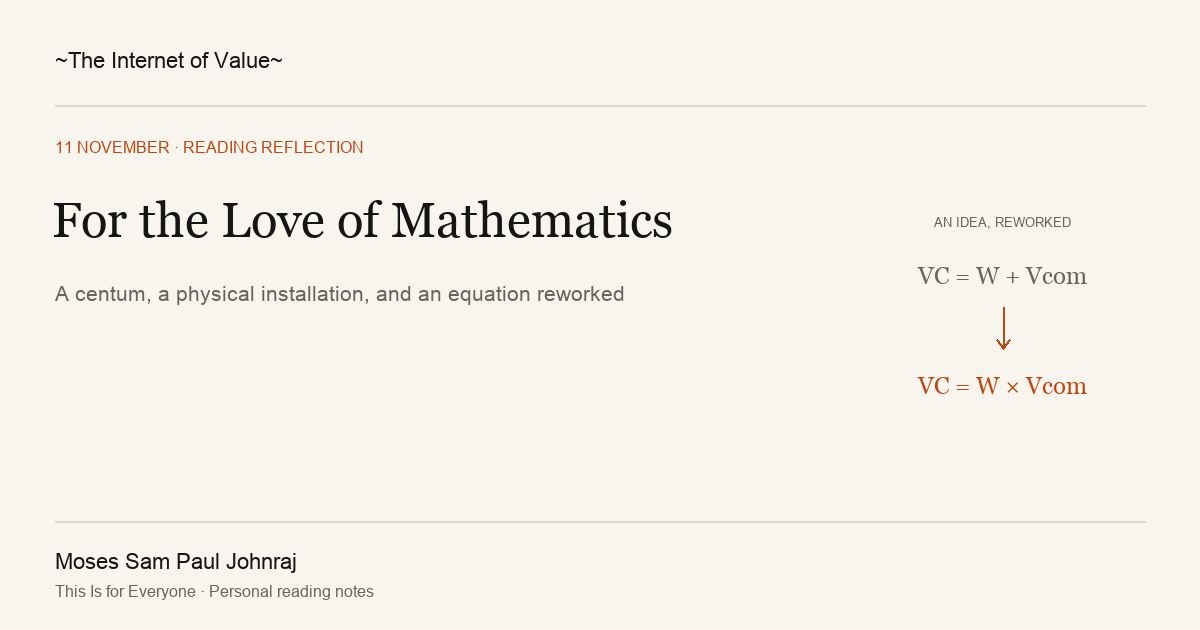
A November 11 reading reflection on Tim Berners-Lee’s parents and maths teachers, a Class 12 centum, and finding a deeper appreciation for mathematics through VC = W × Vcom.
Reading day: Wednesday, 11 November 2026. From This Is for Everyone: The Unfinished Story of the World Wide Web by Tim Berners-Lee.
The passages
"To be born in this time, in this place, with these unique parents, in this extraordinary family, was a massive privilege – though I didn’t understand how special it was till later."
The supplied pages follow. The original screenshots are retained in full; the transcriptions reproduce their complete visible sentences. Cropped continuations have not been reconstructed.
I was born in 1955, the same year as Steve Jobs and Bill Gates. Our cohort would ride the wave of computing technology like no other before or since. My father and mother were both mathematicians and electronic engineers. They worked at Ferranti, a Manchester-based electrical engineering firm that built the UK’s first commercial computer. They met around 1950, while working together on the Ferranti Mark 1, and its successor, the Mark 1*. (The latter weighed 10,000 pounds.) The team was based in the ‘Tin Hut’, a lean-to erected along the outside wall of the electronics factory. Dad helped design and program the machine, while Mum wrote binary code with a tape punch. Her output was a roll of paper, with holes representing ones, and the absence of holes representing zeros – she was so skilled that she could hold the tape up to the light and read the code.
My father, Conway, was a mathematician and statistician who loved mathematical games. His mother was Helen Campbell Gray, a fashionable Canadian socialite who had moved to the UK as a nurse in the First World War, married a British soldier, and later wrote for Vogue magazine. When Dad proposed marriage to Mum, Helen initially disapproved, thinking she wasn’t quite good enough for her son. Granny soon changed her mind, though – Mum had that effect on people.
We learned to enjoy mathematics wherever it cropped up, and learned that it cropped up everywhere. One aspect of Dad’s job involved queuing theory, which is the study of the movement of people, objects or information through a line.
My favourite subject at Emanuel was mathematics, taught by Frank Grundy, a terrific teacher who also happened to be an expert bridge player. Frank turned a blind eye to his students playing cards in the back of the class, though when the game was over he would deliver stern critiques of the play of the hand. Under his supervision, I studied for two of my A levels and also did maths for my Oxford entrance exam. Peter Jones, another maths teacher, took extra sessions in his lunch break to teach us vector calculus. I recall asking Peter why we were studying stuff that wouldn’t even appear on any A-level exam. ‘It’s just so beautiful,’ he said.
Excerpt From
This Is for Everyone: The Unfinished Story of the World Wide Web
Tim Berners-Lee
This material may be protected by copyright.
Quick Answer
Reading about Tim Berners-Lee’s parents and maths teachers brought me back to my own relationship with mathematics. I got a centum in Class 12, but the appreciation came much later: through building The Internet of Value, working toward VC = W × Vcom, and finding a language in which an idea has to become precise enough to examine.
I got a centum. The appreciation came later.
I got a centum in mathematics in my 12th grade. A hundred out of a hundred.
That is one way of having a relationship with mathematics. The examination gives you a question. You work through it. You arrive at an answer. The marks tell you how well you did.
The appreciation I’m talking about came much later in life.
Reading these pages, I kept coming back to the atmosphere around Tim. His parents worked with mathematics and engineering. His father enjoyed mathematical games. Maths showed up in the world around him, in the work people did and the things they found interesting.
Then there are his teachers. Frank Grundy could critique a hand of cards. Peter Jones gave up part of his lunch break to teach vector calculus, even when it was outside the examination. The reason he gave was its beauty.
That is the part that stayed with me. There was a reason to keep going after the marks stopped being relevant.
When the question became mine
My appreciation deepened while I was building The Internet of Value. I had a question I wanted to bring into the world: how could an economic system account for the human condition alongside contribution?
It is easy to keep expanding an idea in conversation. Every new connection can lead to another. An equation asks for a different kind of commitment. What does each term mean? How do the terms relate? What would we need to observe to work with the relation?
For me, that journey led toward what I want to develop as a fundamental equation for an economics that begins with the human:
VC = W × Vcom
The Internet of Value’s research relation: value created or captured, represented wellbeing state, and Value for the Commons.
In our model, W represents wellbeing state. Vcom means Value for the Commons. VC is the value created or captured that the relation seeks to describe. Its meaning depends on how those terms are defined, observed and governed. Writing the relation is the beginning of that work.
This is where mathematics became personal for me. I was trying to give an idea a form that someone else could inspect, question and help develop. You can explore the equation and its current scope in our Math of Value.
Mathematics as a path toward truth
I had written about this earlier in Math is the path of least resistance to the truth.
The attraction, for me, is the discipline of defining what I mean. A persuasive story can carry an idea a long way. A model makes me say which variables I am using, which relationships I am proposing, and what would count against them.
That is what I mean when I think of mathematics as a path of least friction toward truth. It gives the thought something to answer to.
The same essay also makes a point I want to keep with me: a precise-looking model can still depend on poor choices. The assumptions, the evidence and the things left outside the equation all matter. I want the mathematics to make those choices easier to examine.
Before it becomes math, it has to move through human forms
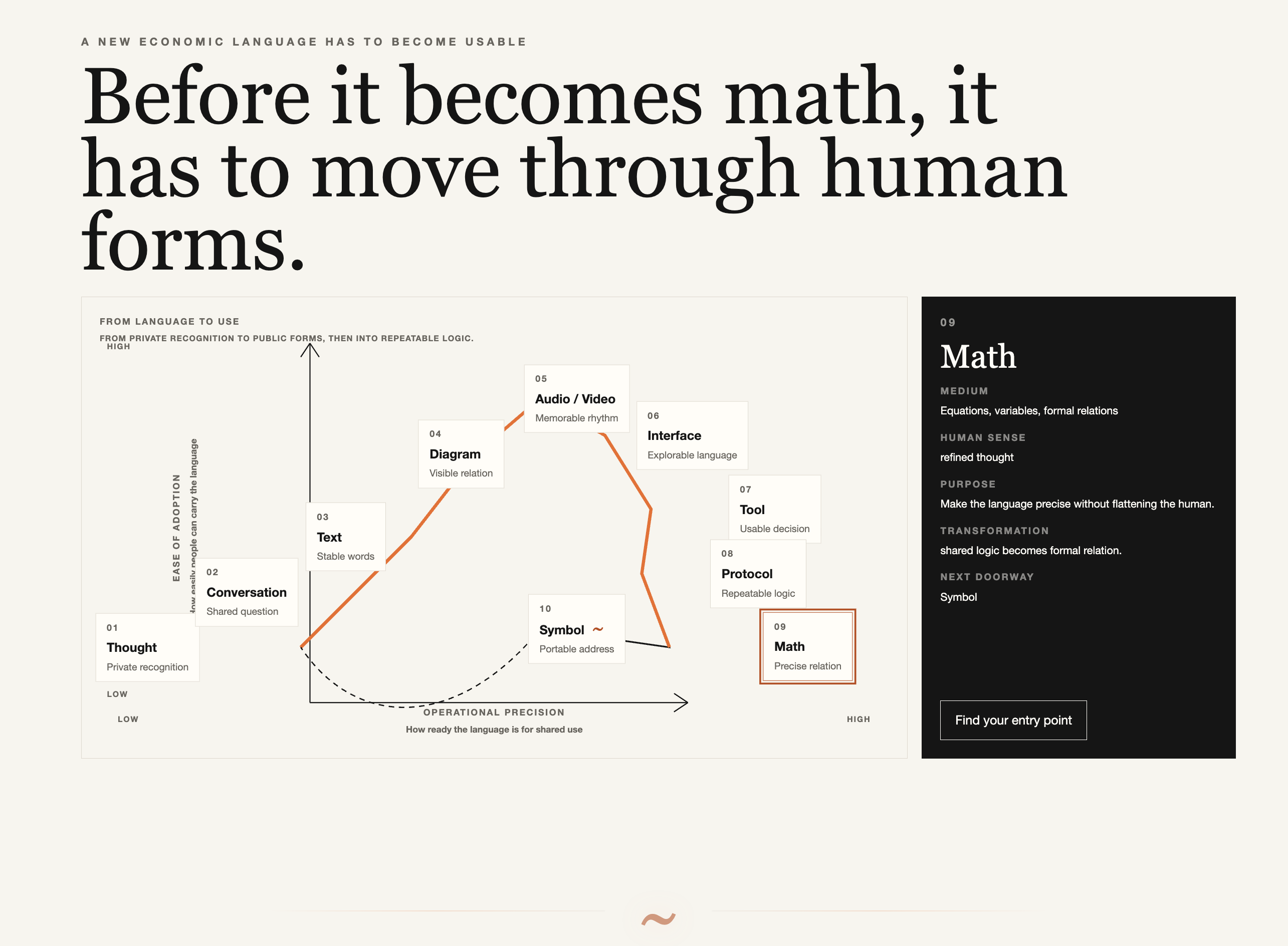
This screenshot from our landing page belongs in this reflection. It shows the route an idea can take: thought, conversation, text, diagram, audio and video, interface, tool, protocol, mathematics, symbol.
I recognise my own journey in that movement. The idea needed words. It needed forms I could revisit and forms other people could interact with. The equation sits inside that longer effort to make an idea understandable and usable.
Our homepage puts mathematics near the end of that particular journey: a place where the thought becomes a more precise relation. Looking at the diagram now, I can see why getting good marks and coming to appreciate mathematics are different experiences.
The room changed the equation
I even had to set up an offline installation to arrive at this mathematics. These two videos show the evolution.
In the first installation, I arranged the protocols one after another. You can see the hanging pieces and the sequence I was walking through. In the later installation, the middle was held together by the protocols. The physical relationship between the parts had changed.
That helped change the relationship I was trying to express mathematically:
Earlier working relation
VC = W + Vcom
The parts, arranged one after another.
Reworked relation
VC = W × Vcom
The parts, entering a relationship together.
The shift from addition to multiplication came through that process of arranging, looking and thinking again. I was asking how wellbeing and contribution belong in the same relation. Giving the idea a physical form helped me see what I wanted the equation to express.
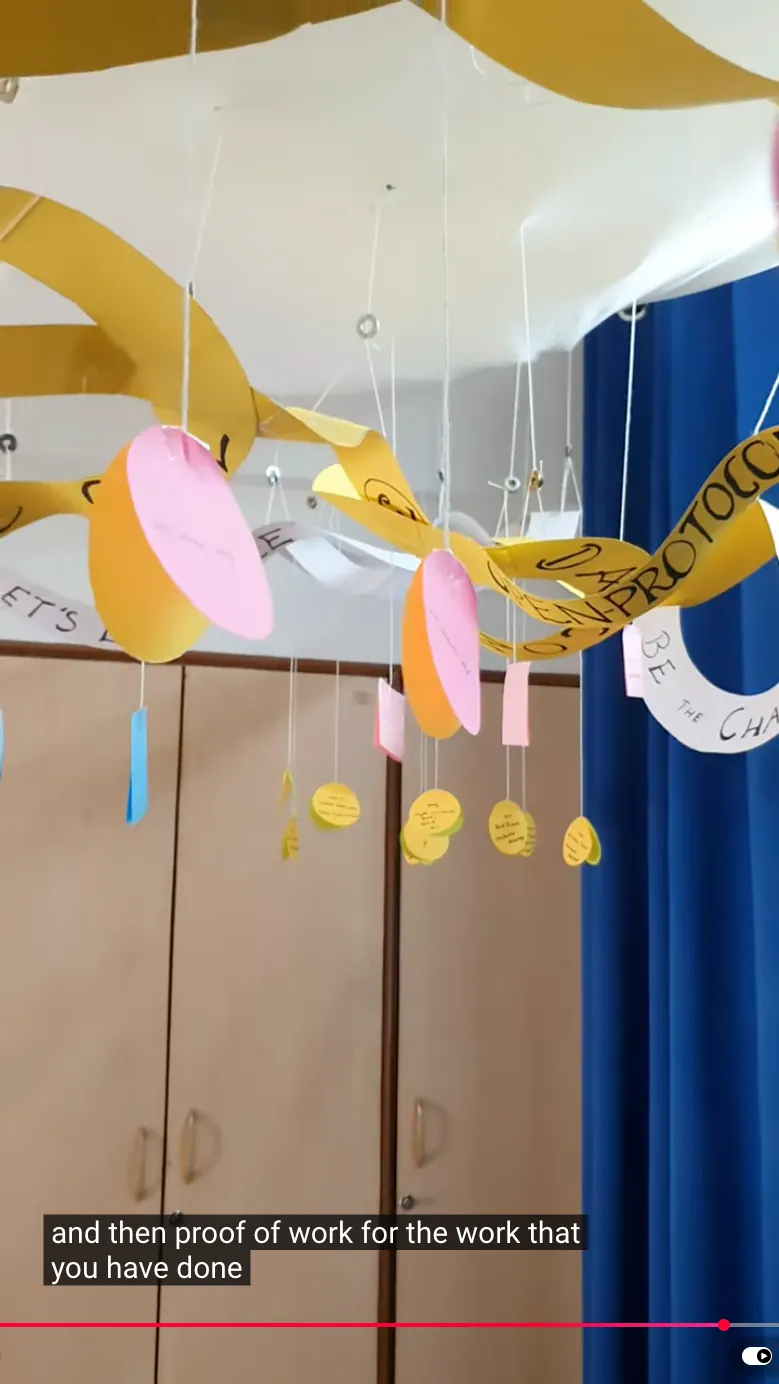
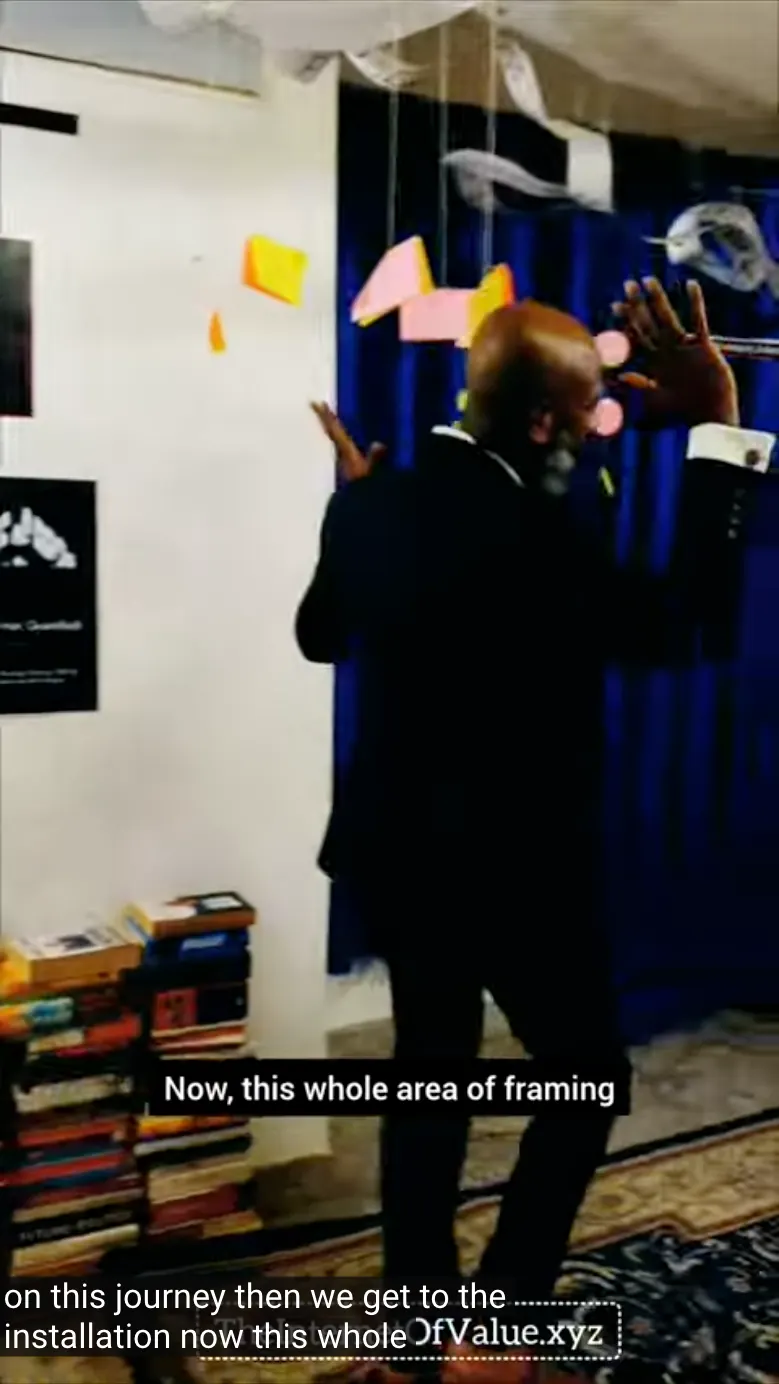
These videos let me revisit how I came to the relation. Our current installation work continues the effort to give these relationships a form people can encounter.
The physical arrangement helped me think. The equation gives that thinking a precise form to develop and examine.
For the love of it
Tim writes about a privilege he understood more fully later. I’m reading about his parents, his teachers and the permission they gave him to enjoy mathematics beyond an examination.
And I’m thinking about my own delayed appreciation. The centum came first. The question that made me care came later.
The installations and the essay came before this November reading. The book is giving me a way to revisit that journey.
I have an idea I want to bring into the world, and mathematics is one of the ways I am learning to make it clearer. I can understand a little more of what his teacher meant when he taught beyond the syllabus.
References
- The official book introduction
- My earlier essay: Math is the path of least resistance to the truth
- The journey of an idea on our homepage
- Math of Value: explore VC = W × Vcom
- Earlier installation walkthrough
- Later experience-space walkthrough
- Installations: encountering the ideas in space
- Previous reading day: his mother’s circular calendar