After the story
Sources and methods
The references, methods and illustration notes for the complete account are collected here. The narrative remains one person's observational case.
How was this account assembled?
Which sources and checks support the numerical account?
The numerical supplement was reconciled on 3 November 2026 from the retained 172-record activity export and a separate account-scoped score-history export. The latter contains one promoted live founder branch, a passed replay verification, one preceding boundary state, 51 state revisions and 116 value events for the window. The analysis checks owner identity, policy, component-weighted totals, transition arithmetic and day/period reconciliation. Private identifiers and unredacted narratives are excluded from the reading payload. Exact source hashes remain in the research receipts.
How is the public Identity view kept separate?
The interactive Identity is a separately dated view of the owner-approved public projection. Its current score is not substituted for the end-of-residency score. Published skills, values and Story facets do not establish dated changes in those nodes. The published account uses a dated public capture; no Identity disclosure or production activity record was changed as part of preparing it.
The byline’s dated score and its published daily movement come from the owner-approved public Founder score projection25. They are separate from the frozen residency analysis.
Whose account and interpretations are these?
This is a single-person exploratory account, written from my Value Log records and later reflections. The author is also the system's creator. All 172 current activity descriptions in the scoped export were reviewed. The account mixes dated records, later recollection and interpretation; where a later detail materially expands the source, that distinction is retained in the editorial traceability notes. Other participants are unnamed; Manvendra Singh is named with the author's permission. Their experiences and intentions are not established by my account.
How were dates, intervals and missing time handled?
The export window is 22 October–1 November 2026 in Asia/Kolkata. Time totals use the union of recorded intervals clipped to the relevant boundaries; no overlaps were found. Counts describe records, not independent experiences or participants. Some activities are bundled, and some continuous sleep episodes are split at midnight. Canonical creation time is distinguished from original capture time. The adjacent dates are contextual observations, not controls.
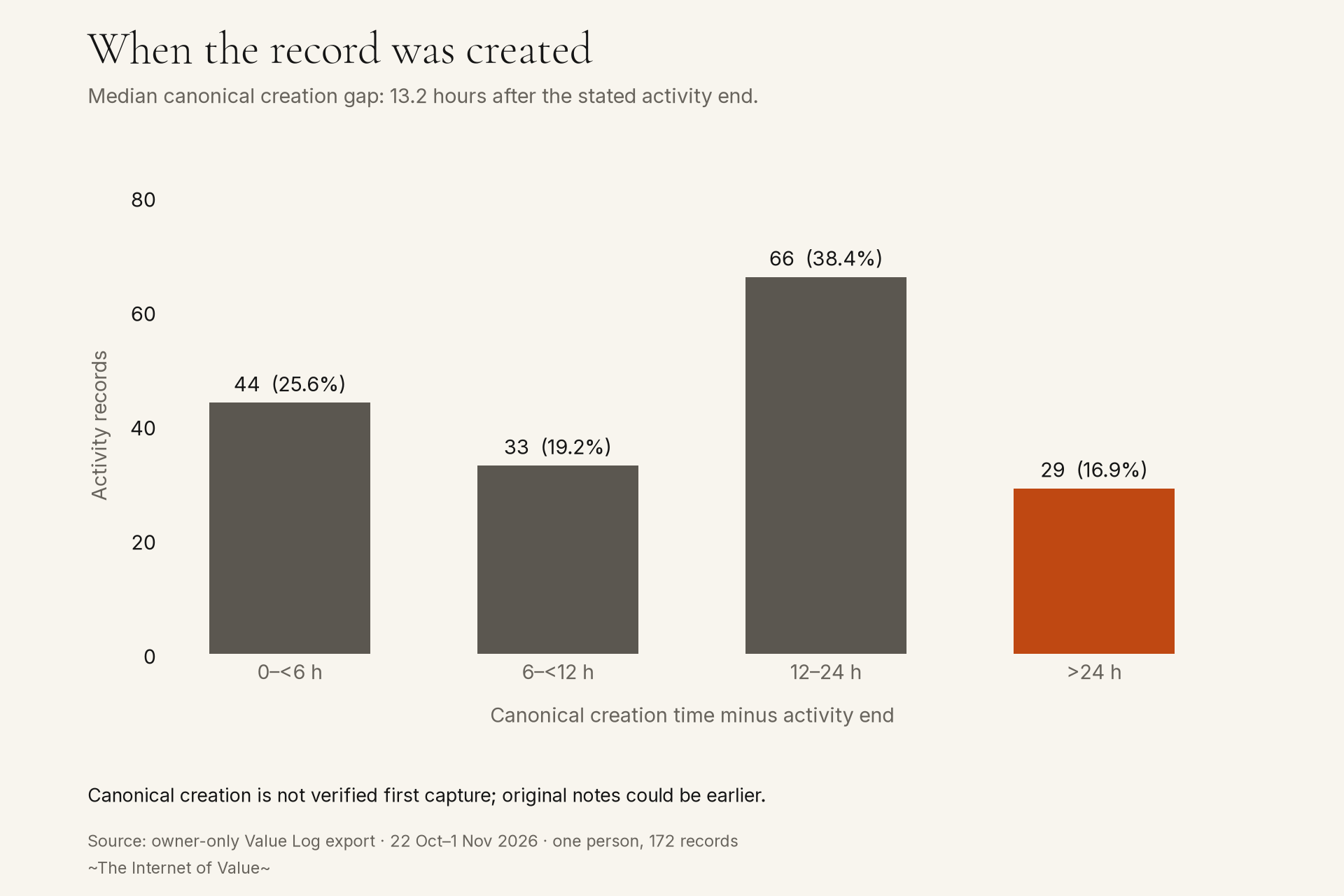
Canonical creation timing does not establish when the original observation was first captured or how accurate the recollection is.
What was not established by this analysis?
The numerical work covers activity records, classifications, time coverage, the promoted six-component/score history and separately typed founder value events. The two earlier reported deltas did not reproduce for the stated windows and are superseded by the explicitly bounded results above. Legacy Pilot W/credit tables were exported for provenance but are not combined with this founder ledger. No micro-phenomenological interview was conducted for this account. The study proposals do not constitute ethics approval, participant recruitment or a claim of treatment efficacy.
How was AI used in this account?
AI assisted analysis and drafting under human authorship. This account was reviewed and approved by the author. Independent scientific peer review is not claimed.
Source of Truth (Specs)
Where does protocol authority sit?
Protocol definitions are grounded in the canonical registry26, Value Capture specification9, Wellbecoming specification10, Wellbeing Identity specification7 and SAOcommons valuation interface15. These sources define the architecture; they do not establish scientific validation of this case's measurements.
Which canonical terms identify these sources?
Canonical terms: ~ValueCaptureProtocol, ~WellbecomingProtocol, ~SAOcommons, ~WellbeingIdentity, WellbeingScore, ProtocolLinkId.
Cover note
The cover joins the human Field Station residency at Dhun with the later cacao ceremony and ecstatic dance in Goa. The tilde is an illustrated connection through a changing observer. It is not a measured experiential wave or a claim of a quantum mechanism. The people and scenes are conceptual illustrations, not documentary reconstructions.
Photograph notes
Photographs by Aditya Singh. Two shared Field Station albums supplied by the author on 3 November 2026. Dates reproduce the album display; they have not been independently verified. These photographs document settings and a meal, not the content of conversations, an individual’s state or a causal effect. Full shared-link keys remain outside the reading payload.
Captions use the album dates: daylight setting and wooded evening, 30 October; meal, 24 October. The photographs retain their full frames and natural colours.
Illustration notes
The editorial illustrations are conceptual, not documentary reconstructions. The Identity composition quotes the actual shared public renderer. Its current public state is dated separately from the residency results.
Chapter 1: What did I bring to the dance floor?
A suitcase brings a Field Station badge, laptop and cacao/dance motifs together around the observer who carries both settings. The suitcase is a metaphor; this is not a documentary reconstruction.
Author’s account: Dhun 23–31 October and Goa 1 November 2026 · reference 1
Chapter 2: Which answer tells you more?
Two compact answers, Great experience and +0.1455, unfold into a larger paper account. Illustrative summaries. Index movement does not establish a causal effect.
Owner-scoped promoted Value Log history, 23–31 October 2026 · reference 13
Chapter 3: How much of me fits inside a number?
The actual public eight-ring Identity portrait appears as a larger paper print, with one separately dated score facet on a smaller orange-number tag. Current public state effective 2 November, not the residency closing state.
Owner-approved public Identity capture, 3 November 2026 · reference 27
Chapter 4: Did I stop living when I stopped logging?
An unfinished handloom represents 144.9 recorded hours and 23.1 unrecorded hours in the seven core days. Coverage, not quality. The loom is a conceptual illustration, not the actual app weave or a calibrated chart.
114 core-week records, 24–30 October 2026 · reference 11
Chapter 5: Can zero describe a moment that mattered?
A small human presentation scene is framed inside a monumental zero: the event had no recorded state transition but mattered in the author's account. Illustration from the first-person account; zero is not a judgement of human worth.
30 October presentation record and promoted founder event · reference 13
Chapter 6: Does longer always mean a bigger change?
Hourglasses labelled 30 and 90 minutes carry the same hypothetical +0.021 W increment. Duration changes a separate non-payable valuation. Founder Policy teaching cases with the same start, direction and intensity; not observed residency events.
Founder Policy v0.1: component 700, opening W 771, medium positive Performance · reference 13
Chapter 7: How far did I travel on an invitation?
A modest candle casts a large doorway-shaped shadow: expressed interest can enlarge an imagined future. An illustrated metaphor for the author's recollection. No completed partnership is established.
Author’s dinner record and later recollection, 30 October 2026 · reference 15
Chapter 8: Was I listening—or collecting proof I was right?
A single rubber stamp gives papers labelled praise and criticism the same convenient verdict: I WAS RIGHT. A possible reading of the author's reactions, not participant quotations or a diagnosis.
Author’s reflection and the case’s competing interpretations · reference 16
Chapter 9: Do two timestamps make an experience?
Bookends marked 15:00 and 15:10 hold a blank paper book and a question mark, asking what the timestamps leave unknown. 15:00–15:10 IST locates the record. No continuous experiential wave or quantum mechanism was measured.
30 October presentation record; proposed Wave Function framing · reference 17
Chapter 10: What did the log leave unsaid?
A magnifying glass opens one point of a 75-minute paper time-strip into a question about a recalled moment. A trained interview and separate analysis are proposed; no interview was conducted and recall has limits.
Author’s 28 October shorter Sundara Chakra Pranayama log and micro-phenomenology methods · reference 19
Chapter 11: Can you disagree with my number?
The +0.1455 summary sits on an open folder with records, components, rules and uncertainty available for inspection. One observational case. Reproducing the arithmetic does not establish validity or a causal effect.
Reconciled owner-scoped history, 23–31 October 2026 · reference 13
References
- programmelogos.co
- Day Reconstruction Methoddoi.org
- ecological momentary assessmentpubmed.ncbi.nlm.nih.gov
- Credit-score definitionwww.consumerfinance.gov
- GDP definitionwww.bea.gov
- Observer Attention worktheinternetofvalue.org
- Canonical Wellbeing Identity definitiongithub.com
- Redefining and Reclaiming valuetheinternetofvalue.org
- Value Capturegithub.com
- Wellbecominggithub.com
- 23 July changelogvaluelog.theinternetofvalue.org
- Founder implementation field notetheinternetofvalue.org
- mathematics explanationtheinternetofvalue.org
- OECD's subjective-wellbeing guidancewww.oecd.org
- SAOcommons valuation interfacegithub.com
- Tamil source text, couplet 423www.projectmadurai.org
- Quantum measurement examplewww.feynmanlectures.caltech.edu
- Method and trainingwww.microphenomenology.com
- methodological investigationdoi.org
- Meditation pilotdoi.org
- contemplative-research talkcenterforcontemplativeresearch.org
- Programme protocolgithub.com
- reading-source notesgithub.com
- Controlled respiration studypubmed.ncbi.nlm.nih.gov
- owner-approved public Founder score projectionwordwallet.theinternetofvalue.org
- canonical registryspec.theinternetofvalue.org
- Owner-controlled public Identitytheinternetofvalue.org
By Moses Sam Paul Johnraj. This account uses AI-assisted writing and illustration and was reviewed by the author. The dates, evidence boundaries and limitations stated in the account apply throughout.