Chapter 10 of 11 · 4 min
What could micro-phenomenology add to meditation research?
During the return journey to Goa on November 1, I listened to a video about meditation and micro-phenomenology. The log marks it as a possible research lead for Sundara Chakra Pranayama. It was an encounter with a method, not a completed research finding.
What does micro-phenomenology investigate?
Micro-phenomenology is an interview and analysis approach for investigating the detailed unfolding of a particular lived experience. It usually works retrospectively. Its distinction from ordinary reflection lies in how a singular episode is evoked, described and analysed, rather than an escape from memory into unmediated truth. Method and training18; methodological investigation19.
My current reflection contains many explanations: what another person may have meant, what I wanted, why a moment mattered and what it says about my growth. Those explanations can be useful. They are different from a detailed account of what I noticed and how a response developed in a short, specific episode.
“Can I describe what happened before I explain what it means?”
How would one moment be elicited and analysed?
A trained interviewer could first help me identify a moment I can actually recall. It might concern presenting, hearing a response or participating in the ceremony. The inquiry could explore what was present, what happened next and how attention shifted, without supplying the experience that the interviewer expects to find. Descriptions would then need a separate, traceable analysis. Temporal sequence and aspects present together have different analytical roles.
How could the questions shape the answer?
Beginning with a question such as whether I was seeking validation would already offer an explanation. A more careful investigation would allow an account that supports, complicates or fails to illuminate that interpretation. It would also permit failed recall. Detail and confidence alone do not establish accuracy; prompting, confabulation and the relation between experience and later report remain methodological concerns. Remembering and interview quality19.
| Approach | Its main job in this investigation | Its limit |
|---|---|---|
| Ordinary journal or reflection | Preserve a story, meaning, evaluation or question. | Detail may be selective and mixed with later explanation. |
| Value Log activity record | Locate an activity in time with classification and context. | A block of time does not describe every experiential transition within it. |
| Modelled component/score history | Summarise declared inputs under a calculation policy. | A numerical trajectory depends on its model and evidence. |
| Micro-phenomenological inquiry | Elicit and analyse fine descriptions of a particular episode. | Training, memory, prompting and analytical quality still matter. |
What precedent exists in meditation research?
A 2019 meditation pilot used micro-phenomenology to investigate meditative experience and developed hypotheses about its processes. It establishes a methodological precedent for investigating meditation this way. It does not establish the effects of my breathing session or validate Value Log. The talk that prompted my interest offers an introduction and guided adaptation; an introductory exercise is not equivalent to a full interview-and-analysis study. Meditation pilot20; contemplative-research talk21.
How could this complement research into Sundara Chakra Pranayama?
What was actually delivered at the residency?
On October 28, I logged facilitating a 75-minute session. The original entry uses a different practice name; I subsequently clarified that it was Sundara Chakra Pranayama in a shorter format. The original wording remains in the log; my correction is retrospective.
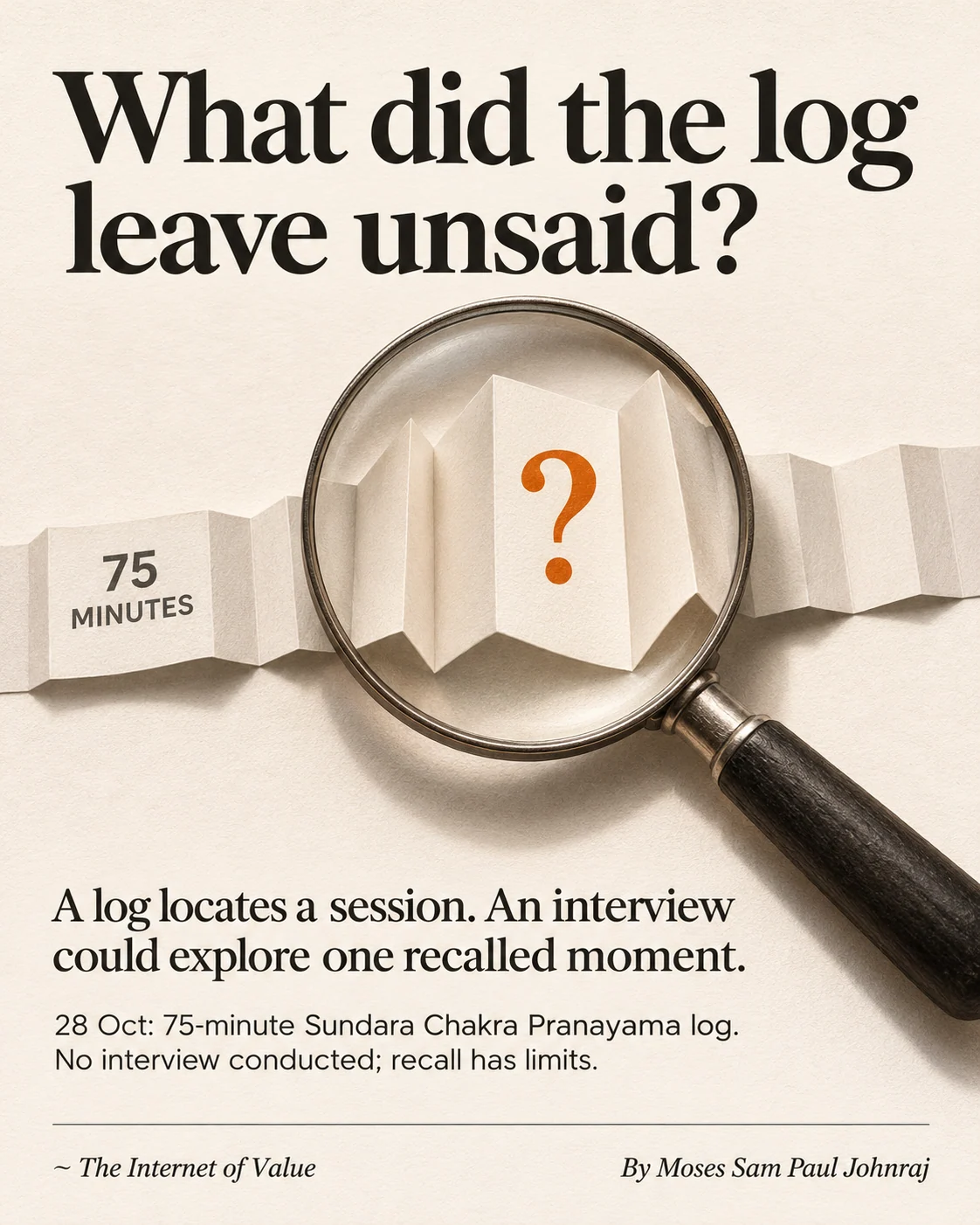
The programme's reading materials identify the named exercise in chapter 31 of Mind Your Breathing: The Yogi's Handbook with 37 Pranayama Exercises. Our separate Goa research programme has a 90-minute reference sequence: 40 minutes of movement, 20 minutes of conceptual framing, 21 minutes of SCP and 9 minutes of stillness/debrief. That protocol is an exploratory design. It does not establish the delivered sequence of the shorter residency session or participant outcomes. Programme protocol22; reading-source notes23.
The ceremony and ecstatic dance are a separate experience. They are not that SCP session or a control condition for it.
Which evidence is adjacent rather than direct?
There is adjacent research on specific breathing practices. For example, a 2023 randomised study compared daily five-minute breathing exercises with mindfulness meditation over a month. Its conditions and duration differ from this programme; its findings cannot be transferred to SCP by similarity of theme. A bounded search for this project did not establish a direct study combining SCP, Value Log and micro-phenomenology. Controlled respiration study24.
What should a first combination study ask?
A useful first study of the combination would ask a modest question: does a separately analysed interview add relevant experiential detail to a time-bounded log? It should preserve disagreements, ambiguous reports, failed recall and the burden of participating. My experience as a facilitator would need to remain separate from participants' experiences of practising.
Which effects would remain unidentified?
The reference protocol's checks before and after stages could help locate episodes, but a change across a composite sequence cannot isolate the effect of pranayama. In particular, its interval after movement and before the post-pranayama check includes both conceptual framing and breathing. An interview could investigate what someone reports about a moment within that interval; it would not by itself establish a causal mechanism or physiological chakra anatomy.
The connection is worth investigating because the methods do different jobs. Whether the combination is useful remains a question for evidence.