Chapter 4 of 11 · 4 min
How does the Wellbecoming Protocol organise observations?
What does the six-node framework capture?
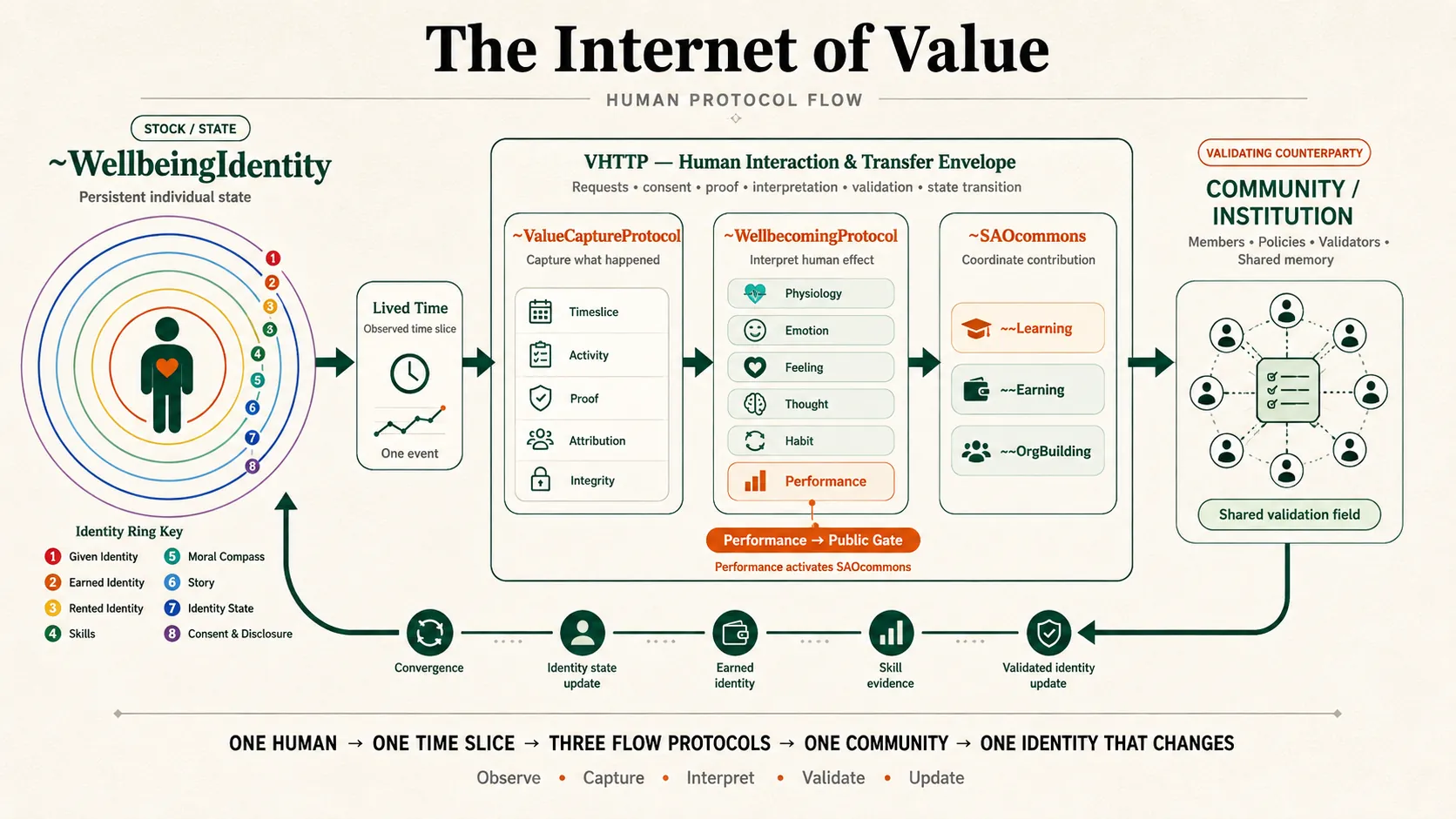
The Wellbecoming Protocol provides six nodes for interpreting observations: Physiology, Emotion, Feeling, Thought, Habit and Performance. Value Log is the implementation I used to record activities and their classifications. The protocol supplies a vocabulary; the records provide particular accounts. Neither supplies an automatic measurement of the whole person.
How does an observation return to Identity?
The wider architecture has four protocols. Value Capture gives a selected event a time boundary, activity description, evidence, attribution and integrity context. Wellbecoming interprets its possible human effect. SAOcommons becomes relevant when a qualifying Performance contribution needs community governance or validation. Wellbeing Identity receives scoped returns. Value Capture9; Wellbecoming10.
For non-Performance observations, the private-state route matters. Rest, a reported feeling, a change in understanding or a repeated routine may become inputs under the declared policy. For Performance, practising a skill or producing something can supply evidence for a contribution claim. A validated return may then inform Skills, EarnedIdentity or IdentityState. Private discouragement does not become a public credential, and an encouraging conversation does not automatically become a skill certification.
What does each thread help me ask?
| Wellbecoming node | The question I use to approach these records |
|---|---|
| Physiology | What was happening around rest, movement, food, travel and bodily interruption? |
| Emotion | How were emotional processes classified, and what evidence supports that classification? |
| Feeling | How did I describe the experience of feeling a particular way? |
| Thought | Where did understanding, uncertainty or a decision change? |
| Habit | Which routines recurred, were interrupted or resumed? |
| Performance | What did the work, learning or contribution actually produce, and what was validated? |
These distinctions need care. The canonical Emotion vocabulary includes biochemical facets, but this corpus contains no cortisol, dopamine or serotonin assays. Reporting discouragement does not tell me a hormone concentration. Similarly, time classified as Performance is not a measured amount of productivity.
The framework becomes useful only if these questions make the experience more specific. My records give us a way to try that.
Why call this a Becoming Weave?
A life does not arrive as six separate stories. The work I do can interrupt my sleep. A conversation can change how I feel about that work. The same dinner can involve food, recognition, uncertainty and an imagined future. What happens next is lived by the person who has already passed through those moments.
The handloom is a useful image for what I mean by weave: a fabric takes form through the relationship between threads, not through any one thread on its own. In Value Log, the recurring Wellbecoming perspectives provide the threads; time-bounded activity records make the stitches. The picture lets me look across a day, follow one dimension across days, or return to a particular occurrence.
“My account of reality is a weave of observations.”
The product’s 23 July changelog11 introduced the Becoming Weave as a way to show where recorded life accumulated. Its structure is deliberate: five inner Wellbecoming threads, followed by a separate Performance lane for capability and outward contribution. An activity retains its interval; a completed state movement and a Performance valuation have different marks. The handloom analogy is a design explanation, not evidence that these categories exhaust lived experience or that the depicted threads establish causal relationships.
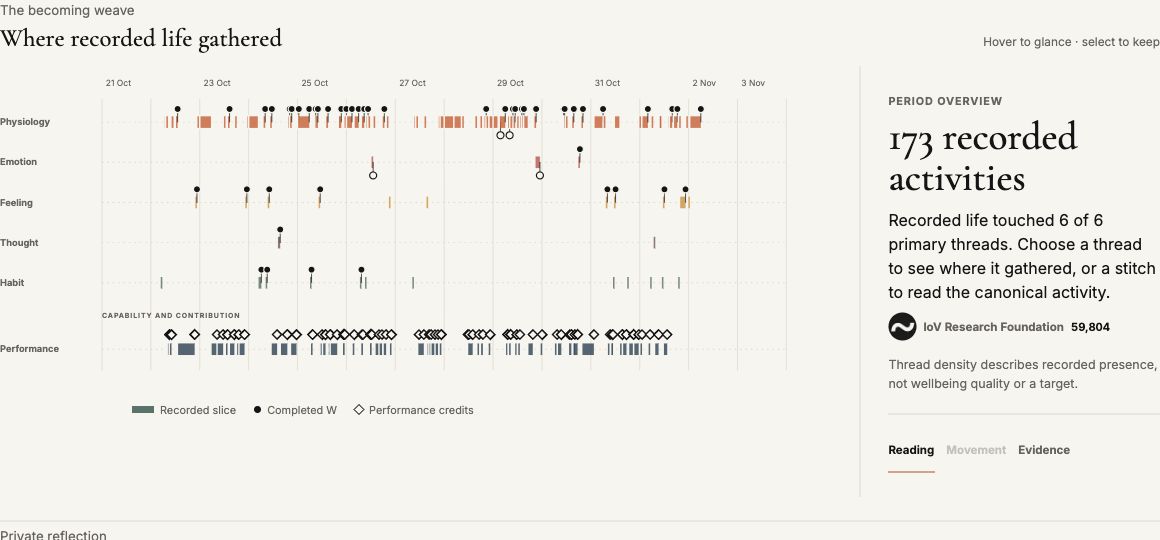
Actual owner-account interface, captured 3 November 2026. This rolling view covers 21 October–3 November and shows 173 records; it illustrates the instrument, not the fixed seven-day result below. No activity descriptions or other participants’ names are shown. The app’s “Performance credits” label refers here to separately calculated, non-payable founder valuations, not money received.
How do I read the threads and stitches?
| Mark in the weave | What it makes visible | What it does not establish |
|---|---|---|
| Thread | A recurring primary Wellbecoming classification across time. | A separately measured biological or psychological process. |
| Stitch | A recorded activity at its actual time interval. | That every aspect of the experience fits its primary label. |
| Circle | A completed W movement at the activity endpoint; negative and positive movements have different positions. | A direct measurement of how good or bad the whole experience was. |
| Diamond in the Performance lane | A separate contribution valuation under its declared rules. | A skill-level gain, payment, or increment to the wellbeing score. |
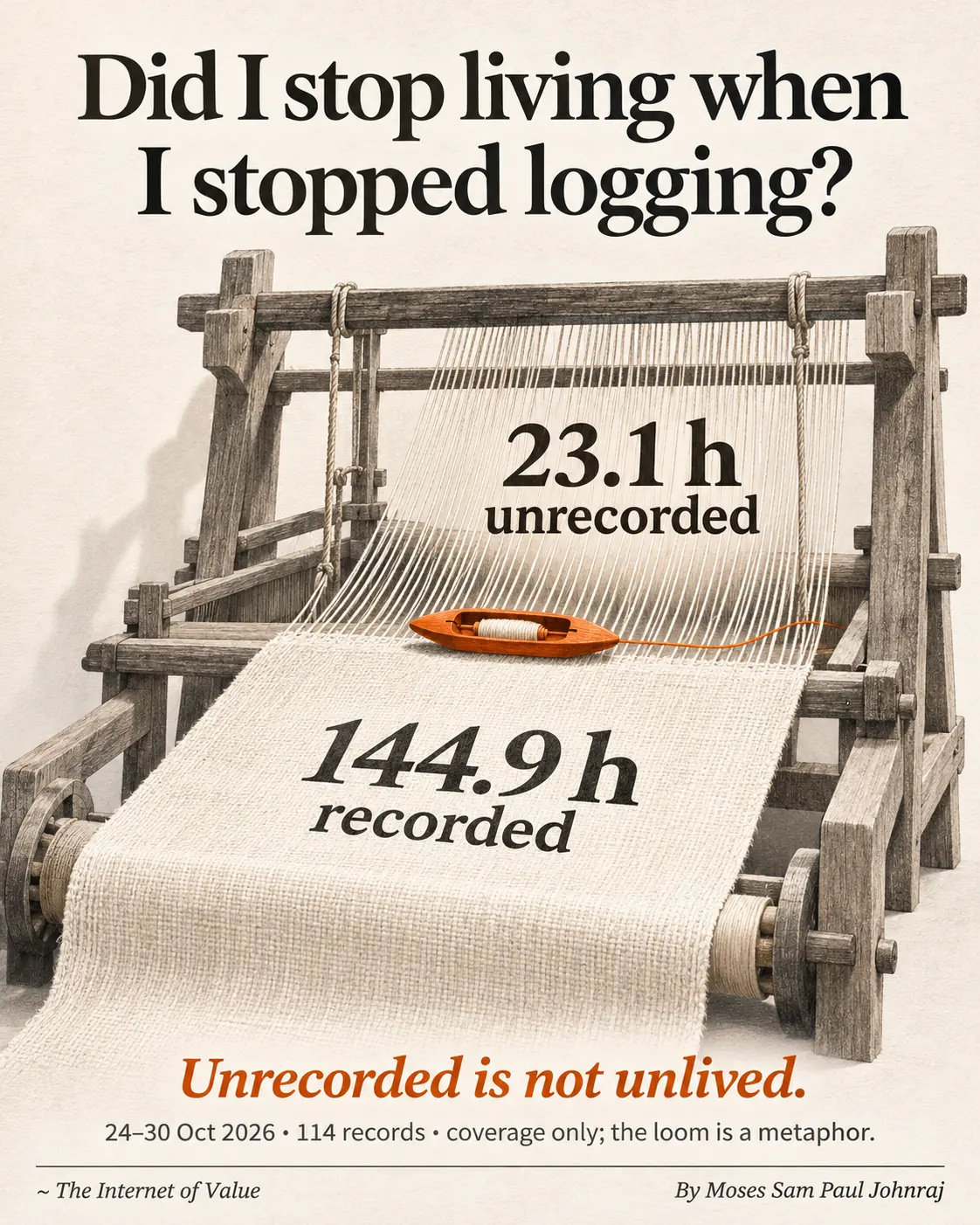
A dense thread means that more recorded life gathered there. It does not mean that dimension was better. A gap may be unrecorded time, and a stitch without a state marker may have no eligible transition. Neither allows me to infer that nothing was experienced.
What moved during the seven core days?
The live weave makes the relationships visible. The replay below freezes the case to 24–30 October, so I can inspect the six component states and their daily movements without a rolling date window changing the result.
Seven core days, 24–30 October: inspect each day’s six stored component values, recorded time, classifications and contribution to the composite. The controls offer a step-by-step replay rather than an uninspectable animation.
View the static counterpart to the seven-day replay
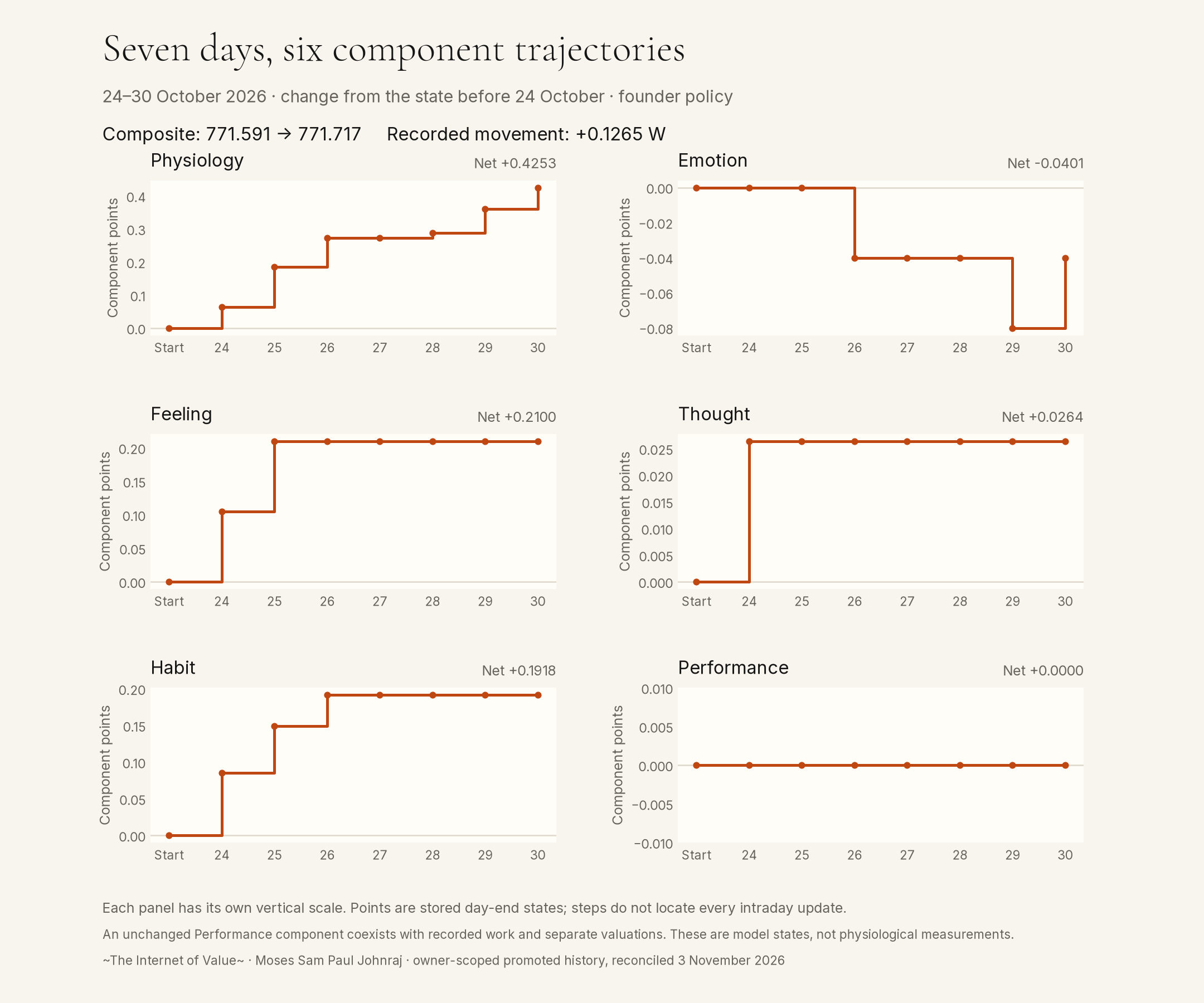
Static counterpart to the replay. Each panel has its own vertical scale. The points are stored day-end states; the lines do not represent continuous measurements of experience. Exact component values and daily movements are available in the replay table.