Chapter 2 of 11 · 5 min
Why put a number on an experience?
If you asked me how Field Station was, I could offer two very different answers.
I could say, “It was a great experience.” Or I could say, “My wellbeing score rose by 0.1455 points during the stay.”
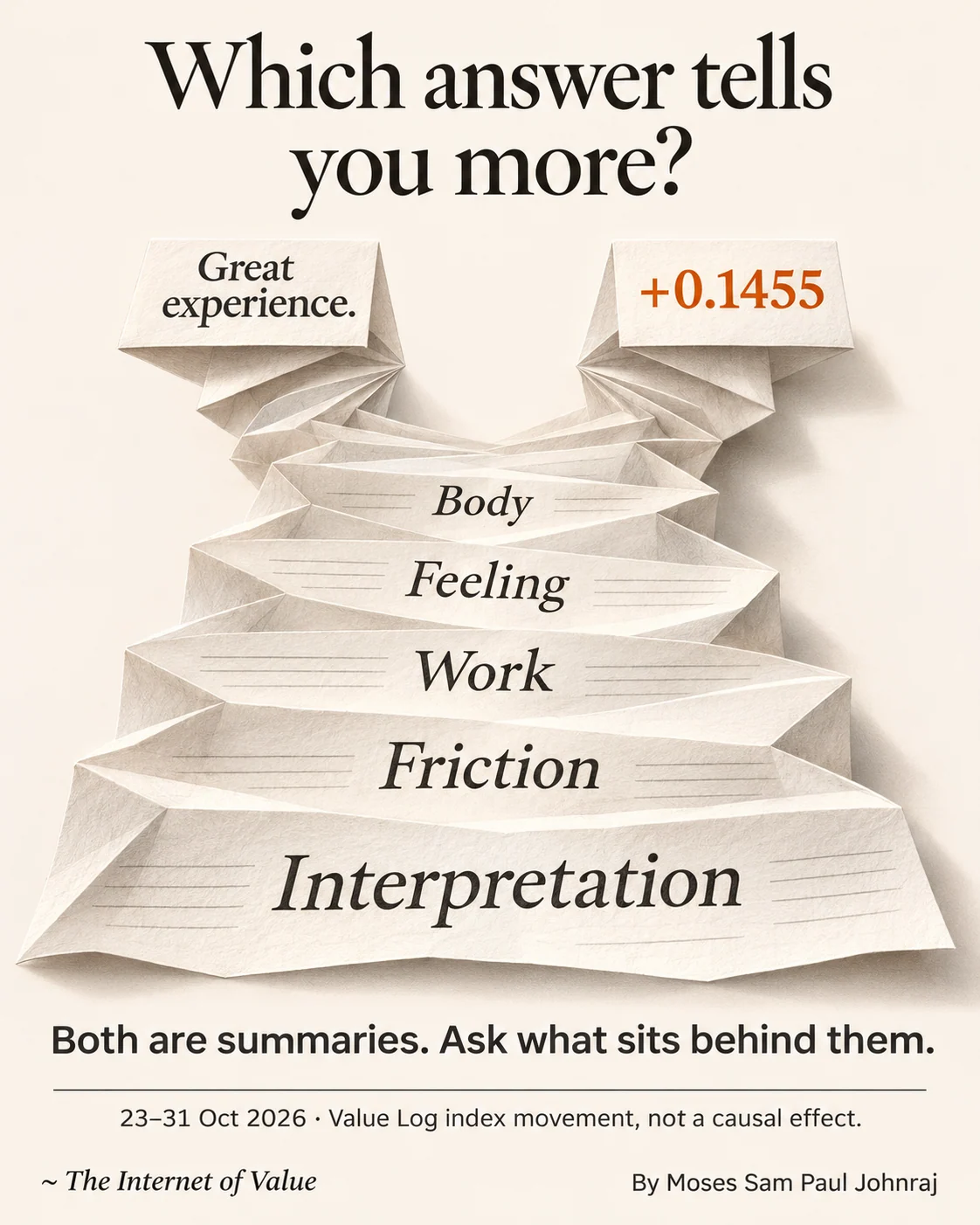
Why did the number provoke a question?
Did the number make you pause?
Perhaps your first question was: “But how can you reduce an experience to a number?”
I want to ask something in return: why does compressing the same experience into “great” feel less reductive?
Both answers leave almost everything out. The interesting question is what happens when you ask me to open either one up.
What changes when words are easy to generate?
I can ask AI for an eloquent account of my stay, then ask for ten more versions. That does not mean I have thought about the experience ten times more deeply. When polished words are easy to generate, their fluency alone gives you little reason to trust my account. What did I notice? What did I record? What am I now explaining away?
The number owes you answers too. What changed, over which dates, under whose rules? Could you follow it back to the records—or challenge how I classified them?
“More words do not guarantee more reflection. More decimal places do not guarantee more understanding.”
“It was a great experience” would communicate something real. It would also leave considerable room for interpretation. Was it great because of the people, the food, the setting, an opportunity, a difficult lesson or the relief of returning home? Could I have enjoyed it while sleeping badly? Could an encouraging conversation coexist with an uncomfortable change in how I saw myself?
What should either answer let us examine?
An overall evaluation is useful. A feedback form might help organisers understand satisfaction, problems or whether people would return. A longitudinal account can ask different questions about what happened during the experience. In this case, I do not have collected feedback forms to compare with the logs, so I cannot establish that one method performed better.
My proposal is that a wellbeing score can be a compact answer that opens into a larger account. Someone who wants one number can receive a summary. Someone who wants to understand it should be able to examine the components, the relevant records, the calculation rules and the interpretations behind it.
That is what I mean by an expandable representation.
The owner-scoped promoted ledger records W = 771.580 at the start of 23 October and W = 771.726 before 1 November: a movement of +0.1455 index points across the stay. The seven core days have a different boundary and a movement of +0.1265. Interactive controls load the exact date-by-date values.
Which dates does the number describe?
The distinction between those periods changes the numerical answer:
| Explicit comparison, IST | Opening W | Closing W | Recorded ΔW |
|---|---|---|---|
| Stay: 23–31 October | 771.580 | 771.726 | +0.1455 |
| Seven core days: 24–30 October | 771.591 | 771.717 | +0.1265 |
| Full observation: 22 October–1 November | 771.570 | 771.740 | +0.1694 |
Opening means the stored state before 00:00 on the first date; closing means the stored state before 00:00 following the last date. State values are displayed to three decimals, movements to four; the inspector preserves the exact stored decimals. These are changes in an issuer-specific index, not percentages or estimates of a residency treatment effect.
The stay’s exact movement is 0.145536522766. That is a more defensible compact answer than the number I initially remembered, because it has explicit boundaries and a traceable ledger. It still needs the story—and the possibility that the model leaves something important out.
A bare number would not accomplish this. Four decimal places do not explain what changed. A composite can conceal differences between its components. It needs an understandable scale, a comparison period, an inspectable method and a way to challenge the inputs.
The same fairness applies to words. “Great experience” is not inadequate because it contains only two words. It may be the beginning of a careful account. The question is what each summary makes available when someone asks for more.
| Form of account | What it can help answer | What needs to accompany it |
|---|---|---|
| Overall evaluation | How do I judge the experience now? | The meaning of the evaluation and the context in which it was made. |
| Activity records | What did I record doing, when and in what context? | Coverage, timing, classification and uncertainty about the account. |
| Component history | How did the model represent particular dimensions over time? | Defined inputs, baseline, update rules and evidence for each change. |
| Composite score | What summary did the declared calculation produce? | Its scale, weights, provenance and an explanation of what aggregation hides. |
| Detailed experiential inquiry | How did one particular moment unfold for me? | A suitable method of elicitation and analysis, with memory and prompting limits. |
How does this relate to existing ways of studying experience?
This inquiry has precedents. The Day Reconstruction Method asks people to reconstruct episodes of a day and report aspects of their experience. Ecological momentary assessment uses repeated reports of current or recent experience in everyday life. An activity diary does not become either method simply by containing timestamps. These approaches help identify what Value Log would need to demonstrate, rather than supplying a reason to claim it is unique. Day Reconstruction Method2; ecological momentary assessment3.
People also encounter numerical representations in institutional life. A credit score estimates repayment likelihood; GDP accounts for production. Wages, credentials and platform metrics answer still other questions. Their purposes and constructs differ. I am interested in whether a person can participate more actively in representing their own becoming. The existence of familiar economic metrics does not validate my alternative. Credit-score definition4; GDP definition5.
To examine that alternative, I have to begin with more than a score. I have to ask who is doing the observing.