Chapter 5 of 11 · 13 min
What do my records show across the six nodes?
What interrupted the apparent flow?
On October 26, I woke during the night, worked with an AI agent on the product and then returned to sleep. Two days later, I recorded resting instead of my usual walk or calisthenics because I was unwell. On October 29, a monkey bite interrupted the morning and led to a vaccination trip. That day also contained work, rest and an evening in which critical comments left me feeling down.
An account organised only around talks and projects could make the residency sound like a continuous exchange of ideas. My body, interrupted routines and responses to other people were part of the experience too.
How complete is the recorded week?
The seven core days contain 114 records, occupying 144.9 of 168 calendar hours. The other 23.1 hours are unrecorded. Across the full eleven-date window, there are 172 records, occupying 232.9 of 264 hours, with 31.1 hours unrecorded. Missing time is not evidence of inactivity, sleep loss or a particular state.
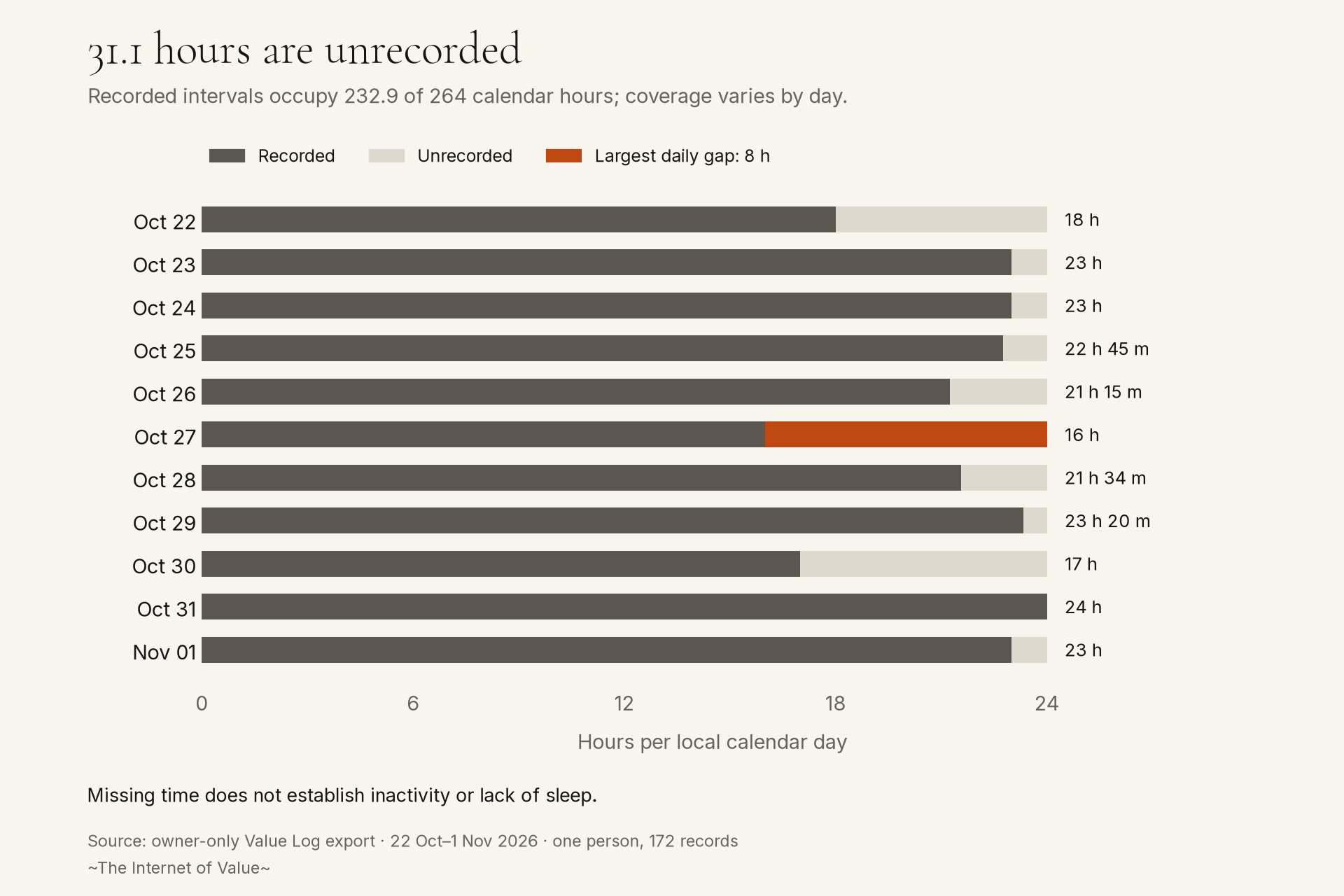
Recorded interval coverage, 22 October–1 November. Arrival, departure and the Goa day have different roles in the account. The chart represents recorded time, not continuous measurement of wellbeing.
Where did recorded time gather?
The six-node distribution looks different depending on which period is being described:
| Node | Seven core days: records | Seven core days: recorded hours | Full eleven-date window: records |
|---|---|---|---|
| Physiology | 55 | 69.65 | 79 |
| Emotion | 3 | 4.00 | 3 |
| Feeling | 4 | 3.00 | 11 |
| Thought | 1 | 1.50 | 2 |
| Habit | 6 | 5.25 | 12 |
| Performance | 45 | 61.50 | 65 |
| Total | 114 | 144.90 | 172 |
Core period: 24–30 October. Counts use record start dates; durations are clipped to the stated window. Categories describe the primary classification of records. They do not measure how much of my life consisted of thought, feeling or physiological activity.
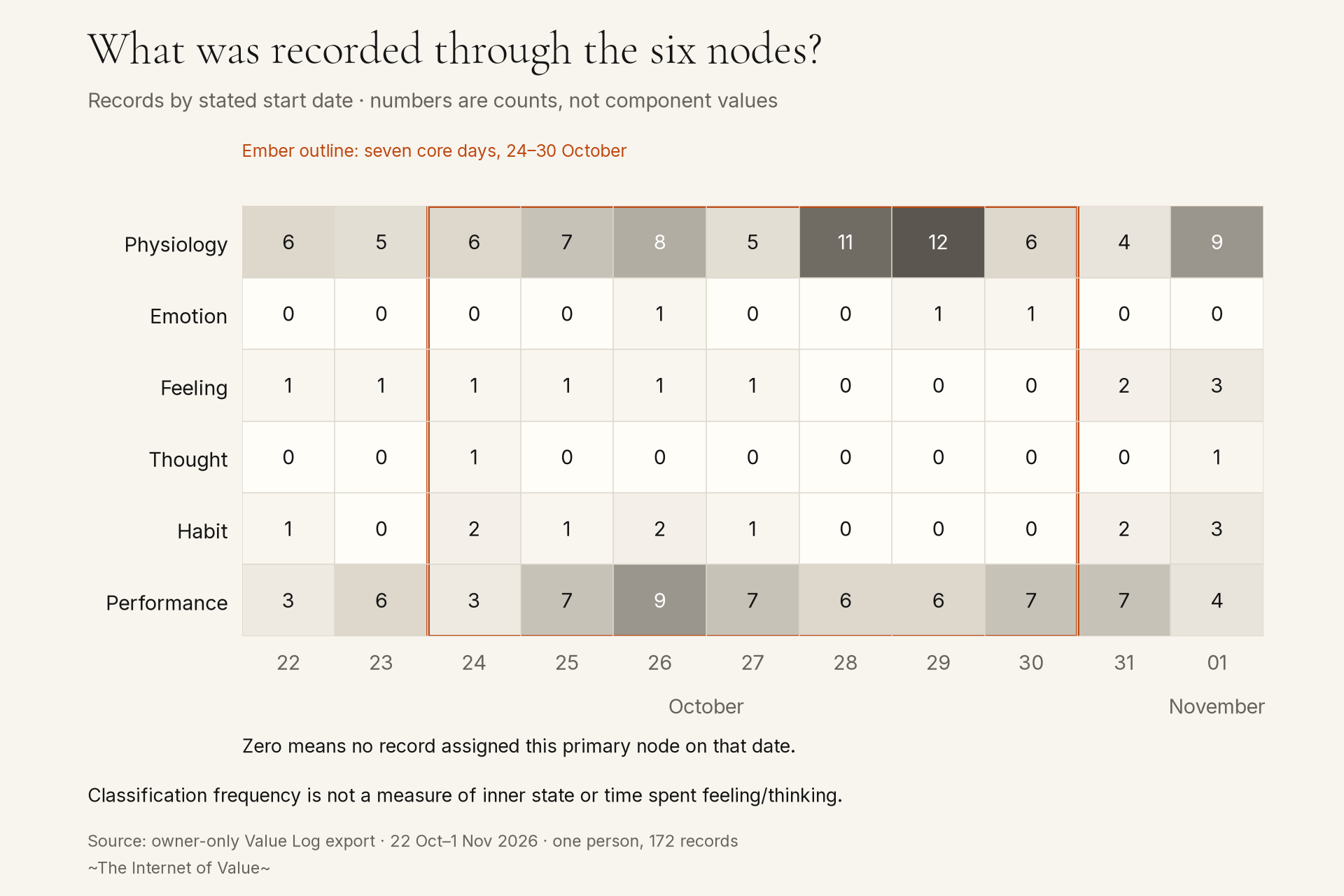
This is a classification timeline. Zero means no record was assigned that primary node on that date; it does not mean an absence of thought, feeling or physiological activity.
How did rest, movement and bodily routines vary?
Physiology: the evidence strip loads the opening and closing component states, daily movement, classification counts and recorded time for 24–30 October.
The opening days included morning routines, walking, calisthenics, meals and movement between the tent area and the main gathering place. The later records complicate any assumption that I sustained one stable routine throughout the stay.
The overnight work on October 26 sits between sleep records. On October 28, the account explicitly links missed usual movement with cough and other symptoms. On October 29, the injury and vaccination trip displaced part of the morning. Later entries include short rests; I attributed one period of dozing to medication. These are reports of events and experience, rather than an independent clinical assessment.
What did I bring to the ceremony?
The return journey adds further context. Late-night project exploration and fragmented rest appear before the flight to Goa. On November 1, I recorded both a shorter rest than planned and another period of sleep before getting ready for the ceremony.
That matters to the opening contrast. The person arriving at ecstatic dance had travelled and rested unevenly. I cannot isolate a difference in experience and attribute it entirely to technology, ritual or the absence of screens.
What does the Physiology label leave out?
Physiology also contains a classification problem. Its 69.65 recorded hours in the core week include food, travel, walking and other bodily routines as well as rest. They are not 69.65 hours of recovery. Some entries bundle several activities. At least six sleep episodes in the full export are split across midnight into separate records. Counting those rows as separate sleeps would change the story through a database boundary.
The records make a disrupted physical context visible. They do not establish sleep quality, recovery, autonomic function or biochemical change.
What does the Emotion component represent here?
Emotion: the evidence strip loads the opening and closing component states, daily movement, classification counts and recorded time for 24–30 October.
Only three records in the entire eleven-date window have Emotion as their primary node. Two carry negative directions; one carries a positive direction.
One records discouragement after a conversation in which my request met a response about autonomy. Another records feeling down after comments about my ideas and me personally. The third concerns stand-up comedy: the comedian joked about me and The Internet of Value with my permission, and I enjoyed it.
Three different contexts: discouragement, critical comments and comedy with permission. Inspect their recorded classifications and score movements separately.
Did enjoying the jokes show that I had grown?
There is a tempting story available here. I could say I learned to take criticism, and point to the comedy as evidence of maturity.
The records do not make that comparison cleanly. Permission was explicit in the comedy setting. The people, expectations and circumstances differed. Enjoying jokes in one situation does not show that my response to criticism had improved generally. The earlier discomfort remains part of the account.
This is where a longitudinal view can help without pretending to settle everything. It preserves differently described responses on different occasions. It gives me an opportunity to investigate the conditions, rather than turning the later positive entry into a verdict about growth.
The labels also have a firm limit: they are classifications of my account. No laboratory or sensor data here establish the biochemical processes named in the protocol's wider Emotion vocabulary.
How did I describe feeling across these days?
Feeling: the evidence strip loads the opening and closing component states, daily movement, classification counts and recorded time for 24–30 October.
Feeling appears in eleven records across the full window, including a family call, informal time with residents, farewells, conversations after returning to Goa and the cacao ceremony. Eight are labelled positive and three neutral.
Those labels do not amount to a representative sample of every feeling I had. Several important responses appear inside records assigned to other nodes. The presentation is Performance, yet its description contains a positive feeling and uncertainty. The Emotion records contain discouragement and enjoyment. The category boundary is an analytical decision, not a boundary around my capacity to feel.
Why did recognition matter to me?
The distinction is especially important around recognition. When Manvendra recorded my presentation, what mattered to me included who was paying attention. Later, at dinner, the possibility of exploring this work within Dhun gave the conversation a future dimension. I could imagine where the ideas might go.
An encouraging encounter can become more valuable in my account because I imagine what might follow. The record can preserve that possibility without treating the imagined future as an outcome already delivered.
What does the ceremony record leave unresolved?
The ceremony then appears as a positive Feeling record. Its three-hour block captures participation and a broad reflection. It does not resolve how attention, hesitation, movement, invitation or intention unfolded within those hours. That gap is a reason to consider a more detailed method, not a reason to invent a smooth curve of emotional change.
Where did my understanding or decisions change?
Thought: the evidence strip loads the opening and closing component states, daily movement, classification counts and recorded time for 24–30 October.
Thought is the smallest primary category: one record during the core week, and two across the full window. A lunch conversation about a different approach to the future of work is one; video listening during the return journey to Goa is the other.
What changed between the two presentations?
Much thinking clearly occurred inside other categories. The first residency presentation left me wondering whether I had explained the work or asked for help clearly enough. Before the later presentation, I recorded thinking through questions, organising the demonstration and building a page to bring the material together.
That is a sequence worth retaining: an unsatisfactory account of an earlier attempt, more deliberate preparation, a later positive response and continued uncertainty about communication. It suggests a practical adjustment. It does not supply an independent measure of how much I learned or how well the audience understood.
I also admired how some residents revised their project direction after a conversation or on a short deadline. That was one of the clearest learnings in my later reflection: adapt when new information arrives. The question is whether I was as willing to revise an explanation about my own behaviour.
Was I equally willing to revise my account of myself?
Some of my most consequential thinking appeared later, in reflection. When told that people were talking about me and might not want to enter the tent if I was there, I interpreted it as resistance to logging and self-improvement. I presented their reluctance to myself as a sign that the demand for awareness made them uncomfortable.
That interpretation deserves scrutiny. It gives my request a beneficial purpose and explains their discomfort in a way that protects me. If interest confirms the value of my work, and resistance also confirms it, what response could make me reconsider my conduct?
The tent account was a report relayed to me, not something I independently observed. I do not know what each person meant or wanted. What I can examine is the explanation I reached for, and whether it left enough room for feedback about me.
Which routines recurred, were interrupted or resumed?
Habit: the evidence strip loads the opening and closing component states, daily movement, classification counts and recorded time for 24–30 October.
The Habit records include morning routines, showering, packing and transitions around travel. During the core week, six records occupy 5.25 hours under this primary label.
My usual movement appears elsewhere, under Physiology. Its interruption while unwell shows why a habit analysis needs context rather than a count of successful repetitions. The same omitted walk could reflect illness, a decision to rest, a missing record or a failure to follow an intention. These possibilities should not receive the same interpretation automatically.
Was I observing in the moment or reconstructing later?
The act of logging also had a rhythm. On October 29, I recorded entering activities for the previous two days. Across the export, the median gap between an activity's reported end and creation of its canonical database record is 13.2 hours; 29 records have gaps greater than 24 hours. Original capture may have happened earlier than canonical creation, so this is not a precise measure of recall delay.
Still, the explicit backfilling entry matters. A record about Tuesday can be composed by the person who has already lived through Wednesday. The state from which I remember belongs in the investigation alongside the state I am trying to describe.
Seven days can reveal repetition and interruption. This case does not establish habit formation or a lasting change in consistency.
What did the work produce or help me learn?
Performance: the evidence strip loads the opening and closing component states, daily movement, classification counts and recorded time for 24–30 October.
Performance accounts for 45 core-week records and 61.5 recorded hours. Across the full window, it accounts for 65 records and 103.33 hours. The category includes presentations, discussion, product building, attending sessions, facilitation and other work-related activity. It is not a time sheet of independently verified productive output.
The presentation record produced a non-payable valuation but no Performance component transition. Inspect the event before treating attention as an increase in capability.
Where did the product get in the way?
Some of the clearest learning concerns my own product and the way I invited people to try it.
I proposed a low-tech awareness exercise in which people mentally replayed their day through the six nodes without phones or logging. Later, I invited people to use Value Log. My records also say the sign-ins did not work, access was restricted, others offered help, and we changed the approach. After repairs, I invited people to test again; successful logging was still unconfirmed in that entry.
These details challenge my explanation of reluctance as resistance to self-improvement. I was asking people to engage with an idea through an implementation that sometimes failed. Other people were helping me repair it. Their actions deserve room in the account without making their motives serve my preferred conclusion.
The work also gave me opportunities to practise communicating and facilitating. I led a shorter Sundara Chakra Pranayama session. I prepared and delivered explanations of the protocol stack. I worked through product problems with others. Each can provide evidence of an activity and a possible learning process. A validated increase in skill, an adopted product and an institutional contribution are more specific claims.
What was recorded, and what was validated?
The retained export routes the 65 Performance records to the IoV community: 30 Learning, 19 Earning and 16 OrgBuilding. All 65 carry a Performance-impact status of no_transition; no task or source-attestation reference is populated in these records. That is an implementation fact about these rows. It does not establish that no relevant validation or credit exists elsewhere.
It does mean I cannot turn the number of records, the hours or the attention my presentation received into Foundation credits earned. A score or credit claim needs its own traceable calculation and validation evidence.
What changes when the score and the story are read together?
Which components account for the net gain?
Across the core week, the composite gained 0.1265 points. Physiology contributed +0.0851, Habit +0.0192, Feeling +0.0210 and Thought +0.0053. Emotion contributed −0.0040; Performance contributed 0. The sum reconciles to the stored composite movement. That composition matters more than a single positive total.
The first two core days account for 61.7% of the week’s net recorded gain. That does not establish that they were the best days. The timing reflects which observations received eligible updates, their direction and intensity, the starting states and the policy’s weighting. It could change if classifications or eligibility changed. A sparse record is not an evenly sampled inner life.
Why can a rising component coexist with illness?
Physiology’s positive net contribution sits alongside illness, interrupted movement and an injury. Ordinary positively classified meals, rests and routines contribute many small updates; the injury contributes a negative one. A rising Physiology component therefore cannot be read as evidence that the illness improved or that recovery was measured. The calculation aggregates classifications of observations. It does not make a diagnosis.
What does the Emotion result add to the story?
The Emotion result is equally instructive. Two discouraging entries each subtract about 0.0040 W; the enjoyable comedy adds about 0.0040 W. The component ends slightly lower. The later positive occasion neither erases the earlier ones nor demonstrates that I learned to receive criticism. The shared numerical size follows the declared rules; it does not establish equal psychological impact.
What did the score miss about recognition?

Performance creates the strongest mismatch between narrative significance and component movement. The presentation mattered to me. Manvendra recording it mattered to me. Yet its recorded composite movement is zero, with a separate 96.464 USD non-payable VCperformance valuation. This is how the current implementation represents that occurrence, not a verdict that it meant nothing. Its description includes positive feeling and uncertainty, while its primary classification remains Performance. A different coding scheme might represent those aspects separately—but adding an unrecorded Feeling update now would alter the evidence to fit my preferred interpretation.
“A zero in the ledger is not an empty moment.”
Which explanations deserve testing?
These differences generate questions worth investigating, rather than a single explanation of the week:
| Hypothesis prompted by this case | Why I would investigate it | Rival explanation or missing evidence |
|---|---|---|
| Attention from someone I respect changes my self-evaluation. | I attach particular significance to Manvendra recording the presentation and considering the work. | Preparation, audience questions and an imagined opportunity may also matter. No isolated recognition effect was measured. |
| Permission changes how I experience being the subject of humour. | The comedy entry explicitly records permission and enjoyment. | Relationship, tone, setting and expectations differ from the critical conversations. Three entries cannot establish a general pattern. |
| The observer’s physical context changes later interpretation. | Illness, interrupted rest, medication attribution and travel surround the major scenes. | No independent sleep-quality or physiological measures were collected; narratives cannot establish the pathway. |
| Primary-node classification changes what the composite makes visible. | Positive feeling inside Performance did not become a separate Feeling transition. | This may be an intentional rule against double counting. Testing alternatives needs predeclared coding and a sensitivity analysis, not retrospective score shopping. |
| Difficulty adopting the product partly reflected access and my approach. | Sign-in failures, restrictions, offers of help and my sharp requests appear in the account. | Other people’s motives remain unknown. Their reluctance cannot be diagnosed as resistance to self-improvement. |
How does my role as the founder affect the analysis?
The uncomfortable implication is that I helped design both the product and the categories through which I am examining myself. Founder self-review makes a calculation traceable; it does not make my explanations independent of my interests. A stronger follow-up could ask another analyst to code selected episodes without knowing the desired story, retain disagreements and compare how the result changes. That study has not been done here.
The activity analysis has made the week more specific. To understand what its numerical summary adds, I now have to open the calculation itself.