Chapter 8 of 11 · 3 min
What changed in my Wellbeing Identity, and what remains a claim?
The encouraging scenes are only part of the record.
What do my own words make uncomfortable?
In the original reflection, I described becoming frustrated with a teammate. I said they could ask me for help, but also told them, in my retelling, “don't come talk to me with random opinions.” That was a sharp boundary, and its impact on the other person is not something my account establishes.
I also described an initially promising connection becoming difficult. When a request met a response about not working for me, I speculated about the other person's past trauma. I had no evidence for that interpretation. It may have let me move too quickly from receiving feedback to explaining the person giving it.
Could resistance tell me something about my approach?
The report about people avoiding the tent creates another uncomfortable possibility. Perhaps they were resisting the discomfort of self-observation, as I initially argued. Perhaps my approach was demanding, unclear or unwelcome. Perhaps practical barriers mattered. The account available here cannot settle their motives. My willingness to examine my own behaviour should not depend on proving that everyone else's interpretation was correct first.
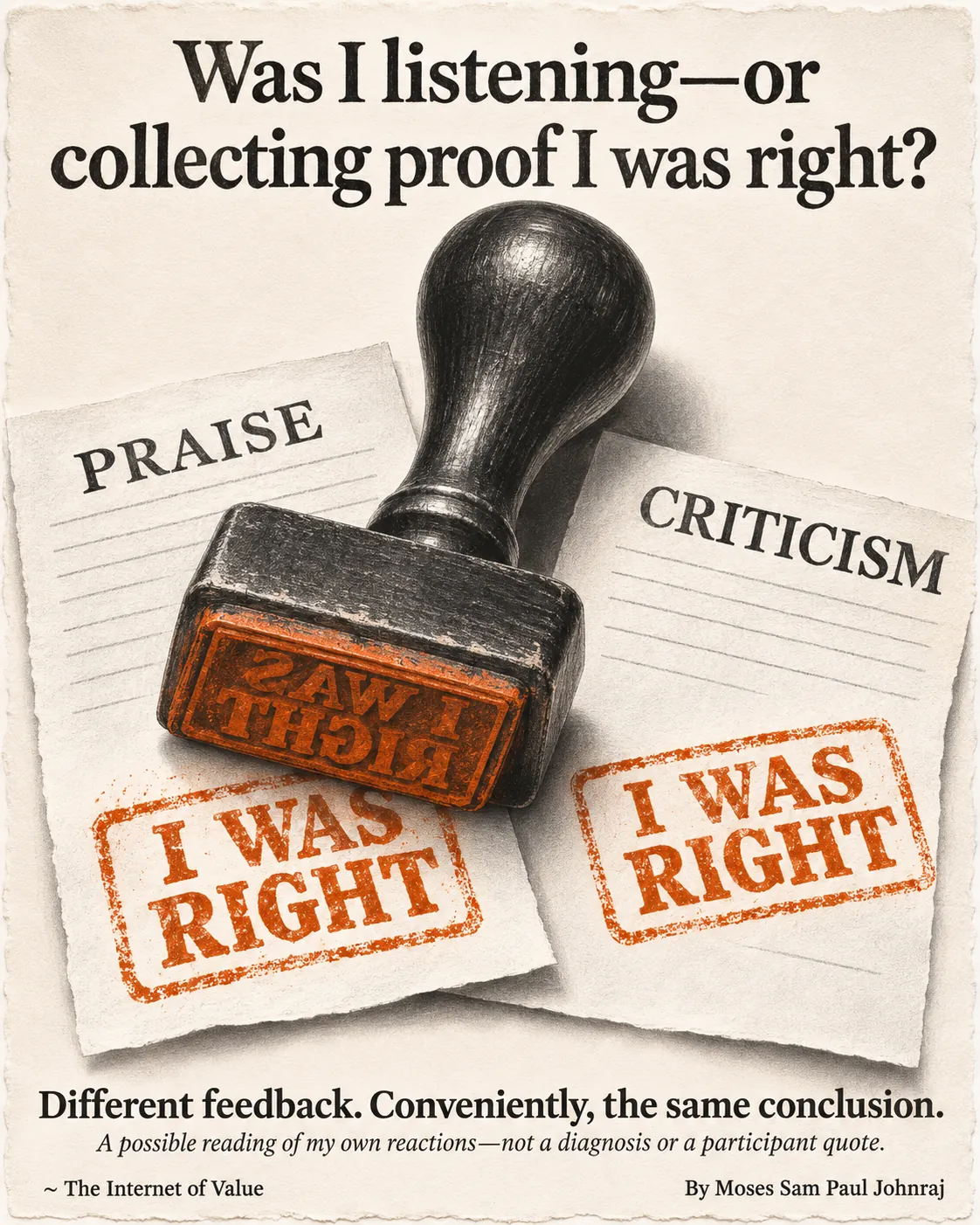
This also changes how I read the pleasure of being recorded by Manvendra. If recognition strengthens my confidence, and criticism prompts me to explain why others resist, I need to examine the different standards I apply to those encounters. Neither a respected person's interest nor my discomfort at a criticism settles whether my idea is sound.
Can I examine praise and criticism by the same standard?
The Tamil Tirukkural, in couplet 423, offers an ethical question I find relevant here:
எப்பொருள் யார்யார்வாய்க் கேட்பினும் அப்பொருள்
மெய்ப்பொருள் காண்ப தறிவு.
My English paraphrase is: wisdom examines the truth in what is said, whoever says it. Applying that to my own account means examining an encouraging interpretation with the same care as an uncomfortable one. This is an ethical lens for the inquiry, not scientific evidence for the model. Tamil source text, couplet 42316.
The week does not end with a clean resolution. A departure-day record describes further friction about logos and the approach to building community. Enjoying the stand-up comedy had not demonstrated that disagreement was now easy for me.
“If praise and criticism both prove me right, what could ever change my mind?”
Which changes can I support?
What, then, can I reasonably say changed?
| Part of Identity | What the account supports | What it does not establish |
|---|---|---|
| Story | New possibilities, discouragement and later reinterpretation entered my account of the stay. | A final, independently verified explanation of what the experience meant. |
| Skills | I practised presentation, facilitation and product work, and adjusted preparation after an earlier attempt. | A quantified or attested increase in skill level. |
| MoralCompass | My stated respect for agency can be examined against the way I made requests and interpreted resistance. | A measured improvement in character or virtue. |
| IdentityState | Records describe positive, neutral and negative classifications and particular reported feelings. | A continuous measurement of experience or an independently validated wellbeing change. |
| EarnedIdentity | Activities and possible outputs can be checked for appropriate evidence. | An automatic credential or institutional recognition from attendance or interest. |
This is a changing account of a changing person. Some revisions are mine to author. Some claims need other evidence or legitimate external validation. A larger Identity representation is useful only if it preserves those differences and gives me room to correct what I previously believed.