Chapter 6 of 11 · 6 min
What does a change in my wellbeing score actually mean?
A change in this wellbeing score means that a declared policy transformed particular inputs into a change in a calculated index. Understanding that change requires the starting component values, the included observations, their classifications, the update rules and the exact comparison interval.
The founder implementation I am investigating uses six components on a 100–1000 index scale. Its declared weights are:
| Component | Weight |
|---|---|
| Physiology | 20% |
| Emotion | 10% |
| Feeling | 10% |
| Thought | 20% |
| Habit | 10% |
| Performance | 30% |
These are issuer-policy choices, not universal weights assigned by the canonical protocol or established as a population measure of wellbeing. The implementation uses band-dependent update rules, direction and intensity, bounded component values and fixed-decimal arithmetic. The calculation is different from adding hours spent in each category. Founder implementation field note12.
Where did the opening state come from?
The baseline is established before these events are processed. In the documented founder example, ratings and review produced six starting components: Physiology 800, Emotion 750, Feeling 700, Thought 880, Habit 800 and Performance 700. Their weighted contributions are 160 + 75 + 70 + 176 + 80 + 210 = 771. The Genesis process retained that baseline following its declared observation and review process. Twenty-five eligible observation days are provenance for that constitution, not 25 points added to the score. The historical rationale behind each initial rating has not been independently reconstructed here.
By the start of the residency, the components had already moved. Before 24 October, for example, the stored Physiology component was 802.336702028797 and Performance was 700.126006595655. Substituting the July baseline of 771 for the residency opening would manufacture a much larger period gain. A baseline, an opening state and a closing state have different jobs.
How does one eligible observation change the model?
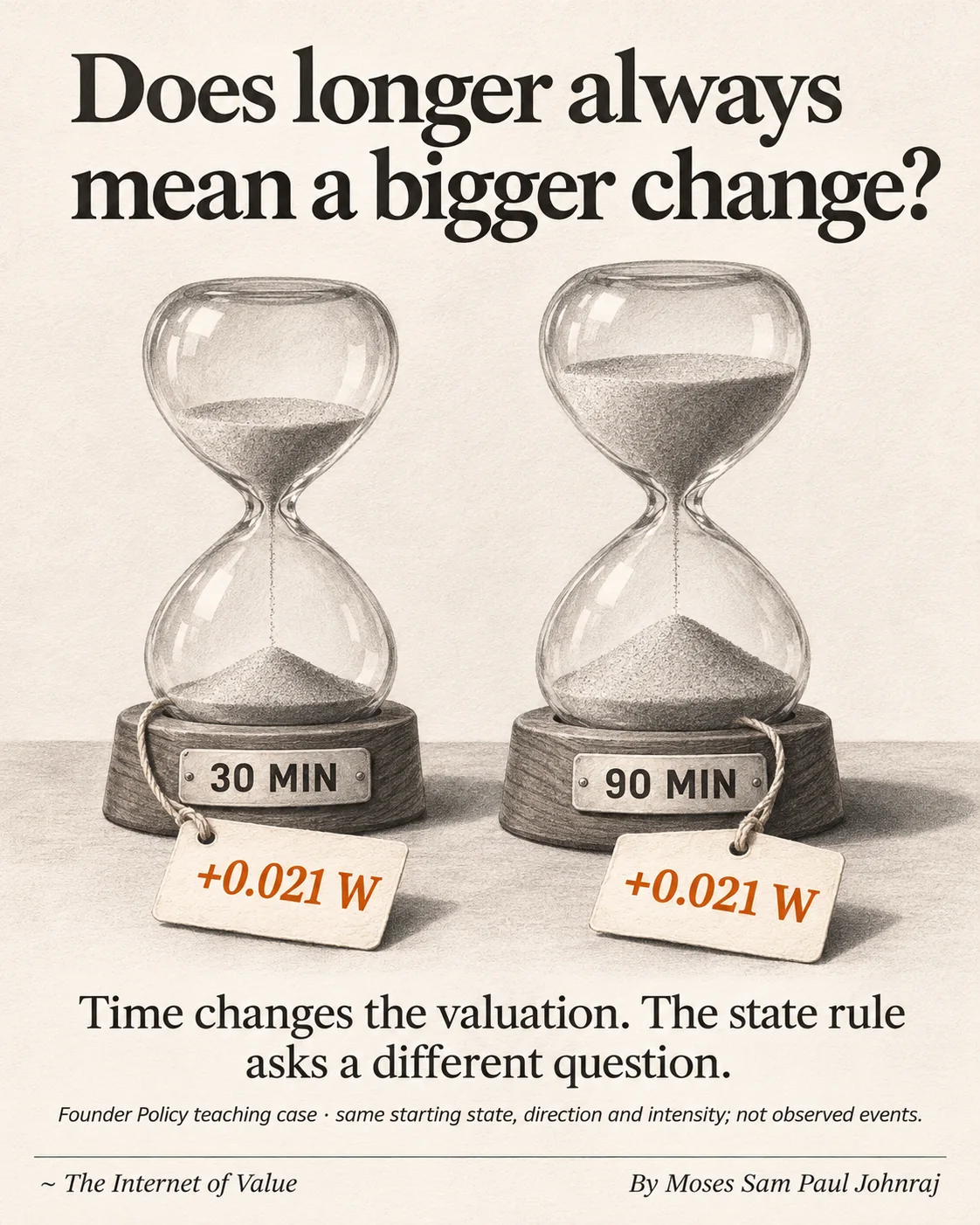
For the founder policy used here, a component’s current band supplies a rate and adjustment factor. Direction supplies the sign; low, medium and high intensity supply factors of one-third, two-thirds and one. The component is bounded to 100–1000. Its weighted contribution changes the composite. Duration does not multiply this state transition.
In symbols, before bounds and the declared fixed-decimal steps: ΔC = sign × C_before × band rate × adjustment factor × intensity factor, and ΔW = component weight × ΔC. The actual calculator below uses the implementation’s fixed12 functions rather than relying on this abbreviated expression.
At Performance = 700, medium positive gives 700 × 0.03 × 0.005 × ⅔ = 0.07 component points, or +0.021 W under its 30% weight. At Physiology = 800, medium positive gives 0.042666666667 component points, or +0.008533333333 W under its 20% weight. These are teaching cases from the mathematics presentation, not two reconstructed events from my residency. The band changes above 800, so it would be wrong to apply the 800 example’s rate to every later Physiology observation.
The interactive teaching calculator shows the documented baseline, band, direction and intensity, then calculates the state movement separately from the non-payable contribution valuation.
Why are duration, contribution value and wellbeing movement separate?
The mathematics presentation uses a hypothetical eligible 90-minute Performance occurrence at my scoped rate of 750 USD/hour. Vcom = 1.5 × 750 = 1,125 USD. Its separate VCperformance = (771 ÷ 1,000) × 1,125 = 867.375 USD, a non-payable event valuation. It uses W before the event. Applying the hypothetical Performance component update afterward gives W = 771.021. A valuation of 867.375 and a state movement of 0.021 are different typed outputs, not rival measures of how much wellbeing the activity created.
Splitting one eligible occurrence into several calendar rows must not create several independent component updates. The replay groups occurrences and orders their transitions. The rates and finality rules also have a scope: this founder example does not establish a universally accepted skill price, a payment or an entitlement. In the actual presentation record, the exported value event and no_transition status can be inspected in chapter 5. There is no basis for importing the teaching example’s +0.021 into that observed record.
The mathematics explanation13 and the declared implementation policy explain the calculation. Whether these classifications, bands and weights adequately represent wellbeing is a further empirical question. A result can be computed correctly while its interpretation remains contestable.
A hypothetical one-point increase in Physiology alone would add 0.2 points to the composite under these weights. An equal decrease in Thought would cancel that composite movement. The resulting unchanged total would conceal two opposing component changes. This arithmetic example illustrates the weighting; it is not an observed result from my residency.
For the same reason, a flat line can be ambiguous. A carried-forward component can mean that no eligible update was recorded. It does not establish that my underlying experience stayed constant. An event can matter deeply in the narrative without producing a Performance transition in the exported row.
Can the period result be reproduced?
I had described the period with a score increase of 0.1109; an earlier note gave 0.1129. The current promoted history does not reproduce either figure for the three explicit comparison periods used here. The stay’s movement is 0.145536522766; the seven core days give 0.126518262599. I retain the earlier figures as an example of why a remembered precise number needs reconciliation, not as alternative findings to choose between.
That is a substantive test of the expandable-score argument. If a precise number is offered as a compact account, I need to be able to open it and reproduce it. The reconciliation now joins the existing activity export to an owner-only export containing the preceding state, 51 state revisions, 116 value events and the promoted replay’s passed verification. It checks the stored component-weighted totals and the chronological W chain. These checks establish arithmetic consistency within the declared implementation; they do not validate it as a measure of wellbeing.
| Question about a numerical result | What would settle it |
|---|---|
| What changed? | Component states and composite values at explicit start and end points. |
| Which observations counted? | The eligible records, occurrence grouping, exclusions and recorded transitions. |
| Which calculation was used? | Baseline, versioned policy, weights and the current approved calculation history. |
| What does the magnitude mean? | Index units and interpretation, with any display transformation stated. |
| How dependable is the interpretation? | Checks of classification, missing inputs, sensitivity and measurement validity. |
| Did the residency cause the change? | Evidence beyond temporal coincidence in this one-person observational case. |
“The calculation can be exact. The interpretation can still be wrong.”
What does correct arithmetic establish?
Reproducible arithmetic is necessary for understanding the model. It is not sufficient to establish that the model measures wellbeing well. The OECD's subjective-wellbeing guidance14 distinguishes questions of measurement and interpretation that a private implementation must address in its own terms. It does not validate this score.
I still think a compact numerical answer can be useful. Its usefulness depends on what I can show when someone asks what went into it, including the parts I have not yet resolved.