A first-person inquiry
Can Experiences Be Observed with Numbers and Words?

From the Logos × ZuGrama Field Station at Dhun to cacao and ecstatic dance in Goa: following one changing observer through stories, logs and a wellbeing score.
How was the Logos × ZuGrama Field Station residency?
I went to Dhun, Rajasthan, for the Logos × Zu-Grama (ZuGrama) Field Station residency. The programme1 brought builders together for shared work, discussion and demonstrations. In my experience, that included Web3 builders, AI maximalists, AI-security researchers and people interested in longevity. These were people with different projects and positions, not a single voice about humanity’s future.

What happens when agents enter a human residency?
One of the projects I remember from the residency was called The Last Human Residency. Residents' profiles had been put into a system in which agents could interact. Alongside the Web3 infrastructure and token demonstrations, people were imagining what a residency of AI agents might become.
I kept returning to a premise I heard in those conversations: given enough compute and a goal, an agent could eventually do things better than a human. What, then, would we mean by human value?
My own presentation approached value from a human-first position. I was trying to explain The Internet of Value: a way of representing experience, wellbeing and contribution in which the person living the life participates in defining what counts.
What did cacao and ecstatic dance ask of me?
On November 1, after returning to Goa, I went to a cacao ceremony and ecstatic dance.
It was a phone-free setting. The ceremony involved the elements, setting an intention and observing. We were invited to dance with ourselves first. There were instructions for inviting someone else to dance, and for politely declining an invitation. The facilitator left room for the experience to develop through the people participating.
That last part stayed with me. There was structure, but the eventual experience would depend on what people did with it. An invitation could be accepted or declined. The facilitator had not specified every outcome.
I had moved between conversations about agents pursuing goals and an experience in which intention, participation and the freedom to respond were part of what mattered. I was also carrying my own work on time slices, observation and measurement. These encounters brought the questions together: what is an experience worth, what changes while we live through it, and what could a record tell us afterward?
Who arrived at the ceremony?
The transition was personal. I use AI extensively in my own work; the logs from the residency include guiding agents through product development. The dance also had instructions and boundaries. These were different arrangements of attention and participation, experienced by the same person over a short period.
Or, more precisely, by a person who had been working, sleeping, becoming unwell, meeting people, receiving encouragement and encountering friction along the way.
The person arriving at the ceremony had lived through all of that.
“I left the residency. I carried the week with me.”

Which days am I actually describing?
This is an investigation of that experience. The stay at the Logos × ZuGrama Field Station residency at Dhun ran from 23 to 31 October 2026. With arrival and departure at the boundaries, I think of 24–30 October as seven core days. My activity records cover 22 October–1 November, including the travel around the stay and the later ceremony in Goa. Those are different periods, and their boundaries matter whenever I make a numerical comparison.
Some aspects of experience can be counted or modelled. The harder question is what those quantities mean, and whether opening them up helps me understand something I would otherwise overlook.
Why put a number on an experience?
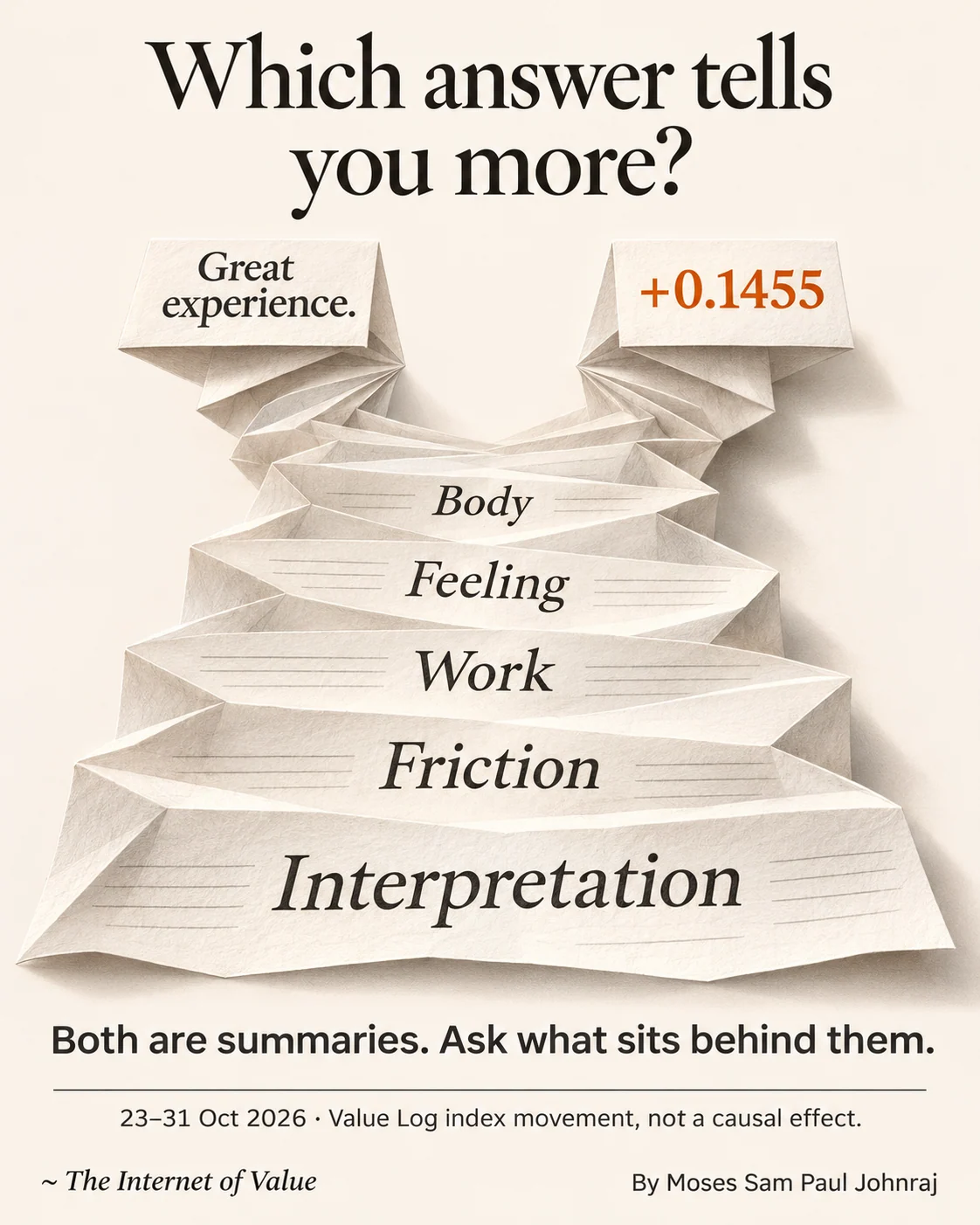
If you asked me how Field Station was, I could offer two very different answers.
I could say, “It was a great experience.” Or I could say, “My wellbeing score rose by 0.1455 points during the stay.”
Why did the number provoke a question?
Did the number make you pause?
Perhaps your first question was: “But how can you reduce an experience to a number?”
I want to ask something in return: why does compressing the same experience into “great” feel less reductive?
Both answers leave almost everything out. The interesting question is what happens when you ask me to open either one up.
What changes when words are easy to generate?
I can ask AI for an eloquent account of my stay, then ask for ten more versions. That does not mean I have thought about the experience ten times more deeply. When polished words are easy to generate, their fluency alone gives you little reason to trust my account. What did I notice? What did I record? What am I now explaining away?
The number owes you answers too. What changed, over which dates, under whose rules? Could you follow it back to the records—or challenge how I classified them?
“More words do not guarantee more reflection. More decimal places do not guarantee more understanding.”
“It was a great experience” would communicate something real. It would also leave considerable room for interpretation. Was it great because of the people, the food, the setting, an opportunity, a difficult lesson or the relief of returning home? Could I have enjoyed it while sleeping badly? Could an encouraging conversation coexist with an uncomfortable change in how I saw myself?
What should either answer let us examine?
An overall evaluation is useful. A feedback form might help organisers understand satisfaction, problems or whether people would return. A longitudinal account can ask different questions about what happened during the experience. In this case, I do not have collected feedback forms to compare with the logs, so I cannot establish that one method performed better.
My proposal is that a wellbeing score can be a compact answer that opens into a larger account. Someone who wants one number can receive a summary. Someone who wants to understand it should be able to examine the components, the relevant records, the calculation rules and the interpretations behind it.
That is what I mean by an expandable representation.
The owner-scoped promoted ledger records W = 771.580 at the start of 23 October and W = 771.726 before 1 November: a movement of +0.1455 index points across the stay. The seven core days have a different boundary and a movement of +0.1265. Interactive controls load the exact date-by-date values.
Which dates does the number describe?
The distinction between those periods changes the numerical answer:
| Explicit comparison, IST | Opening W | Closing W | Recorded ΔW |
|---|---|---|---|
| Stay: 23–31 October | 771.580 | 771.726 | +0.1455 |
| Seven core days: 24–30 October | 771.591 | 771.717 | +0.1265 |
| Full observation: 22 October–1 November | 771.570 | 771.740 | +0.1694 |
Opening means the stored state before 00:00 on the first date; closing means the stored state before 00:00 following the last date. State values are displayed to three decimals, movements to four; the inspector preserves the exact stored decimals. These are changes in an issuer-specific index, not percentages or estimates of a residency treatment effect.
The stay’s exact movement is 0.145536522766. That is a more defensible compact answer than the number I initially remembered, because it has explicit boundaries and a traceable ledger. It still needs the story—and the possibility that the model leaves something important out.
A bare number would not accomplish this. Four decimal places do not explain what changed. A composite can conceal differences between its components. It needs an understandable scale, a comparison period, an inspectable method and a way to challenge the inputs.
The same fairness applies to words. “Great experience” is not inadequate because it contains only two words. It may be the beginning of a careful account. The question is what each summary makes available when someone asks for more.
| Form of account | What it can help answer | What needs to accompany it |
|---|---|---|
| Overall evaluation | How do I judge the experience now? | The meaning of the evaluation and the context in which it was made. |
| Activity records | What did I record doing, when and in what context? | Coverage, timing, classification and uncertainty about the account. |
| Component history | How did the model represent particular dimensions over time? | Defined inputs, baseline, update rules and evidence for each change. |
| Composite score | What summary did the declared calculation produce? | Its scale, weights, provenance and an explanation of what aggregation hides. |
| Detailed experiential inquiry | How did one particular moment unfold for me? | A suitable method of elicitation and analysis, with memory and prompting limits. |
How does this relate to existing ways of studying experience?
This inquiry has precedents. The Day Reconstruction Method asks people to reconstruct episodes of a day and report aspects of their experience. Ecological momentary assessment uses repeated reports of current or recent experience in everyday life. An activity diary does not become either method simply by containing timestamps. These approaches help identify what Value Log would need to demonstrate, rather than supplying a reason to claim it is unique. Day Reconstruction Method2; ecological momentary assessment3.
People also encounter numerical representations in institutional life. A credit score estimates repayment likelihood; GDP accounts for production. Wages, credentials and platform metrics answer still other questions. Their purposes and constructs differ. I am interested in whether a person can participate more actively in representing their own becoming. The existence of familiar economic metrics does not validate my alternative. Credit-score definition4; GDP definition5.
To examine that alternative, I have to begin with more than a score. I have to ask who is doing the observing.
Who is observing, and how is that person changing?
The interactive portrait uses the full shared Identity renderer and my owner-approved public projection, captured on 3 November. Hover or focus to preview a ring; select it to open its published facets. This contemporary view is separate from the residency’s historical states.
What did I bring into the room?
At the residency, we introduced ourselves through names, stories and three emojis. It was a small exercise in representing a person compactly. My log preserves that the exercise happened; it does not preserve the actual emoji choices.
A compact introduction can make a conversation possible. It cannot carry everything someone brings to the room.
In my Observer Attention work6, the observer is the person. Attention selects something from experience. The person may give it a boundary, describe it, correct the account and decide what can be shared. Evidence can still challenge the description. Being the person who experienced something does not make every interpretation of it reliable.
“When you call me by my name, are you reducing me to one word?”
Where does the score sit within Identity?
Wellbeing Identity is the broader representation in this architecture. It includes relatively stable context, capabilities, values, narrative and changing state, with a separate boundary governing disclosure.
| Identity node | What it represents | What this case can examine |
|---|---|---|
| GivenIdentity | Legally or socially anchored context. | The context I bring; no new change in these facets is established here. |
| EarnedIdentity | Education, credentials, work experience and portfolio evidence. | Whether a contribution has evidence or recognition appropriate to a particular claim. |
| RentedIdentity | Representations hosted on external platforms. | How a digital representation relates to the person, without assuming software development changed my personal profile. |
| Skills | Capability, evidence and trajectory. | Practice in communicating, facilitating and building, distinguished from a validated change in skill level. |
| MoralCompass | Values, virtues and ethical boundaries. | The relationship between what I say matters and how I respond when challenged. |
| Story | Past, present, future and turning points. | How encouragement, disagreement and new possibilities alter my account of what happened. |
| IdentityState | Current state, score history and protocol convergence. | A policy-defined wellbeing projection and its recorded changes. |
| ConsentAndDisclosure | What may be disclosed, to whom and under what conditions. | The person's control over which parts of the representation travel. |
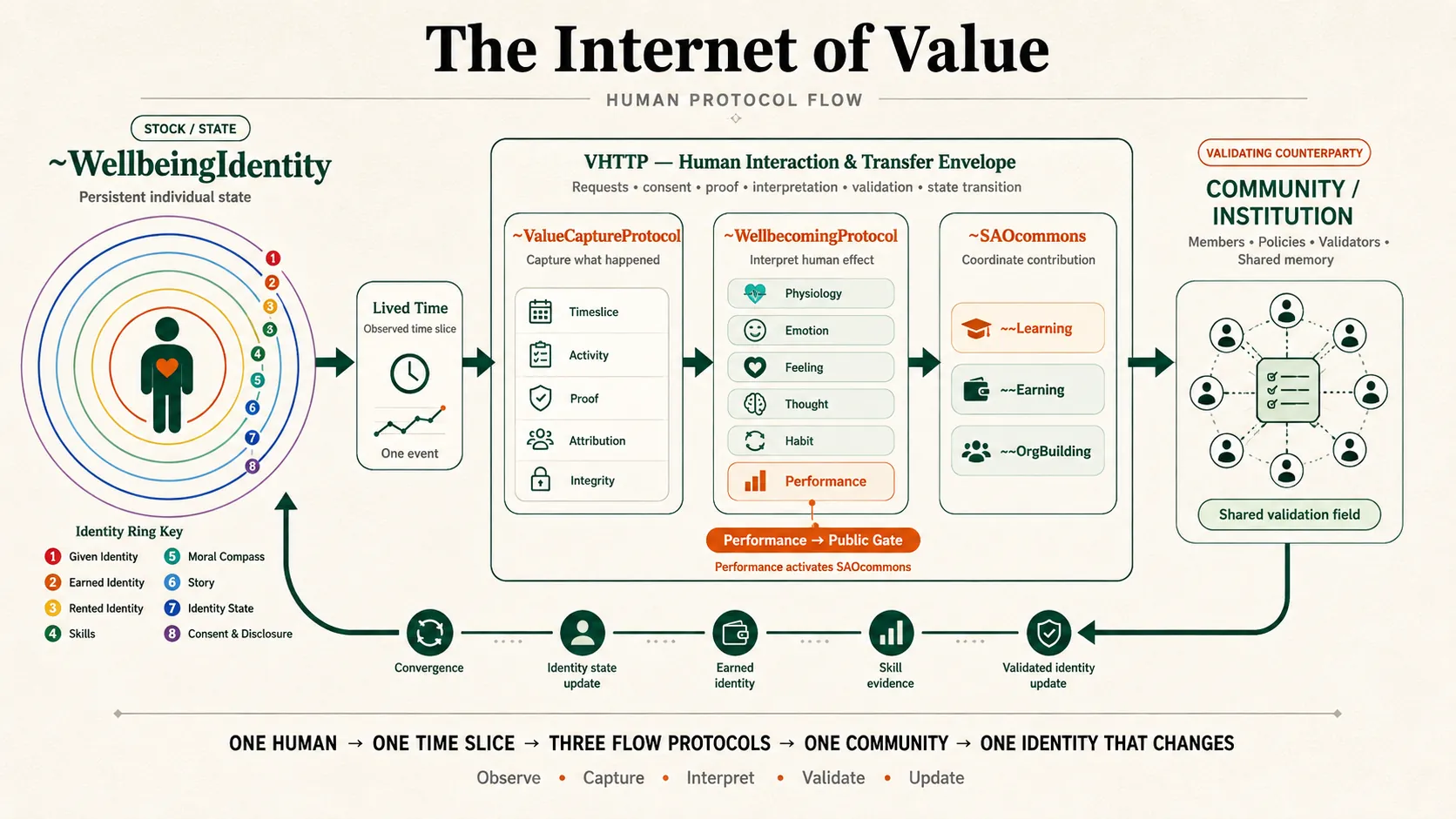
The seventh node is IdentityState. It contains the WellbeingScore, ScoreHistory and ProtocolConvergence. The score is one facet within that node. ConsentAndDisclosure is the eighth. These eight Identity nodes are different from the six Wellbecoming nodes used in the calculation framework. Canonical Wellbeing Identity definition7.

What changed when someone I respected was watching?
This distinction becomes concrete in my final Field Station presentation, Redefining and Reclaiming value8.
On October 30, I delivered the Internet of Value presentation while Manvendra Singh, Dhun's founder, recorded it. In my recollection, he was recording the whole session. The audience mattered to me, and so did his presence behind the camera. I felt positive afterward. I also wrote that I was unsure whether I had communicated everything I intended.
Those responses can coexist. A respected person recording my work could feel like recognition while leaving the quality of the explanation unresolved.
That makes my own observation worth examining. Was I judging the presentation by what I had communicated, by how I felt, by the attention of someone I respected, or by the possibilities I imagined might follow? My entry does not separate those influences well enough to assign each a weight. It does preserve the uncertainty that a more flattering retrospective story could omit.
The event is classified as Performance. Its description also contains feeling and interpretation. The primary category does not exhaust what happened to the person.
What can experience change, and what can the record establish?
Experience can change me whether or not I record it. The protocol represents selected aspects of that change. A record may inform private state; an eligible contribution may enter community validation; reflection may lead me to revise my Story. These returns have different kinds of evidence and authority. None requires pretending that every Identity node changed at once.
The observer who evaluates a later event therefore has a history, including the way earlier events have been understood. A score can offer a partial model of state within that history. It cannot stand in for the whole observer or independently explain the very report from which it was calculated.
How does the Wellbecoming Protocol organise observations?
What does the six-node framework capture?
The Wellbecoming Protocol provides six nodes for interpreting observations: Physiology, Emotion, Feeling, Thought, Habit and Performance. Value Log is the implementation I used to record activities and their classifications. The protocol supplies a vocabulary; the records provide particular accounts. Neither supplies an automatic measurement of the whole person.
How does an observation return to Identity?
The wider architecture has four protocols. Value Capture gives a selected event a time boundary, activity description, evidence, attribution and integrity context. Wellbecoming interprets its possible human effect. SAOcommons becomes relevant when a qualifying Performance contribution needs community governance or validation. Wellbeing Identity receives scoped returns. Value Capture9; Wellbecoming10.
For non-Performance observations, the private-state route matters. Rest, a reported feeling, a change in understanding or a repeated routine may become inputs under the declared policy. For Performance, practising a skill or producing something can supply evidence for a contribution claim. A validated return may then inform Skills, EarnedIdentity or IdentityState. Private discouragement does not become a public credential, and an encouraging conversation does not automatically become a skill certification.
What does each thread help me ask?
| Wellbecoming node | The question I use to approach these records |
|---|---|
| Physiology | What was happening around rest, movement, food, travel and bodily interruption? |
| Emotion | How were emotional processes classified, and what evidence supports that classification? |
| Feeling | How did I describe the experience of feeling a particular way? |
| Thought | Where did understanding, uncertainty or a decision change? |
| Habit | Which routines recurred, were interrupted or resumed? |
| Performance | What did the work, learning or contribution actually produce, and what was validated? |
These distinctions need care. The canonical Emotion vocabulary includes biochemical facets, but this corpus contains no cortisol, dopamine or serotonin assays. Reporting discouragement does not tell me a hormone concentration. Similarly, time classified as Performance is not a measured amount of productivity.
The framework becomes useful only if these questions make the experience more specific. My records give us a way to try that.
Why call this a Becoming Weave?
A life does not arrive as six separate stories. The work I do can interrupt my sleep. A conversation can change how I feel about that work. The same dinner can involve food, recognition, uncertainty and an imagined future. What happens next is lived by the person who has already passed through those moments.
The handloom is a useful image for what I mean by weave: a fabric takes form through the relationship between threads, not through any one thread on its own. In Value Log, the recurring Wellbecoming perspectives provide the threads; time-bounded activity records make the stitches. The picture lets me look across a day, follow one dimension across days, or return to a particular occurrence.
“My account of reality is a weave of observations.”
The product’s 23 July changelog11 introduced the Becoming Weave as a way to show where recorded life accumulated. Its structure is deliberate: five inner Wellbecoming threads, followed by a separate Performance lane for capability and outward contribution. An activity retains its interval; a completed state movement and a Performance valuation have different marks. The handloom analogy is a design explanation, not evidence that these categories exhaust lived experience or that the depicted threads establish causal relationships.
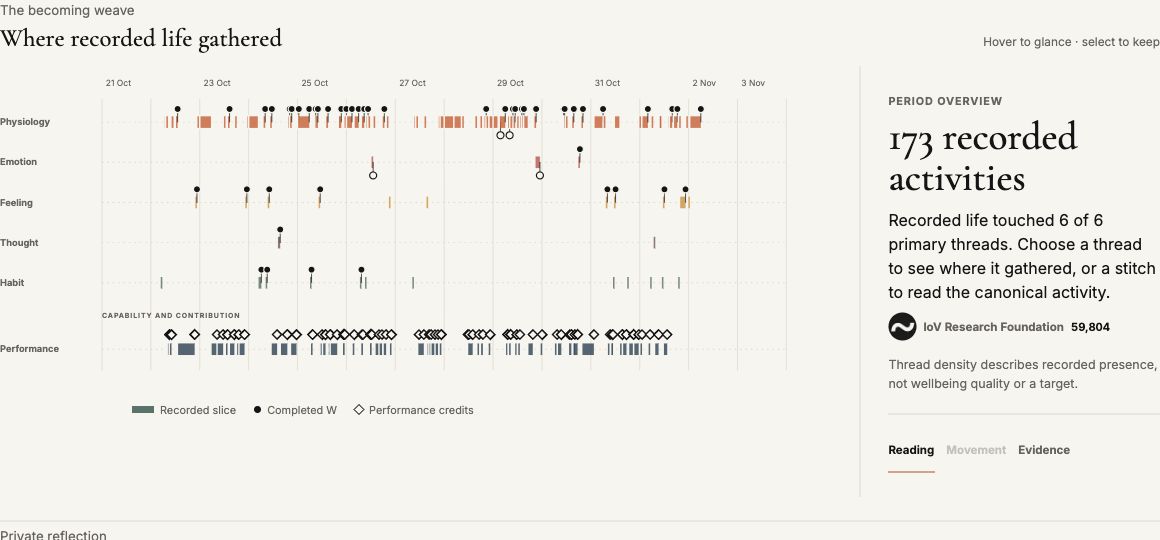
Actual owner-account interface, captured 3 November 2026. This rolling view covers 21 October–3 November and shows 173 records; it illustrates the instrument, not the fixed seven-day result below. No activity descriptions or other participants’ names are shown. The app’s “Performance credits” label refers here to separately calculated, non-payable founder valuations, not money received.
How do I read the threads and stitches?
| Mark in the weave | What it makes visible | What it does not establish |
|---|---|---|
| Thread | A recurring primary Wellbecoming classification across time. | A separately measured biological or psychological process. |
| Stitch | A recorded activity at its actual time interval. | That every aspect of the experience fits its primary label. |
| Circle | A completed W movement at the activity endpoint; negative and positive movements have different positions. | A direct measurement of how good or bad the whole experience was. |
| Diamond in the Performance lane | A separate contribution valuation under its declared rules. | A skill-level gain, payment, or increment to the wellbeing score. |
A dense thread means that more recorded life gathered there. It does not mean that dimension was better. A gap may be unrecorded time, and a stitch without a state marker may have no eligible transition. Neither allows me to infer that nothing was experienced.
What moved during the seven core days?
The live weave makes the relationships visible. The replay below freezes the case to 24–30 October, so I can inspect the six component states and their daily movements without a rolling date window changing the result.
Seven core days, 24–30 October: inspect each day’s six stored component values, recorded time, classifications and contribution to the composite. The controls offer a step-by-step replay rather than an uninspectable animation.
View the static counterpart to the seven-day replay
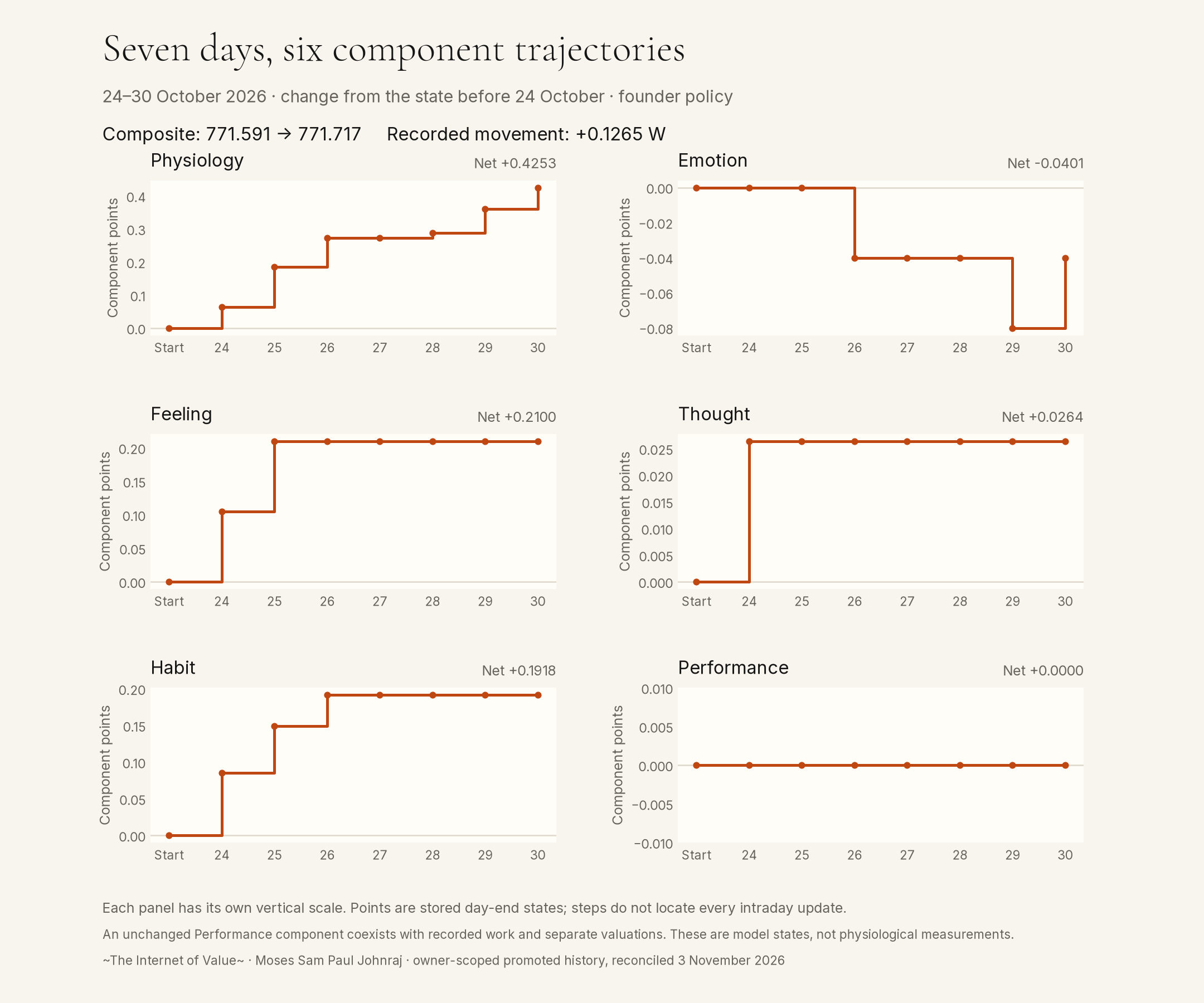
Static counterpart to the replay. Each panel has its own vertical scale. The points are stored day-end states; the lines do not represent continuous measurements of experience. Exact component values and daily movements are available in the replay table.
What do my records show across the six nodes?
What interrupted the apparent flow?
On October 26, I woke during the night, worked with an AI agent on the product and then returned to sleep. Two days later, I recorded resting instead of my usual walk or calisthenics because I was unwell. On October 29, a monkey bite interrupted the morning and led to a vaccination trip. That day also contained work, rest and an evening in which critical comments left me feeling down.
An account organised only around talks and projects could make the residency sound like a continuous exchange of ideas. My body, interrupted routines and responses to other people were part of the experience too.
How complete is the recorded week?
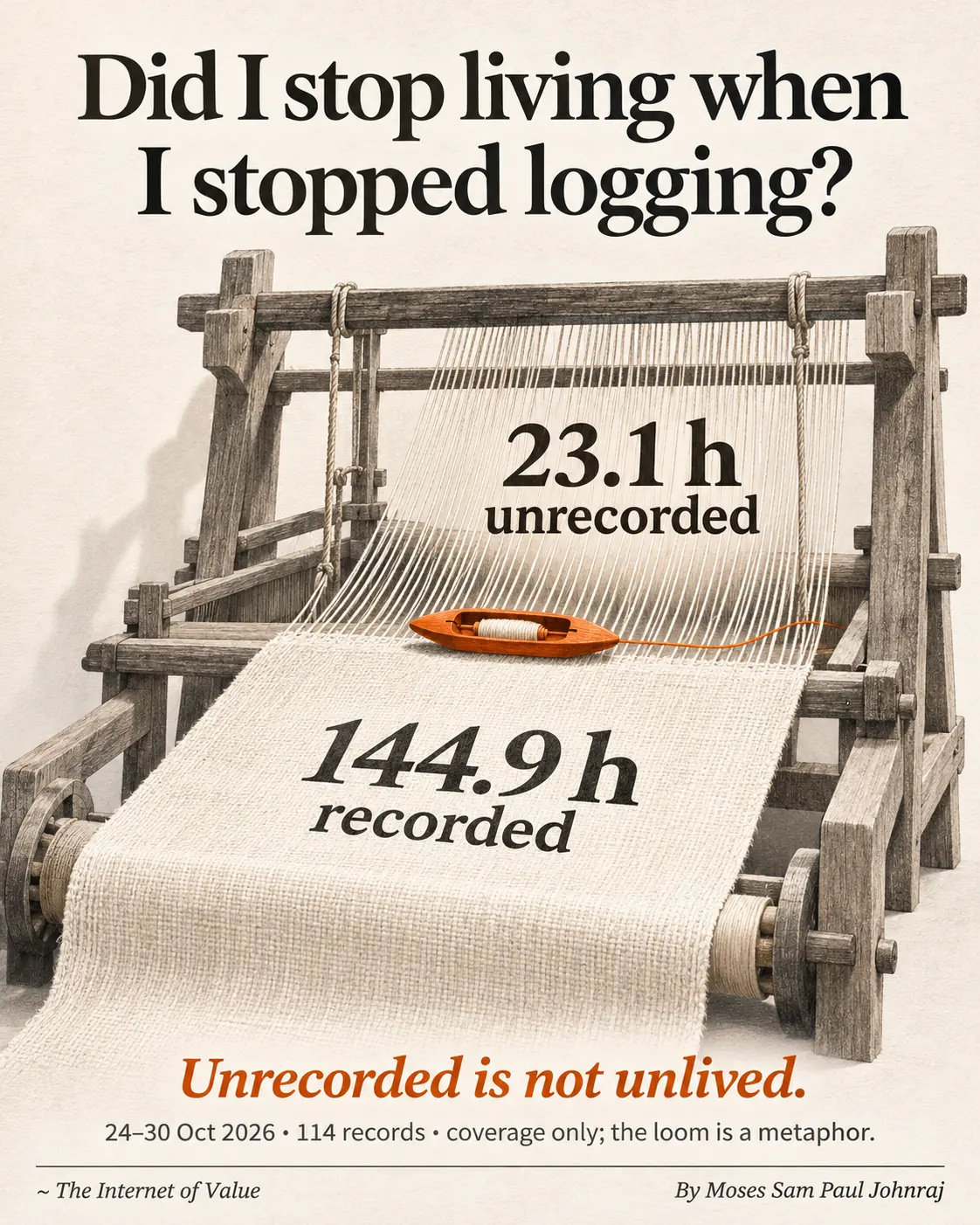
The seven core days contain 114 records, occupying 144.9 of 168 calendar hours. The other 23.1 hours are unrecorded. Across the full eleven-date window, there are 172 records, occupying 232.9 of 264 hours, with 31.1 hours unrecorded. Missing time is not evidence of inactivity, sleep loss or a particular state.
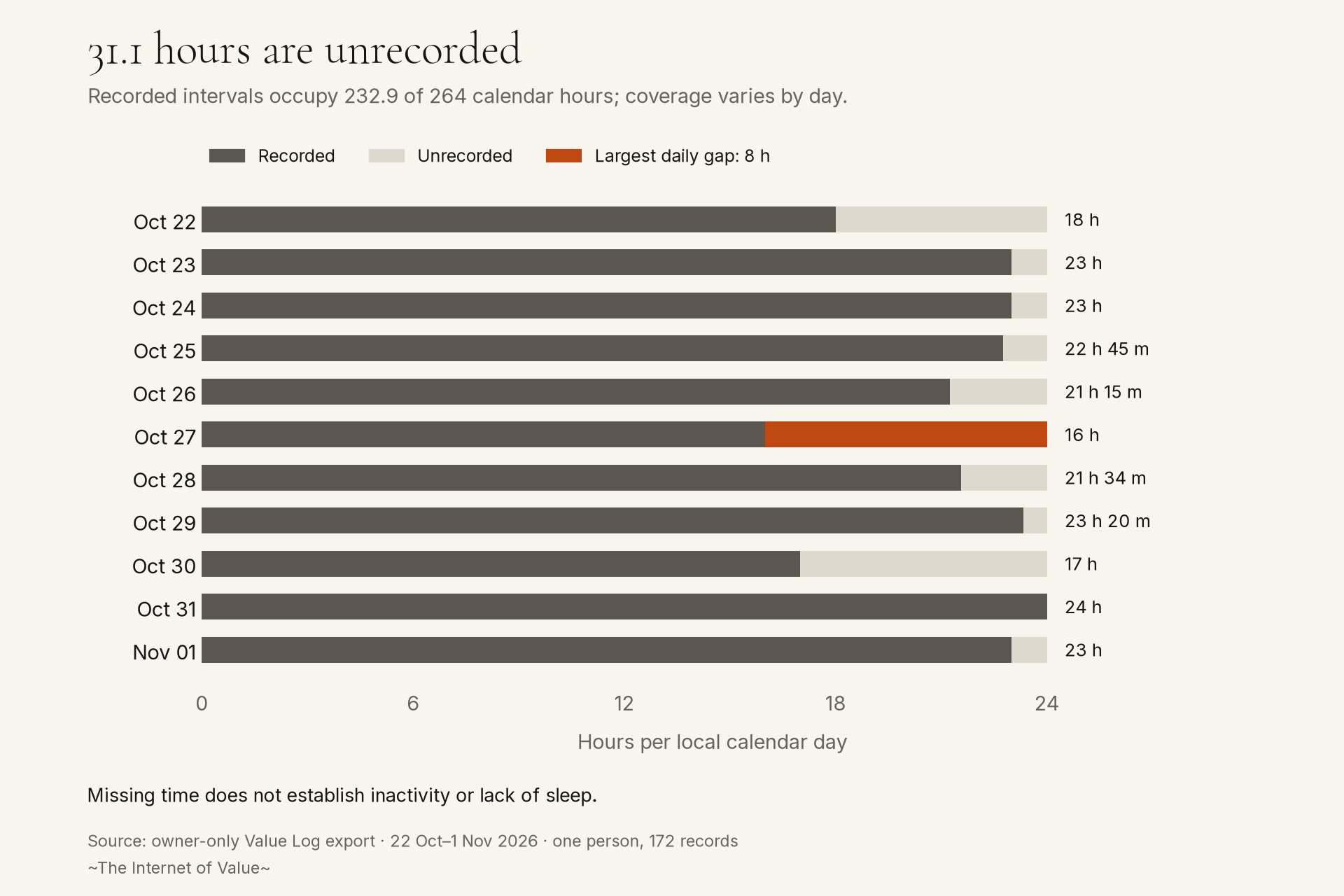
Recorded interval coverage, 22 October–1 November. Arrival, departure and the Goa day have different roles in the account. The chart represents recorded time, not continuous measurement of wellbeing.
Where did recorded time gather?
The six-node distribution looks different depending on which period is being described:
| Node | Seven core days: records | Seven core days: recorded hours | Full eleven-date window: records |
|---|---|---|---|
| Physiology | 55 | 69.65 | 79 |
| Emotion | 3 | 4.00 | 3 |
| Feeling | 4 | 3.00 | 11 |
| Thought | 1 | 1.50 | 2 |
| Habit | 6 | 5.25 | 12 |
| Performance | 45 | 61.50 | 65 |
| Total | 114 | 144.90 | 172 |
Core period: 24–30 October. Counts use record start dates; durations are clipped to the stated window. Categories describe the primary classification of records. They do not measure how much of my life consisted of thought, feeling or physiological activity.
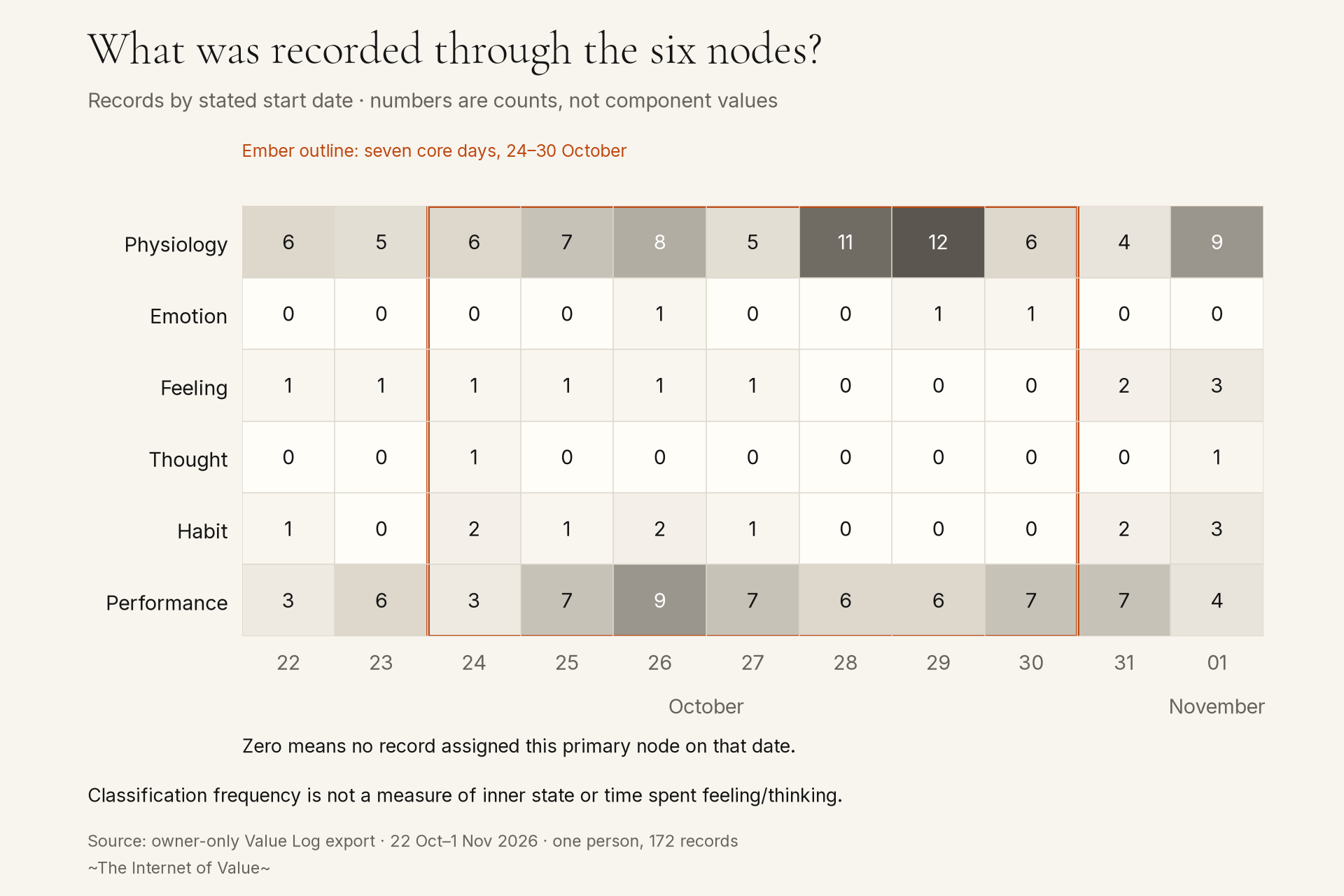
This is a classification timeline. Zero means no record was assigned that primary node on that date; it does not mean an absence of thought, feeling or physiological activity.
How did rest, movement and bodily routines vary?
Physiology: the evidence strip loads the opening and closing component states, daily movement, classification counts and recorded time for 24–30 October.
The opening days included morning routines, walking, calisthenics, meals and movement between the tent area and the main gathering place. The later records complicate any assumption that I sustained one stable routine throughout the stay.
The overnight work on October 26 sits between sleep records. On October 28, the account explicitly links missed usual movement with cough and other symptoms. On October 29, the injury and vaccination trip displaced part of the morning. Later entries include short rests; I attributed one period of dozing to medication. These are reports of events and experience, rather than an independent clinical assessment.
What did I bring to the ceremony?
The return journey adds further context. Late-night project exploration and fragmented rest appear before the flight to Goa. On November 1, I recorded both a shorter rest than planned and another period of sleep before getting ready for the ceremony.
That matters to the opening contrast. The person arriving at ecstatic dance had travelled and rested unevenly. I cannot isolate a difference in experience and attribute it entirely to technology, ritual or the absence of screens.
What does the Physiology label leave out?
Physiology also contains a classification problem. Its 69.65 recorded hours in the core week include food, travel, walking and other bodily routines as well as rest. They are not 69.65 hours of recovery. Some entries bundle several activities. At least six sleep episodes in the full export are split across midnight into separate records. Counting those rows as separate sleeps would change the story through a database boundary.
The records make a disrupted physical context visible. They do not establish sleep quality, recovery, autonomic function or biochemical change.
What does the Emotion component represent here?
Emotion: the evidence strip loads the opening and closing component states, daily movement, classification counts and recorded time for 24–30 October.
Only three records in the entire eleven-date window have Emotion as their primary node. Two carry negative directions; one carries a positive direction.
One records discouragement after a conversation in which my request met a response about autonomy. Another records feeling down after comments about my ideas and me personally. The third concerns stand-up comedy: the comedian joked about me and The Internet of Value with my permission, and I enjoyed it.
Three different contexts: discouragement, critical comments and comedy with permission. Inspect their recorded classifications and score movements separately.
Did enjoying the jokes show that I had grown?
There is a tempting story available here. I could say I learned to take criticism, and point to the comedy as evidence of maturity.
The records do not make that comparison cleanly. Permission was explicit in the comedy setting. The people, expectations and circumstances differed. Enjoying jokes in one situation does not show that my response to criticism had improved generally. The earlier discomfort remains part of the account.
This is where a longitudinal view can help without pretending to settle everything. It preserves differently described responses on different occasions. It gives me an opportunity to investigate the conditions, rather than turning the later positive entry into a verdict about growth.
The labels also have a firm limit: they are classifications of my account. No laboratory or sensor data here establish the biochemical processes named in the protocol's wider Emotion vocabulary.
How did I describe feeling across these days?
Feeling: the evidence strip loads the opening and closing component states, daily movement, classification counts and recorded time for 24–30 October.
Feeling appears in eleven records across the full window, including a family call, informal time with residents, farewells, conversations after returning to Goa and the cacao ceremony. Eight are labelled positive and three neutral.
Those labels do not amount to a representative sample of every feeling I had. Several important responses appear inside records assigned to other nodes. The presentation is Performance, yet its description contains a positive feeling and uncertainty. The Emotion records contain discouragement and enjoyment. The category boundary is an analytical decision, not a boundary around my capacity to feel.
Why did recognition matter to me?
The distinction is especially important around recognition. When Manvendra recorded my presentation, what mattered to me included who was paying attention. Later, at dinner, the possibility of exploring this work within Dhun gave the conversation a future dimension. I could imagine where the ideas might go.
An encouraging encounter can become more valuable in my account because I imagine what might follow. The record can preserve that possibility without treating the imagined future as an outcome already delivered.
What does the ceremony record leave unresolved?
The ceremony then appears as a positive Feeling record. Its three-hour block captures participation and a broad reflection. It does not resolve how attention, hesitation, movement, invitation or intention unfolded within those hours. That gap is a reason to consider a more detailed method, not a reason to invent a smooth curve of emotional change.
Where did my understanding or decisions change?
Thought: the evidence strip loads the opening and closing component states, daily movement, classification counts and recorded time for 24–30 October.
Thought is the smallest primary category: one record during the core week, and two across the full window. A lunch conversation about a different approach to the future of work is one; video listening during the return journey to Goa is the other.
What changed between the two presentations?
Much thinking clearly occurred inside other categories. The first residency presentation left me wondering whether I had explained the work or asked for help clearly enough. Before the later presentation, I recorded thinking through questions, organising the demonstration and building a page to bring the material together.
That is a sequence worth retaining: an unsatisfactory account of an earlier attempt, more deliberate preparation, a later positive response and continued uncertainty about communication. It suggests a practical adjustment. It does not supply an independent measure of how much I learned or how well the audience understood.
I also admired how some residents revised their project direction after a conversation or on a short deadline. That was one of the clearest learnings in my later reflection: adapt when new information arrives. The question is whether I was as willing to revise an explanation about my own behaviour.
Was I equally willing to revise my account of myself?
Some of my most consequential thinking appeared later, in reflection. When told that people were talking about me and might not want to enter the tent if I was there, I interpreted it as resistance to logging and self-improvement. I presented their reluctance to myself as a sign that the demand for awareness made them uncomfortable.
That interpretation deserves scrutiny. It gives my request a beneficial purpose and explains their discomfort in a way that protects me. If interest confirms the value of my work, and resistance also confirms it, what response could make me reconsider my conduct?
The tent account was a report relayed to me, not something I independently observed. I do not know what each person meant or wanted. What I can examine is the explanation I reached for, and whether it left enough room for feedback about me.
Which routines recurred, were interrupted or resumed?
Habit: the evidence strip loads the opening and closing component states, daily movement, classification counts and recorded time for 24–30 October.
The Habit records include morning routines, showering, packing and transitions around travel. During the core week, six records occupy 5.25 hours under this primary label.
My usual movement appears elsewhere, under Physiology. Its interruption while unwell shows why a habit analysis needs context rather than a count of successful repetitions. The same omitted walk could reflect illness, a decision to rest, a missing record or a failure to follow an intention. These possibilities should not receive the same interpretation automatically.
Was I observing in the moment or reconstructing later?
The act of logging also had a rhythm. On October 29, I recorded entering activities for the previous two days. Across the export, the median gap between an activity's reported end and creation of its canonical database record is 13.2 hours; 29 records have gaps greater than 24 hours. Original capture may have happened earlier than canonical creation, so this is not a precise measure of recall delay.
Still, the explicit backfilling entry matters. A record about Tuesday can be composed by the person who has already lived through Wednesday. The state from which I remember belongs in the investigation alongside the state I am trying to describe.
Seven days can reveal repetition and interruption. This case does not establish habit formation or a lasting change in consistency.
What did the work produce or help me learn?
Performance: the evidence strip loads the opening and closing component states, daily movement, classification counts and recorded time for 24–30 October.
Performance accounts for 45 core-week records and 61.5 recorded hours. Across the full window, it accounts for 65 records and 103.33 hours. The category includes presentations, discussion, product building, attending sessions, facilitation and other work-related activity. It is not a time sheet of independently verified productive output.
The presentation record produced a non-payable valuation but no Performance component transition. Inspect the event before treating attention as an increase in capability.
Where did the product get in the way?
Some of the clearest learning concerns my own product and the way I invited people to try it.
I proposed a low-tech awareness exercise in which people mentally replayed their day through the six nodes without phones or logging. Later, I invited people to use Value Log. My records also say the sign-ins did not work, access was restricted, others offered help, and we changed the approach. After repairs, I invited people to test again; successful logging was still unconfirmed in that entry.
These details challenge my explanation of reluctance as resistance to self-improvement. I was asking people to engage with an idea through an implementation that sometimes failed. Other people were helping me repair it. Their actions deserve room in the account without making their motives serve my preferred conclusion.
The work also gave me opportunities to practise communicating and facilitating. I led a shorter Sundara Chakra Pranayama session. I prepared and delivered explanations of the protocol stack. I worked through product problems with others. Each can provide evidence of an activity and a possible learning process. A validated increase in skill, an adopted product and an institutional contribution are more specific claims.
What was recorded, and what was validated?
The retained export routes the 65 Performance records to the IoV community: 30 Learning, 19 Earning and 16 OrgBuilding. All 65 carry a Performance-impact status of no_transition; no task or source-attestation reference is populated in these records. That is an implementation fact about these rows. It does not establish that no relevant validation or credit exists elsewhere.
It does mean I cannot turn the number of records, the hours or the attention my presentation received into Foundation credits earned. A score or credit claim needs its own traceable calculation and validation evidence.
What changes when the score and the story are read together?
Which components account for the net gain?
Across the core week, the composite gained 0.1265 points. Physiology contributed +0.0851, Habit +0.0192, Feeling +0.0210 and Thought +0.0053. Emotion contributed −0.0040; Performance contributed 0. The sum reconciles to the stored composite movement. That composition matters more than a single positive total.
The first two core days account for 61.7% of the week’s net recorded gain. That does not establish that they were the best days. The timing reflects which observations received eligible updates, their direction and intensity, the starting states and the policy’s weighting. It could change if classifications or eligibility changed. A sparse record is not an evenly sampled inner life.
Why can a rising component coexist with illness?
Physiology’s positive net contribution sits alongside illness, interrupted movement and an injury. Ordinary positively classified meals, rests and routines contribute many small updates; the injury contributes a negative one. A rising Physiology component therefore cannot be read as evidence that the illness improved or that recovery was measured. The calculation aggregates classifications of observations. It does not make a diagnosis.
What does the Emotion result add to the story?
The Emotion result is equally instructive. Two discouraging entries each subtract about 0.0040 W; the enjoyable comedy adds about 0.0040 W. The component ends slightly lower. The later positive occasion neither erases the earlier ones nor demonstrates that I learned to receive criticism. The shared numerical size follows the declared rules; it does not establish equal psychological impact.
What did the score miss about recognition?

Performance creates the strongest mismatch between narrative significance and component movement. The presentation mattered to me. Manvendra recording it mattered to me. Yet its recorded composite movement is zero, with a separate 96.464 USD non-payable VCperformance valuation. This is how the current implementation represents that occurrence, not a verdict that it meant nothing. Its description includes positive feeling and uncertainty, while its primary classification remains Performance. A different coding scheme might represent those aspects separately—but adding an unrecorded Feeling update now would alter the evidence to fit my preferred interpretation.
“A zero in the ledger is not an empty moment.”
Which explanations deserve testing?
These differences generate questions worth investigating, rather than a single explanation of the week:
| Hypothesis prompted by this case | Why I would investigate it | Rival explanation or missing evidence |
|---|---|---|
| Attention from someone I respect changes my self-evaluation. | I attach particular significance to Manvendra recording the presentation and considering the work. | Preparation, audience questions and an imagined opportunity may also matter. No isolated recognition effect was measured. |
| Permission changes how I experience being the subject of humour. | The comedy entry explicitly records permission and enjoyment. | Relationship, tone, setting and expectations differ from the critical conversations. Three entries cannot establish a general pattern. |
| The observer’s physical context changes later interpretation. | Illness, interrupted rest, medication attribution and travel surround the major scenes. | No independent sleep-quality or physiological measures were collected; narratives cannot establish the pathway. |
| Primary-node classification changes what the composite makes visible. | Positive feeling inside Performance did not become a separate Feeling transition. | This may be an intentional rule against double counting. Testing alternatives needs predeclared coding and a sensitivity analysis, not retrospective score shopping. |
| Difficulty adopting the product partly reflected access and my approach. | Sign-in failures, restrictions, offers of help and my sharp requests appear in the account. | Other people’s motives remain unknown. Their reluctance cannot be diagnosed as resistance to self-improvement. |
How does my role as the founder affect the analysis?
The uncomfortable implication is that I helped design both the product and the categories through which I am examining myself. Founder self-review makes a calculation traceable; it does not make my explanations independent of my interests. A stronger follow-up could ask another analyst to code selected episodes without knowing the desired story, retain disagreements and compare how the result changes. That study has not been done here.
The activity analysis has made the week more specific. To understand what its numerical summary adds, I now have to open the calculation itself.
What does a change in my wellbeing score actually mean?
A change in this wellbeing score means that a declared policy transformed particular inputs into a change in a calculated index. Understanding that change requires the starting component values, the included observations, their classifications, the update rules and the exact comparison interval.
The founder implementation I am investigating uses six components on a 100–1000 index scale. Its declared weights are:
| Component | Weight |
|---|---|
| Physiology | 20% |
| Emotion | 10% |
| Feeling | 10% |
| Thought | 20% |
| Habit | 10% |
| Performance | 30% |
These are issuer-policy choices, not universal weights assigned by the canonical protocol or established as a population measure of wellbeing. The implementation uses band-dependent update rules, direction and intensity, bounded component values and fixed-decimal arithmetic. The calculation is different from adding hours spent in each category. Founder implementation field note12.
Where did the opening state come from?
The baseline is established before these events are processed. In the documented founder example, ratings and review produced six starting components: Physiology 800, Emotion 750, Feeling 700, Thought 880, Habit 800 and Performance 700. Their weighted contributions are 160 + 75 + 70 + 176 + 80 + 210 = 771. The Genesis process retained that baseline following its declared observation and review process. Twenty-five eligible observation days are provenance for that constitution, not 25 points added to the score. The historical rationale behind each initial rating has not been independently reconstructed here.
By the start of the residency, the components had already moved. Before 24 October, for example, the stored Physiology component was 802.336702028797 and Performance was 700.126006595655. Substituting the July baseline of 771 for the residency opening would manufacture a much larger period gain. A baseline, an opening state and a closing state have different jobs.
How does one eligible observation change the model?
For the founder policy used here, a component’s current band supplies a rate and adjustment factor. Direction supplies the sign; low, medium and high intensity supply factors of one-third, two-thirds and one. The component is bounded to 100–1000. Its weighted contribution changes the composite. Duration does not multiply this state transition.
In symbols, before bounds and the declared fixed-decimal steps: ΔC = sign × C_before × band rate × adjustment factor × intensity factor, and ΔW = component weight × ΔC. The actual calculator below uses the implementation’s fixed12 functions rather than relying on this abbreviated expression.
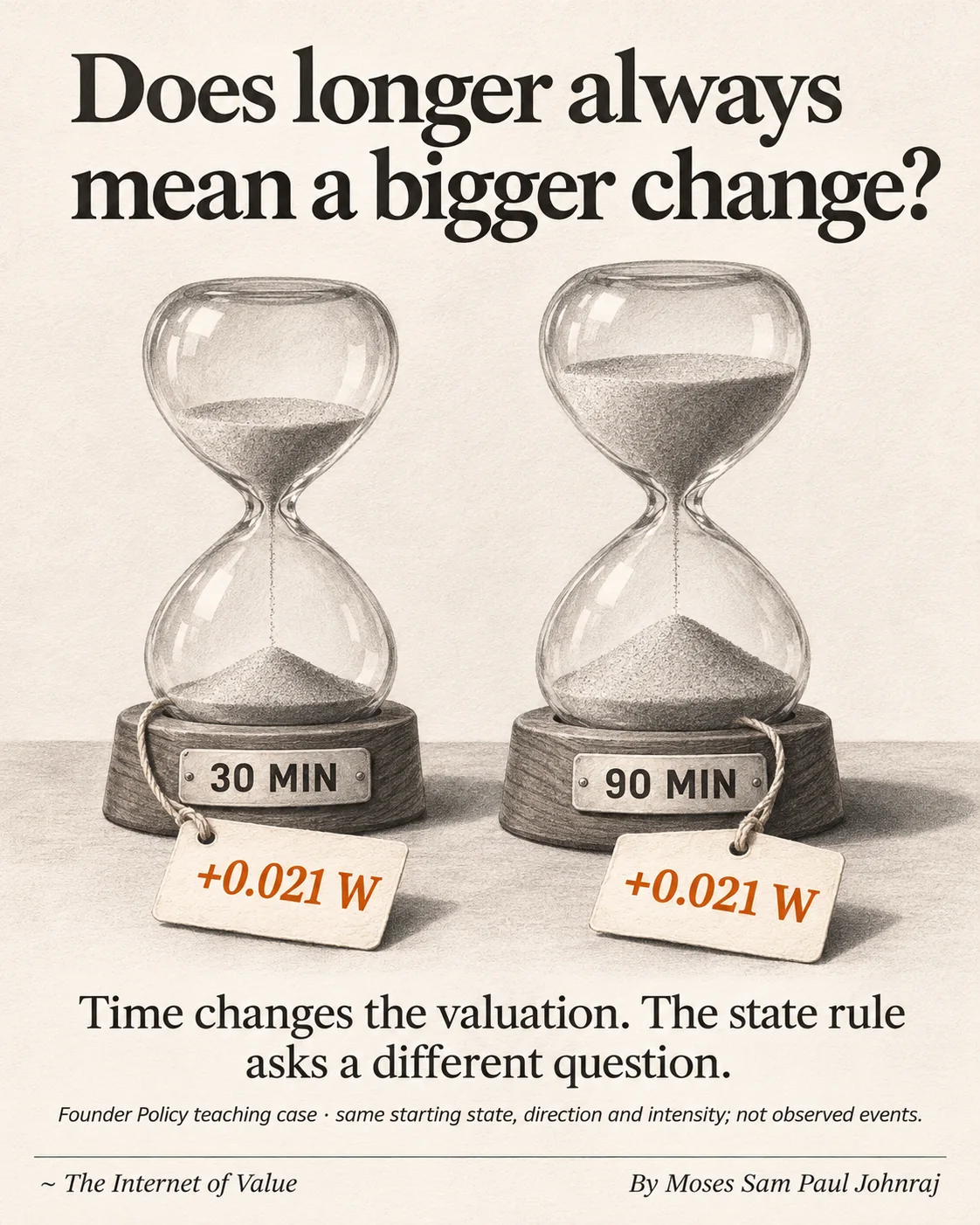
At Performance = 700, medium positive gives 700 × 0.03 × 0.005 × ⅔ = 0.07 component points, or +0.021 W under its 30% weight. At Physiology = 800, medium positive gives 0.042666666667 component points, or +0.008533333333 W under its 20% weight. These are teaching cases from the mathematics presentation, not two reconstructed events from my residency. The band changes above 800, so it would be wrong to apply the 800 example’s rate to every later Physiology observation.
The interactive teaching calculator shows the documented baseline, band, direction and intensity, then calculates the state movement separately from the non-payable contribution valuation.
Why are duration, contribution value and wellbeing movement separate?
The mathematics presentation uses a hypothetical eligible 90-minute Performance occurrence at my scoped rate of 750 USD/hour. Vcom = 1.5 × 750 = 1,125 USD. Its separate VCperformance = (771 ÷ 1,000) × 1,125 = 867.375 USD, a non-payable event valuation. It uses W before the event. Applying the hypothetical Performance component update afterward gives W = 771.021. A valuation of 867.375 and a state movement of 0.021 are different typed outputs, not rival measures of how much wellbeing the activity created.
Splitting one eligible occurrence into several calendar rows must not create several independent component updates. The replay groups occurrences and orders their transitions. The rates and finality rules also have a scope: this founder example does not establish a universally accepted skill price, a payment or an entitlement. In the actual presentation record, the exported value event and no_transition status can be inspected in chapter 5. There is no basis for importing the teaching example’s +0.021 into that observed record.
The mathematics explanation13 and the declared implementation policy explain the calculation. Whether these classifications, bands and weights adequately represent wellbeing is a further empirical question. A result can be computed correctly while its interpretation remains contestable.
A hypothetical one-point increase in Physiology alone would add 0.2 points to the composite under these weights. An equal decrease in Thought would cancel that composite movement. The resulting unchanged total would conceal two opposing component changes. This arithmetic example illustrates the weighting; it is not an observed result from my residency.
For the same reason, a flat line can be ambiguous. A carried-forward component can mean that no eligible update was recorded. It does not establish that my underlying experience stayed constant. An event can matter deeply in the narrative without producing a Performance transition in the exported row.
Can the period result be reproduced?
I had described the period with a score increase of 0.1109; an earlier note gave 0.1129. The current promoted history does not reproduce either figure for the three explicit comparison periods used here. The stay’s movement is 0.145536522766; the seven core days give 0.126518262599. I retain the earlier figures as an example of why a remembered precise number needs reconciliation, not as alternative findings to choose between.
That is a substantive test of the expandable-score argument. If a precise number is offered as a compact account, I need to be able to open it and reproduce it. The reconciliation now joins the existing activity export to an owner-only export containing the preceding state, 51 state revisions, 116 value events and the promoted replay’s passed verification. It checks the stored component-weighted totals and the chronological W chain. These checks establish arithmetic consistency within the declared implementation; they do not validate it as a measure of wellbeing.
| Question about a numerical result | What would settle it |
|---|---|
| What changed? | Component states and composite values at explicit start and end points. |
| Which observations counted? | The eligible records, occurrence grouping, exclusions and recorded transitions. |
| Which calculation was used? | Baseline, versioned policy, weights and the current approved calculation history. |
| What does the magnitude mean? | Index units and interpretation, with any display transformation stated. |
| How dependable is the interpretation? | Checks of classification, missing inputs, sensitivity and measurement validity. |
| Did the residency cause the change? | Evidence beyond temporal coincidence in this one-person observational case. |
“The calculation can be exact. The interpretation can still be wrong.”
What does correct arithmetic establish?
Reproducible arithmetic is necessary for understanding the model. It is not sufficient to establish that the model measures wellbeing well. The OECD's subjective-wellbeing guidance14 distinguishes questions of measurement and interpretation that a private implementation must address in its own terms. It does not validate this score.
I still think a compact numerical answer can be useful. Its usefulness depends on what I can show when someone asks what went into it, including the parts I have not yet resolved.
What did I contribute, and what was recognised?
What opened at the candlelit dinner?
The evening after the presentation and comedy brought another kind of encounter.
Dinner was in a beautifully lit, forest-like part of Dhun. I remember the candles. In that setting, I asked Manvendra about his values, and we talked about the Well-being Passport. My record says he expressed interest in working together, took my number and messaged me. I remember the conversation as an invitation to explore Wellbeing Identity and the Wellbecoming Protocol within Dhun, alongside his earlier Passport idea.

The possibility mattered. I had spent days trying to make these ideas understandable and usable. Here was someone whose work I respected considering how they might relate to a place he was building.
What did that possibility establish?
But the experience contains several different things: my feeling about the conversation, a possible next step, and the work that would have to follow. Expressed interest does not complete the proposal, establish adoption or validate my theory. It can still change the future I imagine for the work, and therefore the story I tell about why the stay mattered.

What kind of evidence does each return need?
This is where Wellbeing Identity needs to carry more than a score. The conversation could inform Story and future intention. A later completed contribution might provide portfolio evidence. A governed validation could support a skill or credential claim. Those returns have different thresholds. Wellbeing Identity update rules7; SAOcommons valuation interface15.
In this architecture, a final protocol valuation is explicitly non-payable. It is not a payment or a transferable balance. Recognition, calculated value and payment should not be silently treated as the same thing.
“Being seen is not the same as being understood.”
What did the work leave me with?
For the Internet of Value Research Foundation, the residency also offered a setting in which I could try explanations, hear questions, build, encounter failures and see where people were willing to help. I learned that a request to participate is entangled with access, clarity, relationships and the burden I place on someone else. Those are observations from the case. They should not be inflated into proven organisational outcomes.
A useful account should let personal significance remain visible while asking what a contribution produced. It should also let an unfinished opportunity remain unfinished.
What changed in my Wellbeing Identity, and what remains a claim?
The encouraging scenes are only part of the record.
What do my own words make uncomfortable?
In the original reflection, I described becoming frustrated with a teammate. I said they could ask me for help, but also told them, in my retelling, “don't come talk to me with random opinions.” That was a sharp boundary, and its impact on the other person is not something my account establishes.
I also described an initially promising connection becoming difficult. When a request met a response about not working for me, I speculated about the other person's past trauma. I had no evidence for that interpretation. It may have let me move too quickly from receiving feedback to explaining the person giving it.
Could resistance tell me something about my approach?
The report about people avoiding the tent creates another uncomfortable possibility. Perhaps they were resisting the discomfort of self-observation, as I initially argued. Perhaps my approach was demanding, unclear or unwelcome. Perhaps practical barriers mattered. The account available here cannot settle their motives. My willingness to examine my own behaviour should not depend on proving that everyone else's interpretation was correct first.

This also changes how I read the pleasure of being recorded by Manvendra. If recognition strengthens my confidence, and criticism prompts me to explain why others resist, I need to examine the different standards I apply to those encounters. Neither a respected person's interest nor my discomfort at a criticism settles whether my idea is sound.
Can I examine praise and criticism by the same standard?
The Tamil Tirukkural, in couplet 423, offers an ethical question I find relevant here:
எப்பொருள் யார்யார்வாய்க் கேட்பினும் அப்பொருள்
மெய்ப்பொருள் காண்ப தறிவு.
My English paraphrase is: wisdom examines the truth in what is said, whoever says it. Applying that to my own account means examining an encouraging interpretation with the same care as an uncomfortable one. This is an ethical lens for the inquiry, not scientific evidence for the model. Tamil source text, couplet 42316.
The week does not end with a clean resolution. A departure-day record describes further friction about logos and the approach to building community. Enjoying the stand-up comedy had not demonstrated that disagreement was now easy for me.
“If praise and criticism both prove me right, what could ever change my mind?”
Which changes can I support?
What, then, can I reasonably say changed?
| Part of Identity | What the account supports | What it does not establish |
|---|---|---|
| Story | New possibilities, discouragement and later reinterpretation entered my account of the stay. | A final, independently verified explanation of what the experience meant. |
| Skills | I practised presentation, facilitation and product work, and adjusted preparation after an earlier attempt. | A quantified or attested increase in skill level. |
| MoralCompass | My stated respect for agency can be examined against the way I made requests and interpreted resistance. | A measured improvement in character or virtue. |
| IdentityState | Records describe positive, neutral and negative classifications and particular reported feelings. | A continuous measurement of experience or an independently validated wellbeing change. |
| EarnedIdentity | Activities and possible outputs can be checked for appropriate evidence. | An automatic credential or institutional recognition from attendance or interest. |
This is a changing account of a changing person. Some revisions are mine to author. Some claims need other evidence or legitimate external validation. A larger Identity representation is useful only if it preserves those differences and gives me room to correct what I previously believed.
What do I mean by a Wave Function of Experience?
Wave Function of Experience is my provisional name for thinking about experience varying as a person moves through activities, environments, relationships and changing states. At this stage it is a metaphor and a research question, not an established scientific model.
What is supposed to vary?
The residency and the ceremony gave that question a concrete setting. A presentation, an uncomfortable exchange, product work during the night, a conversation about future collaboration and dancing with an intention are not interchangeable units merely because each occupies time. Their meaning also depends on the person arriving at them.
The six-node framework offers possible dimensions for describing aspects of that movement. Wellbeing Identity asks what the person brings forward: capability, values, history, narrative and current state. Observation and later interpretation are part of the account, rather than transparent windows onto it.
What would turn the metaphor into a testable model?
I would like to know whether a carefully defined model of these transitions could reveal something useful. That requires saying what is observed, at what time, on which scale and with what uncertainty. It also requires an alternative against which the model can be judged. A curve that merely looks plausible would not answer those questions.
What do these records leave between the points?
My records are too coarse to draw a continuous wave of inner experience. The median activity lasts an hour; eighteen records last at least three hours. Some bundle discussion, eating, work or travel. A boundary between records does not locate a switch in attention, and a category change does not measure the magnitude of an experiential transition.
“A timestamp locates the record. It does not contain the experience.”
Why does observation not establish a quantum connection?

Quantum language needs its own boundary. Physical quantum measurement can alter an experimental system through an interaction; that does not establish the same mechanism for a person reflecting on experience. I cannot infer quantum dynamics from the fact that observation matters in both contexts. Quantum measurement example17.
The current value of the metaphor is therefore limited and practical: it prompts me to ask about changes through time, the dimensions I have chosen, and the observer doing the describing. Its scientific usefulness remains to be tested.
Where could the inquiry become more specific?
One way to investigate further is to change the scale of inquiry. Instead of adding another broad line to the graph, I could return to one actual moment.
What could micro-phenomenology add to meditation research?
During the return journey to Goa on November 1, I listened to a video about meditation and micro-phenomenology. The log marks it as a possible research lead for Sundara Chakra Pranayama. It was an encounter with a method, not a completed research finding.
What does micro-phenomenology investigate?
Micro-phenomenology is an interview and analysis approach for investigating the detailed unfolding of a particular lived experience. It usually works retrospectively. Its distinction from ordinary reflection lies in how a singular episode is evoked, described and analysed, rather than an escape from memory into unmediated truth. Method and training18; methodological investigation19.
My current reflection contains many explanations: what another person may have meant, what I wanted, why a moment mattered and what it says about my growth. Those explanations can be useful. They are different from a detailed account of what I noticed and how a response developed in a short, specific episode.
“Can I describe what happened before I explain what it means?”
How would one moment be elicited and analysed?
A trained interviewer could first help me identify a moment I can actually recall. It might concern presenting, hearing a response or participating in the ceremony. The inquiry could explore what was present, what happened next and how attention shifted, without supplying the experience that the interviewer expects to find. Descriptions would then need a separate, traceable analysis. Temporal sequence and aspects present together have different analytical roles.
How could the questions shape the answer?
Beginning with a question such as whether I was seeking validation would already offer an explanation. A more careful investigation would allow an account that supports, complicates or fails to illuminate that interpretation. It would also permit failed recall. Detail and confidence alone do not establish accuracy; prompting, confabulation and the relation between experience and later report remain methodological concerns. Remembering and interview quality19.
| Approach | Its main job in this investigation | Its limit |
|---|---|---|
| Ordinary journal or reflection | Preserve a story, meaning, evaluation or question. | Detail may be selective and mixed with later explanation. |
| Value Log activity record | Locate an activity in time with classification and context. | A block of time does not describe every experiential transition within it. |
| Modelled component/score history | Summarise declared inputs under a calculation policy. | A numerical trajectory depends on its model and evidence. |
| Micro-phenomenological inquiry | Elicit and analyse fine descriptions of a particular episode. | Training, memory, prompting and analytical quality still matter. |
What precedent exists in meditation research?
A 2019 meditation pilot used micro-phenomenology to investigate meditative experience and developed hypotheses about its processes. It establishes a methodological precedent for investigating meditation this way. It does not establish the effects of my breathing session or validate Value Log. The talk that prompted my interest offers an introduction and guided adaptation; an introductory exercise is not equivalent to a full interview-and-analysis study. Meditation pilot20; contemplative-research talk21.
How could this complement research into Sundara Chakra Pranayama?
What was actually delivered at the residency?
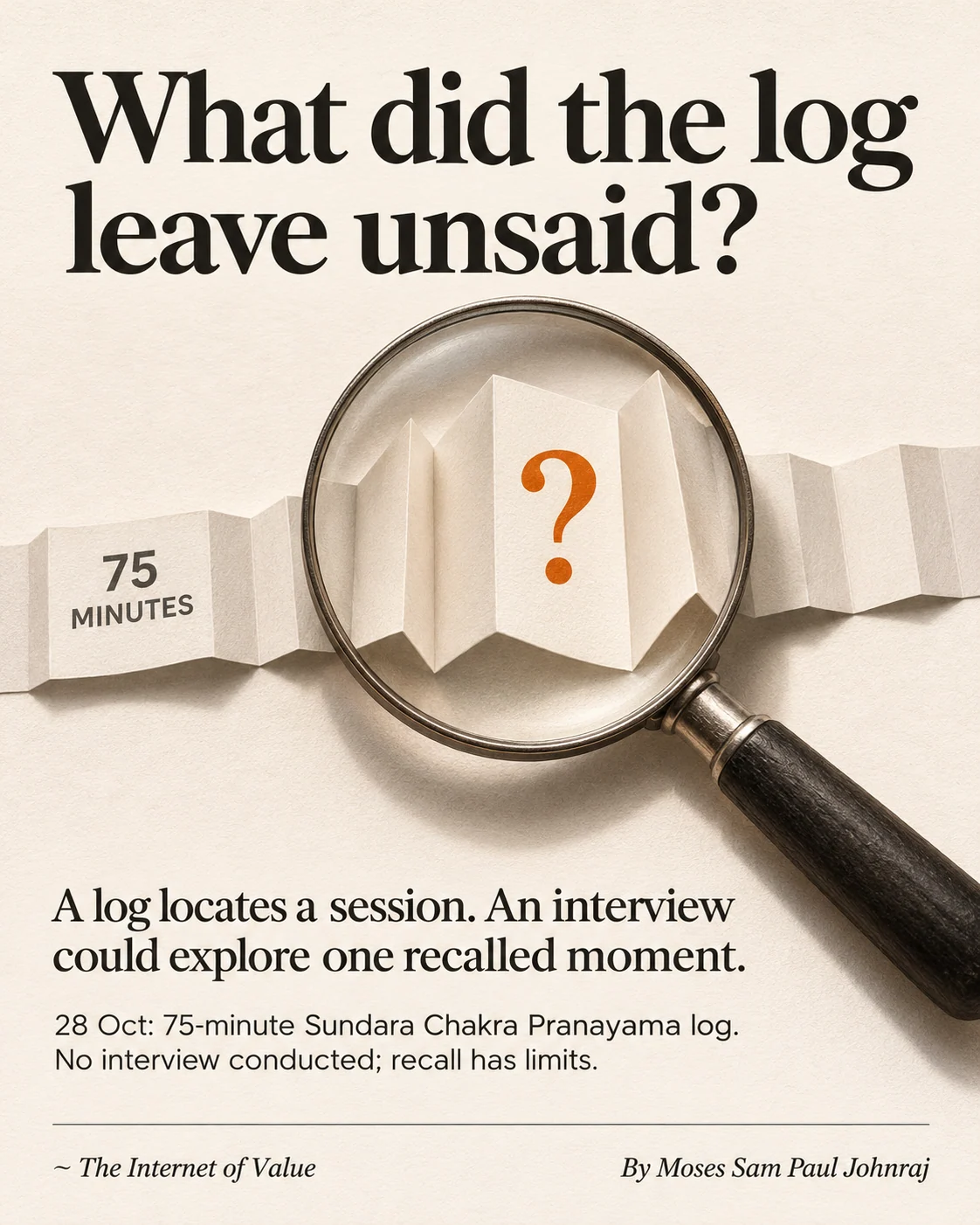
On October 28, I logged facilitating a 75-minute session. The original entry uses a different practice name; I subsequently clarified that it was Sundara Chakra Pranayama in a shorter format. The original wording remains in the log; my correction is retrospective.
The programme's reading materials identify the named exercise in chapter 31 of Mind Your Breathing: The Yogi's Handbook with 37 Pranayama Exercises. Our separate Goa research programme has a 90-minute reference sequence: 40 minutes of movement, 20 minutes of conceptual framing, 21 minutes of SCP and 9 minutes of stillness/debrief. That protocol is an exploratory design. It does not establish the delivered sequence of the shorter residency session or participant outcomes. Programme protocol22; reading-source notes23.
The ceremony and ecstatic dance are a separate experience. They are not that SCP session or a control condition for it.
Which evidence is adjacent rather than direct?
There is adjacent research on specific breathing practices. For example, a 2023 randomised study compared daily five-minute breathing exercises with mindfulness meditation over a month. Its conditions and duration differ from this programme; its findings cannot be transferred to SCP by similarity of theme. A bounded search for this project did not establish a direct study combining SCP, Value Log and micro-phenomenology. Controlled respiration study24.
What should a first combination study ask?
A useful first study of the combination would ask a modest question: does a separately analysed interview add relevant experiential detail to a time-bounded log? It should preserve disagreements, ambiguous reports, failed recall and the burden of participating. My experience as a facilitator would need to remain separate from participants' experiences of practising.
Which effects would remain unidentified?
The reference protocol's checks before and after stages could help locate episodes, but a change across a composite sequence cannot isolate the effect of pranayama. In particular, its interval after movement and before the post-pranayama check includes both conceptual framing and breathing. An interview could investigate what someone reports about a moment within that interval; it would not by itself establish a causal mechanism or physiological chakra anatomy.
The connection is worth investigating because the methods do different jobs. Whether the combination is useful remains a question for evidence.
What can I reasonably conclude about quantifying experience?
I return to the cacao ceremony and ecstatic dance with a more specific account of the person who arrived there.
I had been using AI to build products while asking what human value would mean in a world of increasingly capable agents. I had tried to explain my work, felt encouraged by a respected founder's attention, imagined a possibility for collaboration and remained unsure whether I had communicated clearly. I had also become unwell, had routines interrupted, felt discouraged and offered explanations of other people's behaviour that deserved questioning.
What can the records support?
The records preserve enough to resist a single flattering verdict. They also leave substantial gaps. Their categories do not cover every dimension of each event; their timing is approximate; the calculated trajectory remains a model of classified observations. The framework has to remain answerable to those limitations.
| What this case establishes | What remains open |
|---|---|
| Recorded activities can be counted and placed in a dated account with visible gaps. | How completely or accurately the records represent lived experience. |
| A six-node classification can organise questions about the same period. | Whether this particular model measures wellbeing reliably and validly. |
| Stored score movements can be reproduced for explicit periods and opened into component histories. | Whether the classifications and calculation adequately represent wellbeing. |
| The person's account can change through encouragement, difficulty and reflection. | A complete measured change across Identity facets or a validated skill gain. |
| Micro-phenomenology offers a method for investigating selected moments in more detail. | Its added value in this corpus or effects of the named pranayama practice. |
What does the numerical answer leave open?
Can numbers and words help me observe experience? Defined aspects can be counted or modelled. Words let me describe what mattered; numbers let me inspect how the model changed. Neither contains the whole experience, and both should remain open to examination.
Can the account leave room for me to be wrong?

For me, the most demanding part is personal. I want an account rich enough to include how I behaved, not just how other people responded to my ideas. If someone declined an invitation, could I allow that response to challenge my approach rather than making it evidence that they resisted improvement?
“A useful score should leave room for me to be wrong.”
What should remain open after the score?
At the dance, the instructions included a way to decline. Participation had a boundary.
I want my system for understanding experience to leave that possibility open too, including when the response is one I would rather explain away.
Sources and methods
The references, methods and illustration notes for the complete account are collected here. The narrative remains one person's observational case.
How was this account assembled?
Which sources and checks support the numerical account?
The numerical supplement was reconciled on 3 November 2026 from the retained 172-record activity export and a separate account-scoped score-history export. The latter contains one promoted live founder branch, a passed replay verification, one preceding boundary state, 51 state revisions and 116 value events for the window. The analysis checks owner identity, policy, component-weighted totals, transition arithmetic and day/period reconciliation. Private identifiers and unredacted narratives are excluded from the reading payload. Exact source hashes remain in the research receipts.
How is the public Identity view kept separate?
The interactive Identity is a separately dated view of the owner-approved public projection. Its current score is not substituted for the end-of-residency score. Published skills, values and Story facets do not establish dated changes in those nodes. The published account uses a dated public capture; no Identity disclosure or production activity record was changed as part of preparing it.
The byline’s dated score and its published daily movement come from the owner-approved public Founder score projection25. They are separate from the frozen residency analysis.
Whose account and interpretations are these?
This is a single-person exploratory account, written from my Value Log records and later reflections. The author is also the system's creator. All 172 current activity descriptions in the scoped export were reviewed. The account mixes dated records, later recollection and interpretation; where a later detail materially expands the source, that distinction is retained in the editorial traceability notes. Other participants are unnamed; Manvendra Singh is named with the author's permission. Their experiences and intentions are not established by my account.
How were dates, intervals and missing time handled?
The export window is 22 October–1 November 2026 in Asia/Kolkata. Time totals use the union of recorded intervals clipped to the relevant boundaries; no overlaps were found. Counts describe records, not independent experiences or participants. Some activities are bundled, and some continuous sleep episodes are split at midnight. Canonical creation time is distinguished from original capture time. The adjacent dates are contextual observations, not controls.
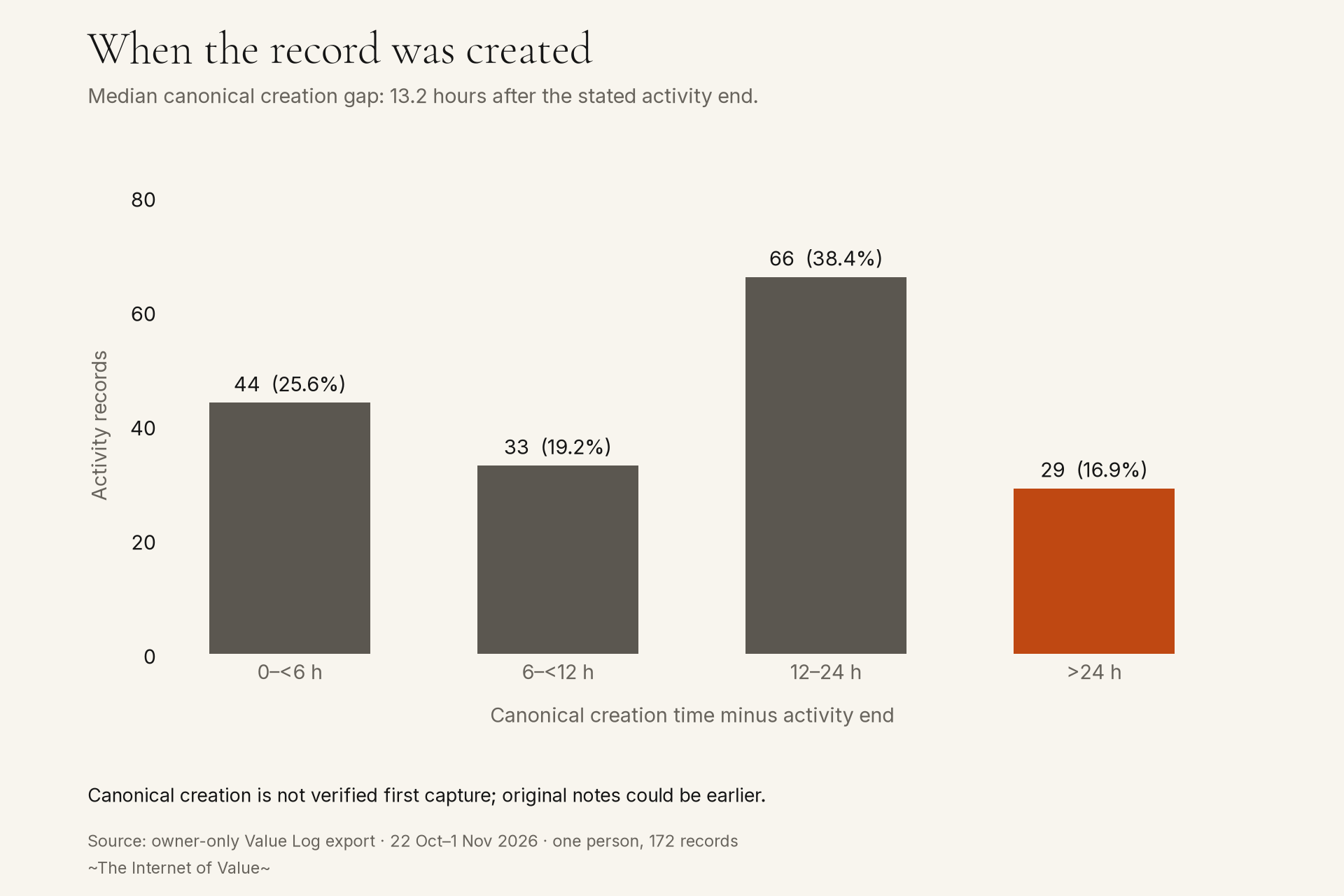
Canonical creation timing does not establish when the original observation was first captured or how accurate the recollection is.
What was not established by this analysis?
The numerical work covers activity records, classifications, time coverage, the promoted six-component/score history and separately typed founder value events. The two earlier reported deltas did not reproduce for the stated windows and are superseded by the explicitly bounded results above. Legacy Pilot W/credit tables were exported for provenance but are not combined with this founder ledger. No micro-phenomenological interview was conducted for this account. The study proposals do not constitute ethics approval, participant recruitment or a claim of treatment efficacy.
How was AI used in this account?
AI assisted analysis and drafting under human authorship. This account was reviewed and approved by the author. Independent scientific peer review is not claimed.
Source of Truth (Specs)
Where does protocol authority sit?
Protocol definitions are grounded in the canonical registry26, Value Capture specification9, Wellbecoming specification10, Wellbeing Identity specification7 and SAOcommons valuation interface15. These sources define the architecture; they do not establish scientific validation of this case's measurements.
Which canonical terms identify these sources?
Canonical terms: ~ValueCaptureProtocol, ~WellbecomingProtocol, ~SAOcommons, ~WellbeingIdentity, WellbeingScore, ProtocolLinkId.
Cover note
The cover joins the human Field Station residency at Dhun with the later cacao ceremony and ecstatic dance in Goa. The tilde is an illustrated connection through a changing observer. It is not a measured experiential wave or a claim of a quantum mechanism. The people and scenes are conceptual illustrations, not documentary reconstructions.
Photograph notes
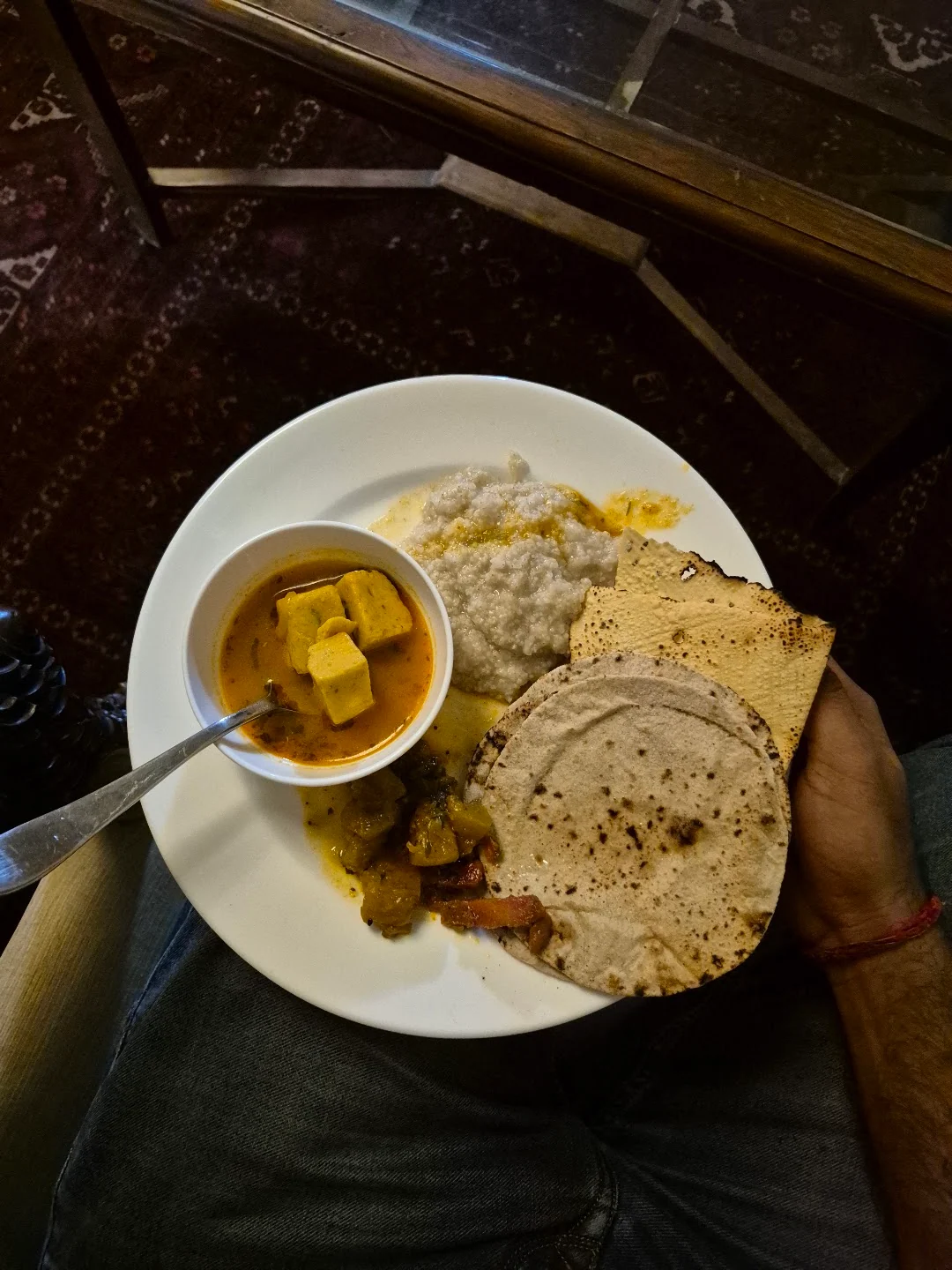
Photographs by Aditya Singh. Two shared Field Station albums supplied by the author on 3 November 2026. Dates reproduce the album display; they have not been independently verified. These photographs document settings and a meal, not the content of conversations, an individual’s state or a causal effect. Full shared-link keys remain outside the reading payload.
Captions use the album dates: daylight setting and wooded evening, 30 October; meal, 24 October. The photographs retain their full frames and natural colours.
Illustration notes
The editorial illustrations are conceptual, not documentary reconstructions. The Identity composition quotes the actual shared public renderer. Its current public state is dated separately from the residency results.
Chapter 1: What did I bring to the dance floor?
A suitcase brings a Field Station badge, laptop and cacao/dance motifs together around the observer who carries both settings. The suitcase is a metaphor; this is not a documentary reconstruction.
Author’s account: Dhun 23–31 October and Goa 1 November 2026 · reference 1
Chapter 2: Which answer tells you more?
Two compact answers, Great experience and +0.1455, unfold into a larger paper account. Illustrative summaries. Index movement does not establish a causal effect.
Owner-scoped promoted Value Log history, 23–31 October 2026 · reference 13
Chapter 3: How much of me fits inside a number?
The actual public eight-ring Identity portrait appears as a larger paper print, with one separately dated score facet on a smaller orange-number tag. Current public state effective 2 November, not the residency closing state.
Owner-approved public Identity capture, 3 November 2026 · reference 27
Chapter 4: Did I stop living when I stopped logging?
An unfinished handloom represents 144.9 recorded hours and 23.1 unrecorded hours in the seven core days. Coverage, not quality. The loom is a conceptual illustration, not the actual app weave or a calibrated chart.
114 core-week records, 24–30 October 2026 · reference 11
Chapter 5: Can zero describe a moment that mattered?
A small human presentation scene is framed inside a monumental zero: the event had no recorded state transition but mattered in the author's account. Illustration from the first-person account; zero is not a judgement of human worth.
30 October presentation record and promoted founder event · reference 13
Chapter 6: Does longer always mean a bigger change?
Hourglasses labelled 30 and 90 minutes carry the same hypothetical +0.021 W increment. Duration changes a separate non-payable valuation. Founder Policy teaching cases with the same start, direction and intensity; not observed residency events.
Founder Policy v0.1: component 700, opening W 771, medium positive Performance · reference 13
Chapter 7: How far did I travel on an invitation?
A modest candle casts a large doorway-shaped shadow: expressed interest can enlarge an imagined future. An illustrated metaphor for the author's recollection. No completed partnership is established.
Author’s dinner record and later recollection, 30 October 2026 · reference 15
Chapter 8: Was I listening—or collecting proof I was right?
A single rubber stamp gives papers labelled praise and criticism the same convenient verdict: I WAS RIGHT. A possible reading of the author's reactions, not participant quotations or a diagnosis.
Author’s reflection and the case’s competing interpretations · reference 16
Chapter 9: Do two timestamps make an experience?
Bookends marked 15:00 and 15:10 hold a blank paper book and a question mark, asking what the timestamps leave unknown. 15:00–15:10 IST locates the record. No continuous experiential wave or quantum mechanism was measured.
30 October presentation record; proposed Wave Function framing · reference 17
Chapter 10: What did the log leave unsaid?
A magnifying glass opens one point of a 75-minute paper time-strip into a question about a recalled moment. A trained interview and separate analysis are proposed; no interview was conducted and recall has limits.
Author’s 28 October shorter Sundara Chakra Pranayama log and micro-phenomenology methods · reference 19
Chapter 11: Can you disagree with my number?
The +0.1455 summary sits on an open folder with records, components, rules and uncertainty available for inspection. One observational case. Reproducing the arithmetic does not establish validity or a causal effect.
Reconciled owner-scoped history, 23–31 October 2026 · reference 13
References
- programmelogos.co
- Day Reconstruction Methoddoi.org
- ecological momentary assessmentpubmed.ncbi.nlm.nih.gov
- Credit-score definitionwww.consumerfinance.gov
- GDP definitionwww.bea.gov
- Observer Attention worktheinternetofvalue.org
- Canonical Wellbeing Identity definitiongithub.com
- Redefining and Reclaiming valuetheinternetofvalue.org
- Value Capturegithub.com
- Wellbecominggithub.com
- 23 July changelogvaluelog.theinternetofvalue.org
- Founder implementation field notetheinternetofvalue.org
- mathematics explanationtheinternetofvalue.org
- OECD's subjective-wellbeing guidancewww.oecd.org
- SAOcommons valuation interfacegithub.com
- Tamil source text, couplet 423www.projectmadurai.org
- Quantum measurement examplewww.feynmanlectures.caltech.edu
- Method and trainingwww.microphenomenology.com
- methodological investigationdoi.org
- Meditation pilotdoi.org
- contemplative-research talkcenterforcontemplativeresearch.org
- Programme protocolgithub.com
- reading-source notesgithub.com
- Controlled respiration studypubmed.ncbi.nlm.nih.gov
- owner-approved public Founder score projectionwordwallet.theinternetofvalue.org
- canonical registryspec.theinternetofvalue.org
- Owner-controlled public Identitytheinternetofvalue.org
By Moses Sam Paul Johnraj. This account uses AI-assisted writing and illustration and was reviewed by the author. The dates, evidence boundaries and limitations stated in the account apply throughout.