
Implementation evidence—not validation
Implementation Field Note: Value Log and Founder Policy
Issuer-specific calculators, HouseOfBros policy, Pilot W history, correction replay, and redacted implementation evidence.This field note demonstrates implementation feasibility in one governed context. It does not validate the theory or redefine the canonical protocol.4 min read · Moses Sam PaulQuick Answer
Value Log v1 demonstrates that observer-attention records can move from machine proposal to human confirmation, community-role validation, versioned calculation, correction, and selective publication without granting the machine observer authority or presenting Pilot W as canonical WellbeingScore.
Implementation evidence—not validation. This supplement is deliberately outside the ten-chapter theory. Its policies are issuer-specific, its evidence comes from one authored context, and none of its calculations redefine the public protocol.
From a proposition to an instrument
Value Log v1 is a private implementation of one narrow part of this paper. A person speaks a narrative. A Custom GPT proposes structured time slices. The person reviews the table as observer. A human then acts in an explicitly named community role to validate evidence and classification. Only after both human actions does the system calculate a Pilot W transition or a Performance contribution.
This is not proof that the research model is correct. It is implementation evidence that the model can be made explicit, inspectable, reversible, and bounded.
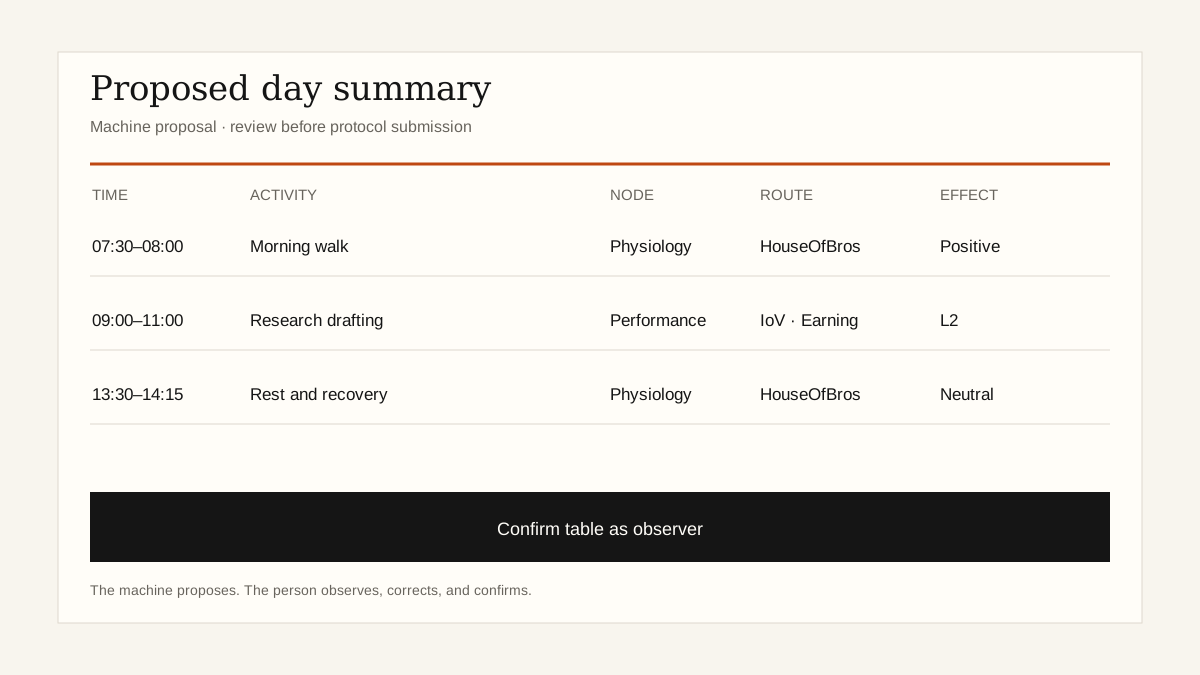
The two human actions
Observer confirmation answers: Does this proposed record accurately represent what I observed?
Community-role validation answers: Is the evidence and classification adequate for this route?
For Non-Performance records, HouseOfBros evaluates evidence adequacy, classification adequacy, and self-observation integrity. It does not claim to externally verify subjective inner truth. During the pilot, Moses acts in multiple roles. This is role separation, not independent external review.
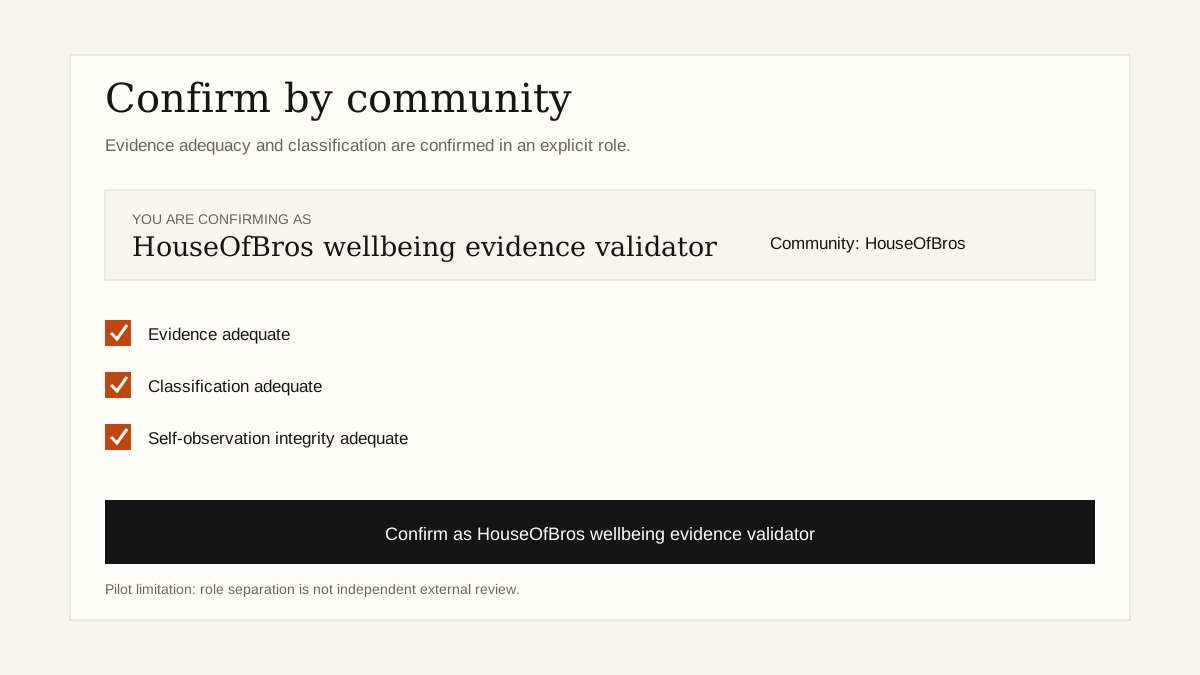
Pilot W and canonical WellbeingScore
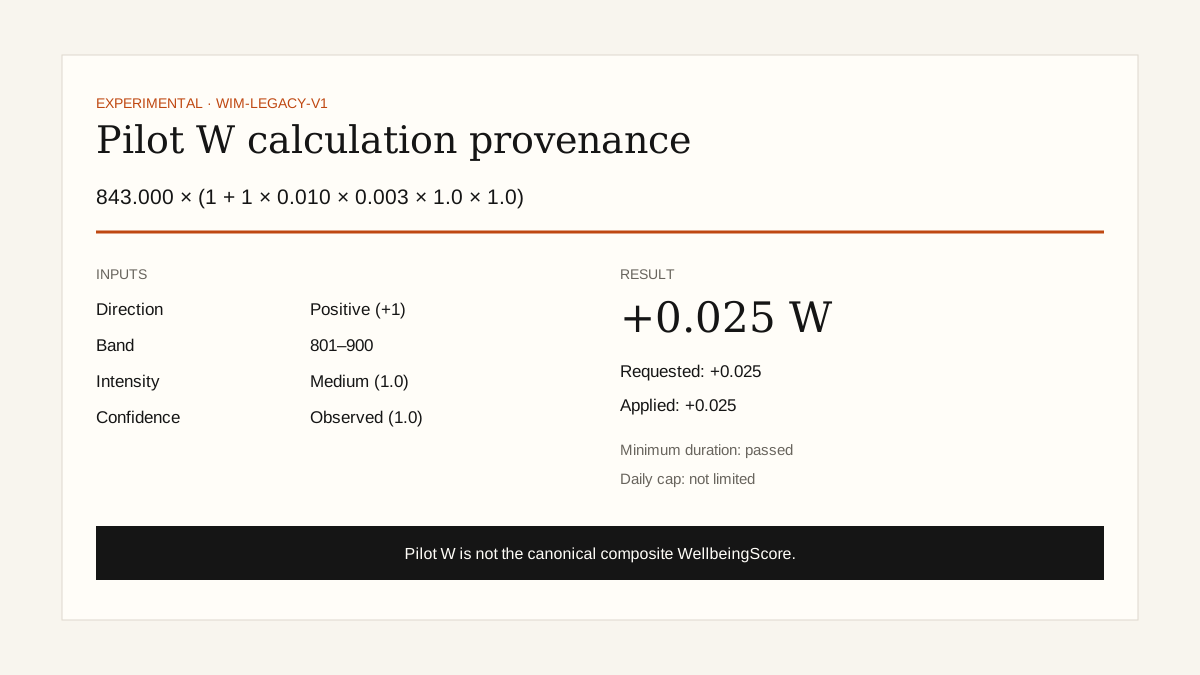
Value Log currently computes Pilot W on a 100–1000 scale. Pilot W is experimental. It is not the canonical composite WellbeingScore located in ~WellbeingIdentity / ~~IdentityState / ~~~WellbeingScore.
The two measures currently have different methods, windows, and governance. The implementation therefore publishes Pilot W as a separately labelled projection rather than silently overwriting the canonical identity state.
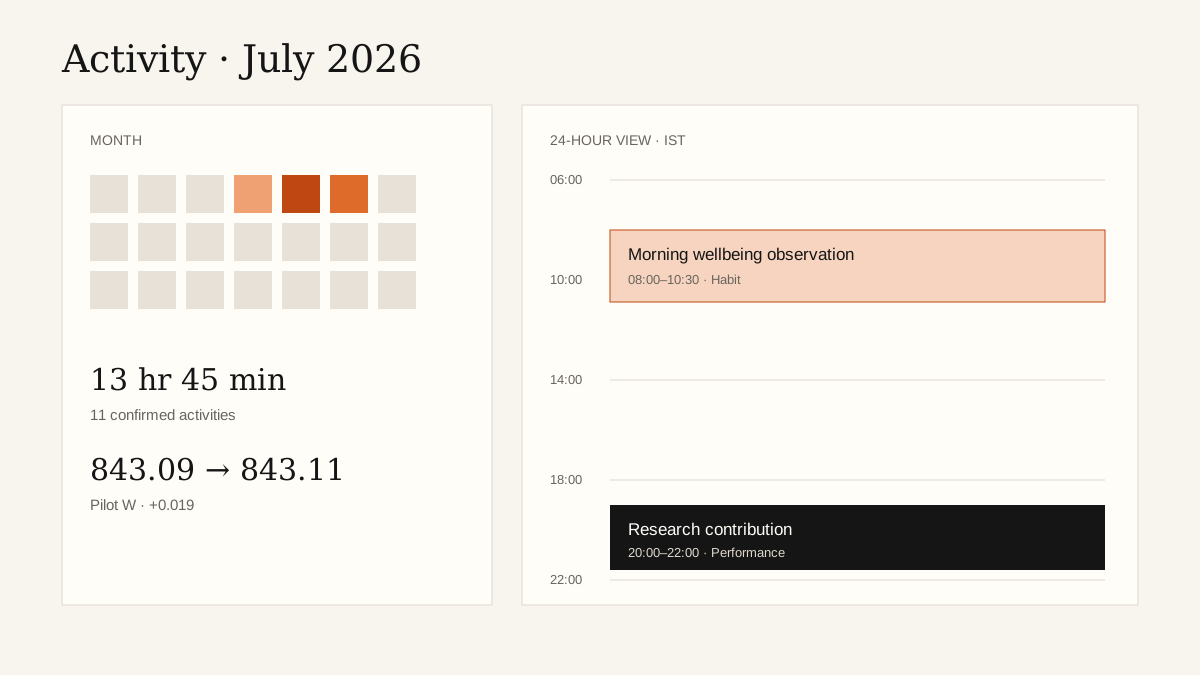
HouseOfBros Founder Policy v0.1
The prospective founder branch represents Wellbeing through six source components:
W = 0.20 Physiology

  + 0.10 Emotion

  + 0.10 Feeling

  + 0.20 Thought

  + 0.10 Habit

  + 0.30 Performance
The bootstrap baseline uses six reviewed 1.0–10.0 inputs converted to the policy's 100–1000 component scale. It does not decompose the historical scalar into invented components. A future calibration baseline creates a new prospective epoch without rewriting prior records.
For a confirmed human-state observation, the affected component's pre-event value selects a policy band and maximum movement. Direction and low, medium, or high intensity determine the applied transition. One real-world occurrence can move the component once even when the activity contains several time-slice fragments.
For validated Performance, value is resolved before the Performance transition:
Vcom_event = rate × validated_duration

VCperformance_event = (W_before / 1000) × Vcom_event
The exact pre-event W is used so an event cannot increase its own multiplier. source_attestation_id and performance_transition_key keep one evidence bundle from creating duplicate movement within a calculation branch.
The resulting projection is labelled HouseOfBros WellbeingScore · Founder Policy v0.1. It is owner-controlled, under longitudinal calibration, and is not a universal ranking, compensation rule, or measure of human worth.
Corrections are events
The implementation does not edit calculated history in place. A correction creates another revision under the same ProtocolLinkId, reverses affected calculations, and replays later W-dependent records in chronological order.
Each transition records the pre-state, requested result, applied result, calculator version, formula inputs, input hash, replay run, source revision, and reversal references.
What this field note supports
The pilot supports the narrower claim that observer-attention records can be:
- drafted without granting the machine human authority;
- confirmed through distinct human protocol actions;
- routed by canonical vocabulary;
- calculated with explicit versions and safeguards;
- corrected without erasing history;
- selectively published through revocable consent.
It does not establish clinical validity, universal comparability, monetary value, independent external validation, or a defensible canonical WellbeingScore.
Read the public Value Log method for the current formulas, safeguards, privacy boundary, and limitations.
Where the evidence lives
The field note is itself versioned evidence. The screenshots and claims belong to v0.5 and remain static even as the live Value Log evolves.
The public profile now shows consented aggregate projections from three community-expression routes:
- HouseOfBros, where value is deposited into wellbeing through validated Non-Performance records;
- ~Growth Flow Engineering~, where skill-based growth work can become Performance contribution;
- IoV Research Foundation, where Systems Thinking & Modeling contribution is validated as research commons work.
These projections remain aggregate and revocable. They do not expose private narratives, raw evidence, validator rationale, or record-level identifiers.