Chapter 7 of 12 · 2 min read
Case study: Value Log
Account continuity without transferring email, identity facets, activity records, or disclosure controls.
Sign in with Wellbeing Identity · v0.1 · edition history · Moses Sam Paul
Value Log demonstrates continuity with a private longitudinal application. Its login page offers “Continue with Wellbeing Identity” alongside the existing email sign-in. This is an additional account-access path, not a migration of Value Log records into Word Wallet.
7.1 What crosses the boundary
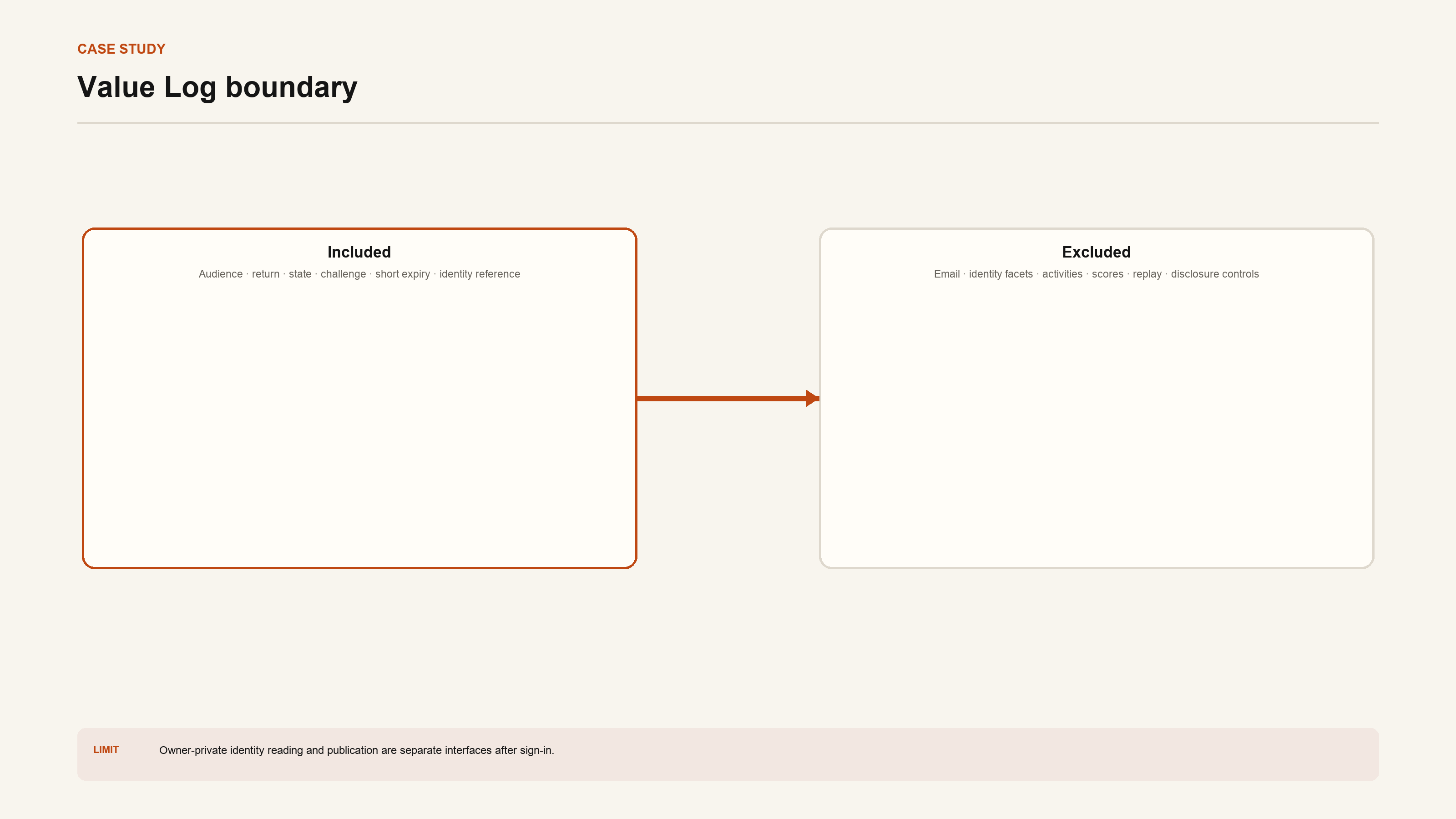
The browser journey carries an approved callback, random state, PKCE code challenge, short signed continuation, and then a short-lived handoff. The handoff contains the verified DID needed to locate an existing private Value Log account. Value Log’s implementation documentation states the boundary plainly: it does not receive an email or profile from the identity home.
After exchange, Value Log can render a private identity portrait only through a separate owner-authorized projection interface. That projection is not embedded in the sign-in code. It can be unavailable even when authentication succeeded. Activities, score calculations, public sharing controls, publication sync, and identity projection reads remain distinct operations.
7.2 What does not cross
Sign-in does not transfer Value Log activities to Word Wallet. It does not transfer identity facets, private score components, narrative evidence, replay history, Genesis dossiers, public disclosure settings, or publication consent to Value Log. It does not publish a profile. It does not alter a protocol event.
Value Log’s public projection publisher is a separate signed server-to-server path. The owner must first enable the relevant Word Wallet sharing control, activate the corresponding publication consent, and explicitly trigger an eligible sync. Code deployment, database migration, private projection delivery, owner disclosure save, signed publication, and public Foundation rendering are separately evidenced states.
7.3 Evidence status
Repository history records the identity handoff as implemented on 21 July 2026 and the smoother continuation after normal identity email sign-in on 22 July 2026. The August 15 launch runbook defines redacted verification fields and forbids recording private content. Existing release records document live authentication boundaries and signed private projection delivery. These records demonstrate operational feasibility for the founding account. They do not constitute independent penetration testing, multi-user usability validation, or proof that every failure and recovery path has been observed in production.