The Internet of Value
What if my digital life didn’t belong to an app?
By Moses Sam Paul 2026-11-12T13:30:59+05:30
Reading Tim Berners-Lee on SoLiD and personal data control alongside The Internet of Value’s protocol stack, Word Wallet Web and ~WellbeingIdentity.
Reading day: Monday, 9 November 2026. Second entry from This Is for Everyone: The Unfinished Story of the World Wide Web by Tim Berners-Lee.
The passage
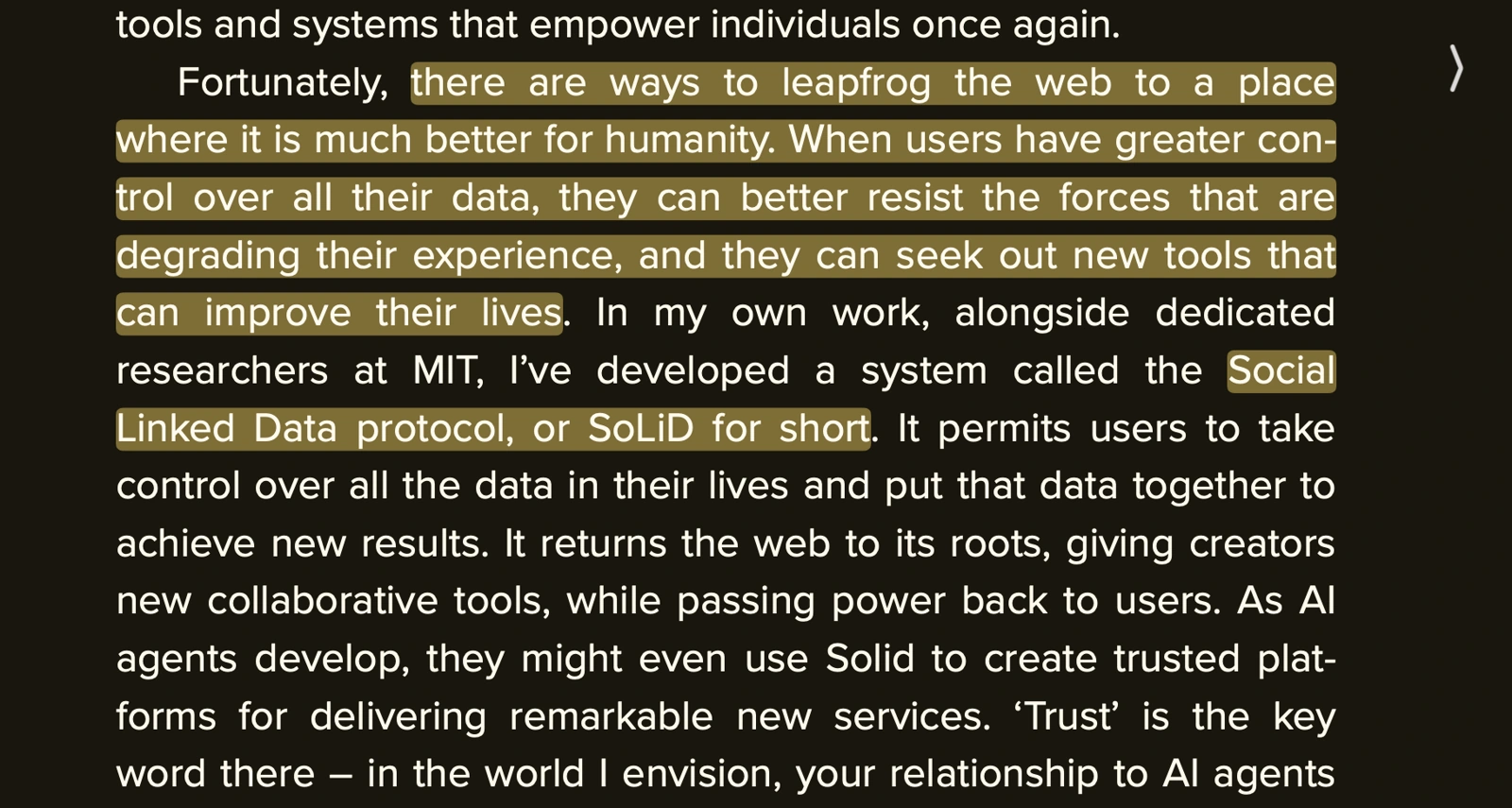
tools and systems that empower individuals once again.
Fortunately, there are ways to leapfrog the web to a place where it is much better for humanity. When users have greater control over all their data, they can better resist the forces that are degrading their experience, and they can seek out new tools that can improve their lives. In my own work, alongside dedicated researchers at MIT, I’ve developed a system called the Social Linked Data protocol, or SoLiD for short. It permits users to take control over all the data in their lives and put that data together to achieve new results. It returns the web to its roots, giving creators new collaborative tools while passing power back to users. As AI agents develop, they might even use Solid to create trusted platforms for delivering remarkable new services. ‘Trust’ is the key word there – in the world I envision, your relationship to AI agents
Tim Berners-Lee, This Is for Everyone: The Unfinished Story of the World Wide Web. Transcribed from the supplied screenshot. The image starts and ends mid-passage; all visible text is included above, with display line breaks and line-wrap hyphenation joined. The unfinished final sentence has not been completed.
This is where the reading becomes a design conversation
The first highlight brought me back to the experience of being obsessed with an idea. This one brings me straight into the architecture of what we’re building.
When Berners-Lee talks about people taking control of their data and bringing it together to achieve new results, I recognise something we have already been working towards with The Internet of Value. That recognition prompted our earlier conversation about SoLiD, Word Wallet Web and ~WellbeingIdentity. My immediate response was: haven’t we already begun doing some of this?
We have. Sign in with ~WellbeingIdentity was created with separation between identity and applications in mind. Word Wallet already has responsibility for authentication and disclosure. Our specification already supplies shared meanings. Value Log already distinguishes an observation from its review and calculation.
Those are concrete beginnings. Reading about SoLiD gives me a way to examine how far they can extend.
What SoLiD brings into focus
SoLiD separates the applications someone uses from the storage holding their information. Its personal online data stores, called Pods, let people authorise access to particular resources. Different applications can work with those records under permission. The SoLiD Project’s explanation describes this as choosing applications around your data, with greater control over access.
That matters when someone has spent years building a history of learning, work and reflection. Choosing another application should not mean starting that history again.
But storage and access are only part of the question. If two applications can read the same record, what do they understand it to mean? Was it written by the person, inferred by software, or attested by a community? What evidence supports it? Which method produced a score?
This is where I see a connection to our protocol stack.
Mapping the passage to our four protocols
The mapping below is my interpretation of the connection. It describes IoV’s specified responsibilities alongside SoLiD’s approach to data access; it does not claim an existing integration between the two.
| Question raised by the passage | Where it connects to The Internet of Value |
|---|---|
| What happened, and what evidence accompanies it? | ~ValueCaptureProtocol structures time, activity, proof and attribution. Its ~~~~ProtocolLinkId preserves event-level lineage across the connected records. |
| What does an activity mean in the context of someone’s wellbeing and development? | ~WellbecomingProtocol provides six contexts: ~~Physiology, ~~Emotion, ~~Feeling, ~~Thought, ~~Habit and ~~Performance. |
| Who can recognise a contribution, review its evidence or contest a decision? | ~SAOcommons provides the community institutional interface for validation, attestation, valuation and disputes across ~~Learning, ~~Earning and ~~OrgBuilding. |
| How does this become a living state the person can carry and choose to disclose? | ~WellbeingIdentity brings identity, skills, story, moral compass, consent and protocol-derived state into one structured identity document. |
The distinction matters: a record’s location does not establish its truth or economic value. A personal statement, a calculation and a community attestation carry different kinds of authority. IoV’s vocabulary gives us a way to preserve those differences.
There is also a boundary I want to keep clear. Personal wellbeing activity does not automatically become an economic claim. ~SAOcommons enters through qualifying ~~Performance output. Recording rest or reflection does not, by itself, submit someone’s private life for institutional valuation.
We already started separating these responsibilities
Sign in with ~WellbeingIdentity is an example. The documented Word Wallet–Value Log handoff proves control of a person’s canonical identity without sending their private portrait, ~~~WellbeingScore or activity records into the receiving application. The application then establishes its own session.
Word Wallet owns authentication and owner-controlled disclosure. Value Log owns private activity records and their review and calculation. The Foundation website receives the approved public projection. Protocol meaning belongs to the canonical specifications.
So the lesson I take from SoLiD is not that we forgot to separate identity from an application. We began that work. The next question is whether the separation can survive a change of provider as well.
Signing into multiple applications and moving the underlying identity or storage infrastructure are different capabilities. The first does not prove the second. A future SoLiD connection would need explicit representations of IoV records, permission rules and interoperability checks.
Control needs to survive the useful things we do with data
In our earlier conversation, I raised regional hosting as a direction worth pursuing. I also asked whether we could build on SoLiD if it served what we need. Those possibilities can coexist: where records are hosted and how applications access them are related design decisions, each with its own requirements.
A practical next experiment could stay small. Put one contribution record into compatible external storage. Let an authorised application read it. Obtain a clearly sourced review. Preserve the resulting attestation with the person’s records. Keep unrelated private wellbeing material outside the reviewer’s access.
That would test something specific: can a contribution remain useful across applications without requiring custody of someone’s entire history?
The same question follows me into the passage’s unfinished discussion of AI agents. If an agent helps someone understand their records, that usefulness should depend on a clear purpose and an appropriate scope of access. An ability to combine information is not permission to disclose everything.
What I’m carrying forward
I read this passage as a conversation with work already underway. SoLiD gives us a concrete approach to personal data access. Our protocol stack asks how activity, wellbeing, contribution and institutional recognition can carry intelligible meaning through a person’s life.
The connection is strong enough to investigate. Whether the systems can work together has to be demonstrated.
The question I want to carry into that investigation is: can someone change the tools they use while retaining their history, the meaning of their records, and a real choice about who gets to see them?
Sources and further reading
- About SoLiD: personal data stores, application choice and access control.
- SoLiD Protocol — public specification: technical protocol reference for any future interoperability work.
- SoLiD specification repository: public source for the project’s technical reports.
- SoLiD project website repository: public source for the official project website.
- Sign in with ~WellbeingIdentity: public explanation of the identity handoff architecture.