~ The Internet of Value
Transparency Is the New Privacy?
What we owe one another—and how much of our lives anyone needs to see.
Explore the nine sections
Chapter 01 / 09
Show me the accounts

Imagine a community collecting money to repair a well.
Someone takes responsibility for the fund. Another person purchases materials. Several people contribute labour. Someone cooks for the workers. Someone looks after their children.
At the end, the community asks what happened.
How much money came in? Where did it go? Who did the work? Who decided what each contribution was worth?
The person managing the fund replies: “I believe in privacy.”
An admirable principle. An incomplete set of accounts.
Now imagine the community demands the cook’s medical history, the childcare provider’s private messages, and a continuous location feed from everyone who volunteered.
That would be an extraordinary way to repair a well. The village would acquire a surveillance department before it acquired clean water.
Both situations reveal the same problem: we have not agreed on what people owe one another.
I find myself increasingly frustrated by conversations about privacy in crypto and Web3 when they move quickly past this question.
We talk about protecting transactions. Protecting identities. Protecting balances.
But when our actions involve shared resources, other people’s labour, or claims on collective value, what must remain answerable?
Privacy matters. So does the person on the other side of the transaction.
That is where this provocation begins: could the right kind of transparency help us protect privacy?
Chapter 02 / 09
The inspection tower
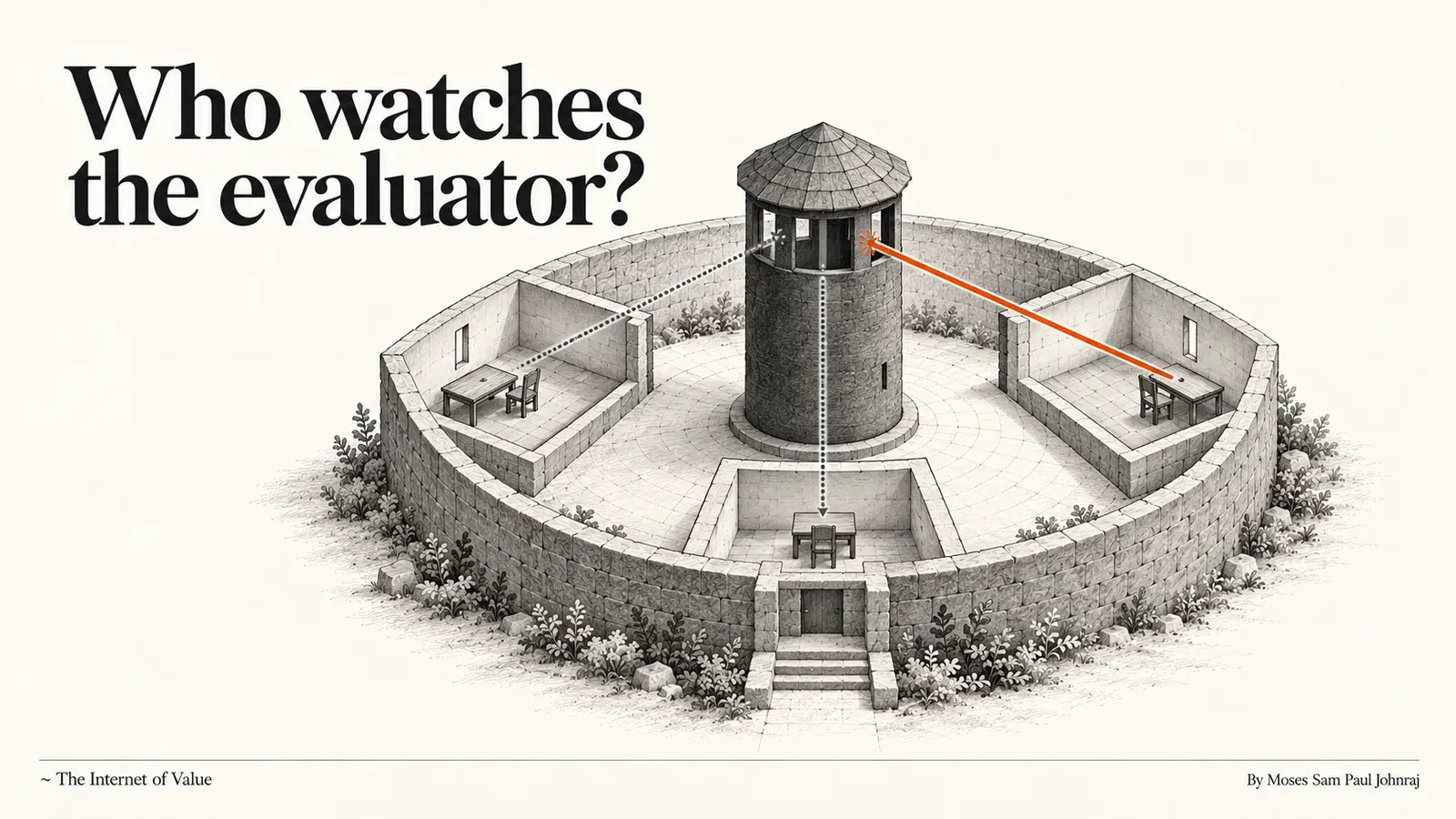
Long before digital wallets, Jeremy Bentham proposed an architecture of visibility.
His Panopticon placed prisoners around the outside of a building and an inspector at its centre. The inspector could observe the prisoners; the prisoners could not see whether the inspector was watching. The possibility of observation was supposed to shape their behaviour. The inspection principle originated with Bentham’s brother Samuel before Jeremy adapted it for his prison proposal. (UCL Bentham Project)
The detail that matters is the unequal view. One side becomes visible. The other controls the looking.
This is the danger inside any enthusiastic argument for radical transparency. A system may ask participants to document every activity while leaving its own judgments unexplained.
The worker supplies the evidence. Who explains the evaluator?
The member reveals their contribution. Who reveals how rewards were allocated?
If a community wants an account of my day, I should be able to inspect the rules through which that account affects my standing.
A transparent person inside an opaque institution is still vulnerable.
Putting the inspection tower on a blockchain does not settle that problem.
Chapter 03 / 09
The man who defended privacy and demanded sunlight

Louis Brandeis offers a more useful historical pairing.
In 1890, he and Samuel Warren published The Right to Privacy, arguing for protection against invasions of private life. (Original essay, University of Louisville collection)
Later, in Other People’s Money, Brandeis argued for disclosure around financial power, including the commissions and profits involved in marketing securities. His famous phrase appears there:
“Sunlight is said to be the best of disinfectants.”
The metaphor is about making abuse easier to detect. When fees, conflicts and financial arrangements are visible to the people affected, those people have a better chance of questioning them. Hidden dealings can survive behind a reassuring reputation; an inspectable account gives that reputation something to answer to.
Brandeis also insisted that disclosure reach investors in a usable form. Filing information somewhere obscure was insufficient. (What Publicity Can Do)
These positions belong together. A person needs space in which to live. Someone exercising power over other people’s money needs to explain how that power is used.
My reading of that pairing is simple: the obligation to disclose should follow the responsibility being exercised.
A treasurer owes an account of the treasury. A reviewer owes reasons for a consequential judgment. A platform allocating rewards owes an explanation of its allocation rules.
Meanwhile, the person buying lunch should be able to buy lunch.
Sunlight needs a direction.
Chapter 04 / 09
What the cypherpunks actually asked for
It would be convenient to cast crypto as the villain here. It would also be intellectually lazy.
In his 1993 Cypherpunk’s Manifesto, Eric Hughes wrote:
“Privacy is the power to selectively reveal oneself to the world.”
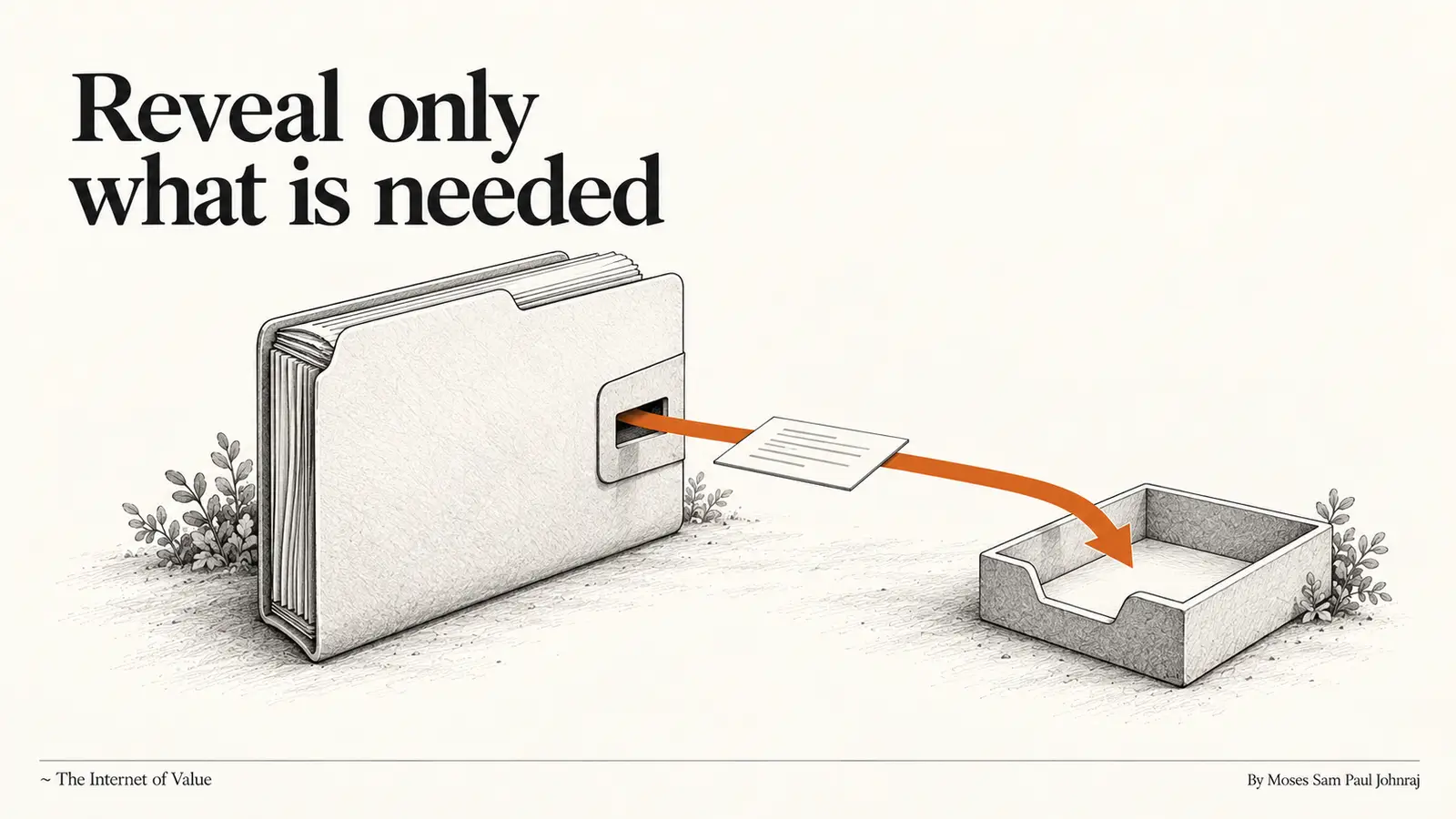
He argued that parties to a transaction should learn only what is necessary for that transaction. (A Cypherpunk’s Manifesto)
That is a serious idea about boundaries.
Modern zero-knowledge proofs offer a technical expression of a related possibility: proving a defined statement without revealing the underlying private information. (Ethereum’s explanation)
Think of an age check. The relevant question may be whether someone meets an age threshold. Their full birth date, home address, and life story add nothing necessary to that answer.
The same reasoning raises an interesting question for contribution systems. Could someone demonstrate that a responsibility was fulfilled without publishing every detail of the experience behind it?
Technology can help answer particular verification questions. We still have to decide which questions are legitimate, who may ask them, and what follows from the answer.
A cryptographic proof cannot make an unreasonable demand reasonable.
Chapter 05 / 09
Does responsibility come before privacy?
My first instinct was to say: perhaps privacy is a state we achieve after fulfilling our responsibilities.
There is something appealing in that formulation. Finish what you committed to. Account for the resources entrusted to you. Address the consequences of your actions. Then go home without being pursued by suspicion.
But making privacy conditional on good behaviour creates a dangerous authority: someone gets to decide when you have been good enough.
The definition of responsibility can keep expanding. One more form. One more explanation. One more inspection.
So I would separate two propositions:
Privacy is a baseline. Taking on a particular responsibility creates a particular obligation to account.
Imagine that I accept money to deliver a workshop. I owe the participants an honest account of what I promised, what I delivered, and what happened to their money. If the workshop fails, an appeal to privacy does not discharge those obligations.
But my responsibility to deliver a workshop does not give the participants unlimited access to my private life.
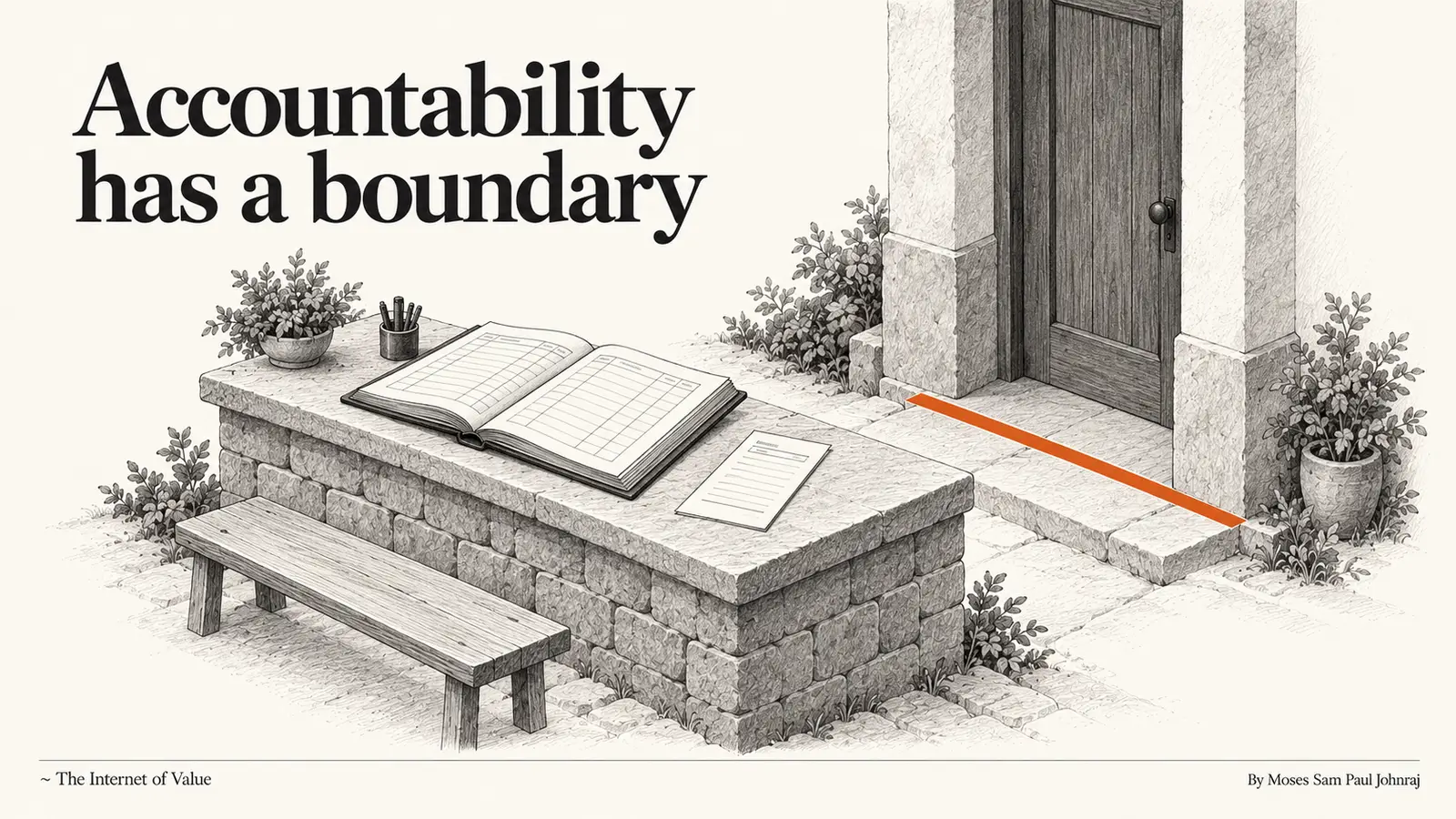
The obligation needs an object, an audience, and a boundary. What exactly must I explain? To whom? With what evidence? For how long?
There also needs to be a stopping point. Once the relevant obligation has been adequately accounted for, continued inspection needs a fresh justification.
That is the part of the original instinct worth preserving: accountability should be capable of completion.
Chapter 06 / 09
A day is larger than a timesheet

Consider an imagined day.
A person spends two hours preparing a community workshop. They spend another hour supporting a distressed friend. They cook for an elderly parent, learn something difficult, travel, rest, and deal with a problem nobody else sees.
A conventional timesheet might capture the workshop preparation. Much of the rest could disappear from the account.
A 24-hour log invites a wider view. It makes room to reflect on where a day went, what it required, and what changed because we lived it.
That is the attraction of the practice we are exploring through The Internet of Value. But a whole day is also intimate territory.
Recording something privately, making a contribution claim from it, having that claim reviewed, and sharing it publicly are separate decisions. They need separate permissions.
Suppose the person claims recognition for caring work. A reviewer may need evidence appropriate to that claim. The wider community may only need to know that an agreed review occurred.
The elderly parent’s diagnosis should not become collateral for someone else’s recognition. Nor should the friend’s distress become public evidence without their consent.
My account of my life often contains pieces of yours.
For The Internet of Value, this boundary is already present in the canonical Wellbeing Identity specification. Withheld and unknown states are valid; completing the identity workshop does not force disclosure. Consent, audience scope, expiry, and revocation have explicit places in the model. The specification also separates private measurements from public credentials. These are design requirements, rather than proof that every application has fulfilled them. (Protocol reference)
The ambition should be a fuller account of human contribution with meaningful control over its disclosure.
A day deserves more attention than a timesheet. It also deserves more protection than a public feed.
Chapter 07 / 09
What radical transparency could enable
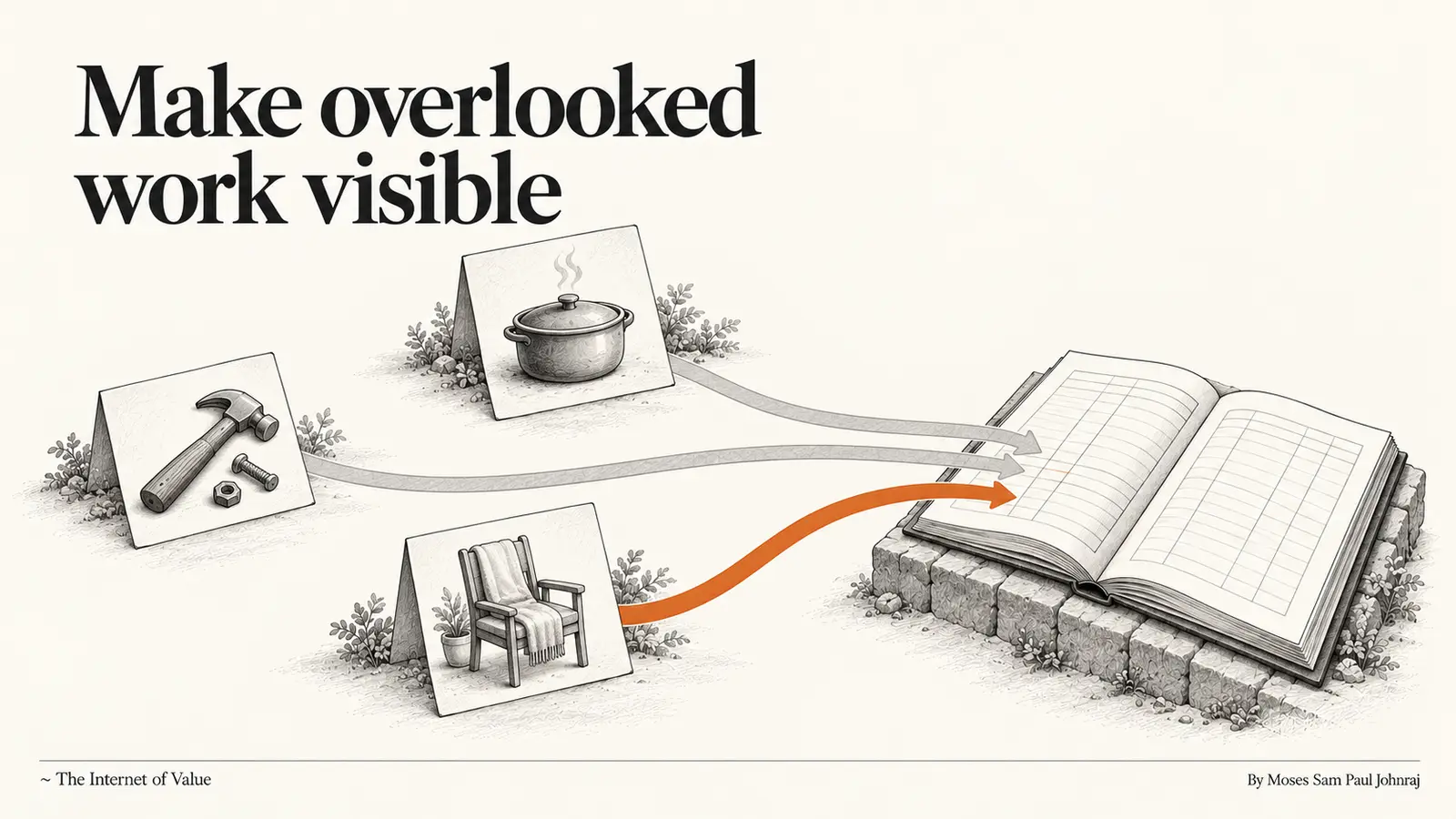
The most interesting benefits go beyond catching people doing something wrong.
Recognition of overlooked work
Return to the well. The people digging are visible. The person feeding them and the person caring for their children made that digging possible.
An account that includes those relationships could change the conversation about contribution. Recognition would still require judgment. Recording an activity does not settle its value. But it gives previously absent work a chance to enter the discussion.
Rewards people can question
Imagine two members receiving very different shares of a community fund. A meaningful explanation would connect the decision to contribution claims, evidence, review, and the rules in force.
People could then question a specific judgment. They would have something firmer than a rumour or a founder’s reassurance.
Trust that survives correction
A community that records a mistake, explains its consequences, and shows how it was repaired gives people a basis for assessing its conduct over time.
Perfection is a demanding admission criterion for humanity. Repair is a more useful institutional capability.
Less repeated interrogation
If an appropriate review has already established a qualification or fulfilled obligation, the next interaction may need only a limited confirmation.
That possibility is central to this argument: better accountability might let us ask for less personal information.
A clearer view of our own lives
A private account of a week might reveal that “I achieved nothing” actually means “I spent most of my available energy caring for others.”
That insight need not become a public claim to matter. Transparency can begin with being able to see ourselves more clearly.
These are possibilities to investigate, rather than outcomes a ledger automatically delivers.
Chapter 08 / 09
A receipt is not the truth
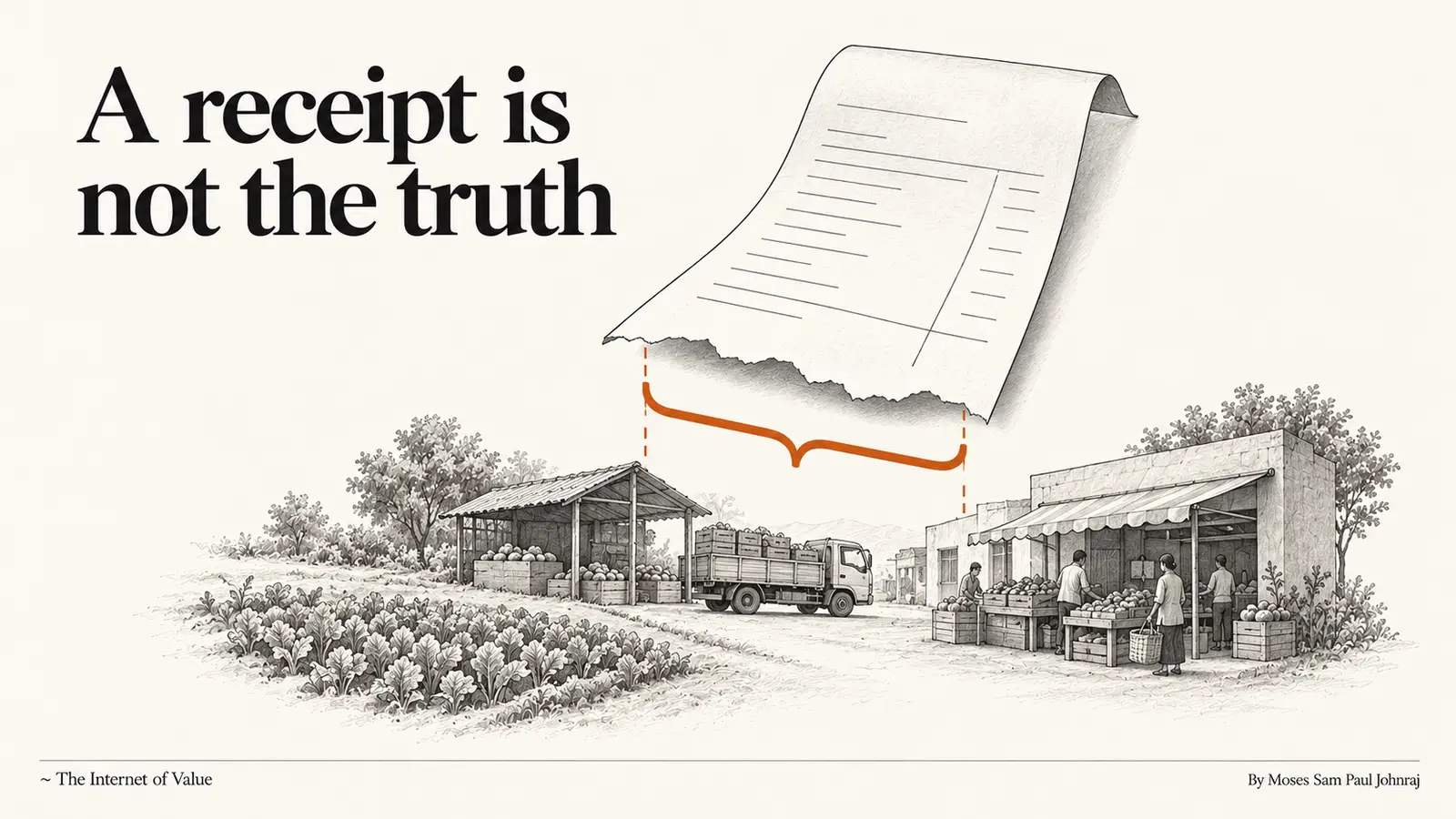
Every proposal for radical transparency needs to confront an awkward fact: documentation can be wrong.
A record can be fabricated. Evidence can be selective. Reviewers can be biased. Two people can describe the same event honestly and disagree about what happened.
Even a perfectly preserved record may preserve a mistake.
There is also a quieter danger. Once recognition depends on documentation, people may organise their lives around what is easiest to document.
An hour of visible activity acquires a receipt. Quiet judgment, prevention, recovery, and care may remain difficult to prove.
We should be wary of building an economy in which every act must arrive carrying its own publicity department.
A useful contribution system therefore needs room for uncertainty, disagreement, correction, and work that resists neat measurement. It also needs restraint.
Rest does not need to produce a contribution claim. An unrecorded afternoon does not establish a moral deficit. A person’s dignity cannot depend on the completeness of their log.
And disclosure itself needs limits. Revoking future access cannot guarantee the disappearance of copies already downloaded or remembered. Decisions about public sharing deserve that practical understanding.
The promise of transparency should make institutions more answerable. It should not make every human moment permanently prosecutable.
Chapter 09 / 09
Enough evidence to leave people alone

“Transparency is the new privacy” is deliberately provocative.
Taken literally, it could become a terrible instruction. Publish everything. Explain everything. Live forever under review.
The version worth pursuing asks us to become precise about our obligations.
If I manage shared money, make the accounts inspectable. If I allocate rewards, make the rules and reasons understandable. If I claim recognition for a contribution, let that claim face an appropriate standard of evidence.
If I judge someone else, make my authority and decision open to challenge.
And when the relevant question has been answered, recognise that something has been completed.
This requires restraint from the people doing the looking. Communities must learn when they have enough evidence. Institutions must justify their demands. Founders must accept the scrutiny they ask of members.
The goal is a society where we can understand how shared value was created and distributed without requiring universal access to the lives behind it.
I want the work of care to count. I want shared resources to be accounted for. I want consequential decisions to come with reasons.
I also want people to have an evening that belongs to them.
Perhaps transparency earns its place beside privacy when it helps us know enough to leave one another alone.
References
- UCL Bentham Project: The Panopticon.
- Warren and Brandeis: The Right to Privacy, 1890.
- Brandeis: What Publicity Can Do, in Other People’s Money.
- Eric Hughes: A Cypherpunk’s Manifesto, 1993.
- Ethereum: Zero-knowledge proofs.
- The Internet of Value: canonical protocol registry.
The well, workshop and daily-life scenarios are illustrative. Proposed social benefits are arguments to investigate, rather than demonstrated outcomes.