Eight-slide proposal · November 2026
Wellbeing Passport for Dhun
An accessible reader of the proposed engagement. The editable master is held by the Foundation; no presentation account is needed here.
Identity and protocol grounding: Observer Attention Is All You Need · Canonical registry.
1. Wellbeing Passport, imagined for Dhun
A living observation of everyday becoming. Proposed six-month research engagement by Internet of Value Research Foundation.
- A personal continuity between experiences, communities and ordinary days.
- Agreement in principle sought; no existing Dhun partnership implied.
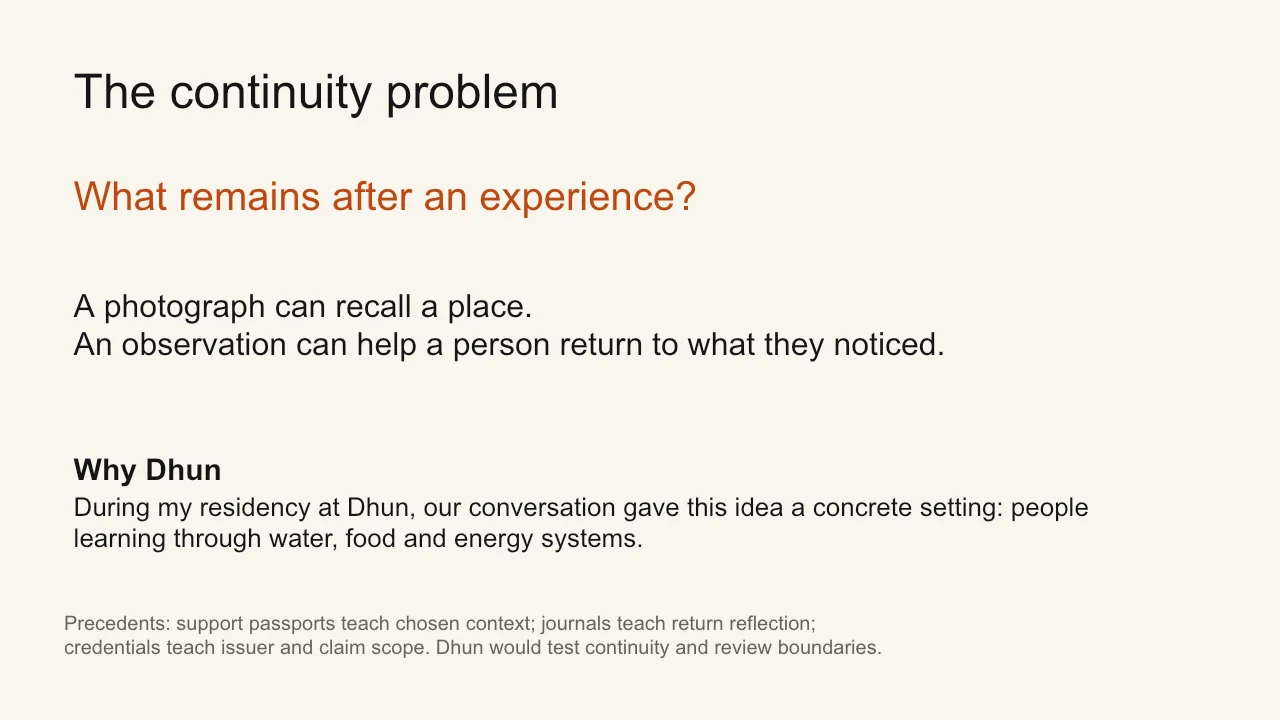
2. The continuity problem and why Dhun
People can leave an experience with a photograph and a memory. What helps them return to what they noticed—and carry selected context into the next setting?
- Dhun offers a setting in which learning and contribution meet daily systems.
- Water, food and energy encounters are proposed research settings, subject to field access.
- Support passports teach chosen context; daily journals teach return reflection; credentials teach issuer and claim scope.
- Our residency conversation informs this proposal; no partnership has been agreed.
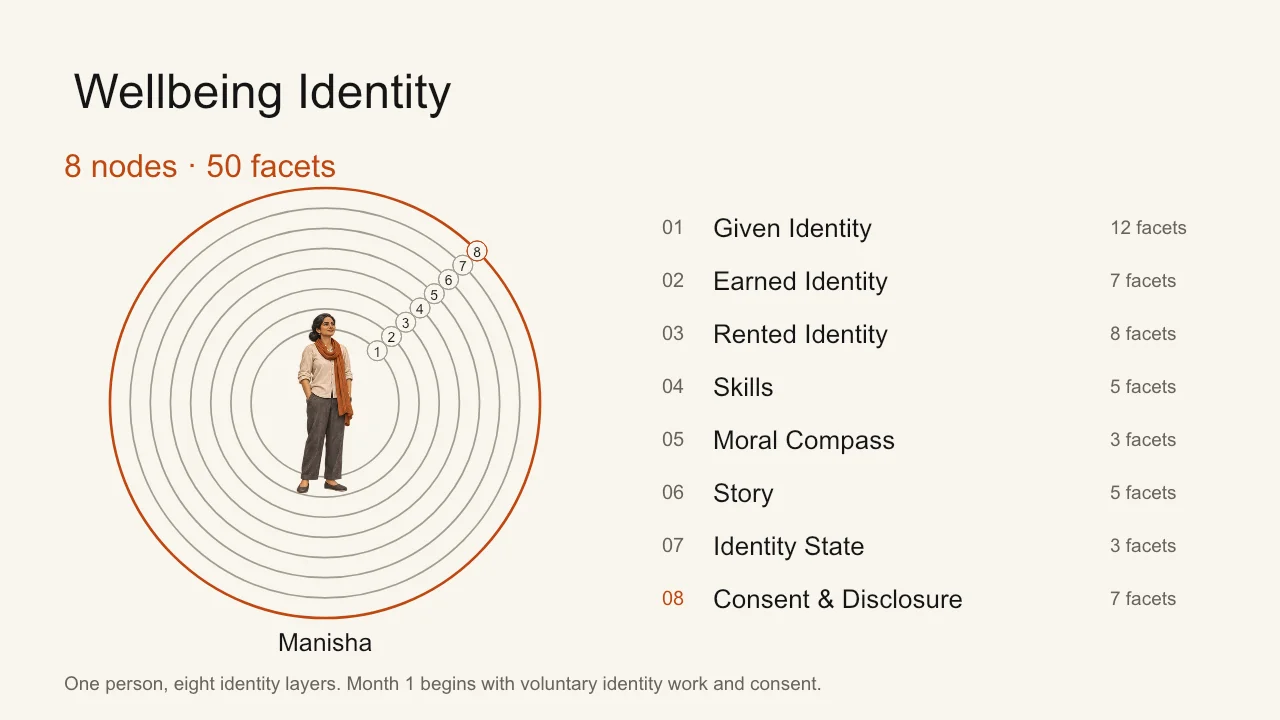
3. Wellbeing Identity
Eight concentric layers · fifty facets. Identity is the starting context for an observed day and the living state to which scoped results may return.
- Given Identity (12 facets); Earned Identity (7); Rented Identity (8); Skills (5).
- Moral Compass (3); Story (5); Identity State (3); Consent and Disclosure (7).
- Month 1 begins with consent and a voluntary identity workshop alongside fieldwork. Participants choose relevant context; fifty facets is not a compulsory questionnaire.
- Identity’s eight nodes describe the person. Wellbecoming’s six nodes interpret an observed moment. Neither is a universal ranking.
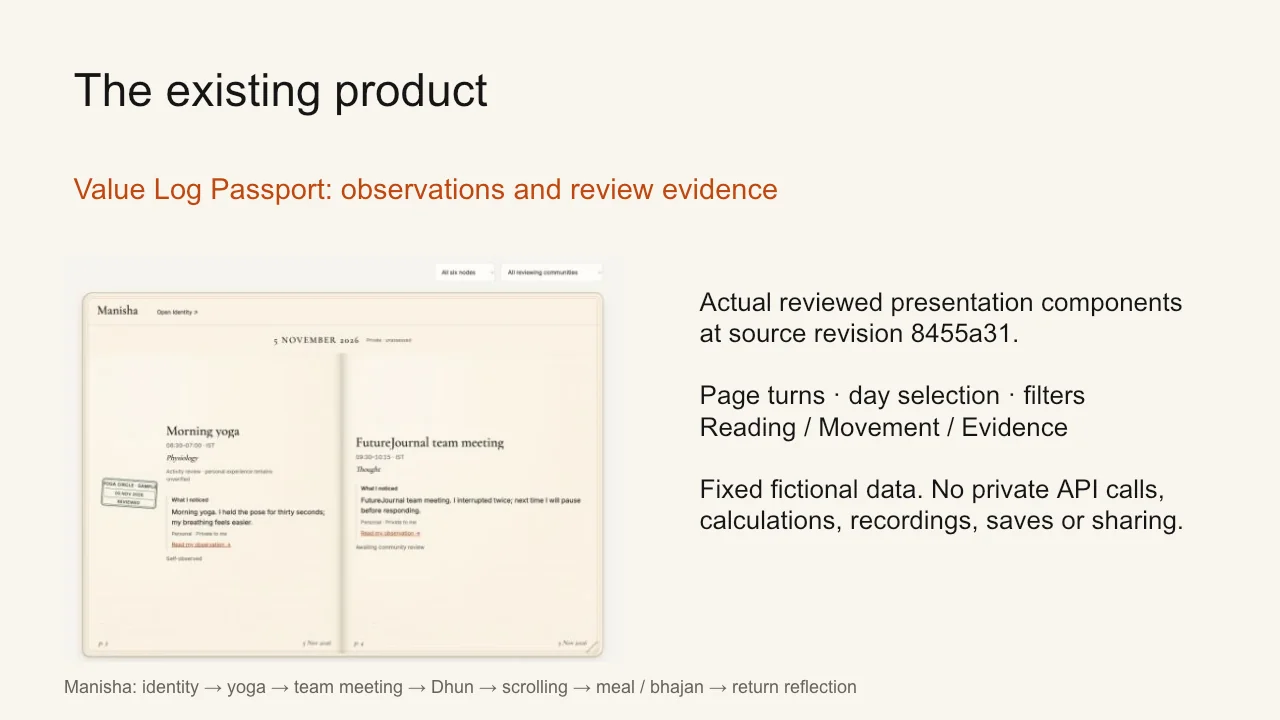
4. The existing product
Value Log already presents observations and review evidence as browsable Passport pages.
- The demonstration reuses the reviewed presentation components at revision 8455a31.
- Page turns, date selection, node/community filters and Reading / Movement / Evidence details.
- The public demo is fixed fictional data. It does not assess, save, record or share.
- Manisha’s identity precedes her day: yoga, a team meeting, Dhun materials, scrolling, a meal and bhajan, then return reflection.
5. Two staged Dhun journeys
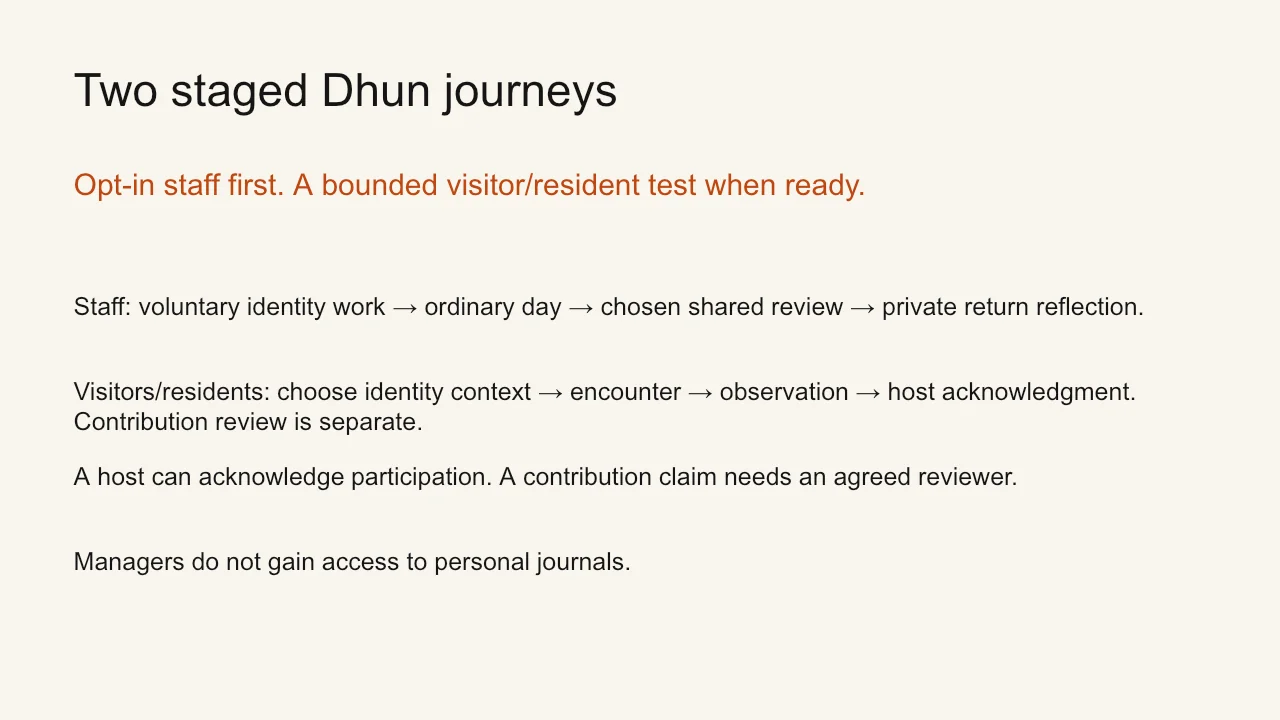
Begin with an opt-in staff cohort. Test a bounded visitor/resident journey only when ready.
- Staff: consent and voluntary identity work → personal day → chosen observation → scoped peer review → private return reflection.
- Visitor/resident: choose relevant identity context → encounter → observation → host acknowledgment → optional contribution review → return.
- Hosts acknowledge participation; contribution quality needs an agreed reviewer and process. Private journals remain personal.
6. The Human Protocol Flow
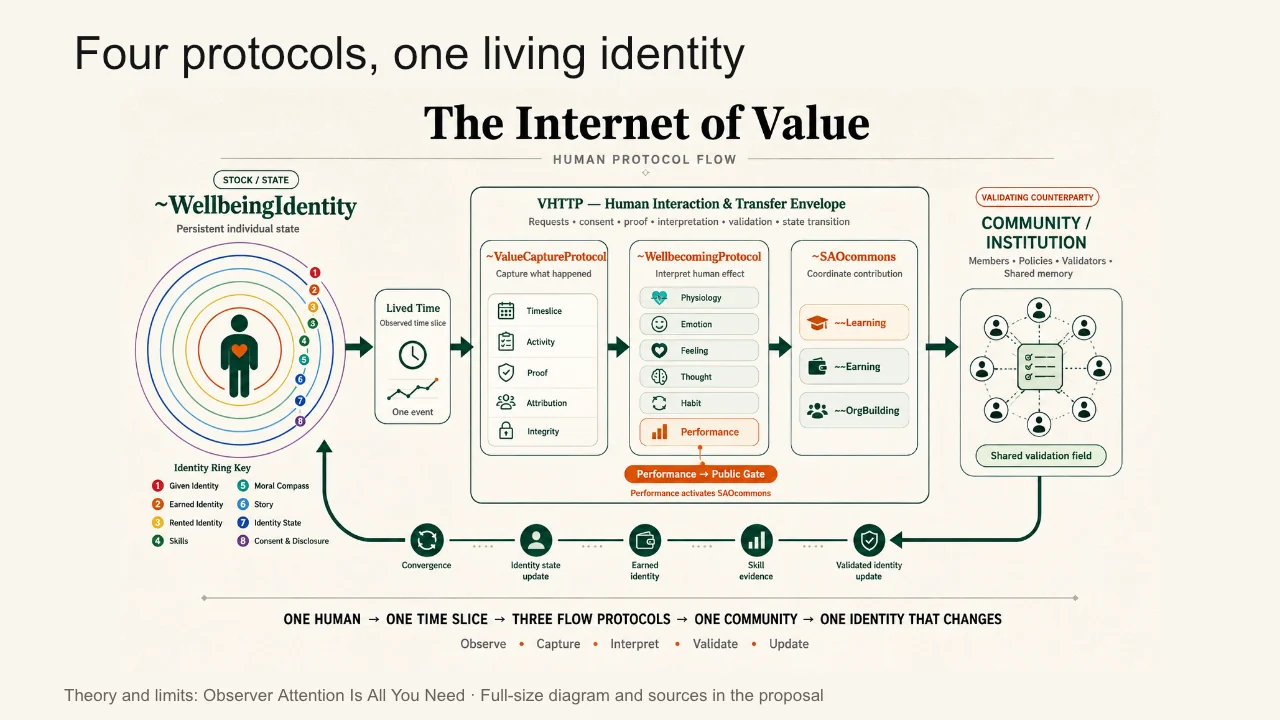
Four protocols connect a represented person, an observed moment and a scoped return to a living identity.
- ~WellbeingIdentity: starting context and living state, with consent and disclosure boundaries.
- ~ValueCaptureProtocol: time, activity, proof, attribution and integrity. ~WellbecomingProtocol: interpretation through six nodes.
- ~SAOcommons: a conditional governed route for eligible Performance contributions; community review is not certification of private experience.
- Private interpretation and reviewed contribution have different return paths. Not every observation receives a stamp, score or public update.
- Theory and limitations: Observer Attention Is All You Need. The approved illustration explains the relationships; the canonical registry and SAOcommons specification govern protocol meaning.
7. Six months, with review points
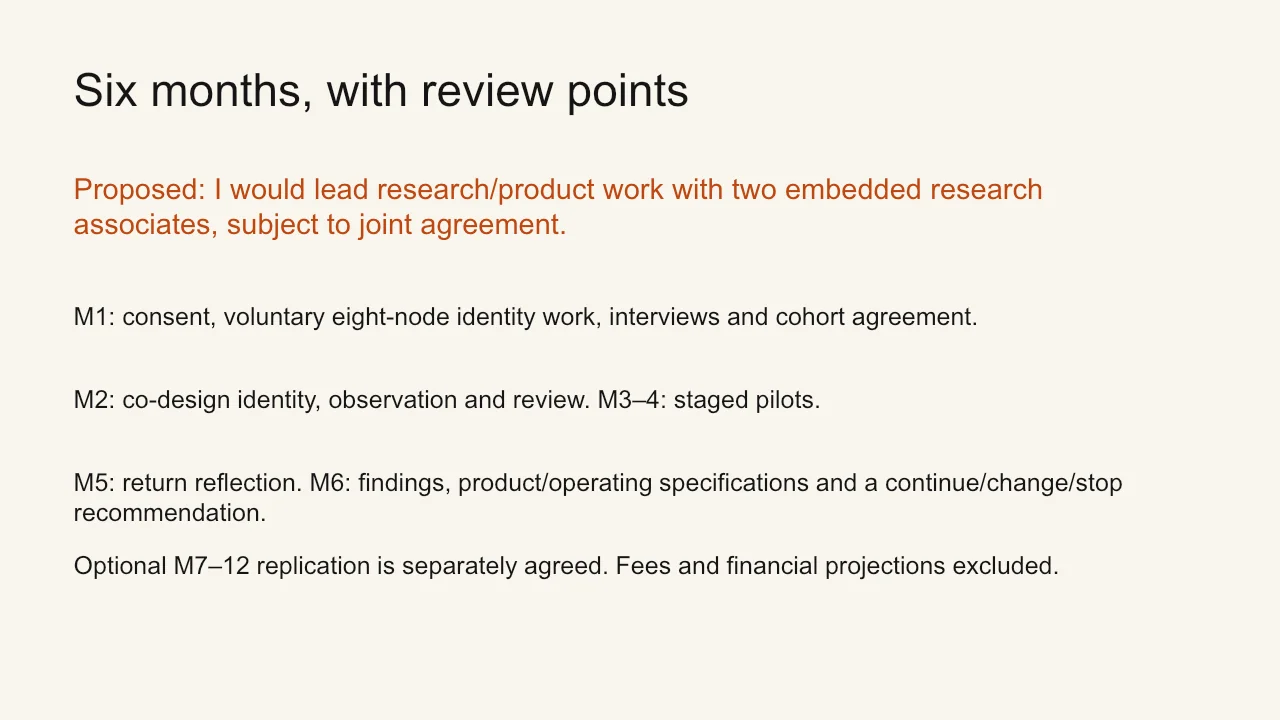
Proposed: I would lead research and product work with two embedded research associates, subject to joint agreement.
- M1: consent, voluntary eight-node identity work, interviews and cohort agreement. M2: co-design identity, observation and review journeys.
- M3–4: staged pilots. M5: return reflection and selected-context test.
- M6: findings, product/operating specifications and continue/change/stop recommendation.
- Optional M7–12 replication is separately agreed. Fees and financial projections are outside this pack.
8. Agreement in principle
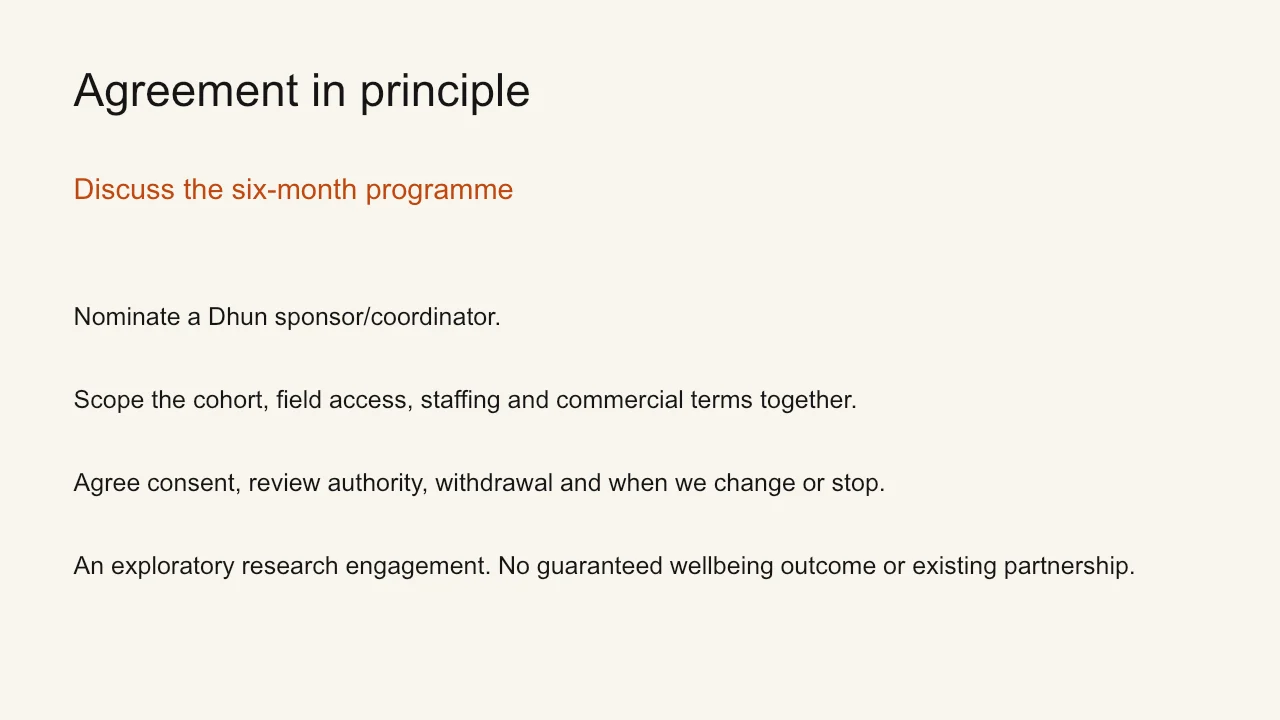
Discuss the six-month programme
- Nominate a Dhun sponsor/coordinator.
- Jointly scope cohort, field access, staffing and commercial terms.
- Agree consent, review authority, withdrawal and the points at which we change or stop.
- No guaranteed wellbeing outcome; the engagement is a research proposal.