~The Internet of Value~Imagined for Dhun · Research proposal

A proposed six-month research engagement

Wellbeing
Passport

Imagined for Dhun

What if a passport helped us remember how we lived between the journeys?

A passport that begins with a person’s Wellbeing Identity and connects everyday observations with reflection and scoped community review.

by Internet of Value Research Foundation

Wellbeing Passport, imagined for Dhun

01 · The idea

A life becoming

Meet Manisha. Her travel passport remembers the countries she has visited. This passport asks what she noticed in an ordinary day.

Yoga. A team meeting. Choosing materials at Dhun. Forty minutes lost in comments. A family meal, bhajan and an evening reflection.

The passport holds the honest day—including what did not go as intended. A stamp has a specific meaning and a source; it is not a reward for living perfectly.

Read the film transcript

On-screen captions, in order. Captions and sound only; no spoken narration. Manisha and all review events are fictional.

Wellbeing Passport. Imagined for Dhun by Internet of Value Research Foundation.

Meet Manisha.

A few particulars.

The places she’s been.

What about the life between trips?

Introducing Wellbeing Passport. A living observation log. A life becoming.

Wellbeing Identity

Given identity

Earned identity

Rented identity

Skills

Moral compass

Story

Identity state

Consent & disclosure

Manisha’s Wellbeing Identity. 8 nodes. 50 facets.

Now, her becoming across a day.

Value Log. Yoga. A 30-second hold.

My breathing feels easier.

Wellbecoming Protocol → Physiology → Movement. Activity: Yoga.

Shower, then departure.

Let’s hear everyone.

I interrupted twice.

Questions before choosing.

Yoga circle: participation confirmed.

FutureJournal: shared summary reviewed.

Dhun: shared note received.

Just five minutes.

Meant five minutes. Spent forty.

Phone away. I’m here.

I feel connected.

Her day, observed. Value Log: one day, 24 hours.

What will I carry into tomorrow?

Roast me.

Seraphina

Thirty seconds in the yoga pose. Forty minutes in the comments.

So you can hold a position.

Tomorrow.

Another page. A life becoming.

Wellbeing Passport Imagined for Dhun by Internet of Value Research Foundation
Captions and sound · 1 min 29 sec · No narration

02 · The setting

Why Dhun

A place where people learn through the systems they help sustain.

During my residency at Dhun, our conversation about a wellbeing passport gave the idea a concrete setting. We propose exploring it through the people learning, working and contributing around Dhun’s water, food and energy systems.

The research question is whether an observation can remain meaningful after an experience ends—and whether a person can carry selected context into a later encounter without handing over their private journal.

This is a proposal from the Foundation. The conversation is not presented as a quotation, endorsement or agreed partnership.

03 · The starting point

Wellbeing Identity

Begin with the person who carries the passport.

Before we ask someone to observe their day, we begin with their context: who they are, the capabilities and experiences they bring, what matters to them, and what they choose to share.

8 nodes · 50 facets

12345678Manisha, the fictional woman from the film, standing at the centre of her identity layersManisha
  1. 01
    Given Identity12 facets
  2. 02
    Earned Identity7 facets
  3. 03
    Rented Identity8 facets
  4. 04
    Skills5 facets
  5. 05
    Moral Compass3 facets
  6. 06
    Story5 facets
  7. 07
    Identity State3 facets
  8. 08
    Consent and Disclosure7 facets
One person, eight layers. The rings describe identity—not scores. Manisha is fictional.
What each layer holds
Given Identity 12 facets
Given or legally anchored context.
Earned Identity 7 facets
Credentials, experience and portfolio.
Rented Identity 8 facets
Platform handles and hosted identity surfaces.
Skills 5 facets
Capabilities, evidence and learning trajectory.
Moral Compass 3 facets
Values, virtues and ethical boundaries.
Story 5 facets
Past, present, future and turning points.
Identity State 3 facets
Changing state and protocol convergence.
Consent and Disclosure 7 facets
Chosen audiences, expiry and revocation.

These are the identity’s eight nodes. The six Wellbecoming nodes describe a different part of the system: interpreting an observed moment. Fifty facets is the system’s vocabulary, not a requirement to collect fifty answers.

Month 1 would include a voluntary Wellbeing Identity workshop alongside interviews and field observation. Participants choose relevant context and what remains unknown or private. Identity is revisitable; it is not a fixed label or a score that defines the person.

How the four protocols connect

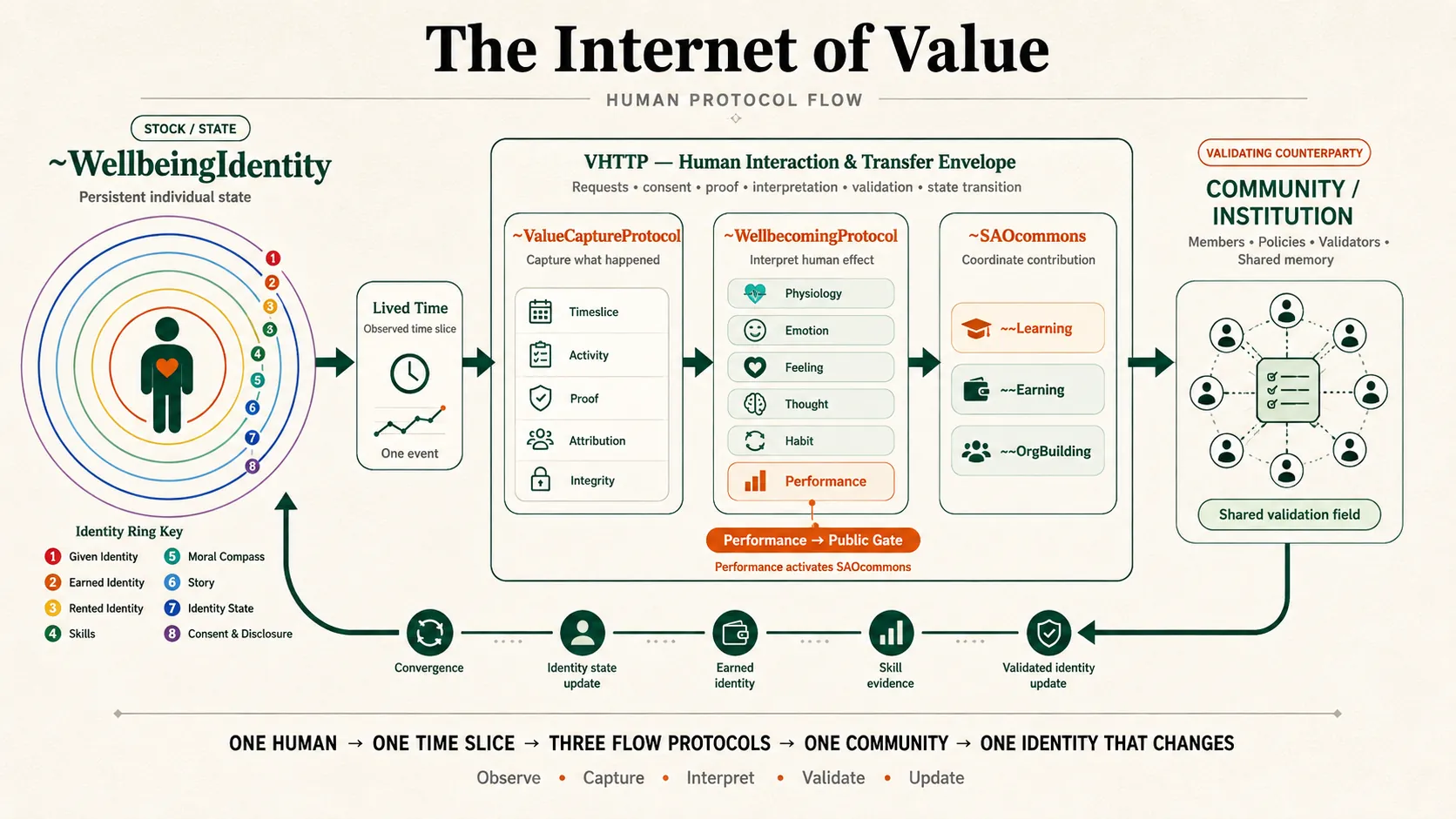
A person brings context to an observed moment. Private interpretation and eligible community-reviewed contributions can return through different routes to that living identity.

Human Protocol Flow: eight-node Wellbeing Identity, an observed time slice, Value Capture, six-node Wellbecoming, a conditional Performance route into SAOcommons and community validation, and scoped returns to Identity.
The approved Human Protocol Flow illustration. Community review applies to an agreed claim within its authority; it does not certify someone’s private feeling. Not every observation receives a stamp, score or public identity update.
~WellbeingIdentity
The person’s starting context and living state, governed by consent and disclosure.
~ValueCaptureProtocol
The observed time slice, activity, proof, attribution and integrity.
~WellbecomingProtocol
Interpretation through Physiology, Emotion, Feeling, Thought, Habit and Performance.
~SAOcommons
A conditional, governed route for eligible Performance contributions and community review.

The whitepaper sets out the theory and its limits; this proposed research would test the experience and operating model at Dhun. Protocol meaning remains grounded in the canonical registry and SAOcommons specification.

04 · Product evidence

Experience the existing product

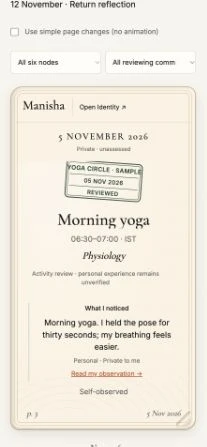
The Passport is a way of reading Value Log observations and their review evidence.

The demonstration reuses the reviewed Value Log presentation components at revision 8455a31, including its page-turn engine. All observations and review events belong to fictional Manisha. The proposed Dhun roles have not been deployed.

Actual Value Log Passport presentation components with fictional Manisha data on desktop
Existing Passport interface · fictional data · desktop
Actual Passport presentation on a phone with fictional Manisha data
The same interface · mobile

Try date selection, page turns, node/community filters and Reading, Movement and Evidence details. The demo makes no private requests or data writes. It does not calculate scores or share observations.

05 · Two staged journeys

Start with staff. Then test encounters.

First · opt-in staff cohort

An ordinary working day

  1. Begin with voluntary identity work; choose relevant context and sharing boundaries.
  2. Observe an activity and what they noticed.
  3. Choose whether an appropriate shared observation needs review.
  4. Read a scoped review alongside the personal observation.
  5. Return later and reflect on what changed.

Participation is voluntary. Employment does not give a manager access to personal observations or a wellbeing ranking.

Later · bounded visitor/resident test

Water, food or energy

  1. Choose the identity context relevant to this encounter.
  2. Take part in an agreed encounter.
  3. Notice an experience, question or learning.
  4. A host may acknowledge participation, with clear scope.
  5. A contribution claim, if made, follows a separate agreed review.
  6. Return and choose what context to carry into a later community.

A host stamp does not certify competence, material safety or an inner feeling.

Recruitment, withdrawal, host capacity, evidence standards and correction/appeal routes are co-design work. Visitor testing follows staff learning and a readiness review.

06 · What exists / what is proposed

A product foundation. A research engagement.

Exists in the productProposed with DhunQuestions to test
Wellbeing Identity’s eight-node teaching view and a separate identity product for authoring and disclosure.A voluntary identity workshop and participant-led choice of relevant context.Which context helps people reflect? What should remain unknown, unasked or private?
Observation and review interfaces; Passport dates, filters and evidence details.Staff cohort; water, food and energy encounters; locally agreed review roles.Does the passport help people return to an observation? Do they understand a stamp’s limits?
Untimed and unassessed observations; review status and available completed results remain distinct.Consent, field routines, contribution criteria, correction and withdrawal processes.What is the burden on hosts? What selected context is useful in a later setting?
Identity, observation, review and calculation

Wellbeing Identity: eight nodes and fifty facets in the canonical registry. It is a living state, not just a biodata page. Identity authoring and disclosure belong in the identity product.

Observation: the person’s account, including incomplete, untimed or private moments. Yoga is an activity; its canonical route here is ~WellbecomingProtocol → ~~Physiology → ~~~Movement.

Review: a named actor reviews an agreed claim within their authority. A person’s private feeling is not certified by a host. Not every observation receives a stamp.

Calculation: separate from observation and review, with an explicit policy, inputs and completed result. This demo deliberately shows no invented WellbeingScore or Performance result.

The six Wellbecoming nodes are Physiology, Emotion, Feeling, Thought, Habit and Performance. No universal human ranking, clinical outcome or automatic cross-community recognition is claimed.

Source of Truth (Specs)

Canonical IoV registry (v0.7.0) · SAOcommons review and governance source. The Foundation website is a presentation layer, not protocol authority.

07 · Research and reasoning

Learn from what already exists

A passport for wellbeing is not a new name. Personal reflection and chosen sharing already overlap with this idea.

FamilyWhat we learnWhat Dhun would test
Support passportsPersonal context, daily check-ins and chosen support conversations.Keeping a useful personal continuity across field encounters.
Daily journalsSimple mood/activity entry, history and patterns.Returning to a specific observation without turning each day into a performance target.
CredentialsExplicit issuer, claim and recognition scope.Whether a bounded community acknowledgment adds value, and what it cannot certify.

Targeted primary-source review dated 5 November 2026; not an exhaustive novelty, security or clinical audit. Public/provider images are attributed. Missing screens are evidence gaps, not absent features.

08 · Six-month programme

Build the evidence before scaling

Month 1

Identity, consent and fieldwork

Begin with consent and a voluntary Wellbeing Identity workshop alongside interviews and field observation; agree the problem, first cohort and responsibilities.

Month 2

Co-design

Co-design paper and digital identity, observation and review journeys; test stamp vocabulary and participant understanding.

Months 3–4

Pilot in stages

Run the agreed opt-in staff pilot, then a bounded visitor/resident test where readiness permits.

Month 5

Return and compare

Test return reflection and selected-context use in another community.

Month 6

Decide what follows

Deliver findings, product and operating specifications, and a continue/change/stop recommendation.

Optional months 7–12

Replicate by agreement

A separately scoped extension for replication and comparison in another setting.

Proposed team: I would lead research and product work alongside two embedded research associates, subject to joint agreement. Dhun provides an agreed sponsor/coordinator, appropriate field access and local hosts/reviewers where needed.

Reviewable outputs: an agreed research and consent plan, tested identity onboarding and paper/digital journeys, pilot evidence with limitations, product and operating specifications, and a decision about continuation. Participant-level reporting and any research publication require a separately agreed consent and disclosure approach.

Staffing, cohort size, field access and commercial terms are to be scoped together. Fees and financial projections are excluded from this pack.

09 · The decision

Agree in principle. Scope it together.

We are asking for agreement in principle to a six-month research engagement.

The next conversation would name a Dhun sponsor/coordinator and agree the cohort, field access, staffing and commercial terms. Together, we would define success, review points and the circumstances in which we continue, change or stop.

This is an exploratory engagement. No guaranteed wellbeing improvement, financial return or existing Dhun partnership is implied.