Chapter 9 of 11 · Kerala’s time bank
What The Internet of Value could contribute
Could a programme explain what happened, how it was experienced, who accepted the record and what was actually promised? That is the practical question I would bring to a possible collaboration.

The Internet of Value separates activity recording, human context, eligible community recognition and living personal state across four protocols. Community mathematics and authority remain community-governed. [P1][P2][P3][P4][P5]
- 01 · Record
What happened?
Time, service, participants, appropriate evidence.
- 02 · Recognition
What was accepted?
A named authority applies a declared rule.
- 03 · Future help
What is promised?
Eligibility, availability and redemption terms.
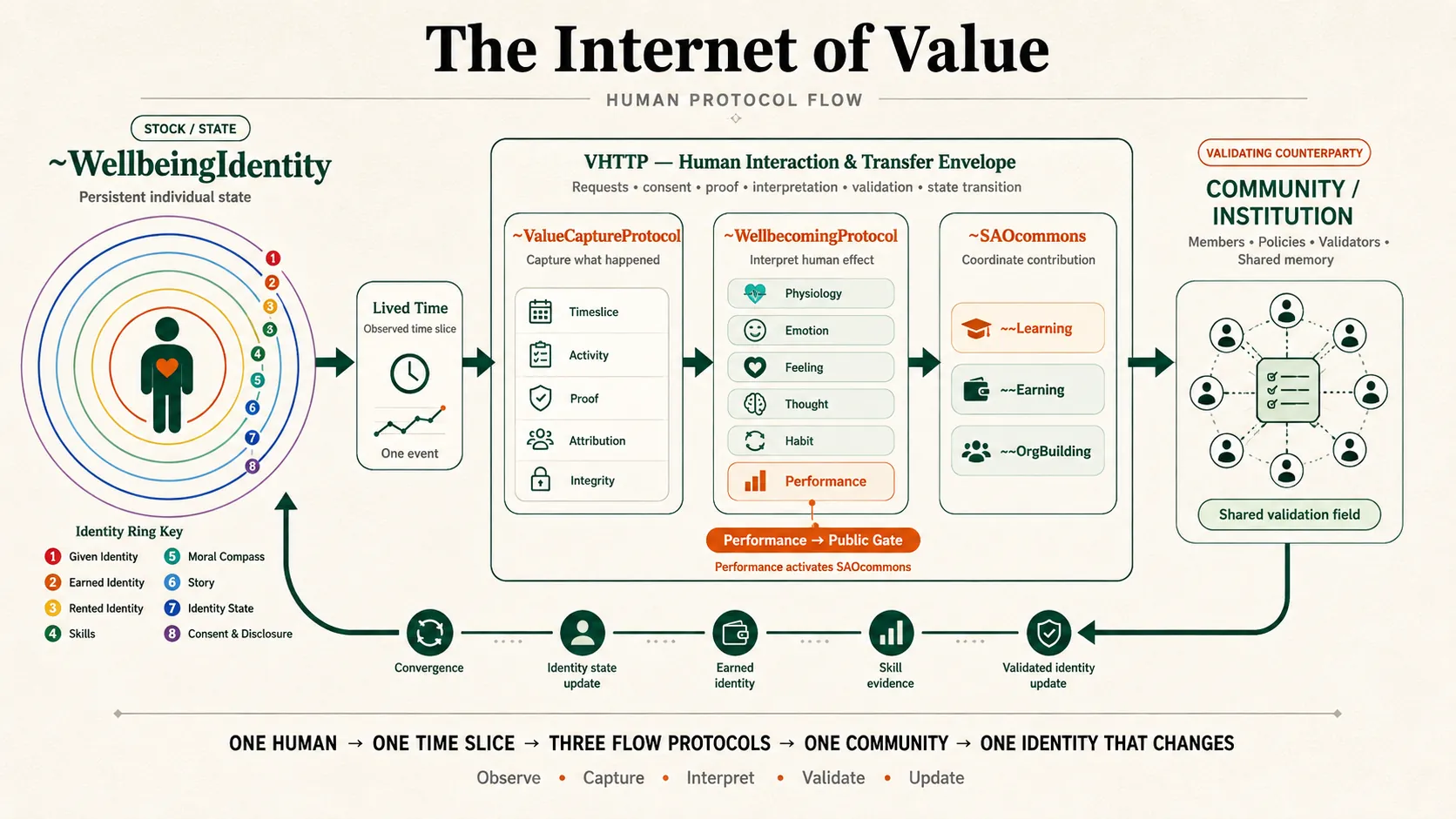
Here is the application I would explore with a programme willing to investigate it. It is a proposed mapping, not an existing Kerala integration or a claim of adoption.
Record the occurrence
With ~ValueCaptureProtocol, I would ask whether each service occurrence could retain a bounded time window, actor, beneficiary, appropriate evidence and a common ~~~~ProtocolLinkId. That identifier would let later interpretations refer to the same occurrence, rather than count it as new hours. The spec defines the recording structure; deciding sufficient evidence for a care interaction remains local work. [P1]
Ask about the experience
With ~WellbecomingProtocol, I would explore consented accounts of the experience alongside the service record. Was the interaction welcome? Did the helper feel overextended? Those are proposed questions, not a validated care questionnaire or outcomes implied by a timestamp. Any resulting personal context would need careful disclosure boundaries. [P2][P4]
Review eligible recognition
Where there is an eligible nonzero ~~Performance output, ~SAOcommons provides an interface for community review and recognition. That conditional gateway does not make every act of care an earning event. A programme would still need to establish its own authority, eligible evidence, review process and disputes. [P2][P3]
Control personal disclosure
~WellbeingIdentity carries living state with consent and disclosure controls. I would not use it as a public ranking of recipients or as a compulsory gateway to support. A programme should ask for the minimum relevant disclosure, with a practical route for people who do not choose to publish a profile. The consent architecture supports scoped disclosure; this access policy is my recommendation. [P4]
The useful experiment would keep three things visibly separate: the service that was recorded, the recognition a community granted, and any future assistance its rules actually promise. The protocol system could help structure that evidence. A time-bank agreement would still have to define the credit and redemption terms.
None of this supplies missing volunteers, funds a coordinator, guarantees clinical competence or creates a legally enforceable promise by calculation. It also adds work. I would only advocate an integration if testing showed that its accountability benefits justified the burden on participants and administrators.