
The Internet of Value
Time banking vs The Internet of Value
By Moses Sam Paul 2026-11-07
One real contribution to value mathematics. Three hours of recorded work. Two different questions about what those hours mean.
Quick answer
What is time banking?
A time bank connects people who offer help with people who need it. Members can contribute everyday skills—care, tutoring, repairs, cooking or a ride—and receive help through the network. TimeBanks.Org describes this as a practice of equality, reciprocity and connection: an hour given can earn a time credit used to receive an hour of help from someone else. [10]
In the Timebanking UK model used for this comparison, different services receive the same credit for the same duration. The exchange rule is deliberately simple: a person's professional price does not make their hour count for more. [1]
Explore how Timebanking UK works →Meet the TimeBanks.Org movement →
What is The Internet of Value?
The Internet of Value is a protocol system connecting lived activity, its wellbeing context, community-recognized contribution and a person's living identity. Its shared vocabulary helps distinguish what happened, what it meant to the person, and what a community is prepared to recognize. The four protocols give those responsibilities separate places. [4] [9] [12] [13]
- Capture what happened.
~ValueCaptureProtocolrecords a bounded activity, its evidence, attribution and event lineage. [4] - Interpret its human context.
~WellbecomingProtocolroutes observations through Physiology, Emotion, Feeling, Thought, Habit or Performance. [12] - Recognize eligible contributions.
~SAOcommonssupplies the community interface for reviewing Learning, Earning and OrgBuilding outputs when the Performance gateway applies. [13] - Carry the living state.
~WellbeingIdentityholds identity and state informed by eligible validated flows, with disclosure governed separately. [9]
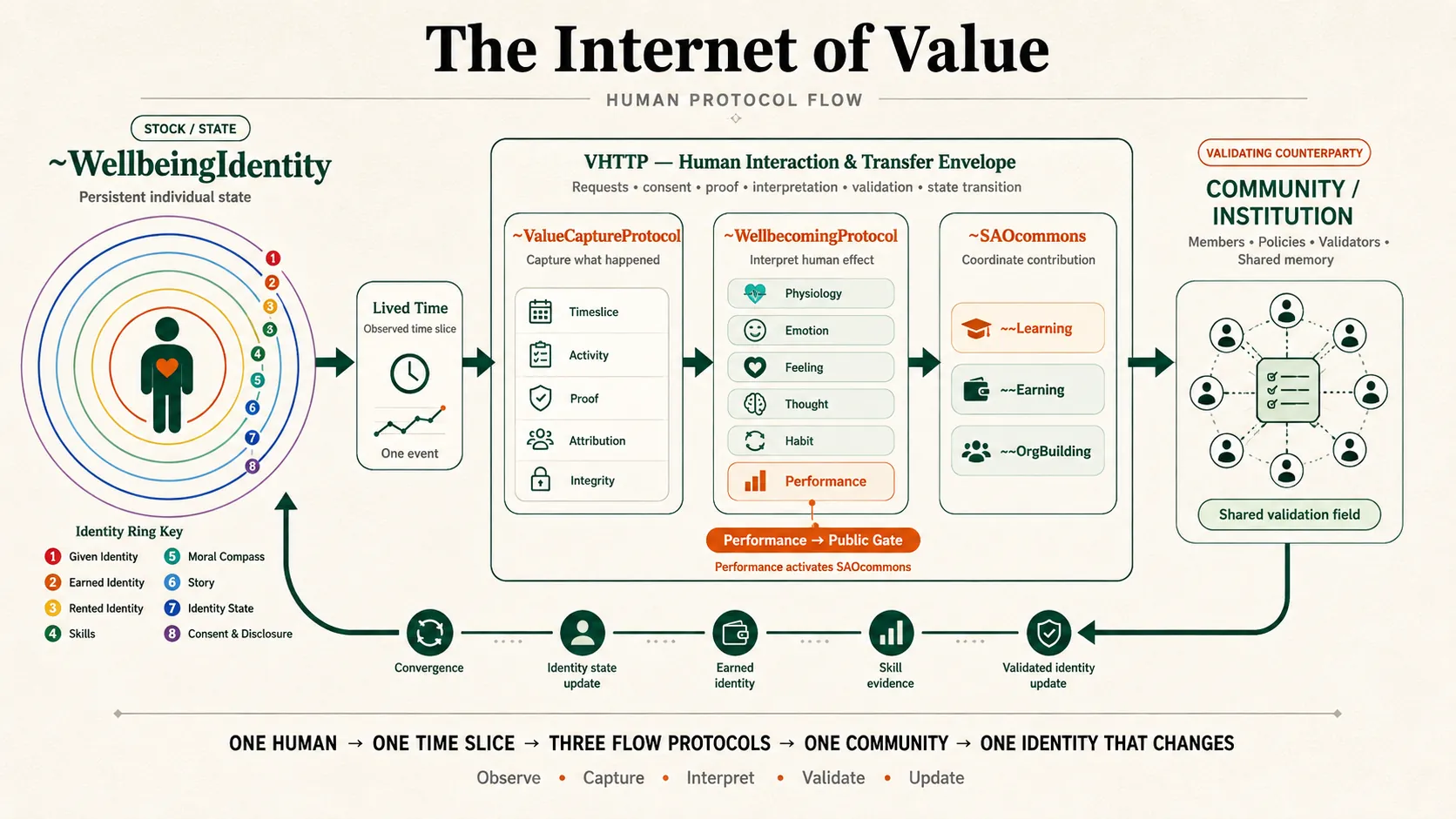
With those responsibilities in view, we can follow one actual Foundation session through the records. The example uses a named founder policy and its real inputs; it is not a rate or wellbeing model assigned to every participant. [2] [3]
Start with the work
On 31 July 2026, from 09:30 to 12:30 India Standard Time, I recorded a Foundation session described as improving The Internet of Value's mathematics, resolving community skill-approval dependencies in Performance calculations, and deploying and testing changes. The canonical record classifies it as Performance, in the Foundation community's OrgBuilding route, and records three hours. [2]
This is an actual recorded research and protocol-engineering session. Its proof field is empty: the entry does not identify a specific commit, deployment receipt or external beneficiary response. I therefore cannot use the activity description alone to prove that a particular artifact shipped or that someone benefited from it. The case concerns what the record and calculation establish. [2]
31 July 2026 · 09:30–12:30 IST
Mathematics and Performance-calculation work
Performance → OrgBuilding → Internet of Value Research Foundation
Actual owner record · founder self-review · no linked proof artifact in the selected record. The calculations below are the promoted replay as exported on 7 November, not a claim about what was known when the work began. [2]
What would time banking record?
Timebanking UK describes equal-hour exchange: one hour of helping earns one hour's credit, irrespective of the skill or task. That is an explicit equality principle, rather than a missing adjustment for professional status. [1]
3 service hours × 1 time credit/hour = 3 time credits
This is a conditional comparison, not an actual credit balance. The selected record does not show a timebank exchange or acceptance by a bank. It does not establish that this research task would qualify. The calculation applies the cited rule to the recorded duration under that stated condition. [1] [2]
What did The Internet of Value record?
The same duration enters a different account. The selected promoted event names the Foundation source community, OrgBuilding route, native SM3 level, rate-policy reference, pre-event wellbeing state, finality and non-payability. It is linked to the captured occurrence rather than treated as additional hours of work. The protocol's ProtocolLinkId provides event lineage across interpretations. [2] [4]
Validated duration and the named community rate produce Vcom. Pre-event wellbeing then weights a separate VCperformance output.
A separate impact decision determines state movement. For this occurrence, the stored outcome is no_transition.
The selected record contains two validation events dated 2 August: one in the Foundation role and one in the HouseOfBros role, both marked founder self-review. The rate authority is also Moses-only and self-ratified, with external validation explicitly not claimed. Separate roles make the decisions inspectable; they do not make them independent. [2]
The real calculation
| Recorded input or output | Value | Meaning and source |
|---|---|---|
| Duration | 3 hours | 180 validated minutes, corresponding to 09:30–12:30 IST. [2] |
| Community rate | USD 750/hour | Moses-only SM3 flat reference rate, policy 1.0.0. Self-ratified; not an observed market price or wage. [2] [3] |
| Vcom | USD 2,250 | The stored contribution valuation before wellbeing weighting. [2] |
| Pre-event W | 771.096 W, rounded for reading | Exact historical input retained in the audit calculation below. This is not the current public profile reading. [2] [3] |
| VCperformance | USD 1,734.97, rounded for reading | A separate wellbeing-weighted reference valuation. Final under the named policy and non-payable. [2] |
| Wellbeing movement | 0 W | Stored impact status: no_transition. It does not prove that no benefit or cost was experienced. [2] |
Vcom = USD 2,250
VCperformance = (Wbefore / 1000) × Vcom
VCperformance ≈ USD 1,734.97
ΔW = Wafter − Wbefore = 0
USD is the declared valuation unit; it is not a payment. The event explicitly says non_payable. These numbers establish neither money received nor a debt, token, transferable balance or claim to compensation. The self-ratified rate does not establish that an independent buyer would pay that amount. [2] [5]
Reproduce the exact audit arithmetic
The exported event uses founder-wellbeing-v0.1.1-fixed12. Each governed step rounds half-even to twelve decimal places. The normalised multiplier is rounded before multiplication; rounding only the final result would not reproduce this event. These decimals support reproducibility, not twelve-decimal measurement accuracy. [2] [3] [6]
duration = 3.000000000000 hours
rate = 750.000000000000 USD/hour
Vcom = 2250.000000000000 USD
q = round12(Wbefore / 1000)
q = 0.771095689848
VCperformance = round12(q × Vcom)
VCperformance = 1734.965302158000 USD
Wafter = 771.095689848427
ΔW = 0.000000000000
The separate decimal calculation for this article matches the exported Vcom, VCperformance and zero delta. Only this event's arithmetic was reproduced; that does not independently validate the rate, wellbeing model, source narrative or every replay event. [7]
Does lower wellbeing mean the same contribution is worth less?
For fixed positive Vcom, the formula returns a lower VCperformance when Wbefore is lower. It leaves Vcom unchanged. That is the distinction this case makes visible: the community contribution valuation and its wellbeing-weighted interpretation are separate quantities. [5]
My interpretation for this page is to call VCperformance a wellbeing-weighted contribution indicator. That describes the operation without claiming a scientifically established measure of productivity or sustainable value. It is explanatory language, not a renamed protocol field.
The multiplier uses starting state, not the event's change in wellbeing. It therefore cannot, by itself, tell us whether producing the contribution depleted or restored the person. Nor does dividing by 1000 establish that the score measures a percentage of human capability. Those conclusions do not follow from the equation. The broader research relation and current founder implementation have different claim statuses. [5] [6]
The person behind the account
Moses Sam Paul Johnraj
When consulted for this article on 7 November 2026, my public Identity presented HouseOfBros wellbeing recognition, Growth Flow Engineering recognition, and Foundation Systems Thinking & Modeling recognition as distinct contexts. The Foundation recognition was shown as SM3 · Architect, with founder review explicitly identified. It is not a single universal rank. [8]
Explore my actual Wellbeing Identity →
The live profile controls which details are visible. Its current dated reading is not substituted for the July event's Wbefore. Deeper rings, private components and private history are not reproduced here.
The protocol treats ~WellbeingIdentity as a living state supported by validated flows. This article's example demonstrates a contribution valuation with no score transition; it does not claim that this occurrence updated every identity ring or issued a new skill credential. [2] [9]
What this comparison teaches us
Our lesson from time banking is to make a recognition rule understandable to the people affected by it. Its equal-hour principle also poses a useful question for us: what social hierarchies might enter through differentiated rates or wellbeing weighting? That is our interpretation of the contrast, not a criticism attributed to timebank operators. [1]
The additional account in this founder implementation makes particular choices inspectable: whose rate applies, whose wellbeing policy applies, who reviewed the event, what changed, and what remained unchanged. This case supports that narrower statement. It does not prove greater fairness, stronger reciprocity, better health or larger economic benefit. [2] [6]
| Question | Timebank rule applied conditionally | This founder record |
|---|---|---|
| What is counted? | Three eligible service hours would yield three credits. | Three validated hours feed a contribution valuation and separate state account. |
| What governs the number? | Equal-hour exchange rule. [1] | Named rate, issuer policy and founder authority. [2] |
| What actually happened? | No timebank transaction established for this session. | A final non-payable valuation, with zero recorded wellbeing movement. [2] |
| What remains unproved? | Whether a bank would accept this research activity. | Independent work verification, external market value and model validity. |
Common questions
Is The Internet of Value a time bank?
This founder implementation does not use the equal-hour exchange rule described by Timebanking UK. The comparison shows a contribution valuation and a separate wellbeing account; the selected output is non-payable. It does not show a time-credit exchange. [1] [2]
Does lower wellbeing reduce my pay?
No payment is established by this case. For fixed positive Vcom, lower Wbefore lowers the separate VCperformance output while Vcom remains unchanged. The selected event is explicitly non-payable. The calculation supplies no rule for reducing wages or judging a person’s worth. [2] [5] [6]
Did these three research hours earn three time credits?
No timebank transaction is established. Three credits is the conditional result if a time bank accepted all three hours as eligible service under the cited equal-hour rule. Eligibility is not demonstrated by the Foundation record. [1] [2]
Was this contribution independently reviewed?
No. The selected event records two community roles, but both decisions are founder self-reviews. The rate is Moses-only and self-ratified. A separate arithmetic reproduction checks the numbers, not independent work quality or external economic value. [2] [7]
Sources and calculation scope
- Timebanking UK — How timebanking works. Primary source for the equal-hour exchange rule. Retrieved 7 November 2026. The comparison is limited to this documented rule, not every timebank design.
- Selected founder record, transcribed for this case. Moses Sam Paul Johnraj’s privacy-filtered Value Log export, 7 November 2026 at 10:48:25 IST. Activity: 31 July 2026, 09:30–12:30 IST; Foundation OrgBuilding; 180 minutes; native level SM3. The inputs, decisions and outputs used from this record appear in the tables and exact calculation above. Source policy 1.0.0 was self-ratified after the session, at 12:34:42 IST on 31 July, and recorded at 14:38:30 IST; the validation events are dated 2 August. This is the promoted replay exported on 7 November. The underlying record is private; this author-provided transcription is not an independently accessible or independently verified work record. No raw export or private profile history is published.
- Calculation method and exact inputs. Author’s method note, based on the inspected Value Log implementation
founder-wellbeing-v0.1.1-fixed12: duration-expanded Vcom, historical Wbefore, and half-even rounding to twelve decimals after each governed step. This is a version-specific implementation description, not a universal protocol formula. The calculation documentation and calculator were inspected locally; those implementation files are not offered as public references. The public calculation record includes the checked source-file hashes. - Value Capture Protocol — public protocol reference and protocol registry. Sources for bounded activity, attribution, integrity and event lineage. Retrieved 7 November 2026.
- Selected-event method and source record note. The separation of Vcom, VCperformance, Wbefore and ΔW, and the non-payable outcome, are shown for this named founder implementation. Local grounding: the accepted community-governed wellbeing mathematics decision and founder calculation documentation. Their repository links are not offered as publicly accessible evidence. The lower-W conclusion follows algebraically for fixed positive Vcom in this displayed formula.
- Claim limits for this implementation. Grounded in the inspected Founder mathematics claims matrix and stated explicitly in this article: founder self-review is not independent review; deterministic arithmetic does not establish empirical validity; W is not human worth, a wage, a diagnosis or a universal ranking; stored precision is not measurement accuracy. These limits apply to the selected case and are not evidence that the model is validated.
- Public selected-event calculation record, prepared 7 November 2026. Contains only the article’s inputs, outputs, rounding method, source-code hashes and verification limits. A separate Decimal calculation reproduced the selected export’s arithmetic. It verifies the multiplication and rounding, not the source narrative, policy legitimacy or wellbeing model.
- Moses Sam Paul Johnraj — owner-approved public Wellbeing Identity. Retrieved 7 November 2026. Current publication is separate from the historical event.
- Wellbeing Identity — public protocol reference. Source for the living state and separate consent/disclosure responsibilities. Retrieved 7 November 2026.
- TimeBanks.Org — Who We Are. Primary source for the community, reciprocity and everyday-service context. Retrieved 7 November 2026.
- Human Protocol Flow. Illustration supplied by Moses Sam Paul Johnraj and approved for reuse on 3 November 2026. Reused unchanged. The diagram explains the system; it is not itself a protocol specification.
- Wellbecoming Protocol — public protocol reference. Source for the six nodes and conditional Performance gateway. Retrieved 7 November 2026.
- SAOcommons — public protocol reference. Source for the community interface and Learning, Earning and OrgBuilding lanes. Retrieved 7 November 2026.
Continue exploring
- What the ledger leaves out · Doughnut Economics
- Leave the return open · Sacred Economics
- When a number becomes a claim · Mutual credit / CES
- Before we price the work: the same session and Valueflows / REA
- What is The Internet of Value?
- Value Capture vs time tracking
- How the four protocols connect
- My public Wellbeing Identity
Prepared 7 November 2026 with AI assistance. The case and its historical reading are a selected author disclosure; current Identity disclosure remains controlled on the live profile.