
The Internet of Value
SourceCred vs The Internet of Value
By Moses Sam Paul 2026-11-07
One real contribution. What did the work connect—and what can we actually calculate?
Quick answer
SourceCred can recognize relationships between contributions: what supports what, and who helped make it possible. This founder implementation of The Internet of Value records an event’s contribution valuation, a separate wellbeing-weighted output and a separate wellbeing decision. SourceCred’s Cred, its optional Grain allocations and our event outputs are different quantities—not competing prices for the same three hours. [1] [5] [13]
Published 7 November 2026. The same already-disclosed Foundation session anchors this page. No SourceCred score or allocation is established for it; missing graph inputs stay unknown. [12]
What does SourceCred stand for?
SourceCred aims to make contributions to a community visible and rewardable. Cred expresses recognition within a particular project. Grain is a separate, community-specific distribution mechanism. Recognition and reward are distinct design choices. [1]
In its graph account, contributions and people become nodes; authorship, references and other supported relationships become connections. Communities choose weights. Cred is project-specific, non-transferable and can be recomputed when new information arrives. These are the model’s documented properties, not evidence that a score objectively measures someone’s worth. [2]
There is also an important version distinction. CredRank uses a graph and PageRank-style calculation. CredEquate evaluates contribution expressions algebraically. The algorithm guide and release notes describe both; the guide calls CredEquate Alpha while the v0.11.0 release uses a different readiness description. We therefore name the algorithm and code version instead of presenting one timeless “SourceCred formula.” [3] [4]
Explore SourceCred →Read its own explanation →Compare its algorithms →
What does The Internet of Value do?
The Internet of Value is a four-protocol system for representing activity, interpreting its human context, routing eligible contributions through communities and carrying validated state into a living Wellbeing Identity. The shared vocabulary separates these responsibilities. It does not make every observation public or automatically turn every hour into a payment. [14] [15] [16] [17]
- Capture:
~ValueCaptureProtocolrecords bounded activity, attribution, evidence and event lineage. [14] - Interpret:
~WellbecomingProtocoldescribes Physiology, Emotion, Feeling, Thought, Habit and Performance context. [15] - Recognize: the conditional Performance route can activate
~SAOcommonscommunity validation through Learning, Earning or OrgBuilding. [16] - Carry state:
~WellbeingIdentityreceives eligible validated flows; its disclosure is governed separately. [17]
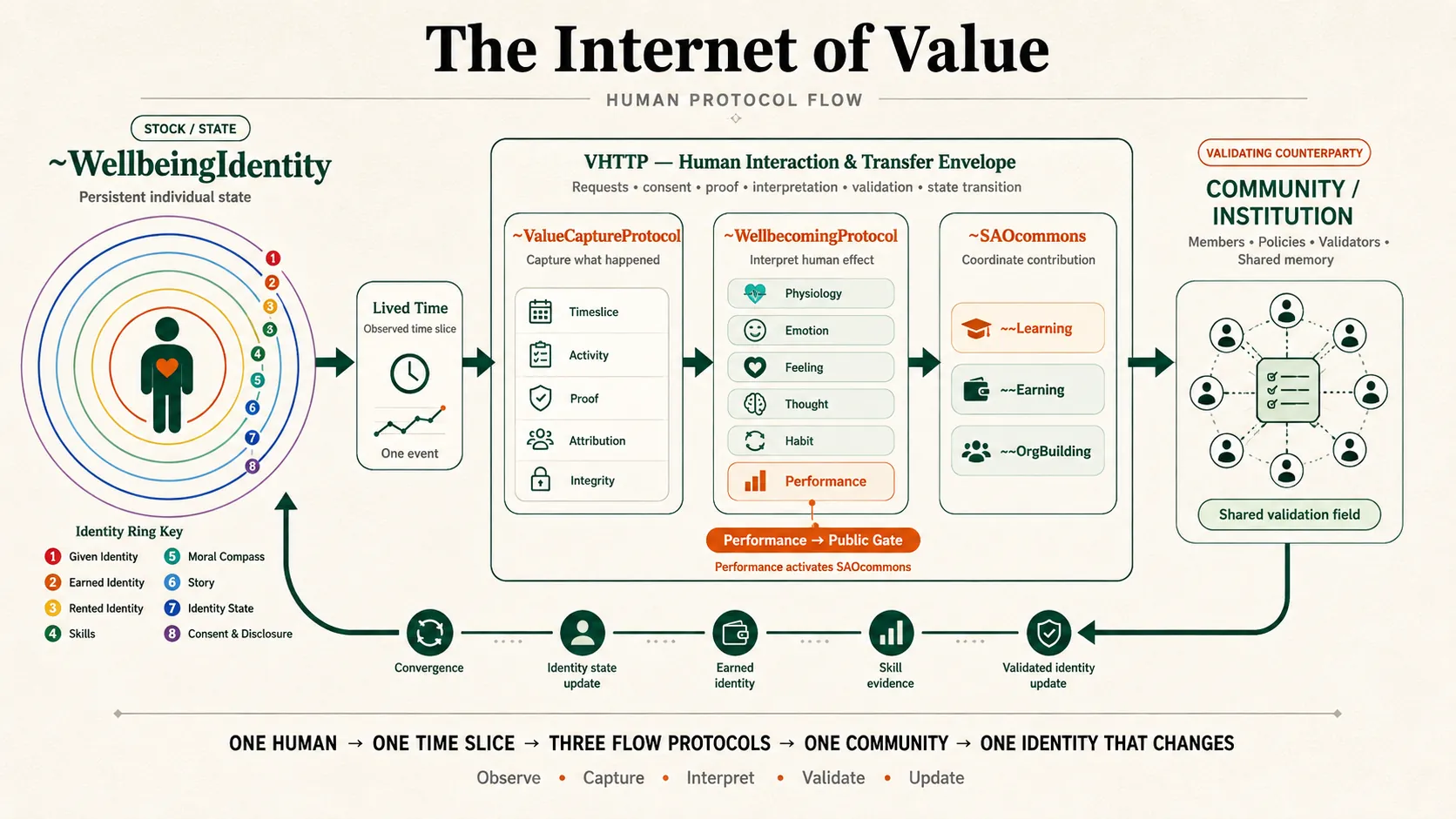
The rest of this article narrows from that system architecture to one real founder-policy event. Its rate, wellbeing policy and review authority are specific to this case. The wider SAOcommons interface includes distribution-rule vocabulary; the non-payable event below does not establish that the whole system is incapable of distributing benefits. [12] [13] [16]
The real Foundation contribution
31 July 2026 · 09:30–12:30 IST · three hours. I recorded Foundation work on The Internet of Value’s mathematics and Performance calculations, including community skill-approval dependencies. The description mentions deployment and testing. Its route is Performance → OrgBuilding → Internet of Value Research Foundation, native level SM3. [12]
This is an author-provided record. The selected case has no linked proof artifact; neither its description nor this article independently establishes a shipped change or later work relying on it. Both community-role decisions were founder self-reviews. Reusing the case keeps the actual activity constant across comparisons without exposing new private records. [12] [13]
The SourceCred question this case exposes: which specific artifact came from this work, and what later contribution depended on that artifact? Our selected evidence does not supply that chain. A later article citing the activity record shows reuse of the record; it does not prove a software dependency on the July implementation. [12]
Follow the same contribution through both models
The same recorded work: three hours of Foundation mathematics and calculation-infrastructure work. [12]
SourceCred · conditional comparison
- Represent an accepted contribution and its attribution.
- Supply evidenced relationships or a contribution expression.
- Apply the instance’s chosen algorithm and configuration.
- If enabled, allocate Grain under its separate rule.
No configured Foundation instance, graph or executed result is established for this event. [3] [5] [7] [12]
The selected IoV founder event
- Record the activity and Foundation route.
- Apply the named contribution-rate policy.
- Use the historical pre-event W for VCperformance.
- Record the separate impact decision: no_transition.
The stored calculation is reproducible and explicitly non-payable. [13]
SourceCred’s math: relationships need evidence
For CredRank v0.11.2, the inspected code takes a weighted graph and participant ledger, constructs time intervals and a Markov process graph, solves for a stationary distribution, and scales its node scores. A three-hour duration alone supplies none of that configuration. [5]
1. The graph becomes a flow calculation
Let Puv mean the probability of moving from node u to node v in the fully constructed Markov chain. Let πv be v’s equilibrium share of probability. In our notation, the stationary condition is: [6]
Σv πv = 1
Internal scaled node scorev = M × πv / A
M is total minted node weight; A is the total stationary mass on the accumulator nodes used by this release’s normalization. The implementation subsequently carries scores in a CredGraph. The scaled node equation is not, by itself, an individual’s final weekly Cred: participant and time-node aggregation also matter. The code and configuration—not just the displayed equation—define an actual result. [5]
Plainly: a node’s score depends on incoming relationships and the scores around it. The constructed graph includes seed and time machinery. The equations are an explanation of that calculation, not a claim that our selected session already exists as a node, or that every new link must increase its score. [5] [6]
2. CredEquate is an algebraic alternative
This is our functional notation for the release’s recursive expression evaluation, not a quoted universal closed-form equation. Its code evaluates nested expressions and weight operands using the applicable configuration. We have neither a SourceCred contribution expression nor its applicable configuration for this session, so we do not invent a score—or force a graph explanation onto CredEquate. [7]
What the real record supplies—and what it does not
My 31 July Foundation session
09:30–12:30 IST · 3 hours
No linked proof in the selected record.
No evidenced later contribution is supplied here.
An evidence map of this case, not a SourceCred graph export. The unresolved steps are not scored as zero. [12]
| Input | Selected evidence | What follows |
|---|---|---|
| Activity, author and duration | Recorded Foundation session; Moses; three hours. [12] | Possible source material for a reviewed mapping—not an imported SourceCred contribution. |
| Proof and downstream dependencies | No linked artifact or demonstrated reuse chain in the selected record. [12] | No measured contribution graph can be reconstructed from it. |
| Instance, algorithm and configuration | Not supplied by this case. | Cred remains unresolved, not zero. |
| Grain policy, eligible participants and budget | Not supplied by this case. | No Grain allocation or payment can be calculated. |
These are limits of the selected evidence, not claims that SourceCred cannot represent this kind of work. Its Initiatives plugin documents adding contributions through JSON and human review, alongside cautions about technical access and attribution. Offline or research work is not categorically excluded. [11]
Cred is not Grain, and Grain is not automatically dollars
Grain is optional and community-specific. The documentation distinguishes IMMEDIATE, RECENT and BALANCED distribution approaches. A community may use Grain without a monetary reward; opt-in and the local rules matter. We do not import another community’s dollar example as an exchange rate for Foundation work. [8]
For the inspected IMMEDIATE implementation, the configured lookback selects a time scope; active participants’ scoped Cred scores are passed to a budget splitter. With nonnegative scores and positive total, the continuous proportional explanation is: [9]
B is the selected Grain budget, ci the participant’s Cred within that scope, and the denominator covers the eligible active participants. This is our explanatory notation. The actual splitter operates in finite Grain units, resolves rounding and preserves the budget; zero-total and invalid-input behavior must be taken from the implementation. The equation is not a complete receipt generator and does not describe BALANCED. [9] [10]
For my session, B, ci, the eligible total and any redemption arrangement are unknown. There is no justified conversion from “3 hours” or “USD 2,250 Vcom” to a Cred score, Grain balance or dollars received. [12] [13] [9]
The IoV math we can actually reproduce
The selected exported event supplies all the inputs needed for its founder-policy calculation. The declared rate is Moses-only and self-ratified; it is a policy reference, not evidence of an external buyer or a wage. The exact historical wellbeing input belongs to that event’s replay, not the latest public profile reading. [12] [13]
Vcom = USD 2,250
q = round12(771.095689848427 / 1000)
q = 0.771095689848
VCperformance = round12(q × 2250.000000000000)
VCperformance = USD 1,734.965302158000
Wafter = Wbefore = 771.095689848427
ΔW = 0
round12 means round-half-even to twelve decimal places after each governed step in founder-wellbeing-v0.1.1-fixed12. Rounding the multiplier before multiplying reproduces the stored result. The separate Decimal check establishes this selected event’s arithmetic, not twelve-decimal measurement accuracy, work quality, economic value or model validity. [13]
Nothing here is a SourceCred allocation or an IoV payment. The source event is non_payable. Vcom is a contribution valuation in the declared unit; VCperformance is a separate wellbeing-weighted reference output. Neither establishes a benefit-pool fraction, money received or a claim against a buyer. [12] [13]
With fixed positive Vcom, lower Wbefore lowers VCperformance while leaving Vcom unchanged. That is a property of this formula, not evidence that someone did worse work or deserves less pay. Wbefore is a pre-event state; it does not by itself measure the cost or restoration caused by the work. Here the recorded impact decision is no_transition and ΔW = 0. [13] [19]
My Wellbeing Identity: see the person, keep the quantities separate
Explore my actual public Wellbeing Identity →
The public page is the existing owner-controlled view, not a new copy of private facets. Its current state is not substituted for the historical Wbefore above. The protocol describes a living, consent-governed identity; the selected event’s economic and impact decisions have their own authority and scope. [17] [13]
A project’s Cred score and a Wellbeing Identity are therefore not interchangeable profiles. This comparison does not establish a Cred-to-W conversion, a universal reputation score, or a payment account. [2] [17]
What The Internet of Value can learn from SourceCred
1. Show what the work enabled
The graph account invites scrutiny of supporting contributions, not just the visible final author. For this case, the missing proof link matters: we cannot point from the logged session to a particular change and then to a later contribution that used it. [2] [12]
Proposed next step: attach the actual artifact, prior work used and evidenced downstream references when available. Keep each relationship’s source and review status. This would improve the case’s inspectability; it would not turn our ledger into SourceCred or prove impact merely by drawing an edge.
2. Separate evidence corrections from value choices
The Initiatives guidance distinguishes factual attribution from subjective weighting and warns against reshaping the former to obtain preferred scores. Applied here, we should preserve the session’s description and missing proof separately from decisions about its rate or wellbeing interpretation. [11] [12]
Our visible policy timing: the selected rate was self-ratified at 12:34:42 IST, after the session ended at 12:30, and recorded at 14:38:30. The founder reviews were dated 2 August. This does not establish advance agreement; neither does it prove that no earlier agreement existed. Showing those timestamps is more useful than calling the result simply “validated.” [12]
3. Make revision reasons visible
SourceCred’s retroactive recognition suggests an audit question: did a score change because new work depended on an old contribution, because previously missing data appeared, or because a weight changed? Our proposed review history should similarly separate source correction, community policy and replayed arithmetic. That is our design lesson, not an implemented cross-system adapter. [2] [13]
4. Explain what the system cannot see
The Initiatives documentation acknowledges technical and review barriers. That cautions against assuming platform visibility equals total contribution. For our case, an exact calculation is also incomplete evidence: reproducible arithmetic cannot supply the absent artifact or independent review. Both systems need readable ways to challenge attribution and recognition. The last sentence is our recommendation, not a demonstrated comparative outcome. [11] [12] [13]
The comparison in one table
| Question | SourceCred | This IoV founder event |
|---|---|---|
| What is calculated? | Cred under a selected scoring algorithm; optional Grain under a separate policy. [3] [8] | Contribution valuation, wellbeing-weighted output and separate W decision. [13] |
| Where do relationships matter? | CredRank uses a configured contribution graph. CredEquate uses configured contribution expressions. [5] [7] | The displayed arithmetic uses duration, declared rate and historical W; it does not traverse dependencies. [13] |
| Can these three hours be scored? | Not numerically from this selected evidence. | The stored arithmetic is reproduced exactly. [13] |
| Does recognition prove payment? | No universal monetary value for Grain; local policy matters. [8] | No. This event is non_payable. [13] |
| What does the case not establish? | An imported event, Cred score, Grain allocation or payout. | Independent work validation, external market price or empirical model validity. [12] [13] |
Common questions
Is SourceCred just a time bank?
No. Its documented scoring approaches use configured relationships or contribution expressions, rather than an equal-hour exchange rule. Three logged hours do not automatically become three Cred. [3] [5] [7]
Does The Internet of Value uniquely use mathematics to recognize contributions?
No. SourceCred’s released scoring code is a direct counterexample. This case supports a narrower distinction between the inputs, rules and meanings of outputs; it does not establish a global invention claim. [5] [7] [13]
Does SourceCred ignore wellbeing?
That would be too strong. Its stated purpose concerns a healthier, community-serving economy. The inspected scoring calculation does not supply this event’s Wbefore multiplier, but we have not audited every community configuration. A stated social goal and an explicit state variable are different claims. [1] [5] [13]
Can one person start within a day?
This session shows that one person’s work can be recorded and later calculated under the named founder policy. It does not show that the first 24-hour log creates exchange, independent recognition, a settled benefit or a unique network effect. Nor have we established that SourceCred cannot be configured by one person. [12] [13]
Could the systems work together?
Possibly, as a research proposal: an evidenced artifact relationship could inform a community’s review while its wellbeing interpretation remains separate. There is no implemented SourceCred adapter or ratified Cred-to-W conversion demonstrated by this case. Any such bridge would need consent, attribution, configuration, units and replay rules—not a multiplication of unrelated scores. [13] [17]
A positioning statement this evidence supports
SourceCred makes contribution relationships and project recognition inspectable. This founder implementation of The Internet of Value makes a contribution’s policy valuation and wellbeing interpretation separately inspectable. Our lesson is to preserve both the person’s context and the evidence of what their work enabled.
Our synthesis of the reviewed model and selected case, not a SourceCred quote or a claim of superior results. [5] [13]
Sources and evidence limits
- SourceCred — Introduction. Project purpose and the separation of Cred from Grain; documentation describes intentions, not an independent outcome evaluation.
- How Cred Works. Community-specific, non-transferable, retroactively recalculated Cred; graph and weighting explanation. Beta documentation, consulted 7 November 2026.
- Configure the Core Algorithm. Documents CredRank and CredEquate. The guide labels CredEquate Alpha; do not use that label to infer the status of every release or deployed instance.
- SourceCred v0.11.0 release notes. Describes the algebraic alternative alongside CredRank. Release language differs from the guide’s maturity label. This article does not assert present maintenance, uptime or adoption.
- CredRank compute implementation — v0.11.2. Release-pinned code: weighted graph and ledger inputs, time intervals, Markov graph, stationary distribution, accumulator normalization and minted-weight scaling. Code inspection, not execution on the Foundation case.
- SourceCred: An Introduction to Calculating Cred and Grain — Evan Miyazono, 19 March 2020. Primary participant explainer of Markov transitions and stationary distributions. Historical account; its old mint totals, payout mix and roadmap are not imported as current rules.
- CredEquate expression scoring implementation — v0.11.2. Recursive evaluation of expression operands and configured weights, plus configuration timing. This draft does not reproduce a full CredEquate instance.
- How Grain Works. Optional community-specific Grain, opt-in and IMMEDIATE/BALANCED/RECENT policy descriptions. The page’s own-community dollar example is not a universal exchange rate and is not applied here.
- IMMEDIATE Grain policy — v0.11.2. Uses active participants and Cred from a configurable interval lookback, then calls splitBudget.
- Grain splitBudget implementation — v0.11.2. Integer Grain allocation, precise budget conservation and finite-unit rounding; continuous proportional algebra is not an exact receipt generator.
- Initiatives plugin. JSON-based contributions, objective attribution versus subjective valuation, review and inclusivity caveats. Counters the claim that only automatically imported online work can be represented.
- The published Foundation session. Already-disclosed 31 July 2026 event and selected-record source note, using the 7 November export cutoff. Underlying owner record is private. Author-provided case, no independent proof of work or downstream dependency.
- Public selected-event calculation record. Historical inputs, policy/calculation version, per-step rounding, outputs and source hashes. Reproduced separately for this draft. Founder self-review, Moses-only self-ratified rate and non-payability remain explicit.
- Value Capture — public protocol reference. Bounded activity, attribution, evidence and lineage.
- Wellbecoming — public protocol reference. Private human-context interpretation and conditional Performance routing.
- SAOcommons — public protocol reference. Community validation and institutional vocabulary. The selected event does not define every possible community implementation.
- Wellbeing Identity — public protocol reference. Consent-governed living identity and separate disclosure responsibilities.
- Canonical registry. specVersion0.7.0 when consulted 7 November 2026; canonical four-protocol structure.
- Published implementation claim limits and selected-event method note. Grounded in the locally inspected Founder mathematics claims matrix and made explicit in the published case. The repository is not offered as independently accessible evidence. W is not human worth or deserved compensation; the displayed lower-W conclusion follows algebraically from this selected formula. Economic valuation and wellbeing impact are separate decisions.
- Human Protocol Flow. Existing owner-approved explanatory image, reused unchanged; specifications govern protocol truth.
Sources consulted 7 November 2026. SourceCred documentation spans different versions and maturity descriptions; release-pinned code grounds the displayed implementation details. No new Cred instance was run and no synthetic participant, contribution graph, rate or payout fills the missing evidence. The independent Decimal check verifies only this event’s arithmetic.
Continue exploring
- What the ledger leaves out · Doughnut Economics
- Leave the return open · Sacred Economics
- When a number becomes a claim · Mutual credit / CES
- Before we price the work: the same session and Valueflows / REA