
The Internet of Value
When a number becomes a claim
By Moses Sam Paul 2026-11-07
When does contribution recognition become capacity to receive? Mutual credit / CES and The Internet of Value, through one real Foundation contribution.

Quick answer
Mutual credit records an agreed exchange as a credit to one participant and a debit to another. In the selected founder implementation of The Internet of Value, a contribution can instead receive a policy valuation and a separate wellbeing-weighted calculation without becoming spendable credit. The difference is the institutional meaning of the entry. [2] [7] [8]
Published 7 November 2026. The Foundation session is real and already disclosed; its application to mutual credit is conditional. No CES trade, account or accepting counterparty is established by the selected evidence. [7]
What are mutual credit and CES?
Mutual credit is an accounting arrangement for exchange; CES is the Community Exchange System. CES provides community exchange tools, including mutual-credit accounting. Its current description also includes gifts, barter, swaps and time trading. This page compares the mutual-credit mode, not every arrangement offered by CES. [1] [2] [3]
Participants can advertise what they offer or need. In an agreed, recorded exchange, the provider’s balance rises and the receiver’s falls. The receiver’s commitment is to contribute within the community, rather than to return the same service to the original provider. [1]
A community exchange need not give every hour the same price. CES distinguishes exchanges with variable prices from timebanks that encourage an equal-hour rule. Its unit may use a national currency as a pricing reference; that reference does not itself promise conversion into cash. [3] [6]
The CES Charter also addresses local terms, account limits and administration. Those choices matter: a balance has practical use within a participating exchange, under its rules and with people willing to offer something. A number alone cannot establish what someone can obtain. The last sentence is our interpretation of those institutional requirements, not a measured liquidity claim. [4]
How CES works →Read the CES Charter →See CES’s own trade example →
What does The Internet of Value do?
The Internet of Value connects bounded activity, human context, community validation and a consent-governed Wellbeing Identity. Its four protocols describe different responsibilities; they are not four names for a currency. [9] [10] [11] [12]
- Capture:
~ValueCaptureProtocolrecords time, attribution, evidence and lineage. [9] - Interpret:
~WellbecomingProtocolsupplies private human context and routes eligible Performance contributions toward community validation. [10] - Validate:
~SAOcommonssupplies the community institution layer when applicable, including recognition and valuation decisions. [11] - Reflect:
~WellbeingIdentitycarries a living, selectively disclosed state. It is not merely a public score or profile. [12]
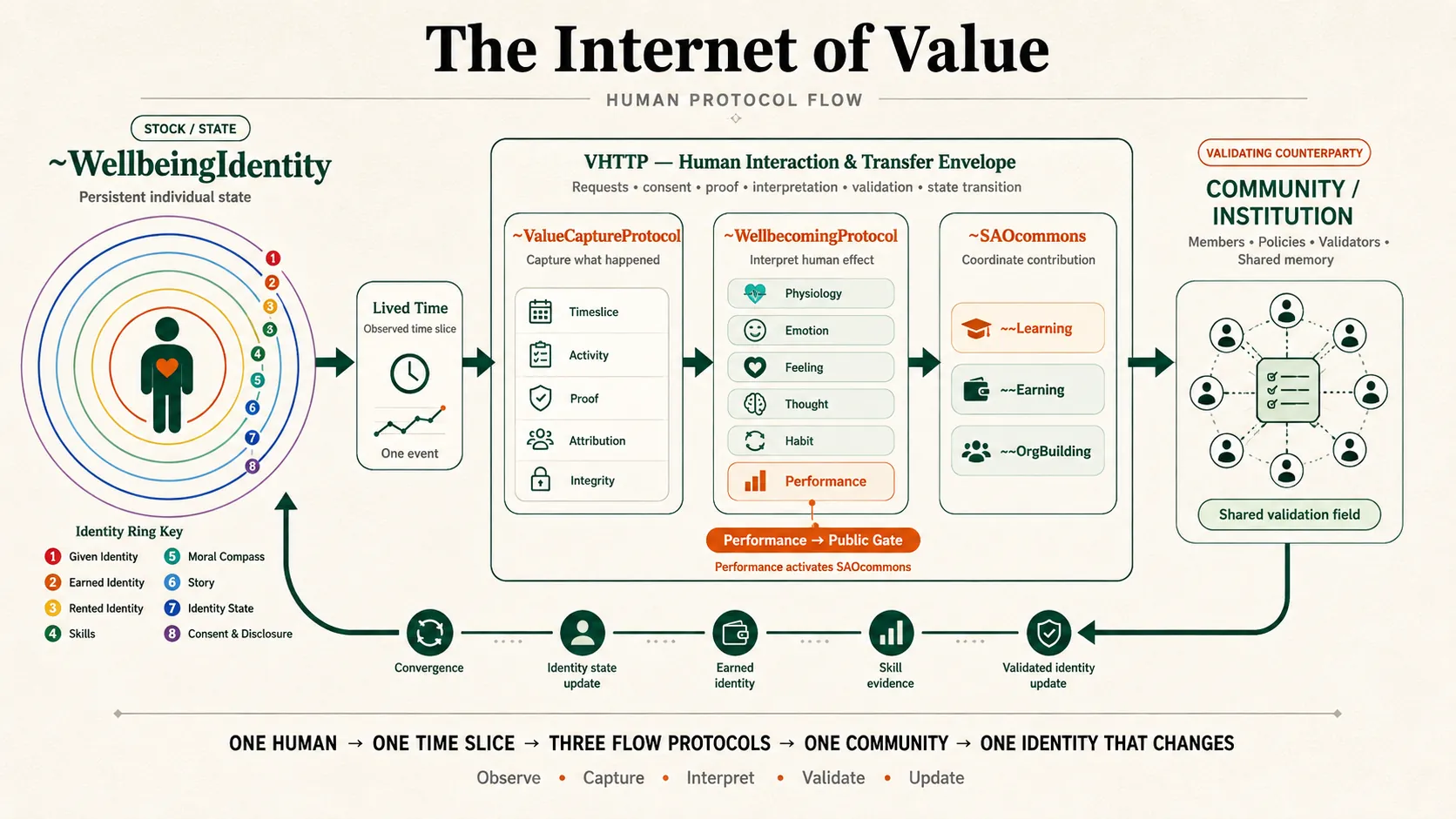
Below, “our calculation” means the named founder implementation and the selected historical event. It does not mean every community must use this rate, wellbeing policy or formula to issue credit. The registry and implementation limits are separate sources. [13] [14]
The actual contribution: Foundation research infrastructure
On 31 July 2026, 09:30–12:30 IST, I recorded work on the Foundation’s mathematics and Performance calculation infrastructure, including community skill-approval dependencies. The selected record routes it through Performance → OrgBuilding → Internet of Value Research Foundation, with native skill level SM3. The interval is 180 minutes = 3 hours. These are author-provided historical records, not an independently witnessed experiment. [7] [8]
non_payable. A valuation is not a payment instruction.These four statements are part of the already-published case limits. No new private journal, export or Identity facets are disclosed here. [7] [14]
The USD 750/hour policy is Moses-only, self-ratified, version 1.0.0. It was self-ratified at 12:34:42 IST and recorded at 14:38:30, after the session ended at 12:30; the reviews followed on 2 August. This evidence does not establish an advance agreement with an external buyer. Nor does that evidence gap prove no earlier agreement existed. [7] [8]
What would mutual-credit accounting require?
CES’s own example follows a service, an agreed amount, a trading record and matching entries. Applying that accounting rule to my session would require an actual participating receiver and an accepted exchange amount. Calling the Foundation a beneficiary does not establish that it holds an exchange account or accepted a debit. [5] [7]
| Needed for this proposed exchange | What the selected Foundation evidence establishes |
|---|---|
| Provider and receiver exchange accounts | Not supplied. Moses is the recorded contributor, not an established CES account holder. 7 |
| Unit of account U and applicable terms | Not supplied. USD is the founder valuation’s reference unit, not a proven CES unit. 4 8 |
| Agreed price x in U | Not supplied. Neither 3 hours nor USD 2,250 establishes an accepted exchange amount. 5 8 |
| Transaction authorization and acceptance | Not established. Founder recognition is not evidence that another account accepts a debit. 5 7 |
| Opening balances, limits and any levies | Not supplied. No closing balance or remaining spending capacity can be calculated. 4 |
| An actual trade recorded by CES | Not established by this case. Do not relabel the non-payable event as a CES transaction. 7 8 |
The paired-entry math
Let U denote one declared exchange unit and x an agreed amount in U. For a single authorized trade between two accounts in the same unit, excluding levies, conversions and other entries, CES’s rule can be written as follows. This is our algebraic explanation of the documented accounting operation, not an export from a CES account. [1] [3]
Δbreceiver = −x U
Σ Δb = (+x − x) U = 0 U
b′provider = bprovider + x U
b′receiver = breceiver − x U
The zero is the sum of the changes for those two entries. It does not mean the work has no value or that either person’s balance is zero. A closed ledger whose opening balances sum to zero retains that total under these paired entries; we have not been supplied those opening balances for this case. That conclusion is arithmetic under the stated assumptions. [3]
Where levies or inter-exchange entries apply, the account set and conversion rules must be included. The simple two-entry equation is not a complete posting specification for those cases. [4] [6]
For my actual contribution, x, U and both balances remain unknown. We cannot substitute USD 2,250 or USD 1,734.965302158000 for x without a separate accepted rule and transaction. Unknown is not a zero balance, and recognition is not authorization to debit someone. [7] [8] [5]
The policy calculation we can reproduce
The existing public calculation record provides the historical inputs and rounding version. It supports an arithmetic reproduction, not an independent valuation of my work. [8]
rate = 750 USD/hour
Wbefore = 771.095689848427 WellbeingScore units
Wafter = 771.095689848427 WellbeingScore units
Vcom_event = round12(3 × 750)
= 2250.000000000000 USD
q = round12(Wbefore / 1000)
= 0.771095689848 (dimensionless)
VCperformance_event = round12(q × Vcom_event)
= 1734.965302158000 USD
ΔW = Wafter − Wbefore = 0 WellbeingScore units
round12 means round-half-even to 12 decimal places after each governed step, as specified by founder-wellbeing-v0.1.1-fixed12. This article separately reproduces the displayed outputs from the published inputs. Extra decimal places show repeatable computation; they do not establish comparable measurement accuracy. [8]
Vcom is this event’s policy valuation, duration multiplied by the selected rate. VCperformance applies the historical pre-event wellbeing factor to that valuation. Both retain the implementation’s USD reference unit. Neither is an exchange balance, a verified market price, a debt or deserved pay; the event remains non-payable. [8] [14]
Does lower wellbeing reduce the value of the same work?
With a fixed positive Vcom, lowering Wbefore lowers the computed VCperformance. It leaves Vcom unchanged. The multiplier changes this particular wellbeing-weighted result; it does not change the recorded hours or prove lower work quality or lower human worth. This is the consequence of the formula, not a demonstrated empirical law about people. [8] [14]
The multiplier uses pre-event state, not the session’s depletion or restoration. The recorded no_transition decision and zero W movement do not prove the person felt no effect. Nor do they make the economic valuation zero. Converting this number into exchange rights would introduce another policy decision; the current case supplies none. [7] [8] [14]
My Wellbeing Identity is context, not collateral
View my actual public Wellbeing Identity →
This is the existing owner-approved public presentation, with its own current disclosure and review context. The historical Wbefore above comes from the selected event, not a number copied from the live page. We do not reproduce hidden facets or freeze today’s Identity as the input to July’s calculation. [16] [8]
An Identity reading is not evidence of a CES credit limit or permission to receive services. As an editorial recommendation, we would keep any future exchange-credit decision explicit and separately governed, rather than quietly making personal wellbeing a condition of access. No such bridge is claimed here. [12] [7]
What we can learn from CES
Make the obligation visible. A mutual-credit posting identifies both sides. Our case identifies a contributor and valuation but no exchange receiver accepting a debit. Our lesson is to show recognition, any claim, and any settlement as separate states. Do not imply that a larger valuation alone gives someone more capacity to receive. This recommendation follows from the comparison, not a claim of an implemented adapter. [5] [8]
Publish the rules that make a number usable. CES’s Charter names units, terms, credit/debit limits and dispute arrangements. Our recommendation for a future exchange experiment is to expose who can authorize a posting, which unit applies, who accepts it and how it can be challenged. A deterministic formula cannot decide those questions on its own. [4]
Keep wellbeing and access decisions distinguishable. This case makes two views inspectable: the source valuation and its wellbeing-weighted interpretation. That can prompt a useful discussion, but using the weighted result for spending would need explicit consent and policy, plus examination of fairness. We have not tested that outcome. [8] [14]
Retain the practical exchange layer. CES connects people’s offerings and needs; our selected record does not demonstrate that someone can obtain anything in return. The Internet of Value’s additional context should not be mistaken for solving that coordination problem. This is a limit of our example, not evidence that CES solves every unmet need. [2] [7]
Same contribution, different questions
| Question | CES mutual-credit mode | Selected founder account |
|---|---|---|
| What does the entry mean? | An agreed exchange amount with credit/debit postings. 1 | A captured contribution with policy valuation and separately computed VCperformance. 8 |
| Must every hour have the same price? | Not in the community-exchange mode; timebanks are a distinct option. 3 | This case uses a Moses-only USD 750/hour policy, not a universal rate. 8 |
| What balances the entry? | A corresponding debit for the simplified same-unit trade. 1 | No corresponding exchange debit is established; it is non-payable. 8 |
| Does it establish capacity to receive? | Within the exchange and its terms; acceptance, limits and offerings still matter. 2 4 | No spendable balance or accepted exchange right is established by this event. 7 |
| What does the wellbeing number do? | No equivalent W multiplier is specified in the cited paired-entry rule; that is not a claim about every CES community. 1 | Historical Wbefore scales VCperformance; Vcom remains separate. 8 |
| What can begin with one person? | An offering or account preparation is distinct from a trade. 2 | An observation can begin individually; the selected reviewed case does not prove an economy activates after one day. 9 7 |
Questions readers may ask
Is Vcom a mutual-credit balance?
No. In this selected record it is a non-payable policy valuation denominated in USD. A CES posting would need an accepted amount, exchange unit, accounts and authorization. Those inputs are not established here. [8] [4] [5]
Can I spend the USD 1,734.965302158000 VCperformance result?
This record establishes no such right. The displayed quantity is an implementation output, not a cash balance or a CES credit. No conversion rule or accepting exchange is supplied. [8] [14]
Must someone earn a positive balance before receiving?
Not as a universal arithmetic requirement: the paired-entry system allows a receiver’s balance to decrease. CES explicitly says someone can begin receiving without a starting balance. Particular trades still depend on the account position, limits and acceptance. “Capacity to receive” cannot be read solely from past contributions. [17] [4]
What happens when the first person completes a 24-hour log?
A completed observation can supply bounded activity records for subsequent interpretation. It does not by itself establish approved rates, a wellbeing state, another participant’s acceptance or spendable credit. This example is one historical three-hour session with later decisions—not a demonstrated first-day activation. Its useful result is the inspectable distinction between activity, policy valuation, wellbeing interpretation and exchange. [9] [10] [7] [8]
Could The Internet of Value and CES work together?
Possibly, but this page does not demonstrate an integration. Our proposed next experiment would require a consenting exchange, accepted unit and amount, explicit authorization, auditable paired entries and correction handling. We would keep the original valuation and personal context separate from the exchange posting. This is a research proposal, not a deployed feature or an interoperability result. [4] [9]
Sources, method and corrections
- CES: How it Works. Primary operational description: agreed provider/receiver postings, account positions and exchange modes. Promotional impact claims are not treated as measured outcomes here.
- CES: What is the CES?. Platform scope, offerings and exchange context. We do not treat the platform as synonymous with every form of mutual credit.
- CES: Exchange Types. Zero-sum accounting, units and variable-price community exchanges versus the equal-hour tendency in timebanks. Jurisdictional tax statements are outside this comparison.
- CES Charter. Unit selection, local terms, member and exchange limits, levies and dispute procedures. No particular exchange’s acceptance or current limits are inferred.
- CES: An Example of a Trade. Its own illustrative service, agreement, signed trading record and posting sequence. This is not a Foundation transaction.
- CES: Conversion Rates. Currency references versus convertibility and cross-exchange unit conversion. No conversion is calculated for our event.
- Already-published Foundation contribution and source notes. Selected 31 July 2026 session, narrative and review limits, policy timing and 7 November export cutoff. Underlying owner export remains private; the account is author-provided, not independent artifact verification.
- Public selected-event calculation record. Exact inputs, units, version, half-even intermediate rounding, outputs and source hashes. Separately reproduced for this article; arithmetic only.
- Value Capture: public protocol reference. Bounded activity, attribution, proof, routing and lineage.
- Wellbecoming: public protocol reference. Human context and conditional Performance routing.
- SAOcommons: public protocol reference. Community validation, valuation and institution layer. One non-payable case does not define every community’s arrangements.
- Wellbeing Identity: public protocol reference. Living state, consent and disclosure responsibilities.
- Canonical protocol registry. Version 0.7.0 when consulted 7 November 2026. The Foundation website explains the protocol; it is not protocol authority.
- Published founder implementation limits. Public method and claim boundaries, grounded in the protocol documents. A research relation is not a universal empirical law or a payment instruction.
- Human Protocol Flow. Approved explanatory illustration reused unchanged.
- Moses Sam Paul Johnraj’s public Wellbeing Identity. Actual existing consent-controlled public context; not July’s historical input.
- CES: Questions & Answers. Beginning without a starting balance and practical limits of available offerings. Broad promotional claims about fairness, inflation, fraud or environmental effects are not adopted as established outcomes.
Sources consulted 7 November 2026. The paired-entry equations are our conditional mathematical explanation of the cited CES rule. The founder arithmetic is a separate Decimal reproduction of already-public inputs. No CES account, accepted price, opening balance, trade, conversion, payout or independent validation is invented. Recommendations and a possible future bridge are editorial proposals. Send factual or interpretive corrections through the link below.