
The Internet of Value
A score is not a year
By Moses Sam Paul 2026-11-07
What does a wellbeing number measure—and what would make it evidence of benefit? WELLBY, wellbeing indices and The Internet of Value, through one real Foundation contribution.
Quick answer
A wellbeing score, a composite index and a WELLBY impact result are different kinds of number. A WELLBY combines life-satisfaction change with people and time. The selected founder implementation of The Internet of Value instead applies a historical wellbeing factor to a contribution’s policy valuation. One cannot be converted into the other merely by rescaling a number. [2] [5] [8]
The real Foundation contribution below is already disclosed. Its founder calculation is reproducible. Its WELLBY impact and any composite-index result remain unresolved; no survey response, beneficiary count, causal effect or duration is invented. [7] [8]
What are WELLBY and wellbeing indices?
They are measurement and appraisal approaches, not one interchangeable economic model. This page separates three examples: subjective survey measures, a composite country index and WELLBY impact accounting. It does not review every wellbeing framework. [2] [3] [5]
A survey response: how someone evaluates their life
The UK Office for National Statistics measures life satisfaction, feeling that life is worthwhile, happiness and anxiety with separate questions. Its life-satisfaction question begins: Overall, how satisfied are you with your life nowadays
, followed by a 0–10 response scale. A response to that question is not the same as a calculated contribution value. [3]
The OECD’s 2025 subjective-wellbeing guidelines distinguish life evaluation, affect and eudaimonia—roughly, reflective judgments about life, emotional experience, and meaning or purpose. Measuring one does not automatically measure the others. [4]
A composite index: several indicators, declared choices
The OECD Better Life Index is a concrete example. It combines normalized indicators into dimensions and lets users weight those dimensions to compare countries. Its method was updated in 2025. This is a comparative composite, not an individual life-satisfaction response or a record of benefit caused by one activity. [5]
A WELLBY: life-satisfaction change over time
HM Treasury’s wellbeing appraisal guidance defines a WELLBY using one point of life satisfaction on a 0–10 scale for one person for one year. In impact analysis, the question is how much life satisfaction changes because of an intervention, for whom and for how long. A high score alone does not answer that question. [2]
The guidance also discusses using wellbeing evidence in policy design, monitoring and evaluation, and sometimes monetary appraisal where evidence permits. That does not supply a universal exchange rate for any wellbeing number. We do not apply a UK monetary value to this Foundation case. [1]
Read the WELLBY appraisal guidance →Explore the ONS measures →Explore OECD’s wellbeing data and index method →
What does The Internet of Value do?
The Internet of Value connects bounded activity, private human context, applicable community validation and a consent-governed Wellbeing Identity. The four protocols distinguish those responsibilities; a recorded activity does not automatically establish a causal wellbeing benefit. [9] [10] [11] [12]
- Capture:
~ValueCaptureProtocolrecords time, attribution, evidence and lineage. [9] - Interpret:
~WellbecomingProtocolsupplies private human context and routes eligible Performance contributions toward community validation. [10] - Validate:
~SAOcommonssupplies the community institution layer when applicable, including recognition and valuation. [11] - Reflect:
~WellbeingIdentitycarries a living, selectively disclosed state—not merely a public score. [12]
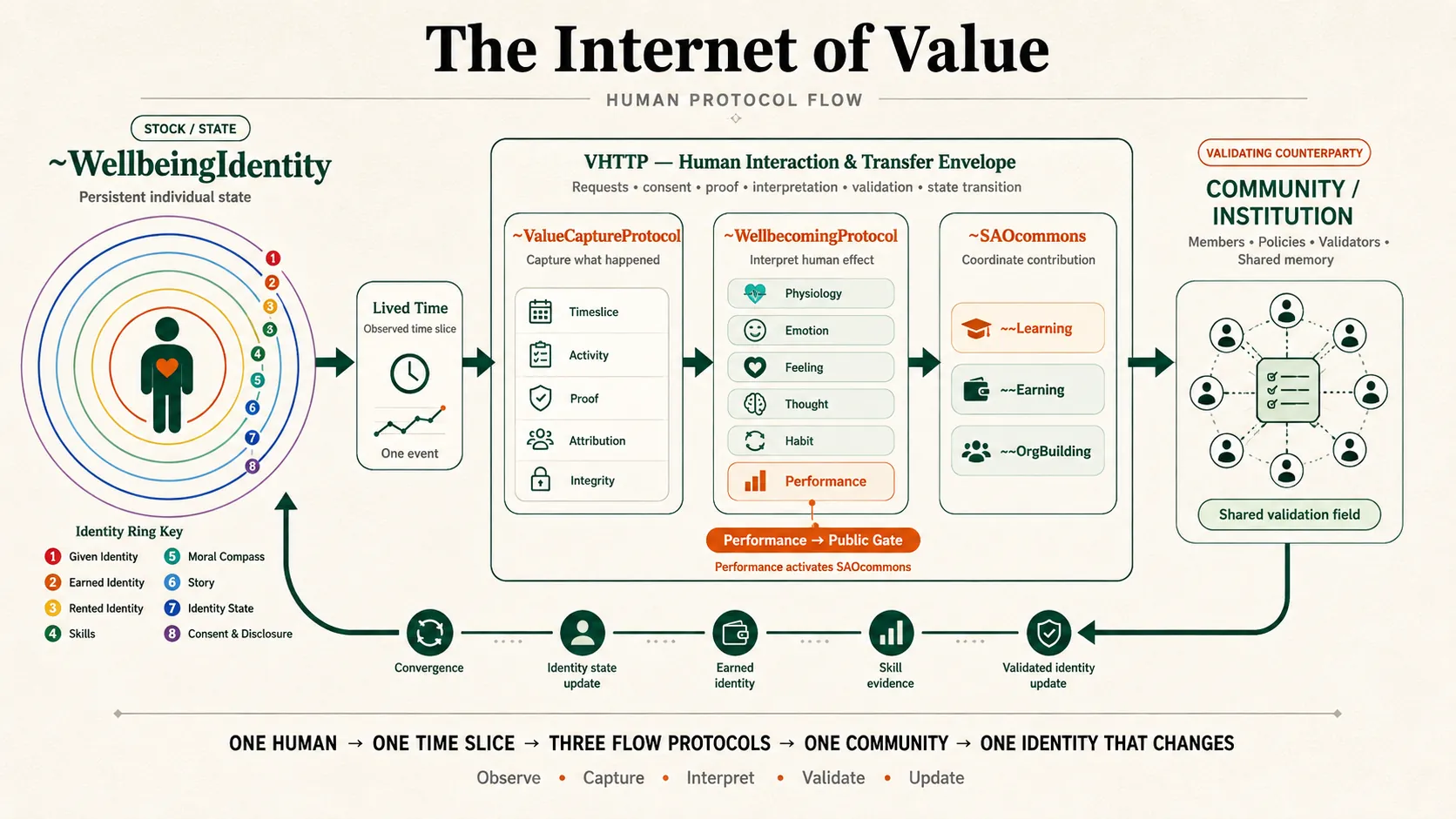
Below, W, Vcom and VCperformance refer to one named founder implementation and historical event. They do not define a universal survey scale, a national index or a rule that every community must adopt. [13] [14]
The real Foundation contribution
On 31 July 2026, 09:30–12:30 IST, I recorded Foundation mathematics and Performance calculation infrastructure work, including community skill-approval dependencies. The event routes through Performance → OrgBuilding → Internet of Value Research Foundation, with native skill level SM3. Its duration is 180 minutes = 3 hours. This is the previously disclosed author-provided account, not a new intervention study. [7] [8]
The description mentions deployment/testing, but the selected proof field has no linked artifact. Reviews are founder self-review, not independent assessment. Neither work quality nor benefit to another person is established by an arithmetic reproduction. [7]
The reference rate is USD 750/hour, Moses-only, self-ratified policy 1.0.0. Self-ratification occurred at 12:34:42 IST and recording at 14:38:30, after the session ended at 12:30; reviews followed on 2 August. The selected evidence does not establish advance buyer agreement, and that gap does not prove no earlier agreement existed. The event is non_payable. [7] [8]
The public calculation artifact lets a reader inspect the disclosed inputs and reproduce the result. It does not contain an ONS life-satisfaction response, a beneficiary survey or a causal effect estimate for this session. [8]
The calculation we can actually reproduce
The selected version is founder-wellbeing-v0.1.1-fixed12. round12 means half-even rounding to 12 decimal places after each governed step. We independently reproduce this selected event’s arithmetic; additional decimal places do not establish measurement accuracy or empirical model validity. [8]
rate = 750 USD/hour
Wbefore = Wafter = 771.095689848427 WellbeingScore units
Vcom_event = round12(3 × 750)
= 2250.000000000000 USD
q = round12(Wbefore / 1000)
= 0.771095689848 (dimensionless)
VCperformance_event = round12(q × Vcom_event)
= 1734.965302158000 USD
ΔW = Wafter − Wbefore = 0 WellbeingScore units
Vcom is the duration-expanded policy valuation. VCperformance applies a pre-event wellbeing multiplier and retains this implementation’s USD reference unit. It is not a WELLBY, a payment, a market price or a measure of someone’s worth. The recorded no_transition and zero W movement do not prove the session had no subjective effect. [8] [14]
Why the W multiplier is a different operation
With a fixed positive Vcom, a lower Wbefore lowers VCperformance while leaving Vcom unchanged. That is a property of the implemented formula. It is not evidence that the same work has lower quality, deserves less pay or produces less life-satisfaction benefit. [8] [14]
The question answered is about a contribution valuation interpreted through a pre-event state. The WELLBY impact calculation below asks about a difference in life satisfaction over time. Its basic unit count does not add a multiplier for the initial score when effect, population and duration are held fixed. Baseline conditions may still matter when estimating the actual effect; they are not supplied here. This is a comparison of the displayed mathematics, not a universal claim about every appraisal model. [2] [8]
What a WELLBY calculation would need
For an unadjusted, undiscounted impact illustration, let Lwith,p(t) and Lwithout,p(t) denote a person’s life satisfaction with and without the intervention at time t. “Without” is a counterfactual, not simply the person’s earlier score. In our explanatory notation: [2]
Y = Σp ∫ ΔLp(t) dt
t is measured in years
For the special case of the same constant effect d
for N people over y years:
Y = N × d × y WELLBYs
This is our algebraic expression of the point-person-year unit, not a complete Treasury appraisal procedure. It assumes comparable life-satisfaction differences and additive aggregation across the specified people and periods. Effect identification, uncertainty, adaptation, spillovers, distribution and any discounting or monetary treatment need explicit handling. A before/after difference alone does not establish causation. [2] [4]
| Required input | What the Foundation case supplies |
|---|---|
| A defined affected population | One contributor is named. The beneficiaries and their outcome population are not established. 7 |
| Life-satisfaction observations | Historical W is supplied; an observed life-satisfaction response is not. 8 |
| A credible “without the work” comparison | No intervention counterfactual is supplied. 7 |
| An attributable effect d or a time path ΔL(t) | Not established. Zero ΔW cannot substitute for zero ΔL. 8 |
| Duration of the effect y | Not supplied. Three work hours are not evidence of how long a benefit lasts. 7 |
| A resulting WELLBY impact Y | Unresolved, not zero. Neither the inputs nor an approved conversion are supplied. 7 8 |
Wbefore is not a life-satisfaction survey response, and ΔW = 0 is not Y = 0. No rule in the disclosed case establishes L = W/100. A numerical rescaling would change the display, not establish equivalence between constructs or create missing causal evidence. This follows from the distinct inputs and operations above. [8] [3] [4]
Even if we restricted the question to my own wellbeing, we would still need an appropriate measure, time path and comparison. We cannot declare the research beneficial or ineffective from the selected account alone. [7] [8]
A composite index performs another calculation
The current OECD Better Life Index method normalizes indicators, averages normalized indicators within dimensions, and assigns weights to dimensions. In compact notation, for a positive indicator x with a chosen reference range a to b, and user importance scores sⱼ: [5]
For a negative indicator: znegative = 1 − z
Dj = mean of normalized indicators in dimension j
ωj = sj / Σksk
I = Σj ωjDj
I is our normalized representation of the documented aggregation, not a displayed OECD country score or a reimplementation of the live tool. The algebra requires b > a and a positive sum of importance scores. Our case supplies no country indicator dataset, reference ranges or selected dimension weights, so we calculate no Better Life Index for me or the Foundation. [5] [7]
A dimensionless index and the dimensionless q above can share a numerical range while measuring different things. The normalization does not establish a common construct, population or purpose. That is a mathematical and measurement distinction—not an argument against using composites. [4] [5] [8]
My Wellbeing Identity is context, not a survey result
View my actual public Wellbeing Identity →
The existing public presentation has its own current disclosure and review context. The historical Wbefore comes from the July event; it is not copied from today’s page. We disclose no hidden facets and do not substitute a live Identity reading for a survey answer, national index or counterfactual outcome. [16] [8] [12]
What we can learn from these approaches
Name the construct before comparing numbers. ONS and OECD distinguish questions about different aspects of life. Our recommendation is to state what W, q, Vcom and VCperformance mean beside their values, including whose policy governs them. A shared word such as “wellbeing” is not a calibration study. [3] [4] [8]
Separate state, change and attributable impact. The founder record shows historical states and a model decision; a WELLBY impact study would need evidence about the difference caused by the work over time. We should not let precise arithmetic stand in for that missing evidence. This is a methodological lesson, not a claim that adding a questionnaire alone solves causality. [2] [14]
Expose aggregation choices. The Better Life Index makes normalization and weighting visible. We can learn from that transparency while keeping its country comparison separate from an individual protocol record. Any future aggregate of IoV states or events would need its own declared population, units, treatment of missing values and justification. No such aggregate is produced here. [5] [8]
Study a real outcome separately from the work log. A stronger next Foundation case would define a delivered output, an affected population, a suitable measure and follow-up, and an appropriate comparison. The existing missing proof link and founder self-review should remain visible. We do not yet know whether this specific session produced a measurable wellbeing effect. [2] [7]
Same word, different quantities
| Quantity | What it describes here | What it does not establish |
|---|---|---|
| ONS life-satisfaction response | A person’s evaluation using the stated survey question and scale. 3 | A contribution price or an effect caused by this session. |
| Better Life Index | A country comparison under declared indicators, normalization and weights. 5 | A personal historical W or an event-level causal benefit. |
| WELLBY impact Y | Life-satisfaction difference across specified people and time, under stated assumptions. 2 | A result available from the hours worked alone. |
| Historical W and ΔW | State inputs and recorded movement in the selected founder branch. 8 | A life-satisfaction survey result or proof of no subjective effect. |
| Vcom and VCperformance | Distinct USD-reference policy calculations for the event. 8 | A payment, a WELLBY or a validated monetary value of life-satisfaction benefit. |
Questions readers may ask
Can W be converted directly into WELLBYs?
Not from this case. We would need evidence linking the constructs and the appropriate life-satisfaction effect, population and duration. Dividing or multiplying the existing W cannot supply those missing facts. [8] [2]
Does the recorded zero ΔW mean the contribution created zero wellbeing benefit?
No. It is the recorded result of the founder branch’s state transition decision. It does not measure a causal life-satisfaction effect for beneficiaries or prove that I experienced no effect. The WELLBY result remains unresolved. [7] [8]
Does lower wellbeing mean the same contribution has lower value?
The formula lowers VCperformance when Wbefore is lower and Vcom is fixed and positive. It leaves Vcom unchanged. That operation does not establish lower work quality, deserved pay, human worth or smaller WELLBY benefit. Those are different claims requiring different evidence. [8] [14]
Are WELLBYs money?
The unit concerns life-satisfaction change and time. Some appraisal frameworks apply a separately justified monetary valuation. Neither the unit’s definition nor this session’s USD rate supplies a universal currency conversion. [1] [2] [8]
Does a first 24-hour log establish wellbeing impact?
It can supply bounded observations for interpretation, but it does not by itself establish a counterfactual, an approved rate or a lasting wellbeing effect. This actual case is a three-hour historical session with later decisions, not a first-day impact trial or proof of methodological uniqueness. [9] [7]
Sources, method and corrections
- HM Treasury: Green Book supplementary guidance, wellbeing. Guidance published 26 July 2021; landing page updated 18 November 2022. Scope of policy, monitoring/evaluation and evidence-dependent monetization. No UK monetary value applied to the Foundation case.
- Wellbeing Guidance for Appraisal: Supplementary Green Book Guidance. WELLBY definition in Annex A2; impact-evaluation discussion includes counterfactuals and follow-up. Our displayed integral/constant-effect equations are explanatory, unadjusted and undiscounted, not a full appraisal procedure.
- ONS: Personal well-being user guidance. Distinct questions, wording, response scales and measurement context. Only the opening of the life-satisfaction question is quoted. No UK survey statistic or response for Moses is fabricated.
- OECD Guidelines on Measuring Subjective Well-being, 2025 Update. Life evaluation, affect and eudaimonia are distinct components. Used for measurement scope, not proof of validity of the founder implementation.
- OECD Well-being Data Monitor: Better Life Index methodology. Current documentation of the 2025 update, normalization, dimension aggregation and user weighting. Equations summarize those operations; no new country dataset or personal index is constructed.
- OECD: Better Life Index tool. Actual interactive country-comparison tool, offered for exploration. We make no country ranking or tool-result claim.
- Already-published Foundation contribution and source notes. Selected 31 July 2026 session, policy timing, founder review, absent proof link and 7 November export cutoff. Author-provided; underlying export remains private.
- Public selected-event calculation artifact. Exact historical inputs, fixed12 method, outputs and source hashes. Supports arithmetic reproduction, not independent work, population comparability or empirical construct validation.
- Value Capture: public protocol reference. Bounded activity, attribution, proof and lineage.
- Wellbecoming: public protocol reference. Human context and conditional Performance routing.
- SAOcommons: public protocol reference. Community validation, valuation and institutional responsibilities.
- Wellbeing Identity: public protocol reference. Living state, consent and disclosure responsibilities.
- Protocol registry. Version 0.7.0 when consulted 7 November 2026. Protocol authority; the Foundation website is explanatory.
- Published founder implementation limits. Public method and claim boundaries grounded in the protocol documents. A typed research relation is not a universal empirical law, payment instruction or wellbeing-impact estimate.
- Human Protocol Flow. Existing approved explanatory illustration reused unchanged.
- Moses Sam Paul Johnraj’s public Wellbeing Identity. Actual consent-controlled context; not a substitute for historical inputs or a life-satisfaction survey.
Sources consulted 7 November 2026. This page compares distinct measures and purposes; it does not establish a universal wellbeing currency, a W-to-life-satisfaction calibration or a causal outcome from Foundation work. The founder arithmetic is separately reproduced. WELLBY and composite-index inputs remain unresolved. No new private records or hidden Identity facets are disclosed. Factual and interpretive corrections are welcome through the link below.
Continue exploring
- Economic model comparisons
- The same session and time banking
- The same session and Sensorica
- The same session and SourceCred
- The same session and Valueflows / REA
- When a number becomes a claim: mutual credit / CES
- Leave the return open: Sacred Economics
- What the ledger leaves out: Doughnut Economics
- Send a correction