
The Internet of Value
Before we price the work
By Moses Sam Paul 2026-11-07
Valueflows / REA and The Internet of Value, through one actual Foundation contribution. What happened, what was valued—and what remains unproven?
Quick answer
Valueflows, grounded in REA, helps us describe economic activity in a shared language. The selected founder implementation of The Internet of Value adds named community decisions and separately interprets contribution valuation and wellbeing. A common event description can support different accounts; it does not, by itself, establish a common price, approval or payment. [1] [8] [14]
Published 7 November 2026. This page follows the same real Foundation session as the earlier comparisons. The Valueflows mapping below is an editorial proposal for discussion, not an executed import, a standards-conformance result or a working integration. [13]
What are Valueflows and REA?
REA means Resources, Events and Agents. It provides an ontology for describing economic activity. Valueflows builds on that foundation for coordination across people, organizations and networks. It describes a vocabulary; it does not prescribe the technical protocol used to transport the data. [1] [2]
Think of the distinction this way: a person does work, a process uses inputs, an output may be created, and resources may move between agents. Naming those relationships consistently helps different participants discuss the same activity. Valueflows extends the picture beyond a single enterprise, and money is not assumed in every reciprocal arrangement. [1] [6]
Agent
Who participates? People, organizations and other agents have roles in flows. [6]
Event
What actually happened? An observed flow is different from a future intent or commitment. [3]
Resource
What is involved? A kind of work, a digital document and an inventoried object need not be represented in the same way. [7]
This is not “a vocabulary instead of mathematics.” Valueflows documentation also discusses value rollups and income-distribution equations. The useful comparison is what each operation means, which evidence it needs and who supplies its policy. [9] [10]
Explore Valueflows →Read its REA background →Inspect the vocabulary →
What does The Internet of Value do?
The Internet of Value is a four-protocol system for representing activity, interpreting its human context, routing eligible contributions through communities and carrying validated state into a living Wellbeing Identity. The shared vocabulary separates these responsibilities. It does not make every observation public or automatically turn every hour into a payment. [15] [16] [17] [18]
- Capture:
~ValueCaptureProtocolrecords bounded activity, attribution, evidence and event lineage. [15] - Interpret:
~WellbecomingProtocoldescribes Physiology, Emotion, Feeling, Thought, Habit and Performance context. [16] - Recognize: the conditional Performance route can activate
~SAOcommonscommunity validation through Learning, Earning or OrgBuilding. [17] - Carry state:
~WellbeingIdentityreceives eligible validated flows; its disclosure is governed separately. [18]
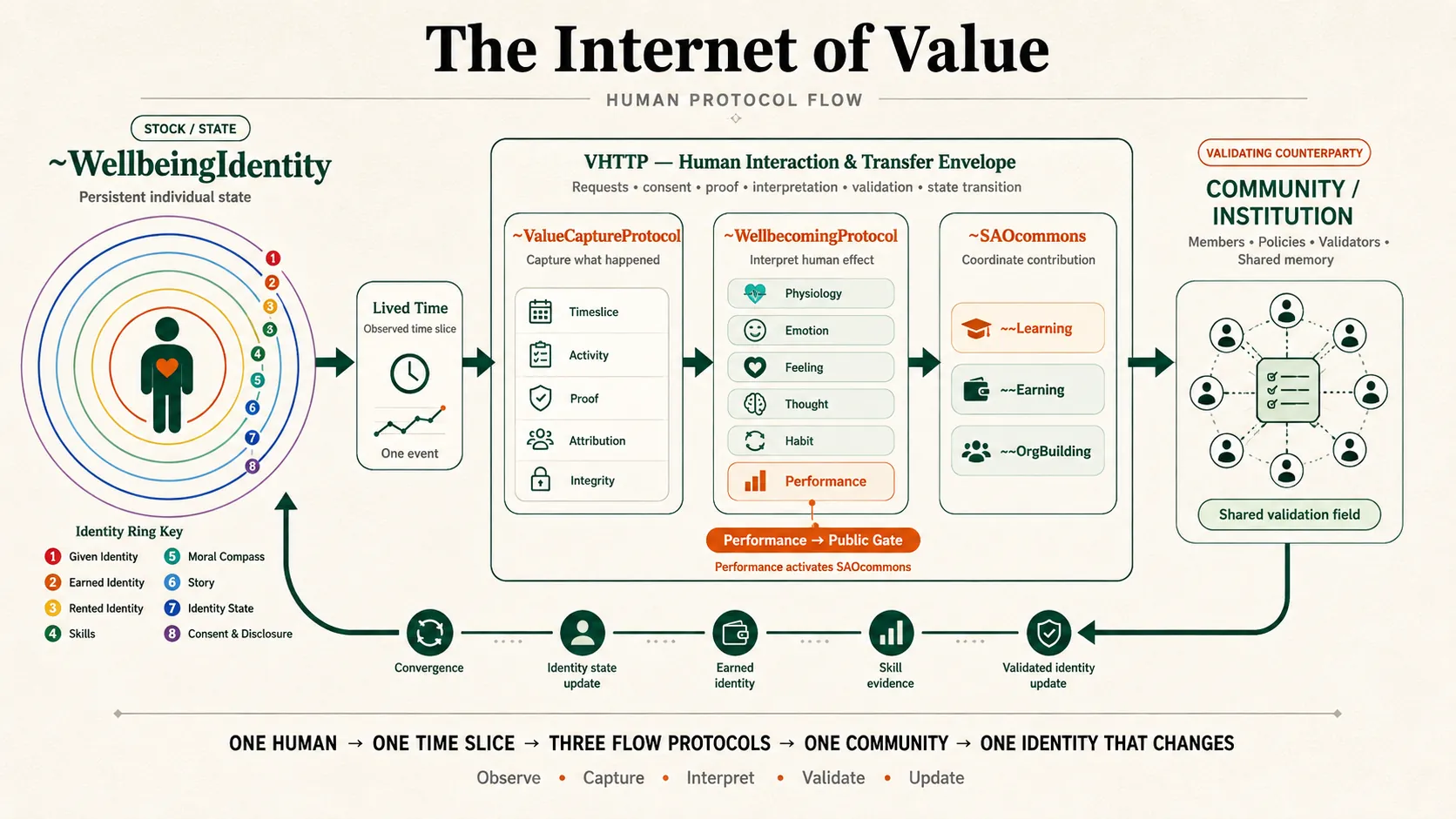
The rest of this article narrows from that system architecture to one real founder-policy event. Its rate, wellbeing policy and review authority are specific to this case. The wider SAOcommons interface includes distribution-rule vocabulary; the non-payable event below does not establish that the whole system is incapable of distributing benefits. [13] [14] [17]
Both approaches take the recorded event seriously. The pages that follow distinguish a shared economic description from the source community’s policy and from a consent-governed human state. Those layers may be useful together, but this article does not demonstrate that they are already connected. [15] [17] [18] [1]
The event we can actually inspect
31 July 2026 · 09:30–12:30 IST. I recorded three hours of Foundation work on The Internet of Value’s mathematics and Performance calculations, including community skill-approval dependencies. Deployment and testing are mentioned in the description. The stored route is Performance → OrgBuilding → Internet of Value Research Foundation, native level SM3. [13]
The record is author-provided, not independently verified. It contains no linked proof artifact, and the two community-role decisions are founder self-reviews. The session description therefore does not establish a particular produced software artifact, its quantity, its ownership or a later dependent contribution. We preserve those unknowns. [13] [14]
These are the already-disclosed case facts. No new private event or Identity component is exposed here. [13]
Translate the description before importing the valuation
The table is a candidate semantic mapping of this selected record. It uses Valueflows terms to ask what a receiving implementation would need. A field match is not evidence that the Foundation has created a Valueflows agent, process or resource. No identifiers are fabricated to make the mapping look complete. [5] [13]
| Valueflows concept | This case supplies | Mapping status |
|---|---|---|
| EconomicEvent | Past recorded Foundation activity. [13] | Candidate representation of an observation, not proof of an imported event. [3] |
| action: work | Labor on mathematics and calculation infrastructure. | Our proposed action classification; it does not assert a produce event. [4] [13] |
| provider | Moses Sam Paul Johnraj is the recorded actor. | Candidate agent mapping; no registered Valueflows identity is claimed. [5] [13] |
| receiver / inScopeOf | Foundation association is recorded. | Candidate roles require an explicit mapping decision; association alone does not resolve every receiver or governance role. [5] [13] |
| hasBeginning / hasEnd | 31 July 2026, 09:30–12:30 IST. | Known source interval, with timezone retained. [5] [13] |
| effortQuantity | 180 minutes = 3 hours. | Our proposed work-effort measure, preserving the unit. [5] [13] |
| resourceConformsTo / inputOf | The description suggests a work type and development context. | A shared ResourceSpecification and actual Process reference remain to be defined and reviewed. [5] [6] |
| Produced resource / output event | No linked artifact or independently established output quantity. | Unresolved. Do not invent one document, one deployment or one transferable asset. [7] [13] |
| Commitment / reciprocal Claim | No such agreement or claim established by the selected public case. | Do not generate a debt from the contribution valuation. [3] [14] |
Valueflows’ work action generally involves a provider and a type of work rather than an inventoried resource. A ResourceSpecification can describe the work type. That does not make the person an inventory item, or convert their three hours into three units of finished software. [4] [7]
Moses · Foundation · 3 hours
Development context needs an explicit Process reference.
No linked artifact or output quantity supplied.
The dashed boxes are unresolved evidence or mapping steps. This is an explanatory case map, not a Valueflows graph export. [13]
The first arithmetic is about meaning, not price
1. Preserve the time unit
180 minutes ÷ 60 minutes/hour = 3 hours
The timestamps and duration are from the actual session. Mapping that duration to work effort is our proposed interpretation using effortQuantity; Valueflows defines this as an amount with a unit. Neither the conversion nor the field name establishes the quality or market price of the work. [13] [5]
2. Two views are not two contributions
Valueflows distinguishes a collaboration-space account from individual agents’ views. To show why that matters, let E mean this one selected session—not a new minted identifier. For this illustration, both a person view and a Foundation view refer to E. [8] [13]
Foundation view = {E}
Work hours in their union = 3 hours
Adding the two view totals would give 6 hours
That would count the same session twice.
This is our set-and-unit illustration of the documented view distinction, not a mandated Valueflows query or an implemented deduplication adapter. It assumes both records have been established as representations of the same occurrence. A real bridge must preserve source lineage and handle corrections; matching a title or timestamp alone would not establish identity. [8] [15]
3. A rollup needs a declared unit and complete scope
The Value Rollup documentation requires input values to be expressed in a common unit. In our notation, a simplified sum would be R = Σj vj for the selected, eligible inputs after any required conversion into that unit. This is explanatory algebra, not a universal formula for all allocation rules. [9]
For this case, we cannot compute the value of a finished output or a full process rollup: the output, other inputs, applicable conversions and allocation rule are not supplied. Missing inputs are not zero. The source-policy number below could only enter another account under an explicit decision to accept its unit, rule and scope. [9] [13] [14]
Three hours, USD 2,250, W 771.095689848427 and ΔW 0 are different typed quantities. They cannot be added into one total. The numeric wellbeing state belongs to the historical event; it is not a currency or another hour measure. This is dimensional analysis of the displayed quantities. [14]
The policy calculation we can reproduce
The selected exported event supplies all the inputs needed for its founder-policy calculation. The declared rate is Moses-only and self-ratified; it is a policy reference, not evidence of an external buyer or a wage. The exact historical wellbeing input belongs to that event’s replay, not the latest public profile reading. [13] [14]
Vcom = USD 2,250
q = round12(771.095689848427 / 1000)
q = 0.771095689848
VCperformance = round12(q × 2250.000000000000)
VCperformance = USD 1,734.965302158000
Wafter = Wbefore = 771.095689848427
ΔW = 0
round12 means round-half-even to twelve decimal places after each governed step in founder-wellbeing-v0.1.1-fixed12. Rounding the multiplier before multiplying reproduces the stored result. The separate Decimal check establishes this selected event’s arithmetic, not twelve-decimal measurement accuracy, work quality, economic value or model validity. [14]
Nothing here is a Valueflows distribution or an IoV payment. The source event is non_payable. Vcom is a contribution valuation in the declared unit; VCperformance is a separate wellbeing-weighted reference output. Neither establishes a benefit-pool fraction, money received or a claim against a buyer. [13] [14]
With fixed positive Vcom, lower Wbefore lowers VCperformance while leaving Vcom unchanged. That is a property of this formula, not evidence that someone did worse work or deserves less pay. Wbefore is a pre-event state; it does not by itself measure the cost or restoration caused by the work. Here the recorded impact decision is no_transition and ΔW = 0. [14] [20]
The distinction is therefore not “Valueflows has no valuation math.” Its value-equation discussion explicitly describes income distribution based on contributions. Our selected founder record instead gives a reproducible event valuation and separate wellbeing outputs. We have no executed Valueflows distribution, sale or settlement for this session. [10] [14]
My Wellbeing Identity stays a human context
Explore my actual public Wellbeing Identity →
This is the existing owner-controlled public view, not a duplicate of private facets. Its current reading is not used as the July input. The protocol describes a living state with governed disclosure; it is not a universal reputation rank or an invoice balance. [18] [14] [20]
In a proposed Valueflows bridge, keep that context in its own typed, consent-governed envelope. Do not silently put W into effortQuantity, a produced-resource quantity or an amount of money. This is our interoperability recommendation; no extension vocabulary or functioning bridge is delivered by this comparison. [18] [5]
What we can learn from Valueflows / REA
1. Keep what happened distinct from what was agreed
Valueflows has different terms for potential, promised, observed and reciprocal flows. That is a useful challenge to a single label such as “validated contribution.” In our actual case, the source rate was self-ratified at 12:34:42 IST, after the session ended at12:30, and recorded at 14:38:30; the founder review decisions were dated2 August. These timestamps do not establish advance agreement, and do not prove that no earlier agreement existed. [3] [13]
Our proposal: show the observation time, policy effective scope, ratification, review and any reciprocal obligation separately. An event valuation should not be displayed as a promise to pay without the agreement that creates that promise.
2. Ask what resource the work actually changed
A useful trace follows an artifact through processes and inputs. Our selected event lacks the proof link needed to identify that artifact. The next evidence to seek is a specific calculation change or test result and its connection to this session—not a generic icon labelled “output.” [11] [12] [13]
Our proposal: attach an identified artifact and review its relationship to the event when the evidence exists. Until then, preserve the gap. A more elaborate diagram would not make the proof stronger.
3. Reuse observations without merging authorities
The independent-view idea shows how shared economic data can support different participants’ accounts. For us, it suggests a bridge that reuses bounded event facts while preserving the source community’s valuation authority and the separate wellbeing issuer’s decision. A common field does not ratify a policy or authorize disclosure. [8] [15] [17] [18]
Applied here: the Foundation’s declared rate remains Moses-only and self-ratified. A receiving community could understand the interval and still decline the rate or require different proof. That possibility is our interpretation of the distinction between shared description and local governance. [13] [14]
4. Make corrections visible in time
Valueflows’ accounting guidance describes correction events and distinguishes occurrence time from record creation time. That is a helpful design lesson for retrospective logs and replay. For this case, a later source correction should preserve its provenance; a new calculation should identify the changed input instead of appearing to be a timeless fact. The last sentence is our recommendation, not an implemented adapter. [8] [14]
5. Treat formulas as declared operations
Rollup, distribution, contribution valuation and wellbeing interpretation each need their own rule, unit and scope. The exact founder decimals let us audit an operation; they do not make its policy universal. This is the comparison’s synthesis, not evidence that either system produces fairer outcomes. [9] [10] [14] [20]
The comparison at a glance
| Question | Valueflows / REA framing | Selected IoV founder case |
|---|---|---|
| Main object of this comparison | Shared descriptions of agents, events, resources and their relationships. [1] [2] | One actual activity, source-policy valuation and separate wellbeing decision. [13] [14] |
| Is mathematics absent? | No. Rollup and value-equation documentation exist. [9] [10] | No. The selected fixed12 calculation is reproduced below its actual policy. [14] |
| What can we show for this session? | A candidate semantic mapping and unit/view calculations; no executed import. | Exact historical inputs and stored outputs, with their review limits. [14] |
| What is unresolved? | Reviewed identities/type/process references, output evidence and any accepted valuation/distribution bridge. | Independent proof of the work, external market value and empirical model validity. [13] [14] |
| Does the record establish payment? | No reciprocal claim or settlement is established for this event. | No. It is non_payable. [14] |
Common questions
Is Valueflows a currency or one economic doctrine?
It describes itself as a vocabulary for distributed economic networks, including conventional and experimental arrangements. Its scope is broader than one currency or one contribution-pricing rule. [1]
Does a Valueflows event need a dollar value?
The documented work-effort measure can carry an amount and time unit. The vocabulary’s existence does not set a dollar rate. A particular rollup or distribution adds its own unit and policy requirements. [5] [9] [10]
Does this page prove IoV interoperability with Valueflows?
No. It supplies a candidate field map and identifies missing decisions. A genuine integration would need stable identities, shared classifications, reviewed role/process mapping, authorization, correction rules and conformance tests. Those are proposed acceptance criteria, not implemented features.
Is a common mathematical language unique to The Internet of Value?
No exclusive claim follows. REA and Valueflows already provide shared economic semantics, and Valueflows documents mathematical operations. The defensible question here is how to preserve event facts, distinct authorities and the meaning of each output. [1] [2] [9] [10] [14]
Does lower W mean the contribution deserves less pay?
For this positive Vcom, lower Wbefore would lower VCperformance and leave Vcom unchanged. That is the displayed founder formula, not a wage rule or proof of lower human worth. The actual event is non-payable and has zero recorded W movement. [14] [20]
A positioning statement this case supports
Describe the work clearly enough that others can understand it. Keep the rules for valuing it—and the person living through it—explicit. Valueflows helps us ask what an event means across accounts; this founder implementation of The Internet of Value makes its contribution valuation and wellbeing interpretation separately inspectable.
Our synthesis of the reviewed sources and selected case, not a quote from Valueflows, proof of a shipped integration or a superiority claim. [1] [8] [14]
Sources and method
- Valueflows — home and abstract. Primary description of scope, REA basis, software interoperability and the distinction between vocabulary and technical protocol.
- REA & Other References. Valueflows’ non-normative REA background and links to the original research. This page does not treat all classic REA axioms as identical to every Valueflows implementation.
- Flows. Intents, Commitments, observed EconomicEvents and reciprocal Claims. Distinguishes what happened from what is planned or owed.
- Actions. Definitions of work, produce, use and cite. Work is labor applied to a process, generally without an identified inventoried resource.
- Valueflows formatted ontology. Displayed version 0.11 when consulted 7 November2026. Field semantics used in the proposed mapping: EconomicEvent, action, provider, receiver, effortQuantity, inputOf, resourceConformsTo, hasBeginning and hasEnd. Documentation inspection is not a validated export or adapter.
- Diagram Explanations. Non-normative explanation of Agent, ResourceSpecification, EconomicResource, Process, observation flows and measures.
- Economic Resources. Resource versus event quantity; inventory may be inapplicable to work; event/resource distinction and resource identity.
- Accounting. Independent collaboration-space view versus agent-specific views; corrections and creation timestamps. Describes a model, not independently proven accuracy of every implementation.
- Value Rollup. Documented recipe/event rollups and the need for input values in a common unit. No complete Foundation rollup is supplied by this case.
- Value Equations. Documents published contribution-based income-distribution formulas and the connection to Sensorica; no universal Valueflows price or payout follows.
- Track and Trace. Resource-flow traversal, data gaps and explicitly qualified example algorithms. Its track pseudocode is described as an untested starting point; no implemented IoV adapter is inferred.
- Provenance. Origins of artifacts through processes, activities and inputs. Used only for provenance context, not a proof of actual Foundation outputs.
- The already-published Foundation contribution. Selected31 July 2026session and public source note;7 November export cutoff. Underlying owner record remains private. Author-provided account with missing proof link, founder self-review and source-policy timing.
- Public selected-event calculation record. Exact historical inputs, fixed12 calculation version, per-step rounding, outputs and source hashes. Arithmetic is reproduced independently for this draft; work and model validity are not.
- Value Capture — public protocol reference. Bounded capture, attribution, evidence, routing and lineage.
- Wellbecoming — public protocol reference. Human context and conditional Performance route.
- SAOcommons — public protocol reference. Community validation and distribution vocabulary; one non-payable event does not define every possible community implementation.
- Wellbeing Identity — public protocol reference. Consent-governed living state and distinct disclosure responsibilities.
- Canonical registry. specVersion0.7.0 when consulted7 November 2026. Protocol truth; the Foundation website is explanatory.
- Published implementation limits and method notes. Public declaration of the selected founder implementation’s claim limits, grounded in inspected canonical documents. See also the method/source notes on the same page. Restricted repositories are not presented as independently accessible public evidence.
- Human Protocol Flow. Existing owner-approved explanatory illustration, reused unchanged. It is not itself the protocol specification.
Consulted 7 November 2026. Valueflows concept and algorithm pages are explanatory documentation with their own qualifications; a candidate mapping is not an executed implementation. No output quantity, missing process input, price, payment or authorization is fabricated. Our diagram and mapping are editorial proposals. The separate Decimal reproduction verifies only the selected event’s arithmetic.
Continue exploring
- What the ledger leaves out · Doughnut Economics
- Leave the return open · Sacred Economics
- When a number becomes a claim · Mutual credit / CES
- Economic model comparisons
- The same session and time banking
- The same session and Sensorica
- The same session and SourceCred
- What is The Internet of Value?
- My public Wellbeing Identity
- Send a correction