
The Internet of Value
What the ledger leaves out
By Moses Sam Paul 2026-11-07
A contribution can be recorded and valued while its wider effects remain unresolved. Doughnut Economics and The Internet of Value, through one real Foundation session.
Quick answer
Doughnut Economics asks how people can thrive within social and ecological boundaries. The selected founder implementation of The Internet of Value records a contribution, its policy valuation and its wellbeing interpretation. Those numbers do not establish who benefits, what resources the work uses or whether an organization operates within planetary limits. The useful comparison is what each account includes—and what remains outside its evidence. [1] [9] [10]
Published 7 November 2026. The real Foundation contribution is already disclosed. No environmental assessment, Doughnut portrait, planetary-budget allocation or verified social impact is claimed for it. The cover is a conceptual illustration, not an assessment result. [9]
What does Doughnut Economics stand for?
Kate Raworth’s Doughnut combines a social foundation with an ecological ceiling. The first concerns essential human needs; the second concerns the Earth systems on which life depends. The space between them expresses the goal of being socially just and ecologically safe. Raworth introduced the concept in 2012 and developed its economic thinking in her 2017 book. [1] [2]
Doughnut Economics Action Lab—DEAL—describes Doughnut Economics as a way of thinking about regenerative and distributive economies. The framework does not reduce thriving to a larger monetary total. Its current concept page also links quantitative global assessment and explains that indicators and data have evolved. We do not copy those global results into this individual case. [2] [1]
It has practical methods, not only a global picture. DEAL’s place-based tools combine data with people’s knowledge and aspirations. Its business tools examine the design of an organization, including purpose, networks, governance, ownership and finance. A fair comparison must recognize that work instead of presenting Doughnut Economics as waiting for everyone to change at once. [3] [6]
Explore the Doughnut →Read the place-portrait method →Explore organizational design →
What does The Internet of Value do?
The Internet of Value connects bounded activity, private human context, applicable community validation and a consent-governed Wellbeing Identity. These responsibilities are distinct. Capturing a person’s activity does not automatically measure its wider social or ecological consequences. [11] [12] [13] [14]
- Capture:
~ValueCaptureProtocolrecords time, attribution, evidence and lineage. [11] - Interpret:
~WellbecomingProtocoladds private human context and routes eligible Performance contributions toward community validation. [12] - Validate:
~SAOcommonssupplies the community institution layer when applicable, including recognition and valuation. [13] - Reflect:
~WellbeingIdentitycarries a living, selectively disclosed state—not merely a public score. [14]
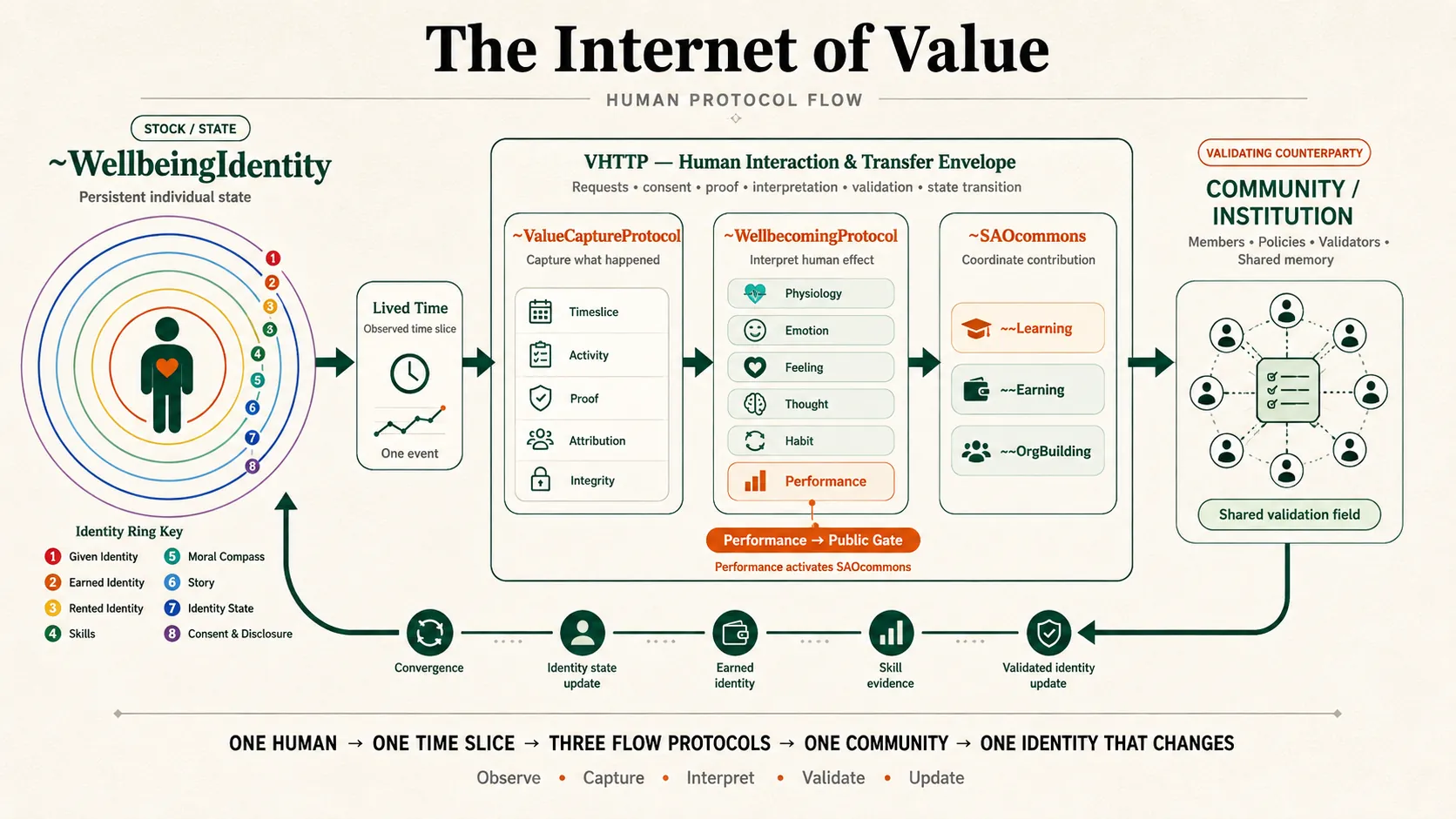
Below, “the account” means one named founder implementation and its selected event. This page does not establish what every possible community implementation can collect, or redefine either system. [15] [16]
Keep the scale visible
A global assessment, a national study, a city portrait, an organizational design exercise and a person’s activity record answer different questions. The table separates documented approaches from the limits we infer for this example. It is not an official cross-scale mapping or a completed assessment. [1] [3] [5] [7]
| Scale | Documented approach or actual record | Why our session cannot stand in for it |
|---|---|---|
| Global | The Doughnut monitors social shortfall and ecological overshoot with declared indicators and data. 1 | One founder’s W or valuation is not the global dataset. 10 |
| National | The Leeds research project compares nations using explicit social and environmental methods, including consumption-based footprint indicators. 7 | A country average or per-capita allocation is not an observed footprint or entitlement for this event. |
| City / community of place | DEAL’s portraits combine locally relevant targets and data with participatory knowledge; the four lenses connect local aspirations with global responsibilities. 3 4 | The Foundation affiliation does not supply a place’s population, indicators, targets or participant perspectives. 9 |
| Organization | DEAL’s business approach focuses on deep design; it explicitly rejects certain “company Doughnut” resource allocations and claims. 5 6 | A Foundation valuation cannot certify the organization or allocate its planetary budget. 10 |
| Individual / event | Our selected record supplies one person’s bounded work, review context, historical W and policy calculations. 9 10 | It does not establish other people’s access to essentials or ecological effects. |
Units, thresholds and populations do not transfer automatically. An allocation from a global budget to a nation, organization or event requires an explicit method and normative choices, not simply division by headcount, hours or USD valuation. DEAL’s business policy specifically rejects allocations to companies based on output, workforce or value added and asks against claims that a business is “within the Doughnut.” We do not make that claim for the Foundation. [5]
The actual Foundation contribution
On 31 July 2026, 09:30–12:30 IST, I recorded mathematics and Performance calculation infrastructure work for the Foundation, including community skill-approval dependencies. The selected event routes through Performance → OrgBuilding → Internet of Value Research Foundation, with native skill level SM3. The interval is 180 minutes = 3 hours. This is the existing author-provided case, not an independently witnessed environmental or social study. [9] [10]
The narrative mentions deployment/testing, but the selected proof field has no linked artifact. Founder self-review is not independent assessment, and a described output does not establish actual reuse or beneficiary outcomes. [9]
The reference rate is USD 750/hour, Moses-only self-ratified policy 1.0.0. Self-ratification occurred at 12:34:42 IST and recording at 14:38:30, after the session ended at 12:30; reviews followed on 2 August. This does not establish advance buyer agreement, and the gap does not prove no earlier agreement existed. The event is non_payable, not a payment instruction or a market transaction. [9] [10]
The math the account actually supports
The public calculation artifact supplies the historical inputs and founder-wellbeing-v0.1.1-fixed12 arithmetic version. round12 means half-even rounding to 12 decimal places after each governed step. We separately reproduce these outputs; that verifies this arithmetic, not work quality, price or model validity. [10]
rate = 750 USD/hour
Wbefore = Wafter = 771.095689848427 WellbeingScore units
Vcom_event = round12(3 × 750)
= 2250.000000000000 USD
q = round12(Wbefore / 1000)
= 0.771095689848 (dimensionless)
VCperformance_event = round12(q × Vcom_event)
= 1734.965302158000 USD
ΔW = Wafter − Wbefore = 0 WellbeingScore units
Vcom is the policy valuation expanded by duration. VCperformance applies the pre-event wellbeing multiplier and retains the implementation’s USD reference unit. With Vcom fixed and positive, lower Wbefore lowers VCperformance; Vcom remains unchanged. That behavior does not establish lower human worth, poorer work or deserved pay. [10] [16]
None of those quantities is a Doughnut result. A normalized W factor is not a proportion of social needs met. Zero recorded W movement is not zero ecological impact or zero social shortfall. The no_transition decision also does not prove the session had no subjective effect. Those limits follow from what the fields measure and what the case does not supply. [10] [16] [1]
Show the missing evidence, rather than fill the rings
The following is our proposed evidence inventory for this one session, informed by the wider questions in the cited methods. It is not an official DEAL event checklist, a new corporate assessment tool or an exhaustive environmental inventory. The selected public case leaves these questions unresolved. [3] [4] [9]
| Question to investigate | Evidence we would need | Present status |
|---|---|---|
| What was delivered, and who used it? | A linked artifact, delivery/reuse evidence and a defined observation period. | Not established by the selected proof field. 9 |
| Whose needs changed, and who was excluded? | Defined participants and relevant needs, their perspectives, baseline and follow-up. | No beneficiary outcome or distribution dataset supplied. 9 |
| What electricity was attributable to the work? | Metered or otherwise justified activity data and an allocation rule, including any shared/cloud use in scope. | Session duration alone does not supply kWh. 8 9 |
| Which emissions factor fits? | Declared geography, period, source, method and matched units. | No applicable factor established; IST is a time-zone label, not supplier or hosting-location evidence. 8 9 |
| What else belongs within the boundary? | An explicit decision about hardware, network/cloud services, materials, water and other relevant resource effects, with data. | No comprehensive footprint boundary or inventory supplied. 9 |
| Which targets or limits apply? | The chosen scale, indicator definitions, threshold sources and justified allocation method. | No event-specific social or ecological thresholds supplied. 3 5 |
Missing evidence is not a zero footprint, and a lack of measured benefit is not proof of no benefit. We retain both uncertainties instead of drawing completed wedges around the contribution. This is our evidence-handling rule, not an assessment outcome. [9]
One environmental calculation, with its inputs still unknown
GHG Protocol describes emissions calculations using activity data and an appropriate emissions factor. For a deliberately narrow electricity-only illustration, let k be attributed electricity consumption in kWh and f a factor already expressed in kg CO₂e/kWh for the declared method and boundary. Then the unit calculation is: [8]
kWh × kg CO₂e/kWh = kg CO₂e
k for this session = unknown
f for this session = unknown
Eelectricity = unresolved, not zero
This is explanatory activity-times-factor algebra. It is not a full GHG inventory, a lifecycle assessment, a certification or a Doughnut score. The factor is assumed already in CO₂-equivalent units; no additional global-warming-potential multiplier is silently applied. Source scope, factor selection, attribution and wider inventory requirements would need their own work. [8]
Three hours is not three kWh. Time would have to be combined with power and a justified operating/allocation boundary to estimate energy. We have not been supplied those inputs, so no device power, electricity use, cloud energy or emissions number is invented. [9] [8]
Even an eventual electricity emissions result would answer only its declared question. It would not, by itself, demonstrate social justice or account for all ecological dimensions. Nor can USD 2,250 be subtracted from kg CO₂e to produce a meaningful “net value”: those are different units with no supplied bridge. This is dimensional analysis and a scope limit, not a claim of a complete impact method. [10] [1]
My Wellbeing Identity is a human context, not a planetary assessment
View my actual public Wellbeing Identity →
The existing public presentation has its own current disclosure and review context. We do not copy hidden facets, or replace the historical Wbefore with a current reading. One person’s state does not establish other people’s access to essentials, the Foundation’s resource use or a place’s social and ecological portrait. The historical calculation and the broader assessment questions remain separate. [18] [10] [3]
What we can learn from Doughnut Economics
Ask whose needs are met. The place-portrait method combines indicators with lived experience. Our proposed next step is to pair any documented Foundation output with an explicit beneficiary question and observation period. Hours and founder recognition should not be presented as sufficient evidence that other people’s needs improved. No such outcome is established here. [3] [9]
Keep local and wider effects in view. DEAL’s four lenses connect social and ecological questions across local aspirations and global responsibilities. For this contribution, we would need to investigate both the intended use of the work and the resource boundary of producing it. This is an editorial learning, not a completed four-lens portrait or an implemented IoV adapter. [4]
Study institutional design, not just individual scores. DEAL’s business tool asks how purpose, networks, governance, ownership and finance enable or obstruct change. The Foundation case gives us reason to inspect who approves valuation, who can challenge it and how benefits might be distributed. Those are research questions; we do not claim that the Foundation has completed the tool or been endorsed by DEAL. [6] [5]
Keep missing dimensions visible. Our account makes the event, rate authority and historical calculation inspectable. Doughnut Economics prompts a wider discussion of what that account omits. A useful next case would show linked delivery evidence, recipient perspectives and declared resource data beside the contribution record, with each scale and unit retained. This is a proposal for evidence, not proof of comprehensive interoperability or impact. [10] [3]
Questions readers may ask
Is W a personal Doughnut score?
No. It is the historical wellbeing input in the named founder calculation. A Doughnut assessment uses its own social/ecological indicators, populations, thresholds and methods. Dividing W by 1,000 normalizes an implementation input; it does not perform that assessment. [10] [1]
Does a positive contribution valuation prove sustainable work?
No. The valuation is based on duration and a self-ratified policy rate. The case supplies no full footprint or beneficiary outcome dataset. It may be useful work, but the calculation does not establish the wider claim. [9] [10]
Can we divide planetary limits by our hours or revenue?
Not without an explicit allocation method and its ethical and empirical justification. DEAL’s business policy specifically cautions against output-, workforce- or value-added-based “company Doughnut” allocations. This page does not produce a Foundation budget, event threshold or certification. [5]
Is Doughnut Economics only useful at a global scale?
No. DEAL provides place-based participatory and data tools and an organizational design approach. These methods do not make an individual activity record automatically interchangeable with a city portrait or organizational exercise. [3] [4] [6]
Can someone begin with one day of observation?
A person can begin recording bounded activity. That does not make a complete social/ecological assessment available after 24 hours, or establish that this entry point is unique. Our actual example is a three-hour historical session with later reviews, not a first-day demonstration of an economy or planetary account. [11] [9]
Sources, method and corrections
- DEAL: What is the Doughnut?. Social foundation, ecological ceiling, evolving global indicators and quantitative assessment context. No global result is transplanted into the Foundation case.
- DEAL: About Doughnut Economics. Raworth’s concept/book history and the regenerative/distributive economic mindset. Used for scope, not a claim that one prescribed policy package applies everywhere.
- DEAL: Doughnut Data Portraits, a Methodological Guide. Version 2.3 (April 2025) as displayed; page updated 21 October 2026. Locally relevant targets, indicators and complementary participatory evidence. No Foundation portrait is undertaken.
- DEAL: Doughnut Unrolled, Introducing the Four Lenses. Local/global social/ecological perspectives and place-based practice. The event evidence inventory is our editorial proposal, not this official tool.
- DEAL: Business & Enterprise. Business policy, deep design, “No Company Doughnuts” and limits on public claims. This is a comparative article, not a DEAL assessment, endorsement or workshop offering.
- DEAL: Doughnut Design for Business, Core Tool. Purpose, networks, governance, ownership and finance. No tool completion or organizational transformation is claimed for the Foundation.
- A Good Life for All Within Planetary Boundaries: About. Researchers’ own national-scale methods, footprint scope and study provenance. Its national results and per-capita methods are not treated as observed individual/event data.
- GHG Protocol: How do I calculate emissions?. Official calculation guidance, updated 7 April 2026, linked from the GHG Protocol guidance service. Activity data, appropriate factors and reporting context. Our electricity equation is a narrow unit illustration with no selected numerical inputs, full inventory or conformance claim.
- Already-published Foundation contribution and source notes. Selected 31 July 2026 session, policy timing, founder review, missing proof link and 7 November export cutoff. Author-provided; underlying export remains private.
- Public selected-event calculation artifact. Exact historical inputs, fixed12 arithmetic, outputs and source hashes. Supports arithmetic reproduction, not independent work or social/ecological validation.
- Value Capture: public protocol reference. Bounded activity, attribution, proof and lineage.
- Wellbecoming: public protocol reference. Human context and conditional Performance routing.
- SAOcommons: public protocol reference. Community validation, valuation and institutional responsibilities.
- Wellbeing Identity: public protocol reference. Living state, consent and disclosure responsibilities.
- Canonical protocol registry. Version 0.7.0 when consulted 7 November 2026. Protocol authority; the Foundation website is explanatory.
- Published founder implementation limits. Public method and claim boundaries. The typed calculation is not a universal empirical law, payment instruction or comprehensive impact measure.
- Human Protocol Flow. Existing approved explanatory illustration reused unchanged.
- Moses Sam Paul Johnraj’s public Wellbeing Identity. Existing consent-controlled public context, not a replacement for historical inputs.
Sources consulted 7 November 2026. This is a comparison and evidence-gap analysis, not a Doughnut assessment or official adaptation of DEAL’s tools. The cover and missing-evidence table are original editorial explanations. No planetary budget, footprint, resource saving, beneficiary count, verified social effect or environmental success is invented. The founder arithmetic is independently reproduced from already-disclosed inputs; underlying work and model validity are not independently established. Corrections are welcome through the link below.
Continue exploring
- Leave the return open · Sacred Economics
- When a number becomes a claim · Mutual credit / CES
- Economic model comparisons
- The same session and time banking
- The same session and Sensorica
- The same session and SourceCred
- The same session and Valueflows / REA
- What is The Internet of Value?
- Send a correction