
The Internet of Value
Leave the return open
By Moses Sam Paul 2026-11-07
Must recognizing a contribution also fix what someone owes in return? Sacred Economics and The Internet of Value, through real Foundation work and a public calculation artifact.
Quick answer
Sacred Economics asks how gifts, money and institutions can support relationships and the commons. The selected founder implementation of The Internet of Value records and interprets a contribution under named policies. Recording a policy valuation does not establish a price someone agreed to pay, a debt or a voluntary gift. These are different questions about the same work. [1] [2] [8] [9]
Published 7 November 2026. The Foundation session and selected calculation artifact are already public. Gift intent, a donation and an agreed financial return are not established by that evidence. [8] [9]
What does Sacred Economics stand for?
Sacred Economics is Charles Eisenstein’s account of money, gift and society, combining a cultural argument with institutional proposals and personal practice. His revised book description includes local currencies, negative-interest money and restoration of the commons. It is broader than a gift ledger or a request to abolish every monetary exchange. [1]
In The Gift World, Eisenstein describes gifts as carrying something of the giver and sustaining an ongoing relationship. He explicitly discusses social obligations and reciprocity. An open relationship is not the same as a precisely priced return, and it is not necessarily free of expectations. This is his interpretation of gift culture, not a universal empirical account of every gift. [2]
In Relearning Gift Culture, he connects daily practice with monetary reform and resists the ideal that every gift must be perfectly selfless. In Community and the Unquantifiable, he argues that some human needs cannot be met by generic, standardized purchases. These are arguments to consider, not findings demonstrated by the Foundation case below. [3] [4]
A concrete practice, not only a theory: the book’s online edition is offered as a gift, with an invitation to make a return gift. Eisenstein’s support page describes voluntary donations without exclusive content in direct exchange. That is evidence of his stated publishing and support approach—not evidence about who donates, how much is received or whether the approach will fund our work. [5] [6]
Explore Sacred Economics →Read the book online →Read about gift practice →
What does The Internet of Value do?
The Internet of Value connects bounded activity, private human context, applicable community validation and a consent-governed Wellbeing Identity. The four protocols assign distinct responsibilities; an activity record does not automatically become a financial claim. [10] [11] [12] [13]
- Capture:
~ValueCaptureProtocolrecords time, attribution, evidence and lineage. [10] - Interpret:
~WellbecomingProtocolprovides human context and routes eligible Performance contributions toward community validation. [11] - Validate:
~SAOcommonsis the community institution layer when applicable, including recognition and valuation. [12] - Reflect:
~WellbeingIdentitycarries a living, selectively disclosed state; it is not just a public score. [13]
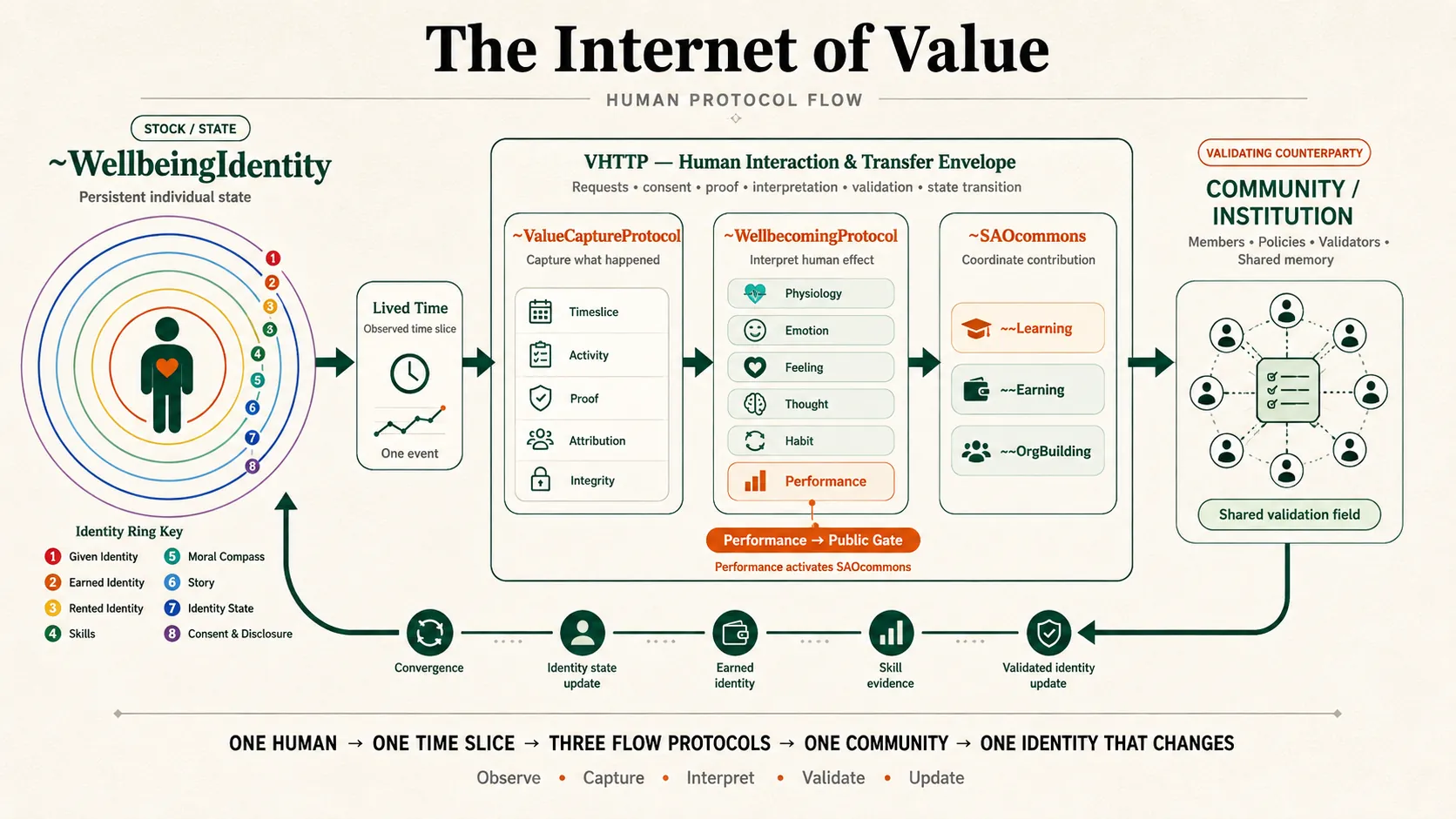
The calculation below belongs to a specific founder implementation and historical event. It does not prescribe a universal exchange price or a required form of giving. The canonical registry and the public implementation limits are separate sources. [14] [15]
The real work, and the public artifact we can inspect
On 31 July 2026, 09:30–12:30 IST, I recorded Foundation mathematics and Performance calculation infrastructure work, including community skill-approval dependencies. The event routes through Performance → OrgBuilding → Internet of Value Research Foundation, with native skill level SM3. Its duration is 180 minutes = 3 hours. This is an author-provided account, not independent verification of the work. [8] [9]
The description mentions deployment/testing, but the selected record contains no linked proof artifact. We cannot use that description alone as evidence that a particular software output was deployed, reused or beneficial. Reviews were founder self-review, not independent assessment. [8]
A real public artifact: the selected-event calculation record provides the disclosed inputs, method, outputs and limits. A reader can inspect the arithmetic. It is not a code-deployment receipt, and its public availability does not establish my original intent, another person’s gratitude or their willingness to pay. [9]
The reference rate is USD 750/hour, Moses-only, self-ratified policy 1.0.0. Self-ratification occurred at 12:34:42 IST and recording at 14:38:30, after the session ended at 12:30; reviews followed on 2 August. The selected evidence does not establish advance agreement by a buyer, and that gap does not prove no earlier agreement existed. The event is explicitly non_payable. [8] [9]
Recognition, valuation, payment and giving are different facts
For this case, there is enough evidence to describe the recorded recognition and reproduce its calculation. There is not enough to classify the work as a voluntary gift or assign a recipient an amount to repay. That boundary is an assessment of the selected evidence, not a theory that giving cannot be recorded. [8] [9]
| Question | What this real case establishes | What it leaves open |
|---|---|---|
| What contribution was recorded? | Three hours of Foundation infrastructure work, with the stated route and founder review. 8 | Independent artifact proof and downstream usefulness are not established. 8 |
| What valuation was computed? | Vcom of 2250.000000000000 USD under the named self-ratified policy. 9 | No external market price, actual cost or buyer agreement follows. 9 |
| Was it payable? | This protocol event is marked non_payable. 9 | That label is not a complete audit of other contracts or cash transactions. 8 |
| Was it given as a gift? | No gift declaration or recipient terms are supplied in the selected evidence. 8 | Intent, recipient understanding and any expected reciprocity remain unknown. 8 |
| Was money donated? | No donation receipt is part of the selected public case. 8 9 | Donor, amount, currency and conditions remain unknown—not zero. |
| Did sharing help someone? | The selected calculation record is publicly available. 9 | Benefit, gratitude, reuse and social/ecological outcomes are not measured here. |
“Non-payable” is a status; “gift” describes an intended relationship or arrangement. They cannot be substituted for one another on the basis of this record. Likewise, public access to one artifact is observable, but a complete account of its licensing, funding and recipient experience would require additional evidence. This is our methodological distinction. [8] [2]
The actual founder math
The disclosed calculation uses founder-wellbeing-v0.1.1-fixed12. round12 means round-half-even to 12 decimal places after each governed step. We separately reproduce this selected event; that verifies arithmetic, not its price, work quality or empirical model validity. [9]
rate = 750 USD/hour
Wbefore = Wafter = 771.095689848427 WellbeingScore units
Vcom_event = round12(3 × 750)
= 2250.000000000000 USD
q = round12(Wbefore / 1000)
= 0.771095689848 (dimensionless)
VCperformance_event = round12(q × Vcom_event)
= 1734.965302158000 USD
ΔW = Wafter − Wbefore = 0 WellbeingScore units
Vcom is the duration-expanded policy valuation. VCperformance applies the historical pre-event wellbeing multiplier and retains this implementation’s USD reference unit. With Vcom fixed and positive, lower Wbefore lowers VCperformance while leaving Vcom unchanged. This does not establish lower human worth, deserved pay or poorer work. The recorded no_transition and zero W movement do not prove the session had no subjective effect. [9] [15]
There is no calculated donation amount
Let G mean an observed voluntary monetary gift in a declared currency, if one is actually received and documented. That is our notation, not a canonical IoV variable or a Sacred Economics scoring formula. Neither valuation above determines G. For this case, G is unknown. We do not set it to zero, to the hourly valuation or to the wellbeing-weighted result. [8] [9]
VCperformance_event = named implementation output
G = observed voluntary gift amount, if documented
No rule supplied: G = Vcom_event
No rule supplied: G = VCperformance_event
G for this case = unknown
A useful counterexample to mandatory equivalence is Eisenstein’s stated support practice: people choose a gift amount, without exclusive content in direct exchange. We do not infer that our Foundation uses the same arrangement, or that any particular reader has given anything. [6]
Sacred Economics also contains monetary mathematics
It would be unfair to contrast “their philosophy” with “our math.” Eisenstein’s negative-interest chapter discusses demurrage: a charge associated with holding currency. That policy concerns monetary circulation and balances, not a formula for how much gratitude someone owes. [7]
To make the distinction inspectable, consider one hypothetical design: a proportional holding charge d is deducted from the remaining balance at each period’s end, with no other flows. Let B₀ be the opening amount in a declared currency unit U, and n a non-negative whole number of periods. For 0 ≤ d < 1, elementary repeated multiplication gives:
Bₙ = B₀ × (1 − d)ⁿ
B: currency balance in U
d: fraction charged per period
n: number of periods
This is our conditional algebra, not Eisenstein’s universal formula or a reconstruction of a historical currency. Designs that charge a fixed face-value stamp, apply other timing rules or include receipts and spending need different calculations. The source chapter discusses more than one mechanism. No charge rate, starting balance, period count or implemented currency is supplied for my session, so there is no numerical demurrage result. [7]
Applying that charge to the non-payable Vcom would silently turn a reference valuation into a currency balance. Applying it to W would mix a monetary rule with WellbeingScore units. Neither operation is authorized by the disclosed case. This is a unit-and-scope check of the displayed quantities. [9] [15]
My Wellbeing Identity is context, not a bill
View my actual public Wellbeing Identity →
The existing public presentation carries its own disclosure and review context. It is not substituted for the historical Wbefore, and hidden facets are not copied into this article. A person’s reading does not establish what a recipient owes them, what a donor should give or the quality of an ongoing relationship. The first distinction follows the actual historical inputs; the latter are limits on what we infer from them. [17] [9] [13]
What we can learn, and what we still have to test
Allow recognition without demanding an equivalent return. Eisenstein’s gift account challenges us to ask whether a recorded number is becoming an implicit invoice. Our recommendation is to distinguish acknowledgment, policy valuation and any separately agreed claim in the interface and language. The selected non-payable record already lets us show why these must not be collapsed. [2] [9]
Ask about the relationship, not only the amount. His discussion of gift practice makes expectations and dependency relevant. For a future Foundation example we would ask the contributor and recipient what was offered, what return—if any—was expected, and whether those expectations were understood. Those interviews and terms are missing here; we will not fill them in with a generous-sounding story. [3] [8]
Keep room for what the account does not measure. Chapter 22 asks readers to consider needs beyond standardized purchases. Our lesson is to retain narrative, consent and an explicit boundary around quantified claims. The published calculation can explain its own inputs; it cannot stand in for trust, care or the full meaning of a contribution. This is a design recommendation, not a claim that one score measures those relationships. [4] [15]
Test support separately from recognition. Eisenstein’s donation page describes a concrete voluntary support model. If we ever test one, actual receipts, costs, conditions and contributor experience would be separate evidence. A high policy valuation does not demonstrate sustainable funding, willingness to pay or a successful gift economy. No such experiment is reported in this case. [6] [8]
Different questions, not a winner
| Question | Sacred Economics, as cited | Selected founder implementation |
|---|---|---|
| What is the emphasis? | Gifts, relationships, commons and changes to monetary institutions. 1 | Bounded capture, policy decisions, human context and living Identity. 10 13 |
| Is there one mandatory price per contribution? | Not in the cited gift account; the book also contains monetary proposals. 2 7 | One named self-ratified rate is used here; it is not a universal price. 9 |
| Does giving imply no obligations at all? | Eisenstein explicitly discusses social ties and reciprocal expectations. 3 | Gift terms are not supplied by this selected record. 8 |
| What can its mathematics describe? | Among its proposals, holding charges on currency; design details matter. 7 | Exact duration, reference valuation, W-weighted output and recorded W movement for this event. 9 |
| Does this example prove funding or outcomes? | No evaluation of Eisenstein’s support model is performed here. | No donation, external work validation or social/ecological outcome is established. 8 |
| Can a person begin without society-wide adoption? | The book explicitly discusses personal practice. 3 | Individual observation can begin, but a completed log does not by itself create reciprocal acceptance or payment. 10 15 |
Questions readers may ask
Does non-payable mean I gave the work away?
No such conclusion follows from this case alone. It describes the protocol event’s payment status. Gift intent, recipient understanding, reuse terms and expectations require their own evidence. We can acknowledge the work without inventing that relationship. [8] [9]
Is Sacred Economics against all money or all quantification?
That would misrepresent its scope. Eisenstein discusses monetary institutions, complementary currencies and demurrage alongside gifts and the commons. His critique asks what monetary measures omit and what their design encourages; it is not simply a proposal to stop keeping any accounts. [1] [7] [4]
Does USD 2,250 tell a reader what to give?
No. That is this session’s policy valuation under a Moses-only rate. It supplies neither an accepted purchase price nor a donation rule. The voluntary gift amount is unresolved, not a value we can derive by multiplication. [9]
Can giving be recorded without becoming a debt?
As a proposed design, we can keep an acknowledgment and its disclosed purpose separate from any fixed return. That proposal must be tested with real participants and clear terms; it is not a delivered gift protocol or proof that quantification leaves a relationship unaffected. Eisenstein’s account gives us a reason to ask those questions. [2] [3]
What would make the next case stronger?
A contributor’s explicit account of their intention, a recipient’s understanding, actual access/reuse terms and any documented support would let us study giving more directly. Outcomes would require their own observation. Until then, this is a real contribution-and-calculation case used to expose the boundary—not a demonstrated Foundation gift economy. [8] [9]
Sources, method and corrections
- Charles Eisenstein: Sacred Economics, revised book description. Author’s overview of theory, policy and practice, including monetary proposals and commons. His social/historical diagnosis is attributed to him, not adopted as an independently established finding.
- Chapter 1: The Gift World. Author’s account of gifts, circulation, relationship and social obligations. Not a claim that every gift culture or modern gift follows one rule.
- Chapter 18: Relearning Gift Culture. Personal practice, monetary reform and qualification of the ideal of purely selfless gifts. Descriptive claims about cultures are not independently tested here.
- Chapter 22: Community and the Unquantifiable. Eisenstein’s argument about relationships, needs and limits of standardized monetary provision. No Foundation wellbeing or community outcome is inferred.
- Sacred Economics: Read Online. Actual public book text and stated gift/return-gift approach. The hosted chapter texts carry the original 2011 site attribution; the separate author overview describes the revised 2020 book. We do not claim the editions are identical.
- Charles Eisenstein: Donate & Support. His stated voluntary support practice without exclusive direct-exchange content. No receipts, amounts, performance or Foundation adoption are asserted.
- Chapter 12: Negative-Interest Economics. Monetary holding charges and multiple designs. Our proportional-balance equation is conditional explanatory algebra, not a historical reconstruction. No historical success, causal claim or chosen rate is asserted.
- Already-published Foundation contribution and source notes. Selected 31 July 2026 session, policy timing, review status, absent proof link and 7 November export cutoff. Author-provided; underlying export remains private.
- Public selected-event calculation artifact. Actual disclosed inputs, fixed12 version, outputs and source hashes. It supports independent arithmetic reproduction, not independent work, market valuation or gift-intent verification.
- Value Capture: public protocol reference. Capture, attribution, proof and lineage.
- Wellbecoming: public protocol reference. Human context and conditional Performance routing.
- SAOcommons: public protocol reference. Community validation, valuation and institutional responsibilities.
- Wellbeing Identity: public protocol reference. Living state, consent and disclosure responsibilities.
- Canonical protocol registry. Version 0.7.0 when consulted 7 November 2026. Protocol authority; the Foundation website is explanatory.
- Published founder implementation limits. Public method and claim limits grounded in the protocol documents. The typed calculation is not a universal empirical law, payment or debt.
- Human Protocol Flow. Existing owner-approved explanatory illustration, reused unchanged.
- Moses Sam Paul Johnraj’s public Wellbeing Identity. Existing consent-controlled context; not a replacement for historical inputs.
Sources consulted 7 November 2026. Eisenstein’s arguments are presented as his arguments; no broad historical, social or environmental thesis is independently established by this comparison. The founder calculation is separately reproduced from already-disclosed inputs. Demurrage algebra and proposed design lessons are explicitly conditional/editorial. Gift intent, donation, recipient obligation, willingness to pay and outcomes remain unresolved. No new private record is disclosed. Factual and interpretive corrections are welcome through the link below.
Continue exploring
- What the ledger leaves out · Doughnut Economics
- When a number becomes a claim · Mutual credit / CES
- Economic model comparisons
- The same session and time banking
- The same session and Sensorica
- The same session and SourceCred
- The same session and Valueflows / REA
- What is The Internet of Value?
- Send a correction