
The Internet of Value
Sensorica vs The Internet of Value
By Moses Sam Paul 2026-11-07
One actual Foundation contribution. How is it recognized—and what can that recognition enable?
Quick answer
Sensorica is a close predecessor in mathematical contribution accounting. Its OVN documentation connects recorded contributions to venture-specific benefit distribution. The founder implementation of The Internet of Value shown here produces a contribution valuation, a separate wellbeing-weighted output and a separate wellbeing-state decision. These quantities answer different questions; they are not competing prices for the same work. [3] [5] [9] [10]
Published 7 November 2026. This article reuses the actual Foundation session disclosed in our time banking comparison, keeping the work constant across the series. No Sensorica participation, acceptance or payout is established for this session. [9]
What does Sensorica stand for?
Sensorica describes itself as an open value network: people and collaborative communities can join open ventures and combine resources to make things together. Its stated mission includes intelligent sensors and sensemaking systems. That practical setting matters: this is a model developed around collaborative production, with a living lab and ventures—not only a proposal about future money. [1] [8]
The OVN knowledge base describes a practitioner model that emerged within Sensorica and continues to evolve. The documentation contains different approaches and implementation histories. We therefore compare the documented contribution-accounting principles below, rather than pretend that every Sensorica venture uses one fixed formula. [2] [6]
Its accounting question
When people contribute different kinds of effort and resources to a shared venture, how should those contributions be recognized in the benefits that venture can provide?
The Contribution Accounting System separates logging, evaluation and benefit distribution. Inputs can include time, materials, money or access to resources. A normalized contribution account is not itself a currency or an exchange. [3]
Explore Sensorica →Read its contribution-accounting model →
What does The Internet of Value do?
The Internet of Value is a four-protocol system for representing activity, interpreting its human context, routing eligible contributions through communities and carrying validated state into a living Wellbeing Identity. The shared vocabulary separates these responsibilities. It does not make every observation public or automatically turn every hour into a payment. [11] [12] [13] [14]
- Capture:
~ValueCaptureProtocolrecords bounded activity, attribution, evidence and event lineage. [11] - Interpret:
~WellbecomingProtocoldescribes Physiology, Emotion, Feeling, Thought, Habit and Performance context. [12] - Recognize: the conditional Performance route can activate
~SAOcommonscommunity validation through Learning, Earning or OrgBuilding. [13] - Carry state:
~WellbeingIdentityreceives eligible validated flows; its disclosure is governed separately. [14]
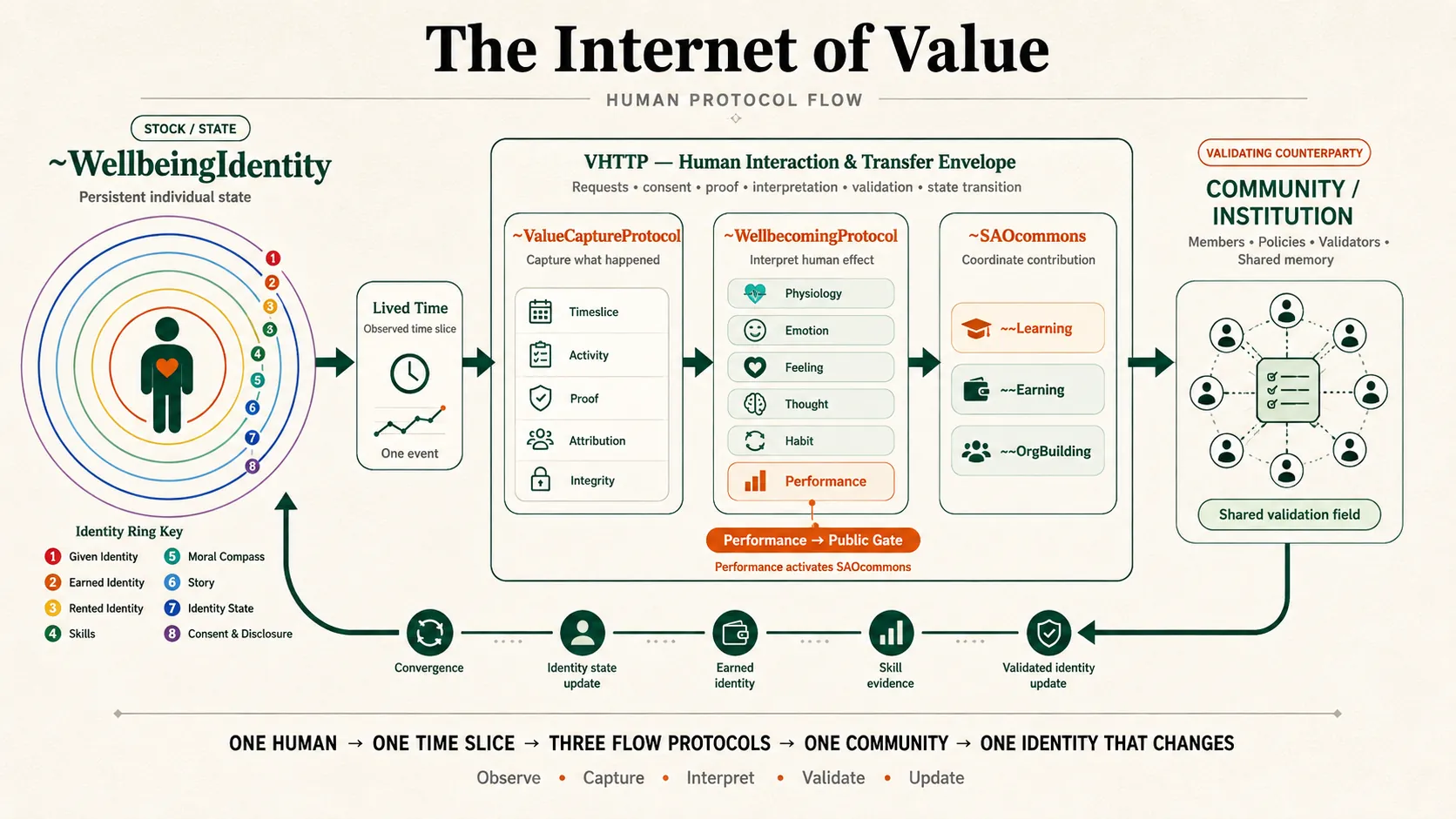
The rest of this article narrows from that system architecture to one real founder-policy event. Its rate, wellbeing policy and review authority are specific to this case. The wider SAOcommons interface includes distribution-rule vocabulary; the non-payable event below does not establish that the whole system is incapable of distributing benefits. [9] [10] [13]
The real Foundation contribution
Observed founder record · restricted underlying source
31 July 2026 · 09:30–12:30 IST
I recorded three hours of Foundation work on The Internet of Value’s mathematics and Performance calculations: resolving community skill-approval dependencies, with deployment and testing mentioned in the activity description. The record’s route is Performance → OrgBuilding → Internet of Value Research Foundation, at native level SM3. [9]
The underlying Value Log record is private. The already-published selected case and calculation record disclose the inputs used here. They are an author-provided account, not independent confirmation of the work. The selected record has no linked proof artifact, so the description does not independently establish a shipped deployment or downstream benefit. Both community-role decisions were founder self-reviews. [9] [10]
Why use this case again? It concerns the mathematics and infrastructure through which contributions become legible. That makes Sensorica’s attention to documenting research and infrastructure work particularly relevant. This is our choice of a comparison case; it is not evidence that a Sensorica venture would accept the work. [18] [8] [9]
Follow the contribution through both models
3 hours of Foundation mathematics and calculation-infrastructure work. [9]
Sensorica / OVN comparison
- Identify an accepting venture and its applicable rules.
- Log and evaluate the contribution in that context.
- Relate it to other eligible contributions.
- Allocate benefits under the agreed rule when the relevant conditions are met.
Conditional route. No accepting venture, evaluation or distribution is recorded for this session. The flow summarizes the documented model, not an executed transfer. [17] [18] [4] [6]
The selected IoV founder event
- Record the activity and its Foundation route.
- Apply the named, self-ratified contribution-rate policy.
- Weight a separate output using exact historical Wbefore.
- Record the separate wellbeing decision:
no_transition.
Observed record and reproduced arithmetic. The valuation is final under the named authority and explicitly non-payable. [9] [10]
Sensorica’s math: a share needs a denominator
The documentation describes normalized benefit allocation from evaluated contributions. To make that operation inspectable, the equations below are our reduced reconstruction of one proportional allocation rule. They are not a quoted universal Sensorica formula or the output of a Sensorica deployment. Actual rules can be more complex; the documented product and service examples already differ. [6] [7]
T = sum of all eligible contribution scores in the selected pool
f = c / T, provided T > 0
B = R × f
This illustration concerns a divisible pool in one unit, such as distributable revenue; it does not convert reputation or governance into money. For this reduced rule, all eligible scores and the distributable pool are nonnegative, and T must be positive. A zero total needs a separate rule. Here c is this event’s accepted contribution score, T the eligible total in the same score unit, f the fraction attributable to this event in this reduced rule, and R the actual pool available for this distribution after any agreed deductions or allocations. B is the resulting allocation—not automatically a settled payment. This is an event-level illustration; someone with other accepted contributions would need those included to calculate their overall participation. These variable definitions are our notation. The algebra derives the fraction and allocation under the stated proportional rule; it is not a reported Sensorica result.
What can our real three hours supply?
If an accepting venture chose a time-linear evaluation for this event, we could write the following conditional special case. We do not assume that choice has been made. The evaluation documentation stresses that contribution assessment is context-sensitive. [4]
f = [(3 hours) × a × m] / T
B = R × [(3 hours) × a × m] / T
a would be that venture’s accepted score units per hour; m would collect any dimensionless modifiers its chosen rule actually applies. Neither is supplied by our Foundation record. The only substituted observation is the duration: three hours. The Foundation’s USD 750/hour policy is not evidence of a Sensorica rate. [4] [9]
| Input | What we actually know | Consequence |
|---|---|---|
| Recorded duration | 3 hours in the Foundation case. [9] | Usable as the observed input to a conditional comparison. |
| Accepting venture and rule | Not established for this event. | Eligibility and evaluation remain unresolved. |
| a and m | No Sensorica evaluation inputs are established. | No numeric c can be claimed. |
| T | No complete eligible contribution pool is established. | No numeric share can be claimed. |
| R | No distribution pool is established. | No numeric benefit allocation or payout can be claimed. |
The unresolved entries mean “not supplied by the selected evidence,” not zero and not a finding about Sensorica’s entire network. [9]
Why the denominator matters
Under this reduced rule, a fixed positive contribution can represent a smaller fraction when the rest of the eligible pool grows. If additional accepted scores total d > 0, then c / (T + d) < c / T. The work itself need not have changed. That conclusion follows from the displayed algebra and matches the contribution-based dilution described in the OVN participation account. It is not a claim that every benefit rule recomputes every past allocation. [7]
The IoV math we can actually reproduce
The selected exported event supplies all the inputs needed for its founder-policy calculation. The declared rate is Moses-only and self-ratified; it is a policy reference, not evidence of an external buyer or a wage. The exact historical wellbeing input belongs to that event’s replay, not the latest public profile reading. [9] [10]
Vcom = USD 2,250
q = round12(771.095689848427 / 1000)
q = 0.771095689848
VCperformance = round12(q × 2250.000000000000)
VCperformance = USD 1,734.965302158000
Wafter = Wbefore = 771.095689848427
ΔW = 0
round12 means round-half-even to twelve decimal places after each governed step in founder-wellbeing-v0.1.1-fixed12. Rounding the multiplier before multiplying reproduces the stored result. The separate Decimal check establishes this selected event’s arithmetic, not twelve-decimal measurement accuracy, work quality, economic value or model validity. [10]
Nothing here is a Sensorica distribution or an IoV payment. The source event is non_payable. Vcom is a contribution valuation in the declared unit; VCperformance is a separate wellbeing-weighted reference output. Neither establishes a benefit-pool fraction, money received or a claim against a buyer. [9] [10]
The W multiplier answers a different mathematical question from c / T. With fixed positive Vcom, lowering Wbefore lowers VCperformance and leaves Vcom unchanged. This founder formula contains no denominator of other participants’ contributions. The proportional allocation above does. These are properties of the displayed operations; they do not establish which model is fairer.
Nor does Wbefore measure whether making this contribution depleted or restored me. That requires the separate impact decision and evidence. The stored decision here is no_transition, with zero recorded movement; it does not establish that no subjective cost or benefit occurred. [9] [10]
My Wellbeing Identity is context, not a payout account
Explore my actual public Wellbeing Identity →
The linked profile is the owner-controlled public view. This article does not copy its private rings or substitute its current reading for the historical calculation. The protocol describes a living, consent-governed state; it should not be read as a universal rank or a balance of money owed to me. The selected case’s non-payable output remains a separate claim with its own limits. [14] [9] [10]
What we can learn from Sensorica
1. Name the output before arguing about the number
Sensorica’s documentation explicitly separates contribution accounting from exchange. Its benefit-distribution discussion also frames the rule as a social agreement rather than a physical law of value. That is a useful discipline for our vocabulary. [3] [5]
Applied to this case: USD 2,250 is the declared Vcom; USD 1,734.965302158000 is its wellbeing-weighted output; zero is the stored W movement. None is a revenue share. Our editorial lesson is to put the quantity, authority and payment status beside the number, as this page does. [10]
2. Make the rule inspectable before the work
The OVN benefit-distribution discussion argues for stating shared valuation rules in advance and iterating them forward. The CAS documentation also encourages recording work before a scheme is fully formalized. Together, these provide a design lesson—not proof that every real venture already follows an ideal sequence. [5] [3]
Our actual timing is instructive. This session ended at 12:30 IST. The selected rate policy was self-ratified at 12:34:42 IST that day and recorded at 14:38:30 IST; the two founder-review decisions were dated 2 August. Those timestamps do not establish advance agreement. Replay can preserve the later decision; it cannot supply missing evidence that the rate was agreed before the session began. [9]
Proposed improvement: for future Foundation contributions, show the applicable rule and its effective scope before work begins, and preserve later ratification or correction as a separate event. This is a recommendation from the comparison, not a claim that a new workflow has been implemented.
3. Show what later work can build on
Sensorica’s Q&A treats documentation as a way for knowledge to remain available as people enter and leave a venture. Its contributions-log guidance also distinguishes an unverified activity report from an accepted contribution. That suggests a stronger evidence question than “How many hours did I log?” [8] [18]
For this session: can we point to the calculation change, a reproducible test, and a later activity that used it? The selected record does not link that proof. Our proposal is to attach those specific artifacts and dependencies when available. A source description alone does not establish that downstream value. [9]
4. Keep recognition and benefit rights connected explicitly
The OVN benefits page includes access to spaces, tools and governance as well as money; the past-looking examples describe multiple distribution approaches. Our lesson is to state exactly what recognition enables in a particular community. In this event it enables an inspectable, non-payable valuation; it does not establish access rights or a distribution. Any bridge to benefits needs its own governance and evidence. [19] [6] [10]
The comparison in one table
| Question | Documented Sensorica / OVN approach | This IoV founder event |
|---|---|---|
| What is being followed? | Contributions in a venture and how they relate to its benefits. [20] | One recorded Foundation contribution, its valuation and separate wellbeing interpretation. [9] |
| Who supplies the evaluation rule? | The applicable venture context; the documentation offers different approaches. [4] [6] | The named Moses-only Foundation rate policy and founder authority. [9] |
| What does the illustrated math output? | A fraction and possible benefit allocation under our reduced proportional reconstruction. It is not an executed Sensorica result. | Vcom, VCperformance and a separately recorded W movement. [10] |
| What can we calculate for this case? | Duration is known; no accepted score, eligible total or benefit pool is established. | The exact stored arithmetic is reproducible. [10] |
| What can this case not prove? | Acceptance by Sensorica, a participation share or a payout. | Independent work verification, external market value, empirical model validity or payment. [9] [10] |
Common questions
Is mathematical contribution accounting unique to The Internet of Value?
No. The practitioner record of Sensorica’s contribution-accounting tools is a clear predecessor. Our defensible comparison concerns the particular governed records and typed outputs shown here, not an invention claim for using mathematics, hours or contribution ledgers. [17] [10]
Can we calculate what Sensorica would pay for these three hours?
No. No accepting venture, applicable evaluation, complete contribution pool or distribution pool is established for this session. The conditional equations show exactly which inputs are missing. A Foundation policy rate cannot fill those gaps. [4] [9]
Is Sensorica just a time bank?
The documented CAS recognizes different kinds of contributions and evaluates them in context; it is not defined here by an equal-hours exchange rule. Its own account distinguishes contribution accounting from a currency or exchange system. [3] [4]
Does Sensorica ignore wellbeing?
That conclusion is not supported. The benefit-distribution discussion names affiliates’ wellbeing among possible criteria for judging an algorithm’s effects. This page identifies the explicit Wbefore multiplier in one IoV founder event; it does not establish that no Sensorica venture could incorporate wellbeing. [5] [10]
Does one person logging work within a day establish a unique economic system?
Not from this comparison. The OVN economic-model account explicitly describes contributions without guaranteed tangible benefits. A log, a validated contribution, a participation fraction and a settled benefit are different things. Neither this record nor our algebra demonstrates a whole economy changing in a day. [20] [9]
A positioning statement this evidence supports
Sensorica asks how contributions participate in a venture’s shared benefits. This founder implementation of The Internet of Value makes contribution valuation and wellbeing interpretation separately inspectable. Our next question is what recognition should enable—and who agrees to that rule.
This is our synthesis of the reviewed sources and the selected case, not a quote from Sensorica or a claim of superior outcomes. [3] [10]
Sources and evidence limits
- Sensorica — official site. Open ventures, OVN identity and mission. Consulted 7 November 2026. Its marketing savings claims are not repeated here.
- OVN wiki — practitioner knowledge base. Identifies its Sensorica origins and continuing revision. Consulted 7 November 2026.
- Contribution Accounting System, OVN wiki, revision identified on the page as 12839. Supports the three accounting responsibilities, heterogeneous contributions, normalized output, distinction from exchange and documentation continuity. Consulted 7 November 2026.
- The evaluation system, OVN wiki, revision 1584. Context-sensitive, partly negotiated contribution evaluation. Consulted 7 November 2026.
- Benefits distribution algorithm, OVN wiki, revision 13181. Terminology, venture-specific rules, governance discussion and stated epistemic limits. It contains evolving approaches and proposals, not one uniform deployment specification. Consulted 7 November 2026.
- Examples of past-looking benefit distribution algorithm, OVN wiki, revision 13078. Different product/service approaches. Consulted 7 November 2026.
- Fluid equity, OVN wiki. Used only for the conceptual contribution-based participation account and changing denominator; its legal characterizations are not adopted here. The page notes evolving terminology. Consulted 7 November 2026.
- Sensorica — Q&A. Living-lab and documentation context. Consulted 7 November 2026.
- The published Foundation case, especially its selected-record source note. Same 31 July session and 7 November export cutoff used here. The original owner record is private; the case is an author-provided transcription, not independent work verification. Source policy timing, two founder self-reviews and the absent proof link remain explicit.
- Public selected-event calculation record. Exact historical inputs, version, per-step rounding, outputs, source-file hashes and verification limits. This article’s separate Decimal reproduction matches the same event. No current profile reading is used as an event input.
- Value Capture — public protocol reference.
- Wellbecoming — public protocol reference.
- SAOcommons — public protocol reference. Conditional community lanes and institutional validation/distribution vocabulary.
- Wellbeing Identity — public protocol reference. Living state and separate consent/disclosure responsibilities.
- The Internet of Value canonical registry, specVersion 0.7.0 when consulted on 7 November 2026. Protocol references govern shared meaning; the selected event establishes the particular founder implementation.
- Human Protocol Flow. Existing owner-approved diagram, reused unchanged; explanatory visual, not a protocol specification.
- NRP-CAS, OVN wiki, revision 13087. Resource/event/agent accounting, contribution-accounting implementation history and evolving infrastructure. Consulted 7 November 2026.
- Contributions log, OVN wiki, revision 12693. Contextual validation, R&D/infrastructure examples and the distinction between a log and an accepted contribution. Consulted 7 November 2026.
- Benefits, OVN wiki, revision 953. Tangible and intangible benefits and governed access. Consulted 7 November 2026.
- Economic model, OVN wiki. Contributions do not guarantee tangible benefits; funding, production and exchange matter. Consulted 7 November 2026.
No synthetic contributor, invented rate, estimated historical W, fabricated revenue pool, Sensorica acceptance or payout is used. The proportional reconstruction and proposed improvements are explicitly labelled. These documentation sources establish described rules and intentions; they are not an independent outcomes evaluation.
Continue exploring
- What the ledger leaves out · Doughnut Economics
- Leave the return open · Sacred Economics
- When a number becomes a claim · Mutual credit / CES
- Before we price the work: the same session and Valueflows / REA