The Internet of Value
Tim doesn’t know who’ll build it next. I’m raising my hand.
By Moses Sam Paul 2026-11-12T13:30:59+05:30
A personal response to Tim Berners-Lee’s invitation to build trustworthy web tools, connecting The Internet of Value, ~WellbeingIdentity and registered expressions.
Reading day: Monday, 9 November 2026. Third entry from This Is for Everyone: The Unfinished Story of the World Wide Web by Tim Berners-Lee.
The passage
will carry the same level of privilege and confidentiality that you’d expect from communications with a lawyer or a doctor.
When I was asked to transmit a live message to hundreds of millions of viewers at the Opening Ceremony of the 2012 London Olympics, I wrote: ‘This Is For Everyone’. Now, in the age of AI, I believe that to be true more than ever. We can restore the web as a tool for collaboration, creativity and compassion across cultural borders. We can fix the internet, and the next person to build web tools can push the boundaries of self-expression and deserve our trust. I don’t know who that individual is, and I can’t predict where they’ll come from. What I do know is that that passion is out there, and that if we dedicate our minds to it, we can take the web back. It’s not too late.
Tim Berners-Lee, This Is for Everyone: The Unfinished Story of the World Wide Web.
All visible passage text is transcribed above. The screenshot starts with the end of a preceding sentence; no missing beginning has been invented. Display line breaks and line-wrap hyphenation are joined. The original is preserved below.
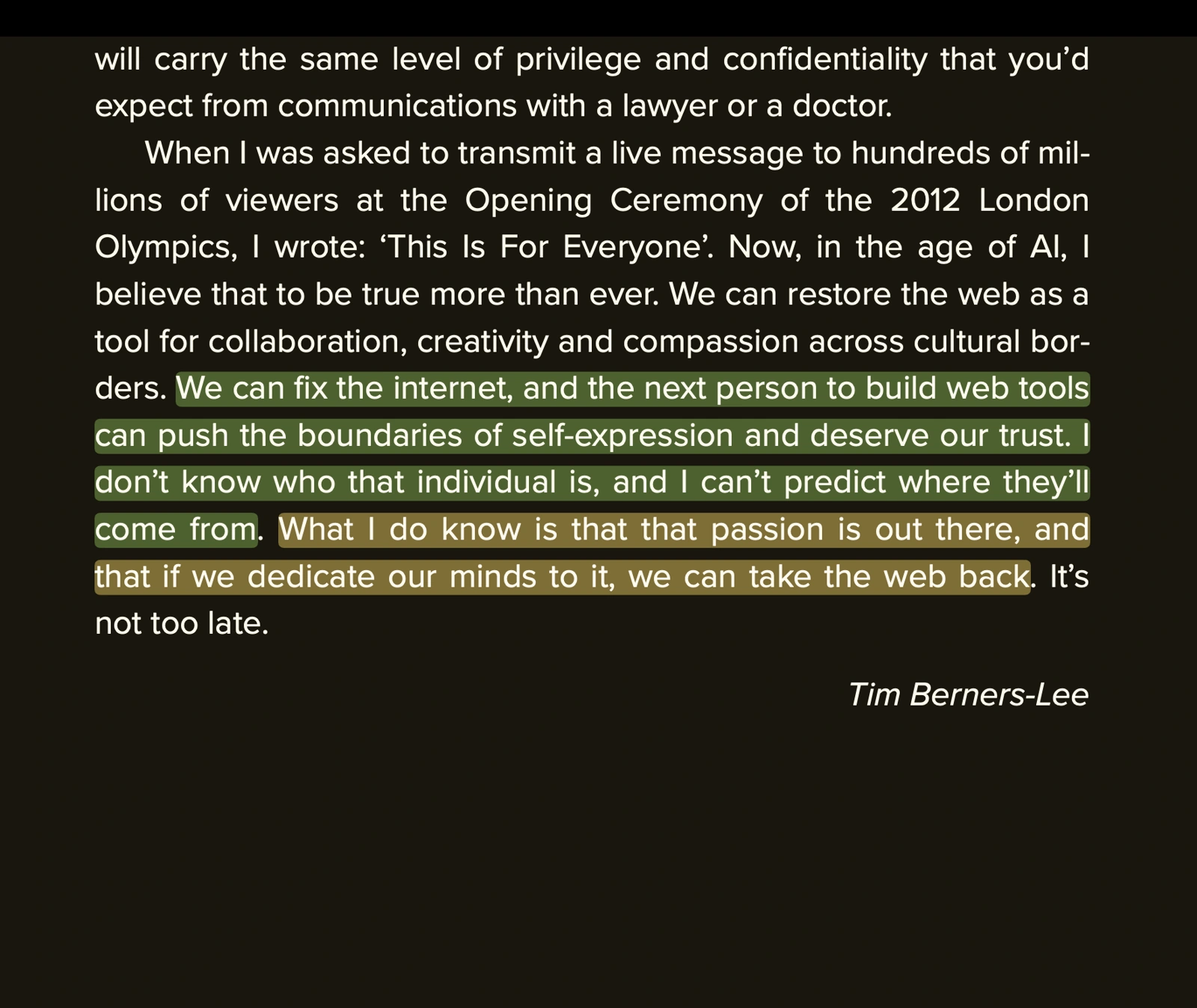
I read this as an invitation
When he said, “We can fix the internet,” I obviously thought about The Internet of Value. Then I read about the next person to build web tools, and my response was: I believe that person could be me.
I want to take the highlighted part apart, phrase by phrase, and put what we are building beside it. Here is the invitation I hear, and here is my response. The connections below are mine; Berners-Lee’s passage is not an endorsement of me or of The Internet of Value.
The passage, connected to the work
His words → my response
An invitation. Six places to begin.
“What I do know is that that passion is out there, and that if we dedicate our minds to it, we can take the web back.” — Tim Berners-Lee
The human layer
The way I picture it is this: HTTP made the exchange of content possible across the web. Bitcoin and UPI are different approaches to moving money or enabling value exchange. Protocols such as Beckn enable open-network transactions around goods and services. Then I ask: where does the person appear in this picture? Where are their time, their wellbeing and their contribution?
That is what I mean by a fourth layer: a human layer. This is my conceptual analogy for explaining the work, rather than a claim that these technologies form one formal network stack. The Internet of Value is the protocol system through which we are trying to make human time and contribution intelligible, with wellbeing and community context.
Its four protocols have different responsibilities. ~ValueCaptureProtocol records time, activity, evidence and attribution. ~WellbecomingProtocol supplies context across ~~Physiology, ~~Emotion, ~~Feeling, ~~Thought, ~~Habit and ~~Performance. Qualifying ~~Performance can enter ~SAOcommons for institutional review, attestation and valuation. ~WellbeingIdentity carries the living state shaped through those flows, with consent and disclosure choices.
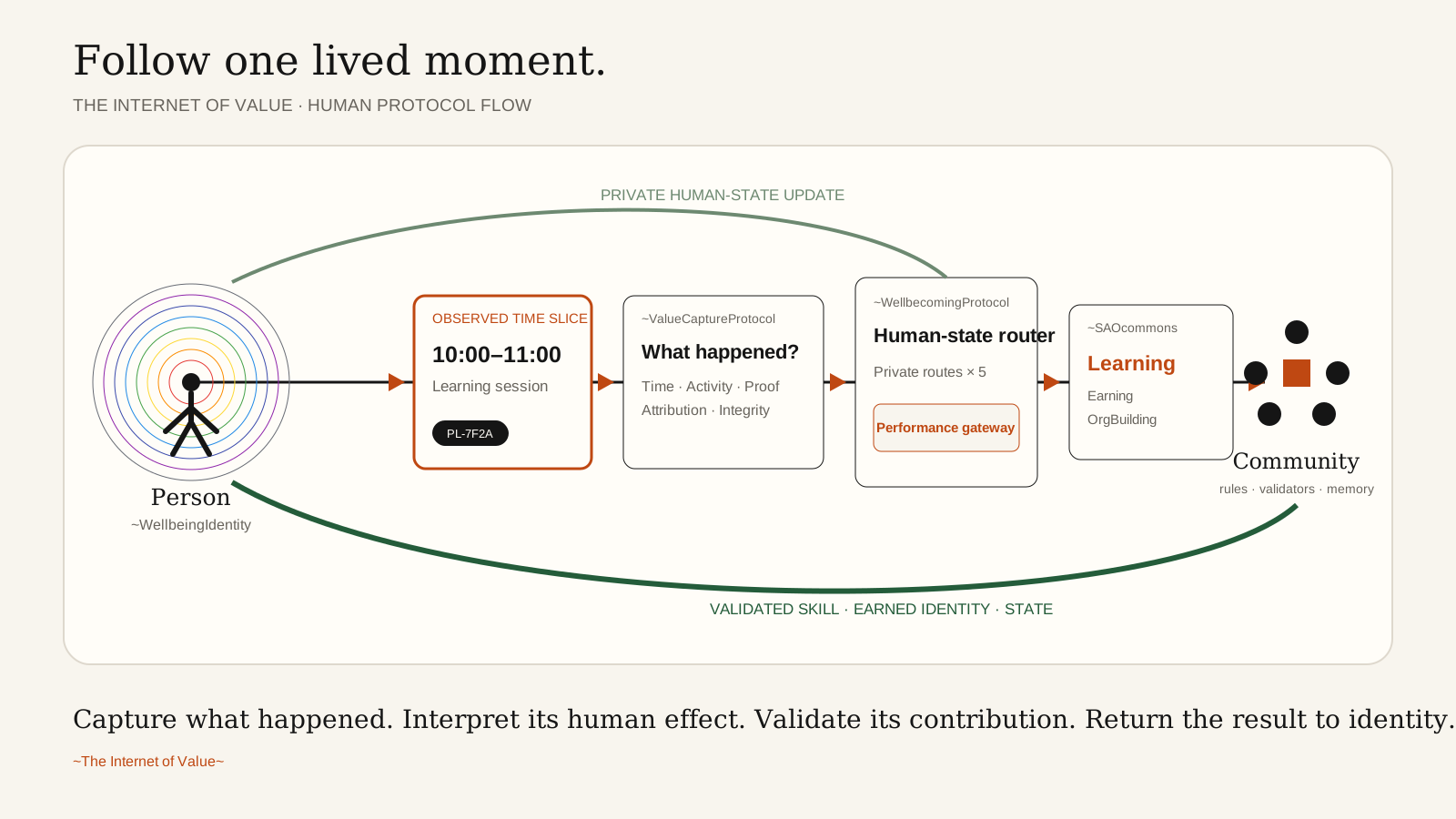
The person does not become an interchangeable transaction. The point is to carry more meaningful context about what they do, how they are doing and what others have actually recognised. The protocol lineage uses ~~~~ProtocolLinkId to connect records; it does not erase differences between a self-report, a calculation and an attestation.
More room for expression
Today, expressing something online often means building a website or an app, or working inside a platform’s chosen format. Twitter, Instagram and similar platforms give us tools, but they also set the boundaries of the expression.
With Word Wallet Web, I’m interested in another possibility: an expression that can be registered, given meaning, connected to a declared capability and carried into a wider community of use. The registered-expression catalogue and ~Cortisol Checker~ are concrete places to explore that direction.
I want creators and communities to be able to earn from the value they help create through those expressions. That is an economic ambition for the system. The current Word Wallet beta records attribution; it does not activate payouts, financial rights, ownership or guaranteed earnings. The Word Wallet Web explanation keeps those present capabilities and future possibilities distinct.
Trust should be earned
I’m grateful that he uses the words “deserve our trust.” For me, that means making something available for people to examine. Here is my identity. Here is the public wellbeing evidence I choose to share. Here is how the score is described and when it was calculated.
My ~~~WellbeingScore is not a certificate of moral worth. What matters to this argument is the willingness to make a claim inspectable, to show its method and limitations, and to let people decide what confidence they place in it. The latest available public update appears at the end of this entry, with a link back to my ~WellbeingIdentity.
Where I come from
I was born in Tirunelveli, Tamil Nadu, India. I’m mostly based out of Bangalore, and I’m in Goa as I record these thoughts.
So when I read “I don’t know who that individual is,” I want to put my ~WellbeingIdentity there. And when I read “I can’t predict where they’ll come from,” I have an answer about where this particular person comes from.
I’m saying this because I believe I can contribute to that future. The passage gives me an invitation to respond with the work itself.
As for the passion being out there, and dedicating our minds to taking the web back: I don’t have anything to add. That part already says what I feel.
Sources and further reading
- HTTP semantics: HTTP as an application-level protocol for distributed hypertext information systems.
- Bitcoin and UPI: different approaches to payment and value exchange.
- Beckn: open transaction networks, including goods and services.
- Word Wallet Web and registered expressions: current implementation and declared limits.