A signal needs context.
A context needs a grammar.
The protocol is a way to keep the records in the right places. What happened, how it affected Mira, whether a public contribution needs community validation, and what may update her identity are related questions with different responsibilities.
Where could wearable observations fit in the IoV protocols?
In this proposed mapping, ~ValueCaptureProtocol structures records of activity and time; ~WellbecomingProtocol distinguishes observations about human state and experience. ~SAOcommons supplies the community branch for eligible Performance validation. ~WellbeingIdentity is the governed living state updated through validated flows. These responsibilities remain distinct, and this story does not describe an existing Temple integration.[10][11][12][13]
Mira now has several records of one morning: a bodily measurement, a description of fear, a presentation and an interpretation she may revise. The Internet of Value proposes a protocol language relevant to keeping such records connected without collapsing them. I develop this system, so the same evidentiary discipline applies here: an explicit architecture is a proposal for organising information, rather than proof that using it improves wellbeing.
The current specification is version 0.7.0. It names four canonical Level 1 roots: ~ValueCaptureProtocol, ~WellbecomingProtocol, ~SAOcommons and ~WellbeingIdentity. Their roles distinguish time-bounded activity, contextual interpretation, community validation and living identity. These are relationships in a specified system, not four interchangeable scores.[10]
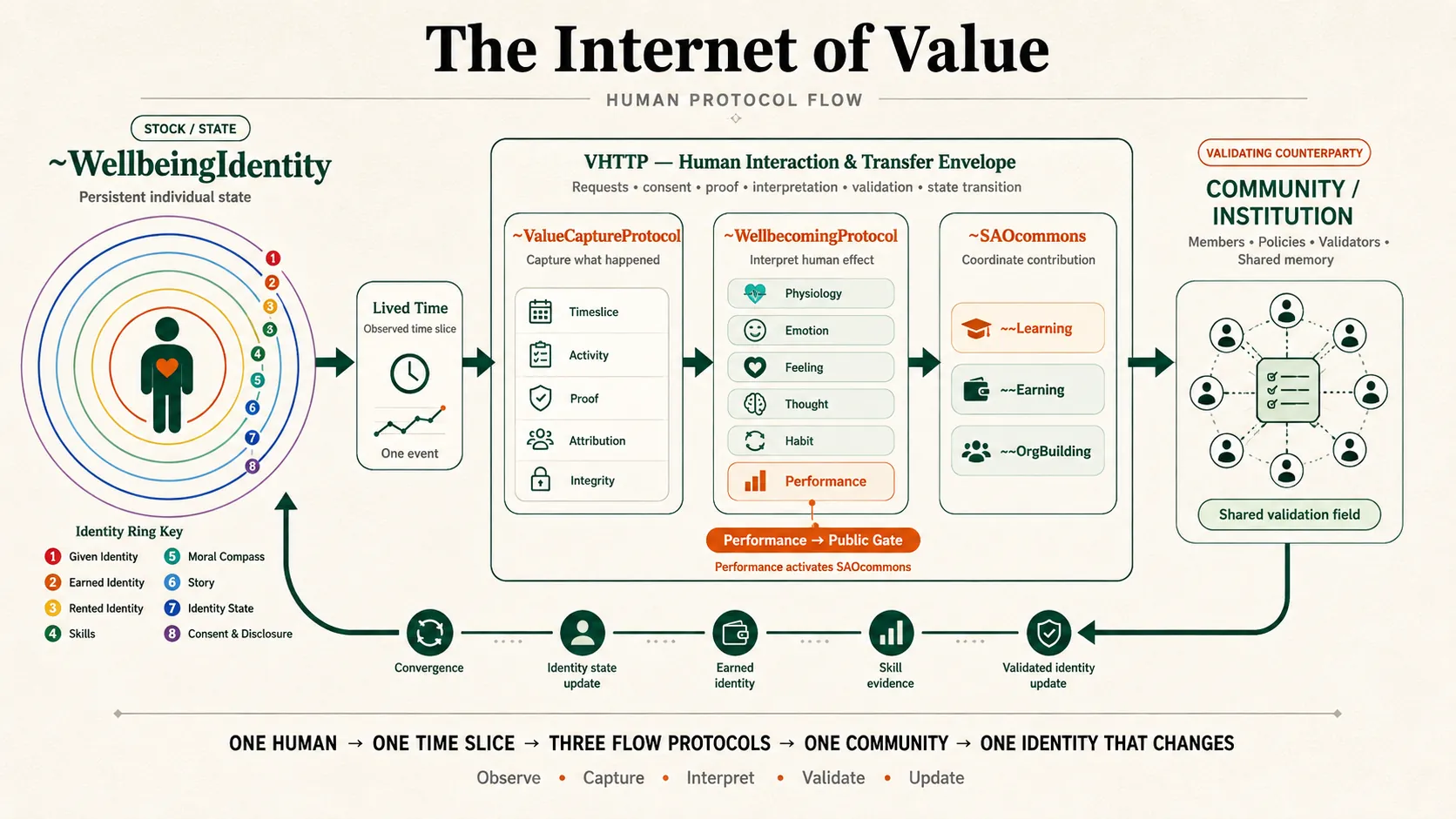
Read the map at full size
One moment, distinct responsibilities
~ValueCaptureProtocolBound the presentation interval; associate activity, proof, attribution and integrity.[11]
~WellbecomingProtocolInterpret captured activity through human context, including the six nodes below.[12]
~~PhysiologyPhysical and biological context~~EmotionBiochemical affective signals~~FeelingSubjective felt states~~ThoughtCognitive states and models~~HabitRecurring behaviour patterns~~PerformancePublic gateway outputs~~Performance outputs can activate ~SAOcommons validation across ~~Learning, ~~Earning and ~~OrgBuilding. This is not a requirement to disclose Mira’s private feelings or biometrics.[10]
~WellbeingIdentityConsent-governed living identity, updated through qualified protocol flows. Private context and a public contribution have different disclosure boundaries; an individual reading does not automatically constitute a new identity.[13]
The distinction between ~~Emotion and ~~Feeling is particularly important. The specification uses the former for biochemical affective signals and the latter for subjective felt states. Their presence in a registry does not establish that a wearable can measure cortisol or dopamine, or infer a person’s feeling from a pulse. Mira saying she felt afraid is a possible first-person input; an optical reading alone does not become the same evidence.[12]
| Possible input | IoV relationship | Evidence boundary |
|---|---|---|
| Optical or derived physiological records | ~WellbecomingProtocol→ ~~Physiology→ ~~~Biomarkers | Retain the distinction between a recorded signal and a derived index; include units, provenance and validation limits. |
| Spoken ideas and intentions | Potential evidence associated with ~~Thought | Speech is a person’s expression. Its transcription is not direct neural thought measurement. |
| Mira reports fear | ~~Feeling→ ~~~Fear | Identify the reporter and timing. Keep later model interpretations separately attributable. |
| A claimed biochemical affective signal | ~~Emotion | Needs a relevant validated measurement. This essay establishes no direct Temple measurement of these biochemical facets. |
| A recurring routine or completed presentation | ~~Habit or ~~Performance, according to evidence and purpose | A one-off event is not yet a habit. Public validation concerns qualifying outputs, with appropriate consent. |
The tilde depth carries meaning: ~ is an L1 protocol, ~~ an L2 node, ~~~ an L3 facet and ~~~~ an L4 signal. Describing a wearable as a possible source of signal evidence does not register a Temple-specific L4 path. The table therefore stops where the verified terminology stops, leaving any actual integration to define its schema and conformance requirements.[10]
The menu analogy now becomes a systems problem. Mira should be able to carry a record of what was served, an account of how she experienced it and a later interpretation without one application silently substituting one for another. A shared grammar can help preserve those distinctions. Whether its costs, usability and consequences justify adopting it is a further question that a specification cannot settle.