Deepinder Goyal’s Temple wearable, the science behind its claims, and the human experience beyond its measurements.
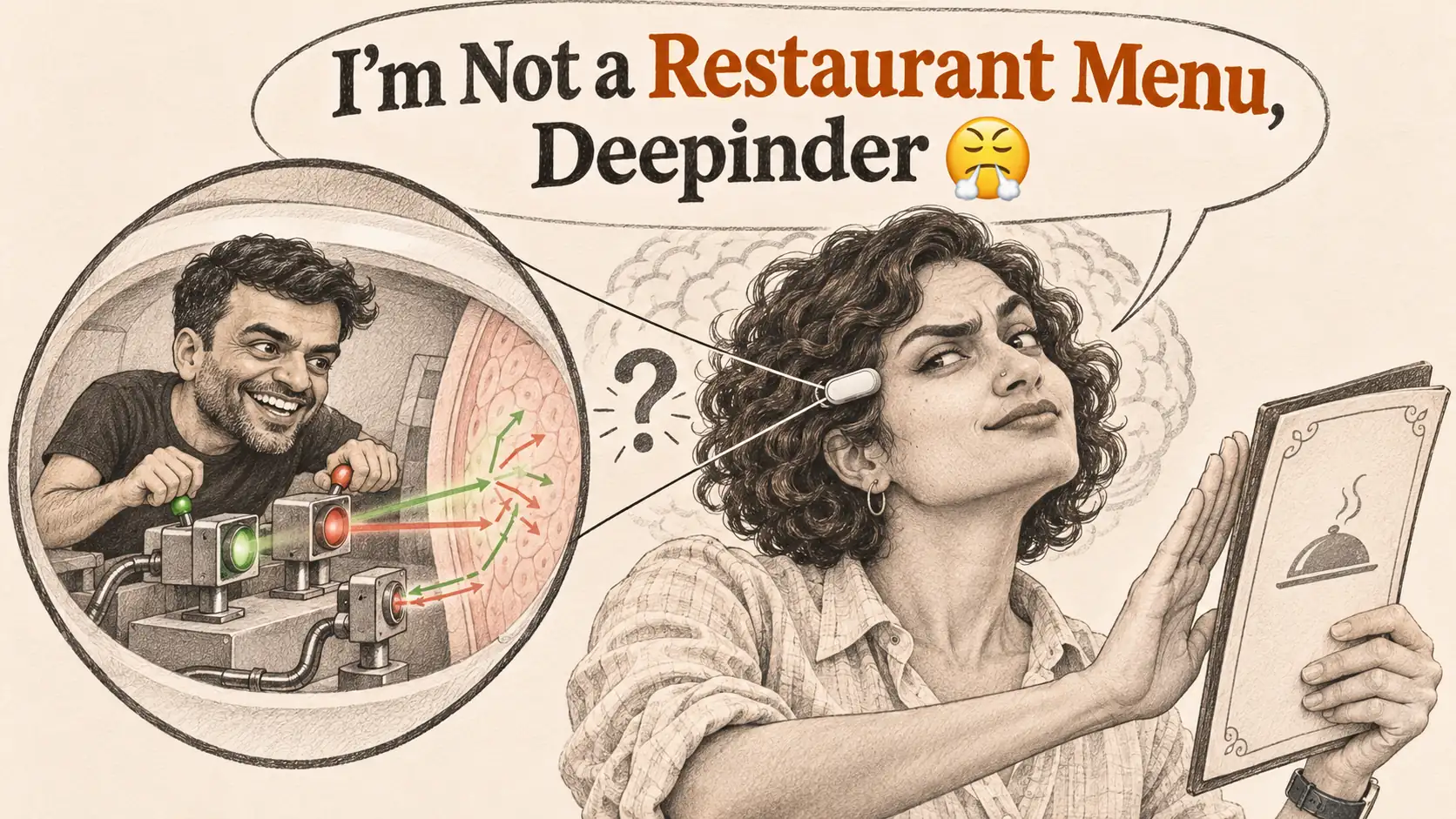
Satirical, AI-generated editorial illustration; all dialogue is invented. Mira wears a Temple-like sensor. The miniature Goyal and enlarged light paths are a conceptual metaphor, not an anatomical diagram or evidence that the device directly illuminates, reads or understands the brain.
A menu can tell Mira what is in her dinner. It cannot tell her what the dinner means. Eighteen years after putting restaurant menus online, Deepinder Goyal is helping turn signals from human tissue into information people can carry through a day. The scientific argument over Temple asks whether those signals measure what the company claims. A second question begins even if the first is answered: how much of a human being has become visible?
One fictional day carries this inquiry, from dinner before an important presentation to dinner the following evening. Mira’s readings, reflections and imagined interactions are illustrative. Product claims, research findings, mathematical demonstrations and protocol proposals are identified separately throughout.
Before Mira’s day begins
What is Temple, the wearable from Zomato founder Deepinder Goyal?
Temple is a skin-worn wellness device from Deepinder Goyal, the co-founder of Zomato. Worn near the temple, it uses optical sensing and reports derived wellness metrics. The company describes Entropy, Resting Entropy, Entropy Max and Span; their names and advertised meanings are company claims, whose measurement and interpretation require evidence. This illustrated inquiry follows one fictional day to examine the signals, the research and the experience behind them.[7]
Temple price, pre-orders and launch: the dated picture
As reviewed on , Temple’s site says pre-orders are open. November reporting gives a ₹85,000 price and a fourteen-day return window; its separate Temple 01 vision describes shipping in early 2027. These are dated descriptions, rather than a live offer or a hands-on review. Check the company’s current terms before relying on them.[2][7][9]
0120:40 · The evening before
The menu knows the dish. Mira knows the evening.
Follow the day
Mira can order from a menu without the menu knowing what dinner means to her. Keep that boundary in mind: making something measurable can be useful without making it a complete account of the person.
Why compare a wearable to a restaurant menu?
A menu describes a meal’s ingredients and price, while the person eating supplies its personal meaning. This is the article’s analogy for Temple: measurements can inform a decision without fully describing the person. Mira’s day is fictional; the product claims and research are sourced separately below.
An imagined dinner, illustrated with AI. Mira is fictional; the artwork does not depict Goyal, Temple hardware, or measured physiological data.
Mira has read the same line on the menu three times. Tomorrow she will present a project she has spent two years building, and her laptop is open beside the water glass. She keeps moving the first slide ahead of the second, hoping that somewhere inside this small rearrangement is the version of the story everyone will understand. When the waiter returns, she orders something familiar. For once, she would like one decision to make itself.
The menu is doing its job. It makes ingredients, prices and alternatives visible, helping her choose without having to enter the kitchen. What it leaves out is the particular life arriving at this table: the unfinished presentation, the appetite interrupted by anticipation, the memory attached to the dish. Another person could order the same dinner and have an entirely different evening. There is no error in the menu. There is a boundary around what it represents.
That boundary makes a useful starting point for Deepinder Goyal’s latest venture. Eternal’s own origin story describes him collecting takeaway menus and putting them on a website in 2008. The information already existed; making it accessible changed what people could do with it. Temple moves that instinct into a more difficult territory, where optical signals from tissue become physiological indices and, potentially, guidance for daily life. The connection is an editorial analogy, rather than a claim about a plan Goyal has followed for eighteen years.[1]
It would be easy to turn this into a story about an entrepreneur moving from food to the future of humanity. Mira’s dinner suggests a more useful question. If making the menu searchable helped people decide where to eat, what would make a physiological reading useful without allowing it to become an inadequate account of the person? To answer that, we have to follow the information beyond its appearance on a screen, through the evidence supporting it and the meanings someone assigns to it.
The founder is talking about a product proving useful in people’s hands. The doctors are asking how its measurements were validated. These questions can both matter; a return policy cannot answer the second one on its own.
Why are doctors questioning Deepinder Goyal’s Temple?
The November 2026 exchange concerns whether Temple’s measurements and broader health claims have adequate independent validation. Goyal’s defence points to commitment, customer choice and further studies; the doctors ask for evidence they can scrutinise. This chapter attributes those positions and keeps allegations separate from established findings. Read the three voices here, then follow the measurement evidence in the research chapter.[2][3][4]
Before leaving the restaurant, Mira opens the argument everyone seems to be having. Temple, reported at ₹85,000 for pre-booking, has become a dispute about what a small device at the side of the head can establish. On 5 November 2026, Goyal defended the project on X, citing its investment, his personal commitment and a fourteen-day return policy. In coverage published the following day, he described it as a fitness and wellness device rather than a medical device.[2][3]
Dr Rishabh Jain’s response separated consumer satisfaction from scientific validation. Dr Cyriac Abby Philips, known as The Liver Doc, challenged the brain-health claims more broadly. Their posts are part of the public record of the disagreement; they are not themselves experimental tests. Goyal’s commercial argument and the doctors’ evidentiary demands concern different questions, even when the exchange makes them sound like competing answers to the same one.[3][4]
The public exchange · Read without leaving the story
Three voices, different standards of evidence
Swipe between the cards or use the arrows. Each begins with an editorial paraphrase checked against dated reporting. “Read the original here” loads that post from X inside this page; it is optional and may depend on X being available.
1 / 3
5 November 2026
Deepinder Goyal
@deepigoyal · The founder’s defence
Goyal points to the team’s investment, his own commitment, the return window and expected independent studies. His case is that Temple deserves a chance to demonstrate value in use. Those are reasons to examine the product; they do not independently establish measurement accuracy.
@theliverdoc · The claim needs scientific scrutiny
Philips challenges the scientific basis and marketing of Temple’s brain-health claims, focusing on what the device can establish about cerebral circulation and broader health interpretation. His stronger allegations remain his assertions; this article evaluates the published evidence rather than adopting them as findings.
@DrRishabhOnco · Satisfaction and validation differ
Jain asks for scientific evidence that can be examined independently. Personal sacrifice, reputation, investment and a customer return policy do not establish the accuracy of a health-related measurement. A person enjoying a device and a study validating its output answer different questions.
Compare the output with a suitable reference, specify the quantity and units, and establish error, repeatability and the conditions under which it works.
Does it help?
Test whether using the information changes decisions or outcomes that matter. Enjoying a device, understanding a reading and benefiting from it are distinguishable results.
A return policy can reduce a buyer’s financial risk. It cannot independently establish the anatomical source or accuracy of a signal.
At the restaurant, Mira could send back a disappointing meal. That would tell us something about her satisfaction, but little about whether the kitchen’s thermometer was calibrated. Conversely, a correctly calibrated thermometer would not guarantee that she enjoyed dinner. The distinction gives both innovation and criticism room to be serious: preliminary experiments deserve examination, while investment and enthusiasm cannot carry a claim further than the measurements support.
The dispute also contains an invitation to overreach. An absence of established clinical benefit does not prove a device has no possible use, just as an interesting signal does not prove a longevity claim. This inquiry therefore leaves the loudest allegations aside and asks what the published comparisons actually tested. Mira closes her laptop and goes home; tomorrow, an ordinary change in her pulse will make the difference between a measurement and its interpretation much harder to ignore.
Stay with one simple picture: a little light goes into tissue and a detector measures what returns. A number comes from that signal. The extra work is showing what the number represents, and how reliably it does so.
How does the Temple wearable work?
Temple is worn against the skin near the temple and uses optical sensing to record pulse-related changes in tissue. A detector observes returning light; processing turns the signal into a reported index. The important question is what that index reliably represents. Measuring a pulse-related optical change is different from directly measuring an absolute volume of blood flowing through the brain.[5][6]
Mira arrives after a hurried walk and a shortened breakfast. In our fictional example, her pulse rises from 72 to 112 beats per minute as she waits to speak. Imagine a future wearable recording the change. The sensor has encountered a physical event, but the meaning of that event has not arrived with it. Before asking whether it represents anxiety, excitement or brain health, we should ask how the instrument has produced its output.
The Temple device described in Kumar and colleagues’ preprint uses multi-wavelength reflectance photoplethysmography, or PPG. Light interacts with tissue, and a detector records the returning intensity. The device’s Brain Flow index is a proprietary, dimensionless output. Its relationship to cerebral circulation is an empirical question, because a surface optical signal can also contain superficial and systemic contributions.[5]
Five words that make the science easier to follow
PPG
Using detected light to observe pulse-related changes in tissue.
Index
A number calculated from signals and a model; its meaning needs validation.
Correlation
How two changing signals move together.
Agreement
How closely readings match in the relevant units, including bias and error.
Validation
Evidence that a measurement or interpretation performs as claimed for a stated use.
What are Temple’s Entropy and Span metrics?
The company describes Entropy as an estimate of how hard the body is working to shed heat. It calls the resting value Resting Entropy and the highest sustained value near maximum heart rate Entropy Max; Span combines the two. These are the company’s descriptions of derived metrics. Their usefulness across the many advertised body systems requires validation beyond a name or a plausible physiological explanation.[7]
Figure 1 · The measurement chain
Optical interactionEmitted light meets tissue; returned intensity varies.
→
Recorded signalHardware and processing recover signal features.
→
Derived indexA model transforms features into Brain Flow.
Conceptual signal chain, informed by the Temple–TCD preprint. The diagram does not disclose Temple’s algorithm or establish where every signal component originates.
Mira’s margin notes · A cartoon explanation
“I sent light. Did a biography come back?”
1 · The sensor’s job
I send light into tissue and detect what comes back. Very illuminating. Literally.
Green · red · infrared IR shown as a dashed line
Temple · mascot
2 · The toy calculation
Suppose the reference reading is 100 and the next reading is 110.
So, 10% more returned light. Where exactly did you find my presentation panic?
+10%Relative optical change Meaning still needs evidence
Mira
The arithmetic describes a change in detected light. It does not, by itself, establish a 10% change in brain blood flow or identify a feeling.
Imagined exchange. The 100/110 readings are invented to unpack Equation 1. The light colours are schematic; they do not establish optical penetration depth or cerebral specificity.Open the equation · How much did the detected light change?
Equation 1 · Illustrative optical normalisation
sλ(t) = [Iλ(t) − Iλ,0] / Iλ,0
Iλ(t) is detected intensity at wavelength λ; Iλ,0 is a nonzero reference intensity. This dimensionless example describes a relative intensity change. It is explanatory mathematics, rather than a disclosed Temple computation.
A normalised signal can be mathematically precise while its biological interpretation remains uncertain. A model might combine several such features into an index; that does not make the index a direct reading of every process contributing to it. In menu terms, the transformation from kitchen observations to a description of a dish must be checked before anyone uses that description to infer how the dinner felt. Giving an output a suggestive name does not complete those checks.
Mira’s margin notes · A cartoon explanation
“Same speed. Bigger pipe. More water.”
1 · Mira spots two pipes
Both streams move at the same speed. But one pipe has twice the cross-sectional area.
A = 1
A = 2
Toy pipes, same speed
Mira
2 · Count volume per second
At 2 centimetres per second, area 1 gives flow 2; area 2 gives flow 4.
2 × 1 = 22 × 2 = 4cm/s × cm² = cm³/s
Deepinder · cartoon
3 · The naming problem
If a reference reports speed, I cannot silently rename it volume per second.
v ≠ QVelocity and flow have different units
Temple · mascot
To move from speed to volumetric flow, the relevant cross-sectional area and measurement assumptions matter.
Imagined exchange. This is an invented constant-flow pipe example for Q = v̄A, not a model of Mira’s arteries or Temple’s proprietary index.Open the equation · Speed × area gives volume per second
A dimensional distinction
Q = v̄ × A
For an appropriate vessel cross-section, volumetric flow Q equals cross-sectional mean velocity v̄ times area A. Velocity has dimensions of length/time; flow has dimensions of volume/time. Changes in velocity cannot automatically be read as identical changes in volumetric flow without considering vessel area and measurement assumptions.
This is why the reference matters as much as the wearable. Transcranial Doppler measures blood-flow velocity in an artery; a haemoglobin-related optical reference provides another kind of information. Neither becomes interchangeable with whole-brain perfusion simply because the signals rise together. Temple’s research can be evaluated fairly only by preserving these distinctions, rather than asking a study of one quantity to validate every possible interpretation of another.
Imagine two dancers who always move together. That tells us something real about their timing, but it does not make them the same dancer. The studies below test related movement in signals; the cartoon shows why that is a beginning rather than the whole claim.
Do the studies prove Temple accurately measures brain blood flow?
The two September 2026 preprints examined here report correlations between Temple’s index and reference signals during specific physiological challenges. They support studying whether the signals track related changes, but do not establish absolute cerebral blood-flow accuracy, diagnosis or longer life. The studies are unreviewed versions; correlation, agreement and clinical usefulness require different evidence. Mira’s two dancers make that distinction visible before the equation.[5][6]
While Mira waits, consider the evidence behind the index rather than the fictional reading on her wrist or temple. A September preprint by Kumar and colleagues compared Temple’s Brain Flow with middle cerebral artery velocity measured using transcranial Doppler. Twenty-three adults completed the programme, with 20 analysed per protocol. Median within-person correlations were 0.795 for exercise and 0.799 for posture transitions. The standardised comparisons concern relative responses, rather than agreement in absolute flow units.[5]
Figure 2 · TCD comparison · Reported study results
Two controlled challenges
0.795Exercise Median within-person r
0.799Postural transition Median within-person r
20 participants analysed per protocol; samples overlap but are not identical. Kumar et al., medRxiv, posted 4 September 2026. Preprint; Temple-funded, with disclosed consultancy. These coefficients are not percentages of accuracy.
A second preprint, by Gulati and colleagues, compared Temple with brain-assigned and scalp-assigned changes in oxygenated haemoglobin, recovered using a two-layer time-domain NIRS model. It analysed 60 sessions from 44 healthy young men. The chart below preserves all three conditions, including the one where the paired brain-versus-scalp difference did not reach statistical significance. This is a comparison with model-derived haemodynamics, rather than a direct whole-brain flow measurement.[6]
Figure 3 · TD-NIRS comparison · Reported study results
Deeper and superficial signals
Brain-assigned ΔHbOScalp-assigned ΔHbO
Head-down tilt0.912 / 0.494
Paired difference significantp < 0.001
Stand → squat0.843 / 0.700
Paired difference significantp < 0.001
Stand → supine0.839 / 0.767
Paired difference not significantp = 0.082
0Median Pearson r · lag adjusted1
Gulati et al., bioRxiv, posted 24 September 2026. Bar pairs show medians; p values test within-session paired differences. No raw data or uncertainty intervals are reconstructed. Temple designed, funded and conducted the study; affiliations include Boston University. Preprint, rather than independent replication.
Both studies offer preliminary evidence of covariation under specific challenges. Their scope leaves cerebral specificity, generalisation to everyday conditions and clinical benefit unresolved. The first discloses Temple funding and a paid consultant; the second discloses company conduct and employee authorship. Those relationships matter when weighing evidence, without making the results disappear. Independent replication would add something these comparisons cannot supply on their own.[5][6]
Mira’s margin notes · A cartoon explanation
“We’re in sync. Why aren’t we equal?”
1 · Mira climbs
I climb one step, then two, then three. Please record what actually happened.
1 · 2 · 3Synthetic reference D
Mira
2 · Temple follows with an offset
Twelve! Fourteen! Sixteen! Look how beautifully I follow you.
12 · 14 · 16Synthetic B = 2D + 10
Temple · mascot
3 · Deepinder checks the claim
The movement matches perfectly. But 12 is still not 1.
r = 1Perfect correlation Unequal values
Deepinder · cartoon
Correlation rewards moving together. Agreement asks whether the readings match in the relevant units and within acceptable error.
Imagined exchange. Three invented data points explain the same mathematical property as the five-point interactive plot. No Temple study data are being redrawn.Open the equation · What does correlation compare?
Equation 2 · Pearson correlation
r(B,D) = Cov(B,D) / [σB σD]
Correlation describes linear covariation when both variables have nonzero variance. For B = aD + b and a > 0, r = 1 even when the scale and offset differ. Agreement requires additional questions about units, bias and error.
Figure 4 · Try the mathematics · Synthetic data
Perfect correlation. Different readings.
B = aD + bEquality B = D (dashed)
r = 1.00When D = 3, B = 16. Perfect covariation does not make the readings equal.
Original arithmetic demonstration, with five synthetic points and a common arbitrary unit for the equality comparison. It illustrates a property of correlation; it is not a reanalysis of either Temple study. Set a = 1 and b = 0 to see equality.
Temple’s website also describes Entropy as a measure of the body’s effort to shed heat, and Span as a combination of resting and maximum Entropy. These are product interpretations requiring their own validation; neither follows automatically from Brain Flow correlations. The shared name does not, by itself, establish equivalence between a proprietary score and thermodynamic entropy in physical units.[7]
Mira’s menu offers the same warning in a less technical form. Two restaurants can increase their prices in perfect proportion while serving very different food. The relation between the numbers is real, but its existence does not settle the question the diner cares about. A strong correlation helps build a case for a measurement. The case still has to name the claim it is building.
Mira’s racing heart could accompany fear, excitement, a hurried walk, or several things together. The reading becomes more meaningful when she can add what was happening and how she experienced it. Her account is valuable evidence, while remaining open to revision.
Can Temple read your thoughts or know how you feel?
The optical studies discussed here do not demonstrate thought reading or an ability to identify Mira’s personal emotional experience. Temple’s separate roomdeaf voice-AI vision describes capturing words the wearer chooses to speak, which is different from reading unspoken thoughts. A bodily signal can prompt a useful question; Mira’s account adds context that the number alone cannot supply.[5][6][9]
Let us give Mira two possible mornings. In one, she wants the room to disappear: she imagines every question exposing a weakness in the project, and every pause sounding like failure. In the other, she is eager to begin, already anticipating the discussion she has been waiting to have. In both imagined versions her pulse is 112. Even a faultless heart-rate measurement would leave us unable to select between those experiences from that number alone.
Figure 5 · A fictional counterexample
112 beats / minute
“I want to leave.”
Mira anticipates humiliation. She would postpone the presentation if she could.
“I want to begin.”
Mira anticipates a valuable exchange. She is excited to share the work.
Identical hypothetical pulse, different reported meanings. These are alternative scenes, not study observations or outputs of Temple’s emotion detection.
Mathematically, this is a problem of identifiability. If a measured output is represented by y = g(z) + ε, where z includes underlying conditions and ε is measurement noise, more than one z may be compatible with the same y. Removing noise can make the observation more precise without making the inverse unique. Additional measurements, context and suitable assumptions may narrow the possibilities; they need evidence of their own. A physiological signal cannot earn a psychological interpretation merely by being measured very well.
Mira’s margin notes · A cartoon explanation
“112. That clears absolutely everything up.”
1 · One possible morning
112 beats a minute. I would quite like the floor to swallow me.
112“I’m afraid.” Hypothetical report
Mira
2 · Another possible morning
112 beats a minute. I cannot wait to show them what I built.
112“I’m excited.” Hypothetical report
Mira
3 · The sensor pauses
Same pulse. Two stories. I need your context, Mira.
One number.More than one compatible state
Temple · mascot
Even eliminating measurement noise would not make these two meanings uniquely recoverable from the pulse alone.
Imagined exchange. These are alternative fictional scenes. A caricature of the sensor is asking a question, not demonstrating an existing Temple emotion feature.
After speaking, Mira writes that she had been afraid her idea would be misunderstood, and that the first thoughtful question changed the atmosphere for her. The note adds a report of experience, an interpretation and an event that mattered. It also remains a report: Mira may revise it later, notice something she omitted or realise that she has reconstructed the morning through its successful ending. Treating her account seriously need not require treating it as infallible.
Ecological momentary assessment offers a research tradition for gathering reports near the moments they concern. Stone, Schneider and Smyth’s review examines the opportunities and unresolved problems: how questions are understood, what people actually report, missing responses, reliability and selection bias. A prompt delivered close to an event can preserve useful context, but adding prompts does not automatically produce an unbiased record of someone’s inner life.[8]
Measured
“The pulse was 112.” An instrument and its measurement conditions.
Reported
“I feared being misunderstood.” Mira’s account, at a stated time.
Inferred
“Presentations tend to unsettle Mira.” A hypothesis across observations.
Temple’s own vision makes this distinction particularly relevant. Goyal describes a proposed screenless voice companion that converts wearer-generated vibrations into text using motion sensors, under the name roomdeaf. Its intended uses include recording ideas and experiences. That is a direction involving explicit human input, with performance and privacy claims still requiring verification; it would be inaccurate to describe Temple’s ambition as passive sensing alone.[9]
Speaking a thought to a device is different from a device directly measuring thought, and a model’s summary is different again from the words spoken. Mira’s restaurant can now supply the rule: keep the menu, her review and the recommendation engine’s prediction distinguishable. All three may help her decide where to eat next. Their usefulness depends partly on remembering who said what, how they knew it and whether Mira has agreed to the interpretation.
There are 1,440 minutes. There is no denominator for a life.
Follow the day
Think of the day as a receipt with some lines filled in and some blank. Adding the recorded minutes tells us how much time the receipt covers. It cannot tell us how much of Mira’s life we understand, because meaning is not measured in minutes.
Does recording more of a day mean understanding more of a life?
Recording more minutes increases time coverage, provided overlapping intervals are counted only once. It does not supply an equivalent percentage of understanding. Mira’s receipt explains the calculation: count the filled-in minutes first, then ask what they tell us about her experience. The calculator uses illustrative records, not Temple data.
By late afternoon, the presentation is only one part of Mira’s day. She has slept, travelled, waited, eaten, worked and called someone who wanted to know how it went. An activity record could make some of those intervals visible, preventing the memorable hour on stage from swallowing the quieter hours around it. But a complete calendar and a complete account of experience are different ambitions, and the mathematics should preserve the difference.
Mira’s margin notes · A cartoon explanation
“I have the receipt for three-quarters of Tuesday!”
1 · Temple brings the ledger
I found records for 1,080 minutes. That is eighteen hours accounted for.
TIME RECEIPT1,080 min18 hours
Temple · mascot
2 · Deepinder does the division
Divide by 1,440. That is 75% time coverage, with 360 minutes still unrecorded.
75%1,080 / 1,440 360 minutes unknown
Deepinder · cartoon
3 · Mira reads the fine print
Lovely. Which percentage tells you what that phone call meant to me?
75% logged≠ 75% of a life understood
Mira
Coverage is a fraction of recorded duration. It is not a fraction of experience captured, personal insight achieved or wellbeing attained.
Imagined exchange. Invented time accounting, matching Equation 3. Missing time remains unknown rather than being filled with an assumed average.Open the equation · Count the minutes without counting twice
Equation 3 · Coverage of time intervals
Cday = Σi Δti / 1,440
Δti is the duration in minutes of a confirmed interval inside the chosen 24-hour window. Intervals must not overlap; if they do, use the duration of their union. This is illustrative accounting, rather than a canonical IoV wellbeing formula.
Figure 6 · An arithmetic example · No personal data
Time accounted for
75%
1,080 of 1,440 minutes are represented by non-overlapping records.
Start of 24-hour windowEnd
Orange means recorded time; grey means unrecorded time. The order of blocks is only a display convention. 75% time coverage says nothing about percentage of experience understood, accuracy of reports, or quality of life.
The missing quarter might contain an unremarkable commute, a private conversation, or the moment that matters most to Mira. It cannot responsibly be filled with a flattering average. Nor does recording every minute guarantee that the meaningful distinctions survived. A ledger can be exhaustive about duration and impoverished about experience, just as a menu can list every ingredient while remaining silent about the person eating.
A useful record would therefore preserve more than a timestamp. It could link an activity interval to a sensor observation and to Mira’s own account, while keeping each source and permission visible. The following tuple makes that design choice explicit; it is a conceptual example for this essay, rather than an existing protocol schema.
Mira’s margin notes · A cartoon explanation
“Two notes. One moment. Please keep the signatures.”
1 · The instrument’s slip
My note says: pulse 112 at 09:14. Include my units and measurement conditions.
SENSOR112 bpm09:14
Temple · mascot
2 · Mira’s own account
My note says: I feared being misunderstood. Please keep that in my voice.
FIRST PERSON“I feared…”Mira’s report
Mira
3 · Provenance and permission
Link the notes to the activity. Keep any model inference separate. Ask Mira what may be shared.
Time + activitySource + consent
Deepinder · cartoon
An observation record can connect different evidence without merging who produced it, what it claims or who may access it.
Imagined exchange. A cartoon unpacking of the conceptual tuple in Equation 4, not an existing Temple–IoV data pipeline or canonical record schema.Open the notation · What belongs in the record?
Equation 4 · An illustrative observation record
Oi = (ti, ai, si, fi, pi, ci)
t: bounded time · a: activity · s: sensor record · f: first-person report · p: provenance, including model versions where relevant · c: consent scope. A link between records does not make their contents equally certain or give them identical disclosure rights.
The tuple does not solve self-understanding. It makes certain mistakes harder to hide: an inferred feeling cannot quietly become a quotation from Mira, and a recorded interval cannot quietly become proof of value. Once the sources remain distinct, a system can allow her to correct, qualify or decline an interpretation. The next question is whether that discipline can survive when records move between applications and begin to affect a representation of who she is.
A signal needs context. A context needs a grammar.
Follow the day
The protocol is a way to keep the records in the right places. What happened, how it affected Mira, whether a public contribution needs community validation, and what may update her identity are related questions with different responsibilities.
Where could wearable observations fit in the IoV protocols?
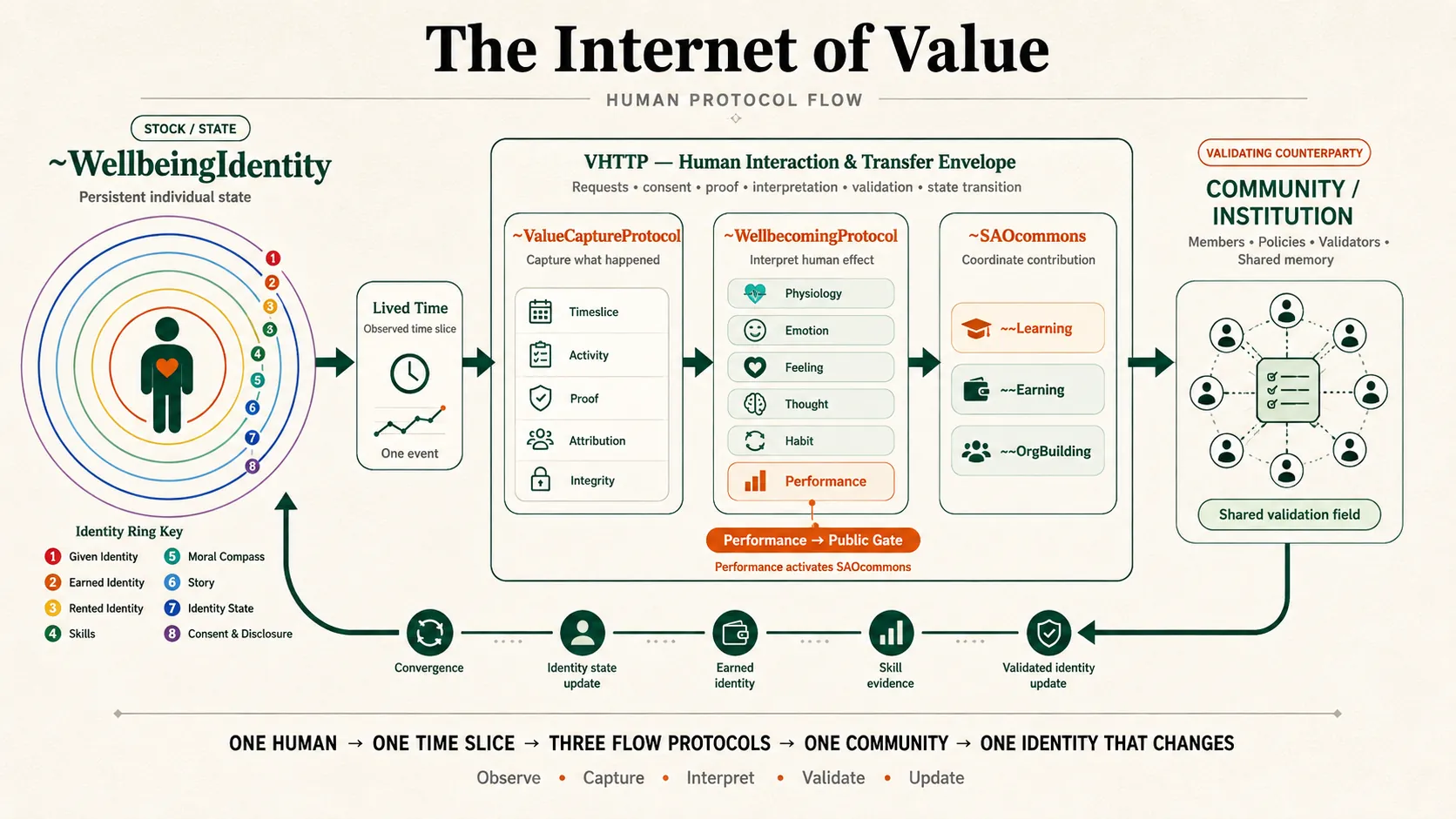
In this proposed mapping, ~ValueCaptureProtocol structures records of activity and time; ~WellbecomingProtocol distinguishes observations about human state and experience. ~SAOcommons supplies the community branch for eligible Performance validation. ~WellbeingIdentity is the governed living state updated through validated flows. These responsibilities remain distinct, and this story does not describe an existing Temple integration.[10][11][12][13]
Mira now has several records of one morning: a bodily measurement, a description of fear, a presentation and an interpretation she may revise. The Internet of Value proposes a protocol language relevant to keeping such records connected without collapsing them. I develop this system, so the same evidentiary discipline applies here: an explicit architecture is a proposal for organising information, rather than proof that using it improves wellbeing.
The current specification is version 0.7.0. It names four canonical Level 1 roots: ~ValueCaptureProtocol, ~WellbecomingProtocol, ~SAOcommons and ~WellbeingIdentity. Their roles distinguish time-bounded activity, contextual interpretation, community validation and living identity. These are relationships in a specified system, not four interchangeable scores.[10]
The existing Human Protocol Flow visual, reused in its full approved frame. In Mira’s case, a private observation can remain private; the community branch concerns eligible Performance outputs. The illustration is an explanatory map, not evidence of an existing Temple integration. [18]Read the map at full size
Figure 7 · Canonical roots, illustrated through Mira’s morning
One moment, distinct responsibilities
1~ValueCaptureProtocol
Bound the presentation interval; associate activity, proof, attribution and integrity.[11]
2~WellbecomingProtocol
Interpret captured activity through human context, including the six nodes below.[12]
~~PhysiologyPhysical and biological context
~~EmotionBiochemical affective signals
~~FeelingSubjective felt states
~~ThoughtCognitive states and models
~~HabitRecurring behaviour patterns
~~PerformancePublic gateway outputs
Conditional public route
~~Performance outputs can activate ~SAOcommons validation across ~~Learning, ~~Earning and ~~OrgBuilding. This is not a requirement to disclose Mira’s private feelings or biometrics.[10]
~WellbeingIdentity
Consent-governed living identity, updated through qualified protocol flows. Private context and a public contribution have different disclosure boundaries; an individual reading does not automatically constitute a new identity.[13]
The four roots and six nodes are canonical. Mira’s examples and any Temple input mapping are proposed illustrations. No deployed Temple–IoV integration is asserted.
The distinction between ~~Emotion and ~~Feeling is particularly important. The specification uses the former for biochemical affective signals and the latter for subjective felt states. Their presence in a registry does not establish that a wearable can measure cortisol or dopamine, or infer a person’s feeling from a pulse. Mira saying she felt afraid is a possible first-person input; an optical reading alone does not become the same evidence.[12]
Retain the distinction between a recorded signal and a derived index; include units, provenance and validation limits.
Spoken ideas and intentions
Potential evidence associated with ~~Thought
Speech is a person’s expression. Its transcription is not direct neural thought measurement.
Mira reports fear
~~Feeling → ~~~Fear
Identify the reporter and timing. Keep later model interpretations separately attributable.
A claimed biochemical affective signal
~~Emotion
Needs a relevant validated measurement. This essay establishes no direct Temple measurement of these biochemical facets.
A recurring routine or completed presentation
~~Habit or ~~Performance, according to evidence and purpose
A one-off event is not yet a habit. Public validation concerns qualifying outputs, with appropriate consent.
The tilde depth carries meaning: ~ is an L1 protocol, ~~ an L2 node, ~~~ an L3 facet and ~~~~ an L4 signal. Describing a wearable as a possible source of signal evidence does not register a Temple-specific L4 path. The table therefore stops where the verified terminology stops, leaving any actual integration to define its schema and conformance requirements.[10]
The menu analogy now becomes a systems problem. Mira should be able to carry a record of what was served, an account of how she experienced it and a later interpretation without one application silently substituting one for another. A shared grammar can help preserve those distinctions. Whether its costs, usability and consequences justify adopting it is a further question that a specification cannot settle.
The day can change her. A score cannot define her.
Follow the day
Mira is more than her pulse this morning or a score this evening. Her history, skills, values and choices still matter. A representation becomes more useful when she can help confirm it, challenge it and govern what leaves her private record.
How is Wellbeing Identity different from a wearable score?
~WellbeingIdentity is a living state with eight canonical nodes, including history, capabilities, values and consent; WellbeingScore is a facet under ~~IdentityState. It is updated through validated protocol flows rather than equated with a sensor reading. Mira’s ability to observe, contest and govern the representation is part of this proposal, whose usefulness still requires evaluation.[13][14][15]
Mira’s margin notes · A cartoon explanation
“One heartbeat. Quite an ambitious biography.”
1 · A tempting shortcut
Could I turn this one pulse reading into “Mira is an anxious person”?
112 bpm ↓ Entire personality?
Temple · mascot
2 · Mira keeps the pen
That is a lot of biography for one heartbeat. I would like a say in the story.
My story.History · values skills · consent
Mira
3 · Deepinder slows the leap
A signal can inform a record. Identity needs qualified evidence and governed updates.
Evidence first.No automatic identity verdict
Deepinder · cartoon
Wellbecoming context and Wellbeing Identity have different roles. Neither a sensor reading nor a cartoon’s confidence can collapse the distinction.
Imagined exchange. Fictional dialogue introducing the identity boundary. The canonical Wellbeing Identity and baseline rules remain explained below in the original text.
Back at home, Mira looks at the presentation again. The morning was demanding, but she would choose it again. A system optimised only to lower arousal might have suggested avoiding the very event she values. Her reflection brings in a different kind of context: what she is trying to become, what discomfort she considers worthwhile and which judgements she wants to retain the authority to revise. These questions concern an evolving person, rather than the interpretation of a single signal.
This is the role of ~WellbeingIdentity in the IoV architecture. Its nodes include given and earned identity, platform-based rented identity, skills, a moral compass, story, living identity state and consent. The vocabulary extends beyond physiology into biography and agency. It remains a representation of a person, with the limits and governance obligations that any representation introduces.[13]
~~GivenIdentityGiven or legally anchored context
~~EarnedIdentityCredentials, experience and portfolio
~~RentedIdentityPlatform handles and social surfaces
~~SkillsCapabilities and their trajectory
~~MoralCompassValues and ethical boundaries
~~StoryPast, present, future and turning points
~~IdentityStateLiving state and score history
~~ConsentAndDisclosureDisclosure rules and consent controls
Version 0.7.0 also distinguishes a calculated daily Wellbeing state from a constituted Genesis Baseline. Baseline formation draws on identity, observed Wellbecoming, first-person assessment, consent and issuer review; it is not simply a sensor average. Its replay boundary prevents pre-Genesis observations used as baseline evidence from later being counted again as movement. The distinction is a specification contract, rather than evidence of clinical validity.[14]
The difficult question turns back on my own work. IoV includes a composite ~~~WellbeingScore under ~~IdentityState. What construct does it represent, how sensitive is it to missing observations, and when could a mathematically consistent change misrepresent someone’s life? A name in a registry cannot answer these questions any more than the name Entropy can validate a product score. The obligation to define assumptions and test usefulness travels with both systems.[15]
Control over the record is equally consequential. Temple’s vision states that conversations are encrypted and do not reach a model company. Its privacy policy, updated 31 October, permits certain app features to use third-party AI with prompts and device metrics, while prohibiting those partners from using the data to train or improve their services. These may describe different processing paths. The documents leave a practical question about which path handles which input; they do not justify announcing a proven contradiction.[9][16]
For Mira, useful answers would identify where her spoken note is processed, what is retained, what she can export and how a correction propagates to later inferences. Temple’s policy promises access, correction, deletion, export and consent withdrawal. Those promises can be examined in implementation. IoV’s consent language needs the same practical examination: a disclosure rule matters only if the systems carrying the record honour it.[16]
At dinner, the menu never claimed to own Mira’s review or decide whether she was a discerning person. Technologies that build persistent profiles can acquire far more power. Representing her well therefore requires both richer evidence and boundaries around its use. A better account of a human being should leave that human able to challenge the account, including when the record looks orderly and the model sounds certain.
We return to the restaurant with a testable question: does combining sound measurement with careful personal observation help people make better decisions? More records would not be enough to establish success. The result would have to matter in the life being recorded.
What would make a richer record worth keeping?
The practical test is whether the record helps a person make better decisions in a life they recognise as their own. That requires sound measurement, useful interpretation and control over disclosure. The final restaurant scene turns the argument into a proposal to evaluate, rather than treating more data or a richer protocol as proof of benefit.
Mira returns to the restaurant the following evening. The menu has barely changed, but she has. The presentation has become a conversation she can continue, and the possibility she feared yesterday has acquired a different shape. She orders the familiar dish again. If we recorded only the order, the two evenings might look identical; if we recorded only a pulse, we might miss why tonight feels easier. Even her own explanation will remain open to what she notices tomorrow.
The useful comparison is therefore an experiment we could lose. After validating any sensor measurements required for the task, a study could compare sensing alone, structured first-person observation alone and their combination. A suitable control or usual-practice arm would help distinguish the effects of monitoring from the passage of time and the attention participants receive. The intervention would need a clear purpose and a primary outcome chosen before seeing the results.
Condition ASensor recordsValidated physiological information and the context needed to interpret its limits.
Condition BPersonal observationTimed reports about activity and experience, with a measured reporting burden.
Condition CLinked recordsBoth sources, with explicit provenance and the ability to reject interpretations.
One test might ask whether participants make better decisions about a specific recurring situation, assessed independently of the system’s own score. Another could examine calibration: do people become better at distinguishing what the evidence supports from what they merely believe? Any claims about wellbeing would require appropriate outcome measures and a design able to estimate benefit as well as harm. Reporting burden, missingness, privacy, cost and the possibility of increased preoccupation should count in the result, rather than vanish into a footnote.
The combined condition might help. It might also produce more records without better judgement, or require enough attention that people stop using it. An IoV-based implementation would have to demonstrate an advantage over simpler alternatives. A Temple-based implementation would have to demonstrate the value of the signals and features actually available. Neither gets to declare success because the architecture is elegant, the founder is committed or a fictional Mira finds a satisfying ending.
Conceptual illustration: a description of the meal and an account of the evening can remain connected without becoming interchangeable.
The menu was an achievement because it made useful information available. It became more valuable when it helped a person act. Wearables may extend that achievement into parts of life previously difficult to observe, while protocols may help those observations travel with their meaning and permissions intact. But the diner remains the reason for the system. When Mira puts down her notebook and begins to eat, she is living the evening that every record can only partially describe.
~
End of signal · The person continues
Evidence, provenance & limits
Sources and editorial notes
Evidence reviewed on 8 November 2026. This is an authored analysis by the developer of The Internet of Value. The IoV material describes a protocol proposal and specification, not a clinically validated measure of a person. Mira, her dialogue and all personal readings are fictional. All cartoon dialogue, including the Deepinder caricature’s lines, is invented explanatory dialogue rather than a quotation or an account of a real exchange. The equations and interactive examples are explanatory unless explicitly attributed to a source.
The two cited Temple studies are September 2026 preprints. The medRxiv full text and bioRxiv abstract, methods summary and disclosures were retrieved; their publication pages identify them as unreviewed versions. Dated reporting was used to cross-check the public exchange because direct X retrieval was restricted. The publisher’s oEmbed service confirmed the author and availability of each of the three linked posts during preparation; their original contents are loaded from X on request, rather than reproduced as verified transcripts. Links to original posts are retained for inspection, with no claim that their full threads were independently retrieved. Product pages and privacy statements describe company claims and policies, rather than verified performance or a legal audit.
01
Eternal · Culture and the original menu websitePrimary corporate origin account: collecting takeaway menus and putting them online in 2008. The connection to Temple is this essay’s analogy, rather than an assertion of Goyal’s motivations.
02
NDTV · Goyal’s response to doctors, 6 November 2026Dated coverage of pre-orders, reported ₹85,000 price, fourteen-day returns and the wellness-device positioning. The original statement is dated 5 November: Goyal’s X post. Price is contextual reporting, not a live offer.
Kumar et al. · Temple and transcranial Doppler“Concordance Between a Temple-Worn Optical Wearable and Transcranial Doppler During Exercise and Postural Transitions in Healthy Adults.” Posted 4 September 2026. DOI: 10.64898/2026.09.02.26362022. Preprint. Funding, consultancy and standardisation limits are disclosed; Figure 2 restates reported coefficients.
06
Gulati et al. · Temple and depth-resolved TD-NIRS“Evaluating Brain Flow Index from a temple-worn wearable against depth-resolved time-domain NIRS during head-down tilt and postural transitions in healthy young men.” Posted 24 September 2026. DOI: 10.64898/2026.09.17.751664. Preprint. Figure 3 restates abstract results and preserves the non-significant condition; the deeper reference is model-derived.
Stone, Schneider & Smyth · Ecological momentary assessment“Evaluation of Pressing Issues in Ecological Momentary Assessment,” Annual Review of Clinical Psychology 19, 107–131 (2023); first online December 2022. DOI: 10.1146/annurev-clinpsy-080921-083128. Research context and methodological limits, rather than validation of Temple or IoV.
09
Temple · Humanity’s Last Personal DevicePrimary vision statement for roomdeaf speech capture, personal logging and encryption claims. Retrieved 8 November 2026; the page describes Temple 01 shipping in early 2027. Planned capabilities are not treated as independently demonstrated functions.
10
The IoV Datatracker · Version 0.7.0Canonical four-root stack, tilde layering and protocol relationships. “Production-candidate” is the specification’s maturity label, not clinical evidence.
11
Value Capture Protocol · Canonical mapTimeSlice, Activity, Proof, Attribution and Integrity. Mira’s intervals illustrate the role; the tuple in Equation 4 is not a canonical schema.
12
Wellbecoming Protocol · Canonical mapThe six nodes and relevant Biomarkers and Fear facets. Emotion and Feeling are existing distinct nodes. Temple input routes are proposed mappings, with no registered Temple-specific L4 signal asserted.
13
Wellbeing Identity · Canonical mapThe eight identity nodes, living state and consent/disclosure framing. A fuller representation should still be evaluated for bias, burden and downstream use.
14
IoV 0.7.0 · Genesis and baseline formationPublished 28 July 2026. Daily calculated state versus constituted baseline; observation-backed formation, consent and the prohibition on replaying baseline evidence as later movement.
15
Spec API · Wellbeing ScoreThe L3 composite-state facet under ~WellbeingIdentity → ~~IdentityState. Its presence does not establish construct validity or clinical usefulness.
16
Temple · Privacy policyLast updated 31 October 2026. Sections 4 and 5 cover AI providers, training-use restrictions and user rights. The relationship between app processing and the vision statement’s conversation guarantees remains a question for a feature-specific data-flow explanation.
Human Protocol Flow · Existing approved visualThe same complete composition used in the Dhun reader. Private observations and the conditional public Performance gateway remain distinct. The graphic is explanatory; the current specification governs protocol claims.
Source of Truth (Specs)
Protocol terms are grounded in the IoV registry, the core specification and the SAOcommons interoperability contract. A linked observation, an attestation and a Wellbeing Identity update are distinguishable operations. The quoted essay and reused visual explain those relationships; they do not override their definitions or establish a deployed Temple adapter.
Cartoon approach: original character-led explanations and small comic scenes, prompted by the reader’s reference to Wait But Why’s Elon Musk introduction. No dialogue, drawings or scientific claims are copied from that article.