
Whitepaper · v0.2
The ~WellbeingIdentity Rendering Architecture
One canonical identity reference across private, public, replay, and teaching surfaces.
00
Abstract · v0.2
The thesis
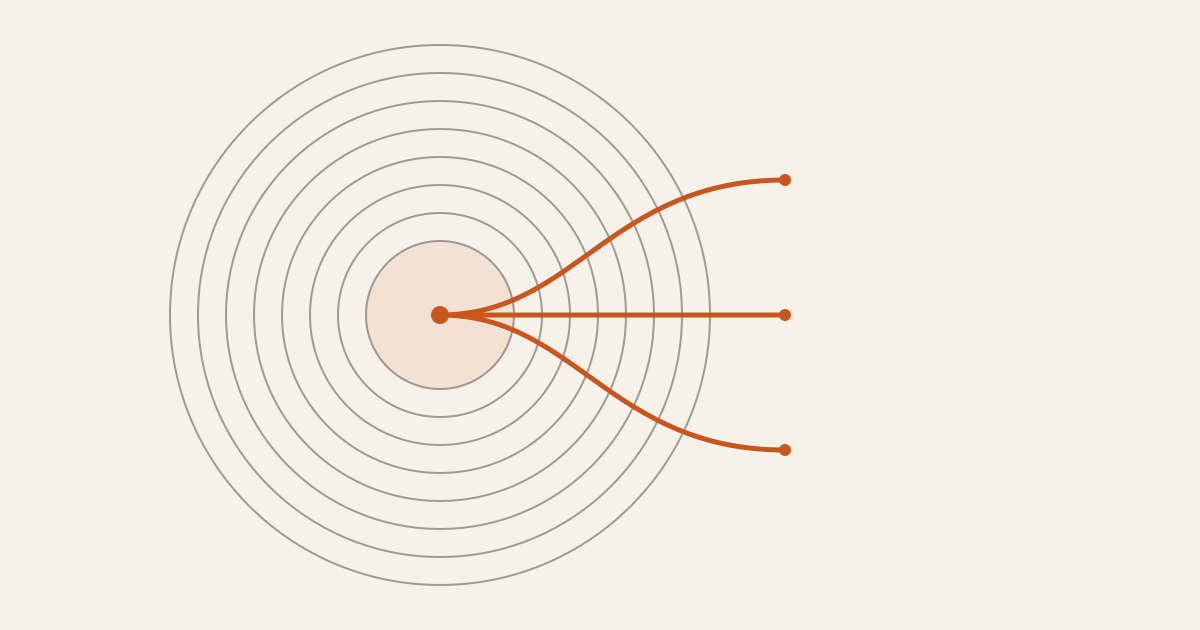
One person can be read through several legitimate views when those views share meaning but not indiscriminate access. A canonical reference is an anchor and grammar, not a universal profile.
The proof
The paper traces two paths end to end: a consented public profile and an owner-authorised replay. Each uses an intentionally minimised projection rather than a copied identity record.
The boundary
Word Wallet Web governs verified owner binding and consent. The renderer receives an already-authorised projection; it does not fetch records, calculate a score, decide disclosure, or alter canonical history.
The edition
v0.2 rebuilds the argument and responsive visual presentation. It does not change protocol semantics, renderer behaviour, contracts, consent boundaries, or product runtime.
This paper uses the canonical tilde grammar of The Internet of Value: ~ protocol, ~~ node, ~~~ facet, and ~~~~ signal.
Choose format
Start with the version that fits your attention.
Reader guide
How to read protocol notation
Canonical grammar
A single tilde marks a protocol, double tilde marks a node, triple tilde marks a facet, and four tildes mark a signal.
~ProtocolProtocol~~NodeNode~~~FacetFacet~~~~SignalSignal
Sources & Edition
Edition utility
This public architecture edition was developed with AI-assisted drafting and structure review under human authorship, source verification, and public-safety review.
BibTeX citationBibliography, methods, and version historyPublic edition ledger