
Prologue · 00
VĀDA: An Invitation to Disagree
Vaiśeṣika, Nyāya and Vāda: an introduction to reality, knowledge and disciplined disagreement, told through a fictional village bridge.
Quick Answer
Imagine building a bridge that everyone agrees is necessary, but nobody agrees is safe, useful, or worth its cost. The disagreement is not necessarily a problem. It may be the beginning of a better design.
Centuries ago, Indian philosophical traditions developed sophisticated ways of examining questions like these. Vaiśeṣika investigated the categories of reality, Nyāya investigated the foundations of valid knowledge and reasoning, and Vāda emerged within the Nyāya tradition as a disciplined form of argument involving competing positions, evidence, and logical examination.
This essay introduces these traditions and explains why they inspire a new public dialogue series at the Internet of Value Research Foundation. We are developing protocols to make human time, wellbeing, and contribution more observable and intelligible. But before asking others to trust our propositions, we should be willing to examine them in public.
A bridge that everyone can see, but nobody can agree upon
Imagine a small village divided by a seasonal stream. During the summer, crossing is relatively easy, but during the monsoon, residents must walk several kilometres to reach the other side. Children take longer to reach school, farmers struggle to transport produce, and families have to plan their days around a landscape that changes with the rains.
Eventually, the community constructs a modest footbridge. People gather to celebrate its completion, and for a while, the project appears to be an unquestionable success. But before long, someone asks whether the bridge has actually improved life in the village.
One farmer is convinced that it has. His journey to the market is shorter, and he no longer worries about missing the morning buyers. A schoolteacher agrees that the route is faster but questions whether the bridge will remain usable during the heaviest rains. An older resident points out that maintaining the structure could become a burden on families who rarely use it. Meanwhile, a young researcher produces a notebook containing measurements of journey times and crossing frequency.
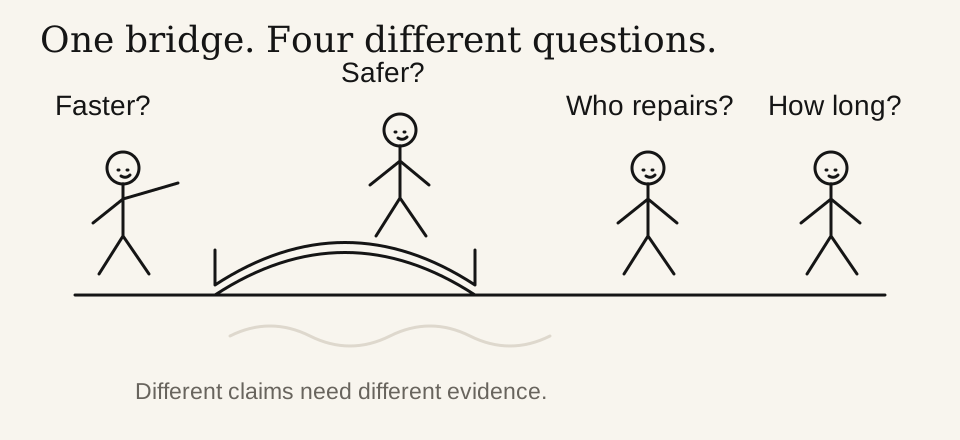
All four people are looking at the same bridge, yet their conclusions are different. They are not necessarily disagreeing because somebody is irrational or dishonest. They may be discussing different properties of the bridge, relying on different kinds of evidence, and using different meanings of the word better.
The farmer means quicker access to markets. The teacher means reliable access to education. The older resident means a fair distribution of maintenance responsibilities. The researcher means measurable changes in how people travel. Each person may be describing something important, but none can establish the whole picture by insisting that their observation is the only one that matters.
I find this kind of disagreement particularly interesting because it reveals a problem that often appears long before people begin arguing. We assume that because we are using the same word, we are discussing the same thing. Then we become frustrated when other people refuse to accept conclusions that seem obvious to us.
If our villagers want to resolve the question of whether the bridge has improved their lives, they must do something more fundamental than count votes or argue more loudly. They need to examine what they are talking about, what would count as knowing something about it, and how competing interpretations can be tested.
This is where I want to introduce three ideas from Indian philosophy.
Vaiśeṣika: Before we measure something, what exactly are we measuring?
The first question concerns the nature of reality itself. When we say that a bridge exists, we are referring to something relatively concrete. But what about its usefulness, strength, accessibility, or the time it saves? Are these independent things, properties of something else, relationships, or judgments arising from human experience?
Vaiśeṣika is one of the classical darśanas, or philosophical systems, of the Indian tradition. Traditionally associated with the sage Kaṇāda and the Vaiśeṣika-sūtra, it developed a realist and pluralistic account of the world through categories called padārthas. Rather than treating everything we experience as though it belonged to the same category, Vaiśeṣika sought to distinguish the fundamental kinds of realities and relationships that make knowledge possible.
The mature, commonly taught system recognizes seven padārthas: substance (dravya), quality (guṇa), action or motion (karma), universality (sāmānya), particularity (viśeṣa), inherence (samavāya), and absence (abhāva). The foundational tradition originally worked with six positive categories, while absence acquired explicit status as a seventh in later developments. Historical account: Vaiśeṣika.
To understand why classification matters, return to our bridge. We can distinguish the physical structure from its properties, its location from its use, and what makes it one instance of a broader kind of structure. We can also ask whether a necessary safety feature is absent. These are useful modern analogies for developing careful distinctions, although they are not exact translations of classical Vaiśeṣika categories. In particular, karma, viśeṣa, and samavāya have technical meanings that cannot simply be reduced to activities, unique records, and ordinary database relationships.
One detail is especially fascinating for the Internet of Value. Vaiśeṣika recognizes time, kāla, among nine kinds of substance, alongside space, self, mind, and the classical material elements. The tradition's metaphysics is not identical to modern physics, nor does its treatment of time prove anything about our economic model. But it illustrates how seriously the question of time's relationship to reality has been treated.
Our village researcher measures the duration of a journey and records that a particular crossing took thirteen minutes. Yet that duration is not the bridge, the journey, the traveller's experience, or the eventual benefit. It is one measurable aspect of an event. The categories we use determine which questions can subsequently be asked without confusing fundamentally different kinds of information.
This is the first lesson I want to carry into the Internet of Value. When we use words such as activity, wellbeing, contribution, evidence, and value, we cannot assume that they refer to interchangeable things simply because our software can store them together.
A protocol may capture the duration of an event, represent someone's experience of it, and support the validation of a contribution. But the fact that these records relate to the same event does not make their meanings identical.
If Vaiśeṣika helps us ask what kinds of things we are dealing with, the next question becomes unavoidable: how can we establish what is true about them?
Nyāya: How do we know what we think we know?
Suppose our village researcher announces that the bridge has improved everyone's lives because the recorded journey times are shorter. The claim sounds reasonable, perhaps even scientific. But the teacher asks whether the measurements included rainy days, while the farmer asks whether travel time is the only outcome worth examining.
We have moved from the problem of defining reality to the problem of justifying knowledge.
Nyāya, traditionally associated with Akṣapāda Gautama and the Nyāya-sūtra, offers a sophisticated body of inquiry into knowledge, logic, inference, argument, and error. Its foundational text discusses sixteen topics, including the means of valid knowledge, objects of knowledge, doubt, reasoning, debate, fallacies, and grounds for defeat in disputation. This is much broader than a narrow account of formal logic.
One of Nyāya's important contributions is its recognition of four principal pramāṇas, or means of valid knowledge. They are perception (pratyakṣa), inference (anumāna), comparison (upamāna), and reliable testimony (śabda). Different Indian philosophical schools disagree about which means of knowledge are independent, and Vaiśeṣika historically recognized a narrower set. The disagreement between these traditions is itself a reminder that Indian philosophy was not a single, unquestioned system. Nyāya and its means of knowledge.
Consider how these methods might help our villagers investigate the bridge. Perception allows people to observe the structure, the crossings, and relevant events. Inference allows them to reason from appropriately established facts to conclusions that may not be immediately visible. Reliable testimony permits consideration of reports from people whose experience or expertise is relevant, without requiring every person to rediscover everything independently.
Comparison deserves a little more care. In classical Nyāya, upamāna is often illustrated through learning the meaning of an unfamiliar word by recognizing its referent from a comparison—for example, identifying an unfamiliar animal after being told that it resembles a familiar one. This is more specific than using any analogy whatsoever. In our contemporary discussion, comparing the bridge with another community's crossing can be a useful way to clarify unfamiliar concepts, but the comparison alone does not establish that both structures perform equally well.
What makes this framework powerful is the demand to explain how a conclusion was reached. A person who directly observed a crossing, a person who inferred a pattern from records, and a person who accepted an engineer's assessment may all arrive at similar beliefs. Their reasons for holding those beliefs differ, and those differences matter when evidence is challenged.
Nyāya also developed a five-member structure for presenting an inference to another person: the proposition (pratijñā), the reason (hetu), the illustration of the relevant general relation (udāharaṇa), its application to the case (upanaya), and the conclusion (nigamana).
We can borrow the discipline of that structure to examine a carefully limited claim about the bridge. We propose that using the new route shortened certain journeys. Our reason is that it provided a shorter traversable path under otherwise comparable conditions. We appeal to the general relationship between route length, travelling conditions, and duration, before establishing that the relevant conditions apply to the journeys we actually observed. Only then do we conclude that those observed journeys were shorter.
The conclusion is deliberately limited. We have not established that every villager benefits, that the bridge is structurally safe, or that the community's resources were allocated fairly. Those are additional claims requiring different evidence.
The distinction between an observation and an inference may appear obvious, but it is astonishingly easy to lose in everyday reasoning. We observe a change, assume we understand its cause, and then tell a story about the world as though the explanation were part of the observation itself.
Nyāya provides a way to interrupt that process. It asks us to expose the path between what we claim and what justifies the claim, leaving others free to examine the reasoning.
What can precise mathematics establish?
Our researcher returns with numbers. Before the bridge was constructed, a particular route took an average of twenty-four minutes. Using the new bridge, comparable journeys take an average of thirteen minutes. If forty such journeys are made, the researcher proposes a simple calculation of aggregate time saved.
Time saved = Number of journeys × (Old average duration − New average duration)
S = 40 × (24 − 13) = 440 minutes = 7 hours 20 minutes
This is an entirely hypothetical calculation, but it illustrates something important. Once the quantities are defined, mathematics enables us to express a relationship with precision. Other people can inspect the inputs, reproduce the arithmetic, and challenge the assumptions without relying solely on the researcher's authority.
Yet the calculation is only as defensible as the conditions that produced it. Were the old and new journeys genuinely comparable? Were differences in weather, destination, route choice, and walking speed accounted for? Does the sample represent the wider village? And what about residents who cannot easily use the new bridge?
Even if every number is accurate, our calculation supports a much narrower conclusion than the statement that the bridge improved everyone's lives. We have estimated a time difference for a defined set of journeys, not established an exhaustive account of their social, personal, or economic value.
That is why mathematics and philosophical reasoning are not competing disciplines in this investigation. Mathematics gives us precise relationships once quantities and operations are specified. Ontology helps clarify what the variables refer to. Epistemology asks whether we have adequate grounds to believe the inputs and conclusions.
A valid calculation can accompany an invalid inference. The mathematics may be correct while the proposition it is used to defend remains unproven.
For the Internet of Value, this distinction is foundational. We are interested in the mathematics of human time, wellbeing, and contribution, but we cannot allow the precision of a model to substitute for the legitimacy of its definitions. The responsibility of a research foundation is not merely to produce equations. It is to explain what each equation can establish, what assumptions it requires, and what evidence might reveal its limitations.
Our villagers now have a clearer understanding of the bridge. They have distinguished relevant categories, examined the sources of their knowledge, and identified the limits of the mathematics. But they still disagree about whether the project was worth undertaking.
So how should the conversation proceed?
Vāda: What happens when people disagree without making victory the objective?
This is where the idea of Vāda enters our story.
Within the Nyāya tradition, three forms of disputation receive particular attention: vāda, jalpa, and vitaṇḍā. Their differences are philosophical and procedural, not simply a modern classification of pleasant versus unpleasant conversations.
Vāda involves opposing positions being established and examined through appropriate means of knowledge and reasoning. The Nyāya-sūtra, particularly 1.2.1, describes a process in which a position and counterposition are supported and criticized through proofs and arguments, following recognized standards of reasoning. It is not merely two people exchanging perspectives. The participants are expected to make their claims answerable to justification.
Jalpa places greater emphasis on victory in disputation and permits contentious strategies that would not characterize an ideal truth-oriented discussion. Vitaṇḍā focuses on refuting an opponent's thesis without establishing an independent positive position. Criticism of that kind may reveal genuine weaknesses, but its objective and argumentative structure differ from those of Vāda.
Imagine how these distinctions might change our village meeting.
In a victory-oriented contest, the bridge's supporters and opponents might devote their energy to defending their reputations. The farmer would select the most favourable journey times, while the critics would emphasize the most alarming incidents. Both might have legitimate concerns, but their attention would increasingly shift toward defeating the other side.
A critic concerned only with refutation might spend the entire meeting demonstrating that the researcher's evidence is insufficient without offering an alternative account. Some of those criticisms could be valuable, but they would not necessarily move the community toward a more defensible conclusion.
Now imagine a discussion inspired by Vāda. The participants agree to begin with a precise proposition: the bridge reduces average journey time for a defined set of users under specified conditions. They examine the evidence for that claim, consider objections, and establish which parts survive scrutiny. Only then do they move to additional propositions concerning safety, accessibility, cost, and community benefit.
Nobody is asked to suppress disagreement. The teacher should still raise concerns about flooding, and the older resident should still question the distribution of maintenance responsibilities. What changes is the purpose of their objections. Instead of functioning primarily as weapons against another person's position, they become opportunities to improve or reject a claim on rational grounds.
This does not guarantee consensus. Two people can examine the same evidence responsibly and remain divided, particularly when their disagreement concerns values, priorities, or acceptable risks rather than empirical facts. Nor does truth-oriented dialogue require endless patience with unsupported claims. Participants still need standards for evidence, consistent definitions, and a willingness to recognize contradictions.
The important distinction is that the argument remains open to correction. If an objection exposes a flawed premise, we revise the premise. If evidence is insufficient, we acknowledge the uncertainty. If an experiment contradicts our prediction, we examine what failed instead of protecting the original claim at all costs.
A dialogue becomes intellectually useful when its participants are willing to specify what would cause them to change their minds.
I think that willingness is more important to the future of public reasoning than the ability to construct an argument that sounds convincing.
Why should the Internet of Value begin here?
Over the last several years, I've been developing the Internet of Value around a question that sounds simple but becomes increasingly difficult the longer I sit with it: how can we make the different dimensions of human activity, experience, and contribution more observable and intelligible without reducing human worth to a single measure?
The Foundation's emerging architecture attempts to distinguish capturing time-bounded activities, interpreting changes in human-state dimensions, validating eligible contributions through community-governed processes, and updating a consent-governed living identity. These are proposed ways of structuring observations and claims, not declarations that our understanding of value is complete.
The challenge extends beyond software design. What constitutes an activity? What counts as valid evidence of a contribution? Can we objectively examine subjective experiences without flattening their meaning? Who is permitted to recognize value, and under which rules? If mathematical relationships produce outcomes that appear unjust, do we adjust the equations, question the definitions, or reconsider the entire model?
These are questions involving ontology, epistemology, measurement, ethics, economics, and governance. No single discipline can settle them all.
This is one reason my time at Field Station in Dhun was so intellectually energizing. Conversations with people thinking about parallel societies, autonomous communities, water, energy, governance, wellbeing, and new forms of coordination repeatedly revealed how many foundational assumptions are shared across apparently unrelated projects. One group might be designing an energy system while another experiments with governance, yet both ultimately confront questions of evidence, legitimacy, cooperation, and what should count as a desirable outcome.
In Language, Time and Mathematics, I proposed that these three tools could be understood as powerful primitives for human coordination. Language allows meaning to be communicated, time enables events to be situated in a shared sequence, and mathematics helps express relationships precisely. But I also acknowledged an essential limitation: precise symbols do not automatically establish trust, and measurement does not automatically establish value.
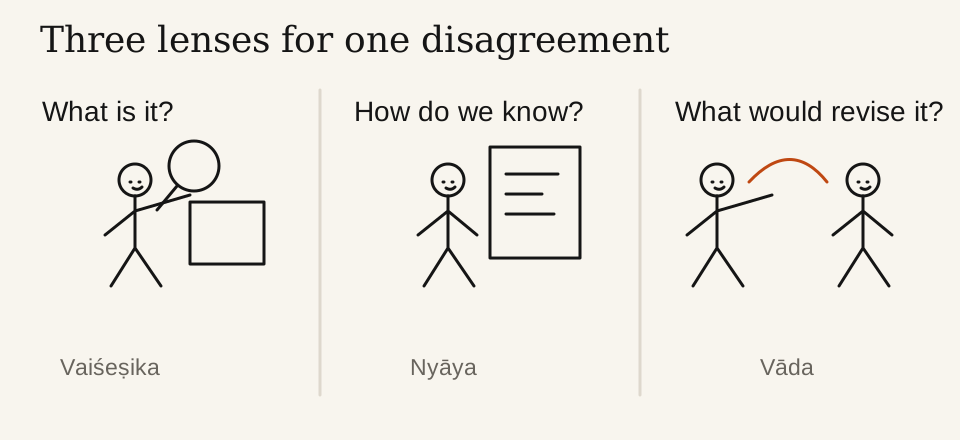
Vaiśeṣika, Nyāya, and Vāda add an intellectual discipline to that conversation. What kind of thing are we describing? What evidence justifies our conclusion? And how do we examine competing claims without allowing the desire to win to replace the desire to understand?
I don't want to claim that ancient Indian philosophy predicted or validates the Internet of Value. These traditions arose in their own historical and philosophical contexts, including questions of knowledge, reality, self, and liberation. Their insights deserve to be studied on their own terms, while recognizing the differences between their original concerns and our contemporary applications.
What I do want is to build a research culture in which those questions are not treated as obstacles to progress. They should be part of how progress is made.
An open table, not a finished theory
VĀDA will be a public dialogue series within the Internet of Value Research Foundation's Insights. Each edition will begin with a proposition that can be questioned, examined, and, where possible, tested. Some discussions will focus on philosophical definitions, others on mathematical models, empirical evidence, economic assumptions, or governance arrangements.
We will invite researchers, economists, mathematicians, philosophers, technologists, community builders, and people whose everyday experiences challenge the abstractions we construct. Participants will not need to agree with the Internet of Value to contribute. In fact, some of the most useful participants may be those who believe its foundational assumptions are mistaken.
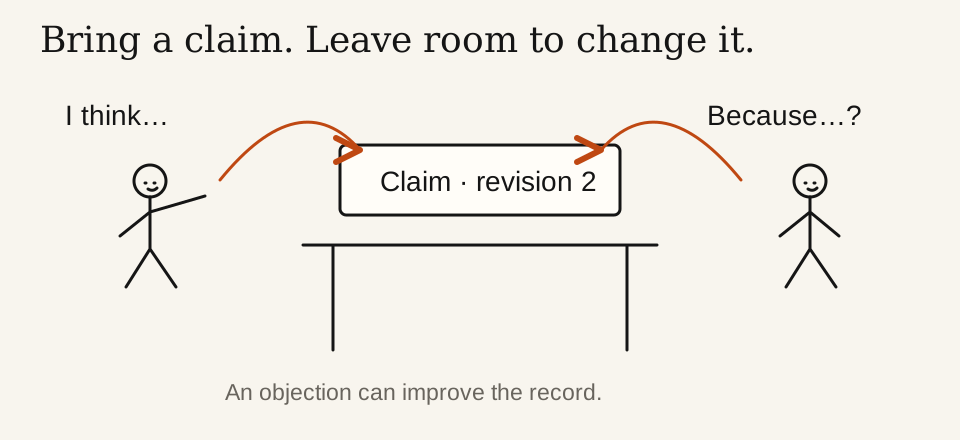
I would like each dialogue to leave behind more than a recording or a collection of opinions. We will work toward a living argument ledger that identifies the proposition under examination, the strongest objections, the available evidence, unresolved questions, and any revisions resulting from the conversation. It should be possible for someone encountering the discussion months later to understand not only what we concluded, but why, what remains uncertain, and what could change the conclusion.
The structure itself should remain open to improvement. This is a proposed contemporary adaptation inspired by classical Indian philosophical inquiry, not a reproduction of the historical procedures of a Nyāya debate. Modern research methods, experimental design, mathematical formalization, and contemporary philosophy all have roles to play.
Our inaugural dialogue will examine a foundational distinction in the Internet of Value: is time a unit of value, or a common unit of observation through which different forms of value can subsequently be examined?
At first glance, the question may sound semantic. But its answer shapes what our protocols record, what our equations represent, how communities validate contributions, and whether we risk equating the time a person spends with the worth of the person spending it.
We have developed a provisional position. Now we want to examine whether that position survives scrutiny.
Before we cross the bridge
Let's return to our village one final time. The bridge still stands, and the people discussing it have not necessarily reached a unanimous conclusion. The farmer may continue to value the faster route, the teacher may demand stronger safety evidence, and the older resident may insist that maintenance responsibilities be reconsidered.
But the conversation has changed. What began as a disagreement about whether the bridge was good has become a series of more precise questions about what it does, what evidence supports its claimed benefits, which risks remain, and how decisions should be made.
The villagers may eventually reinforce the structure, change how it is maintained, gather more evidence, or decide that some of their original assumptions were wrong. Their disagreement has not prevented them from improving the bridge. It has provided a reason to examine whether the bridge deserves their trust.
That is the spirit in which I want to introduce VĀDA.
We are attempting to build infrastructure through which people and communities can describe, examine, and recognize forms of value that our current systems may not adequately represent. It is an ambitious proposition, and precisely because of that ambition, it should be exposed to serious scrutiny before we expect others to rely on it.
The first bridge we need to build may not be between two economic systems or two communities. It may be between what we believe and what we are prepared to discover.
We are building an Internet of Value. We invite you to question its foundations.
Welcome to VĀDA.
The dialogue belongs to everyone.
References and further reading
The bridge and its participants are fictional and serve as a continuous illustration, not a historical case study. The philosophical descriptions are based on classical texts and secondary scholarship; the bridge applications and proposed dialogue process are contemporary interpretations.
- Nyāya — Internet Encyclopedia of Philosophy
- Hindu Philosophy — Internet Encyclopedia of Philosophy
- Vaiśeṣika — INFLIBNET academic text
- The Nyāya-sūtra 1.2.1 on Vāda, with translation and commentaries
- The Nyāya System — INFLIBNET academic text
- Internet of Value — Language, Time and Mathematics
- Internet of Value — Protocol Stack