
Dialogue · 001
What Is Value? Is Time a Unit of Value or Observation?
A well at Dhun, one fictional teaching hour and a contested equation open VĀDA 001: how do time, wellbeing, evidence and community validation differ?
Quick Answer
What if the problem with our economy isn't simply that we value the wrong things, but that we haven't agreed on what we mean by value in the first place? Beginning with a story about an ancestral well at Dhun, this essay explores how human activity becomes observable, how observations become claims, and how communities decide what deserves recognition. Along the way, two Indian philosophical traditions—Nyāya and Vaiśeṣika—help us examine the assumptions behind The Internet of Value, including its mathematics. The purpose isn't to prove a new economic system correct. It's to invite others to help discover whether it can withstand serious disagreement.
1. The well that became someone's identity
At Field Station in Dhun, Rajasthan, Manvendra Singh Shekhawat told us a story that has stayed with me. During his brother's wedding in Jaisalmer, someone from the bride's family asked him a peculiar question: "Where is your nose?" His brother initially took the question literally, which apparently caused some amusement. But according to Manvendra's telling, the expected answer wasn't a part of the body. It was a well that their ancestors had helped dig.
I explored this story in an earlier essay, Where Is Your Nose? What a Community Chooses to Remember. I haven't independently verified how widely that particular custom existed, but the underlying idea fascinated me. In an arid landscape, a well could represent far more than the labour required to construct it. It could become a source of water, a condition for survival, a shared responsibility, and something a community chose to remember long after its builders were gone.
That raises an uncomfortable question about value. The people who originally dug the well might receive recognition for generations, but what about the people who maintain it? The person who replaces a damaged rope, the person who teaches someone else how to operate the pulley, or the person who notices a problem before the well becomes unusable? Their contributions might not produce a new monument, yet the monument may depend on them.
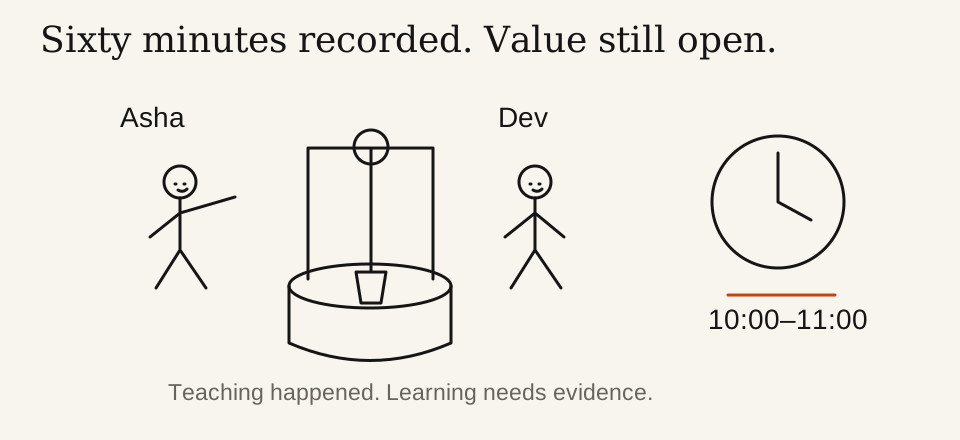
Now imagine a fictional scene at a well like the one in that story. A woman named Asha spends an hour teaching a younger community member, Dev, how the mechanism works and how to identify early signs of damage. They begin at ten in the morning and finish at eleven. Dev feels that he has learned something. Asha, who has spent the morning preparing and demonstrating the lesson, feels exhausted. Someone watching them decides to record the activity in a ledger.
What should that person write? An hour of teaching, an hour of learning, an hour of maintenance training, or an investment in the future resilience of the community? If Dev never uses the knowledge, does the value change? If he prevents a failure months later, should some of that benefit be attributed to Asha? And who has the authority to answer any of these questions?
A conventional ledger might record sixty minutes of work, an expense if someone was paid, and perhaps a completed task. But it cannot tell us, from that entry alone, what the hour meant to Asha, whether Dev genuinely acquired a skill, or what benefit the community will eventually receive. We need to distinguish the event, the experience, the outcome, and any recognition attached to it.
I want to keep this imaginary hour on the table for the rest of our conversation, because I think it contains a surprisingly large part of the challenge behind The Internet of Value.
2. Everyone agrees on the hour. Nobody agrees on the value.
Let's begin with the easiest part of the ledger. If Asha's session started at 10:00 and ended at 11:00, its elapsed duration is sixty minutes. We can express that mathematically without needing to know anything about Asha, Dev, or the community.
Δt = t_end − t_start = 60 minutes
Now consider another person who spends the same hour trading financial assets and makes a substantial profit. Both activities occupy one hour. One may have a readily observable financial outcome, while the other may generate a capability whose usefulness is only demonstrated later. It would be unreasonable to conclude that they produced equal value, but it would also be unreasonable to conclude that the activity without a market price produced no value at all.
The difficulty is that words such as value, price, worth, productivity, contribution, and wellbeing frequently appear in the same conversations as though they refer to interchangeable quantities. They do not. Price can describe the terms of an exchange. Income can describe monetary receipts. Productivity relates outputs to inputs under a defined measurement system. Wellbeing concerns aspects of human experience and functioning. Contribution involves effects on other people, organizations, communities, or shared resources.
An hour can locate these different phenomena in time without making them equivalent. If two activities have the same duration, we can say something precise about their temporal extent, but not automatically about their benefit or legitimacy. In mathematical terms, equal duration does not imply equal outcomes.
This takes me back to another Field Station essay, Language, Time and Mathematics. I described these as three coordination primitives: language offers shared meaning, time provides shared sequence, and mathematics supplies ways to express quantities and relationships. Our ledger needs all three. We need language to explain what occurred, time to establish its boundaries, and mathematics to make its measurable properties inspectable.
Yet their intersection reveals a deeper problem. A timestamp does not prove that an event happened as described. An equation does not establish that its variables are meaningful. And a community agreeing to use the same word does not guarantee that everyone understands it in the same way. Before designing a common economic language, we have to ask what exactly our concepts represent and how we can justify the claims we make about them.
It turns out that Indian philosophical traditions have been examining versions of these questions for centuries.
3. Before arguing about value, what exactly exists?
Imagine that a philosopher trained in Vaiśeṣika joins us beside Asha's ledger. Instead of immediately asking whether her hour was valuable, this person begins by questioning our categories. Are we talking about the person who acted, the activity she performed, the duration of that activity, the qualities associated with it, or the effects produced? If these are different things, why are we attempting to describe them with one number?
Vaiśeṣika, traditionally associated with Kaṇāda, developed an intricate examination of the categories of reality. The early tradition emphasizes substance (dravya), quality (guṇa), and motion or action in a specific metaphysical sense (karman). Later systematic accounts developed the familiar categories of universality, particularity, and inherence, with absence subsequently receiving explicit treatment. In this framework, time (kāla) is itself recognized among the kinds of substance. Vaiśeṣika and its categories.
I find this fascinating not because we should convert Vaiśeṣika into a software architecture, but because it demands conceptual discipline. Asha's exhaustion is not the same kind of claim as the session's duration. Dev's understanding is not identical to the fact that a lesson was delivered. A community's decision to recognize the lesson is different again. Each may be related to the others, but we should explain the relationship instead of pretending that the categories collapse naturally into one quantity.
There is a philosophical danger in borrowing ancient terminology carelessly. Classical karman in Vaiśeṣika is not equivalent to everything we now call human activity, and the padārthas were not invented to specify economic data models. Our contemporary use is an analogy that can guide clearer definitions, not a claim that the ancient school already contains the Internet of Value protocol stack.
The useful challenge remains: what are the entities in our model, what are their properties, and what relationships can we legitimately establish among them? If a protocol records an hour, evaluates a change in human state, and allows a community to recognize a contribution, those must remain distinguishable operations even when they originate from the same lived event.
Otherwise, we may build an extraordinary system for calculating relationships between things that nobody has adequately defined.
4. How do we know that anything in the ledger is true?
Our imagined philosopher has helped clarify what we are talking about, but another question remains. Who can establish whether the entries in Asha's ledger are accurate? Here, the Indian philosophical tradition of Nyāya becomes particularly useful.
Nyāya, traditionally associated with Akṣapāda Gautama and the Nyāya-sūtra, developed methods for reasoning, knowledge, inference, and disciplined argument. It recognizes four principal means of valid knowledge, or pramāṇas: perception (pratyakṣa), inference (anumāna), comparison (upamāna), and reliable testimony (śabda). These are not merely four ways to express an opinion. They are part of a broader inquiry into when a cognition is justified. Academic account of Nyāya.
Return to Asha's session. Someone could directly witness the teaching, but that wouldn't establish every claim about its outcomes. We could infer that Dev acquired a skill from a suitable demonstration, although one successful demonstration might not establish lasting competence. Classical upamāna concerns learning a word’s referent through recognized similarity, not every use of analogy. We can compare learning sessions as a contemporary aid to explanation, while recognizing that this is not an exact application of that classical pramāṇa and similarity is not proof. We could also consider Asha's and Dev's testimony about the experience, paying attention to their knowledge, reliability, incentives, and circumstances.
The distinction between a recorded statement and a justified conclusion is essential. Asha saying she felt exhausted is meaningful evidence of her reported experience, but it is not automatically a physiological measurement of fatigue. Dev claiming he learned something deserves attention, but if the community intends to issue a consequential credential, it may reasonably require a relevant demonstration. A timestamp can establish a boundary for an observation while leaving the truth of other claims open.
Classical Nyāya also offers a five-member structure for presenting an argument: a proposition (pratijñā), a reason (hetu), an example establishing the relevant relationship (udāharaṇa), an application (upanaya), and a conclusion (nigamana). We can use that discipline to construct a modest argument about Asha's ledger. We propose that an appropriately maintained activity record can support later examination; we explain that it preserves inspectable information beyond immediate memory; we identify comparable cases in which reliable records permit review; we apply that principle to Asha's confirmed session record; and we conclude that her activity can now be examined with greater specificity.
Notice how carefully that conclusion is limited. We have not proved that observing an activity improves human wellbeing, that the record is immune to manipulation, or that the session deserves a certain amount of economic recognition. Those would require their own arguments, evidence, and possibly experiments.
This intellectual restraint is central to what I want this series to become. A strong argument should carry only the weight its evidence can support. When the conclusion is larger than the evidence, the appropriate response is not a more beautiful explanation. It is a better question.
5. What if we built the ledger as a protocol?
Let's bring that discipline into the architecture of The Internet of Value. The goal is not to declare how much Asha is worth. It is to develop a shared language through which relevant aspects of her activity, experience, contribution, and identity can be represented without confusing one with another.
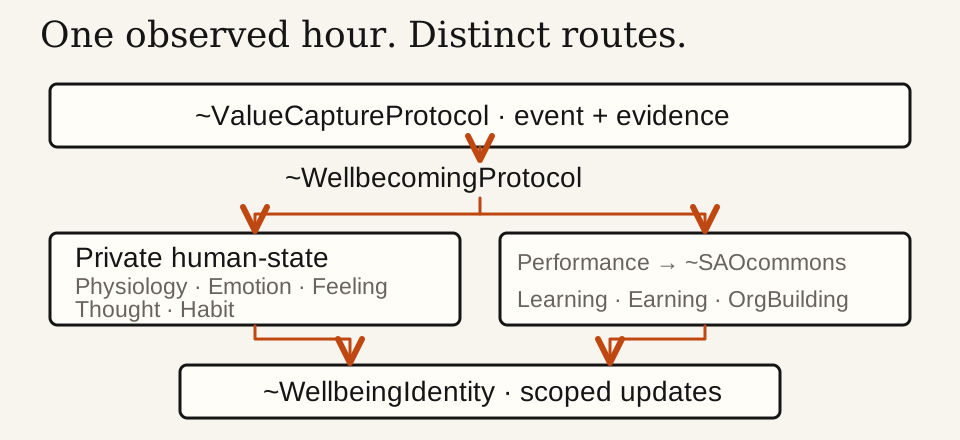
The first part of that architecture, ~ValueCaptureProtocol, concerns the bounded observation. Asha's session happened between two points in time; it involved an activity, identifiable participants, relevant context, and potentially supporting evidence. The canonical protocol includes nodes for time slices, activity, proof, attribution, and integrity. This gives the event a structure that can be inspected, corrected, and connected to later claims.
The second part, ~WellbecomingProtocol, concerns interpretation in relation to human-state dimensions. Its canonical nodes are ~~Physiology, ~~Emotion, ~~Feeling, ~~Thought, ~~Habit, and ~~Performance. Asha's report of exhaustion might inform a properly governed private human-state observation. Dev's reported confidence could be considered in his own context. A claim about demonstrated skill might belong to the Performance route. These are different observations and should not be treated as though one automatically establishes the others.
The third part, ~SAOcommons, concerns the conditions under which eligible Performance claims may receive community validation, attestation, and constituted value. Its lanes include ~~Learning, ~~Earning, and ~~OrgBuilding, as explained in From Performance to Commons. Dev's demonstrated learning might support one type of claim, while Asha's teaching may support another, but neither automatically deserves a specified economic reward. Communities need explicit rules concerning evidence, authority, conflicts of interest, appeals, correction, and the scope of the recognition they provide.
The fourth part, ~WellbeingIdentity, provides a living, consent-governed representation that can be updated through authorized protocol flows. It is not simply a public profile or a permanent summary of a person's worth. Private human-state observations can remain private while updating appropriate identity state; validated community claims can follow a separate governed path. Their connection to the same person should preserve context without erasing the distinctions between self-reported experience and external recognition.
This is what I find promising about the architecture. The protocol does not need to answer every question about Asha's hour at the moment it is recorded. It can represent what is known, what is claimed, what remains pending, and what has been validated under particular rules. Corrections can remain traceable rather than silently replacing a previous account.
But this is still an architecture, not proof that every implementation works or that every community using it will behave fairly. A well-structured ledger can make a bad judgment easier to inspect without making the judgment good. We have only moved the difficult question to a more precise place, which is progress of a particular kind.
6. What does the value equation assume?
Eventually, someone beside the ledger will ask us to stop discussing philosophy and show the mathematics. I welcome that request, because it forces us to expose assumptions that can otherwise remain hidden in appealing language.
The Internet of Value publishes the conceptual research relation VC = W × Vcom, where VC is a typed value output associated with an eligible commons-valued event, W is a defined represented wellbeing-state term, and Vcom is the constituted commons-value term. The equation is not a universal measure of human worth. Its use depends on the relevant Performance route, defined valuation inputs, and appropriate governance.
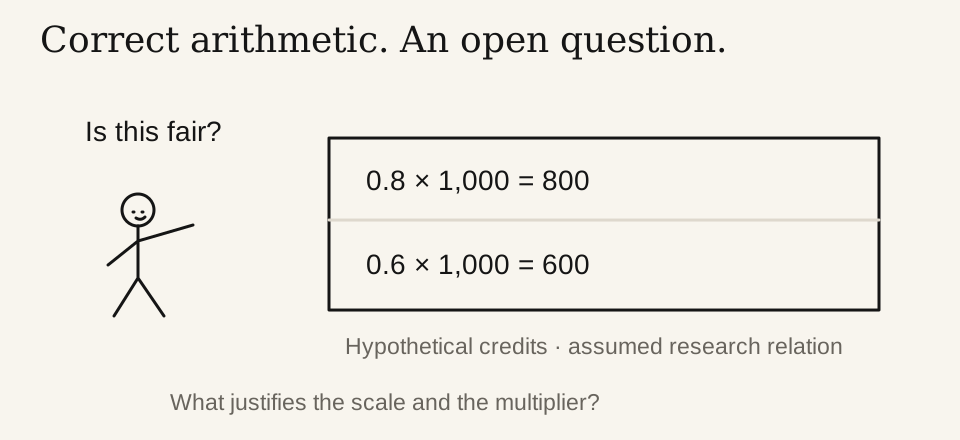
The public mathematical guide provides a synthetic example of one eligible Performance hour. Assume a pre-event represented wellbeing state of 800 out of 1,000, normalized to 0.8, and a constituted event value of 1,000 hypothetical credits. Under that example's specified research relation, the result becomes:
W_before = 800 / 1,000 = 0.8
Vcom_event = 1,000 hypothetical credits
VC_performance,event = 0.8 × 1,000 = 800 hypothetical credits
The arithmetic is elementary. The difficult questions concern how W was established, what its scale means, why a community constituted that particular value, and whether multiplication is a defensible relationship between the constructs. The example does not establish a live wage rate, a payment owed, or an experimentally validated economic rule. When the required community valuation inputs do not exist, the relevant economic outputs remain undefined rather than being assigned an automatic zero.
Now let's subject the equation to a more serious challenge. Suppose, in an illustrative sensitivity calculation, that the same constituted Vcom value of 1,000 credits were combined with a normalized W of 0.6 instead of 0.8. The output would become 600 credits. A change of 0.2 in the normalized input would produce a difference of 200 credits under the assumed multiplication rule.
ΔVC = Vcom_event × ΔW
That relationship is mathematically consistent, but why should it be desirable? If the lower represented state reflects a person experiencing illness, exhaustion, disability, or difficult circumstances, could applying such a multiplier to consequential economic allocation penalize someone for conditions that deserve support? If W is a composite of several different human-state dimensions, what licenses that aggregation? And if the represented baseline carries measurement uncertainty, how should that uncertainty affect the interpretation of the output?
These are not objections we should hide in a technical appendix. They are the exact questions that mathematical modeling makes possible to examine. The model's dimensions must be clear, its assumptions public, its sensitivity testable, and its failure conditions meaningful. We should be willing to preserve wellbeing and contribution as distinct quantities if the evidence does not justify multiplying them.
What matters is not whether we can calculate 800. What matters is whether 800 answers a legitimate question, whether the answer is robust enough for its intended use, and whether anyone affected by the result can challenge the assumptions behind it.
The fact that we can express an idea mathematically does not make that idea true. Sometimes the greatest contribution of an equation is that it makes a disagreement precise enough to investigate.
7. Does deliberate observation change the observer?
There is another question waiting beside Asha's ledger, one that may be even more important than the economic calculation. What happens to Asha when she begins observing her life differently?
Suppose she starts keeping a deliberate account of her activities, including what she noticed about her own experience. Over time she might discover that certain teaching sessions exhaust her, that preparation affects how confidently she facilitates, or that apparently unproductive periods contain necessary care and recovery. This would be a meaningful form of learning if it occurred, but we should not confuse a plausible benefit with a demonstrated result.
The distinction between passive collection and conscious observation matters here. A device might record movement, location, or an activity interval without asking Asha what she understood about it. Such records can be useful for appropriate purposes, but they do not automatically establish her experience or increase her awareness. In ValueLog, the approach we're exploring emphasizes the person's participation in observing, checking, and confirming the representation of their day.
I suspect that naming an experience can sometimes make it more available for reflection and deliberate action. Yet this remains a hypothesis requiring evidence. An experiment could compare an active observation-and-confirmation practice with consented passive data collection and a suitable comparison condition. Researchers could examine whether participants improve their ability to recall, distinguish, and explain their activities, while also measuring burden, error, behavioural reactivity, and privacy concerns.
Let A denote a pre-specified, appropriately validated measure of activity awareness. We could examine each participant's change in that measure over a defined period, then compare average changes across experimental conditions:
ΔA = A_after − A_before
Estimated difference = Average(ΔA_active) − Average(ΔA_comparison)
This expression is a proposed research estimator, not a measured result. Its causal interpretation would require an appropriate study design, ideally with random assignment when feasible, attention to missing data, and clear safeguards. Perhaps deliberate observation produces a substantial benefit. Perhaps the benefit is small or short-lived. Perhaps a conventional diary performs just as well. Any of those findings would teach us something important.
The immediate accessibility of this research direction is one of the reasons I remain interested in it. A person can begin observing a day without waiting for a new economy to be built. But whether that individual practice can eventually influence larger economic institutions is a separate question involving adoption, incentives, interoperability, and governance.
We shouldn't leap from one person's awareness to a civilization-scale transformation merely because the story is attractive. We should investigate the steps connecting them.
8. Why I want disagreement at the beginning
By now, our imagined hour has produced more questions than answers. Asha's activity has a time boundary, a description, possible evidence, private human-state observations, and perhaps an eligible community-recognition claim. The ledger is more informative than it was when we first opened it, but its additional detail has not eliminated disagreement.
Someone might argue that none of this requires a new protocol stack. Activity diaries, skills assessments, existing community organizations, and transparent accounting practices already accomplish parts of what we are describing. Another person might question whether observation makes activities meaningful or merely encourages people to perform what is easiest to measure. An economist could challenge the relationship between wellbeing and constituted value. A philosopher might dispute our definitions. A community organizer could reasonably ask who controls the validation rules and what happens when those rules disadvantage the people doing quiet, essential work.
I would want all of them in the conversation. Indeed, I would prefer that they challenge the foundations before the system becomes sufficiently established that correcting it requires overcoming institutional inertia.
This brings us to Vāda, a concept within the Nyāya tradition concerned with reasoned, truth-oriented dialogue. Classical Nyāya distinguishes vāda from jalpa, a dispute oriented toward winning, and vitaṇḍā, a form of disputation focused on refuting another position without defending a positive thesis. The historical traditions surrounding these terms are sophisticated, and I am not proposing to reproduce an ancient debate procedure exactly. I want to adapt the intellectual discipline to a contemporary public inquiry.
VĀDA will be a series within The Internet of Value's Insights, where each edition examines one proposition that can withstand disagreement. Some propositions will be conceptual, demanding clear definitions and coherent arguments. Others will be mathematical, requiring models, calibration, and sensitivity analysis. Empirical propositions will require studies capable of producing results that could contradict our expectations. Governance claims will need scrutiny from the people whose lives and opportunities could be affected by them.
I also propose a living argument ledger accompanying the series. A proposition would not disappear when the next essay is published. Its strongest objections, supporting evidence, unresolved assumptions, and subsequent revisions would remain visible. The record would distinguish claims we are confident about from hypotheses we are testing and questions for which we do not yet have an adequate answer.
That ledger would be open to correction, just as any worthwhile research process should be. An objection that exposes a weakness is not a failure of the conversation. Refusing to address it would be.
9. What would change your mind?
I can imagine someone asking this question at our fictional courtyard table, just as everyone prepares to leave. Asha has completed her session, Dev has gone home, and the person keeping the ledger has learned how many different claims can emerge from one hour of ordinary human activity. We still do not know whether Dev will use the skill, whether Asha's experience changed her future behaviour, or whether the community will choose to recognize the contribution.
What we do have is a clearer separation between what happened, what was experienced, what can be justified, and what remains to be decided. We can preserve the record without pretending to know its final meaning. That distinction is a modest beginning, but perhaps modest beginnings are exactly what systems of measurement need.
The first VĀDA proposition is therefore this: time can serve as a common observational reference for human activity without becoming a universal measure of human worth. My present view is that the distinction is foundational to The Internet of Value. But a philosophical position is only the start of an investigation, not its completion.
I want economists to ask whether our constructs genuinely improve economic reasoning. I want mathematicians to question the model's scales, operations, and assumptions. I want philosophers to challenge our categories and the validity of our arguments. I want psychologists and other researchers to examine whether deliberate observation produces the changes we hypothesize. And I want community builders to tell us whether the governance we imagine would survive the messy reality of people with competing interests and unequal power.
Above all, I want ordinary participants to have the ability to tell us when the language we've designed does not describe their lives.
At the beginning of this essay, a community remembered a well through the people who had helped create it. We then imagined an hour of teaching that might sustain such a resource long after the original builders were gone. Our clock could measure that hour precisely, but understanding its significance required people, language, evidence, institutions, and judgments that mathematics alone could not provide.
Perhaps developing a new economic language begins by resisting the temptation to produce a final number too quickly. The Internet helped machines communicate through agreed rules. If an Internet of Value is to help people and communities communicate about value, it will need not only shared representations but shared ways to examine and contest what those representations mean.
That is the invitation behind VĀDA. We are putting The Internet of Value's foundations on the table, including the parts we are least certain about, because the purpose of a public research institution should not be to protect its original proposition from criticism. It should be to discover what survives when the proposition is examined.
The Internet of Value is our proposition. The dialogue belongs to everyone.
Opening argument ledger · VĀDA 001
Proposition: Time is a shared observational reference through which human activity can be represented, contextualized, and examined, without making duration a universal measure of human value.
Strongest current objection: A common time reference does not by itself make different forms of experience or contribution meaningfully comparable. Additional definitions and governance might introduce distortions, exclusions, and arbitrary judgments.
Current position: The protocol distinguishes captured duration, human-state interpretation, and conditional community validation. This provides a proposed structure for examining different claims, but it does not establish that every combination is legitimate or useful.
Unresolved mathematical question: Under what assumptions, if any, is multiplication between represented wellbeing state and constituted commons value justified for real-world decisions?
Empirical hypothesis: Deliberate, participant-confirmed observation may improve a person's understanding of lived activity relative to suitable comparison practices.
Evidence needed: Validated measures of awareness and usefulness, comparative studies of observation methods, calibration and sensitivity analysis, and independently scrutinized governance cases.
Status: Open to challenge. No claim of universal calibration or demonstrated economic superiority.
To challenge this proposition or contribute evidence, use the Foundation's contact form and reference VĀDA 001. The first task is to identify what would change our minds.
References and reading
Internet of Value primary sources
- The canonical IoV Spec and protocol registry
- Protocol stack
- How a Lived Moment Becomes a Value Claim
- Observer Attention Is All You Need — The Observed Time Slice
- Observer Attention Is All You Need — From Performance to Commons
- Field Station — Where Is Your Nose?
- Field Station — Language, Time and Mathematics
Philosophy and research references
- Nyāya-sūtra 1.2.1 — translated primary text
- Internet Encyclopedia of Philosophy — Nyāya
- Internet Encyclopedia of Philosophy — Classical Indian Philosophy and Substance
- Stanford Encyclopedia of Philosophy — Logic in Classical Indian Philosophy
Editorial note: Asha and Dev are fictional participants used to explore the problem. The ancestral-well account is attributed to Manvendra Singh Shekhawat as documented in the author's Field Station essay. The mathematical examples are synthetic, and the proposed awareness study has not been conducted as part of this article. This edition distinguishes protocol specifications, historical scholarship, conceptual arguments, and hypotheses requiring empirical research.