
Chapter 9 of 9 · 2 min read
The Observer Changes
Three redacted moments from the author's day show how private and validated returns change future attention.
Observer Attention Is All You Need · v0.8 · edition history · Moses Sam Paul
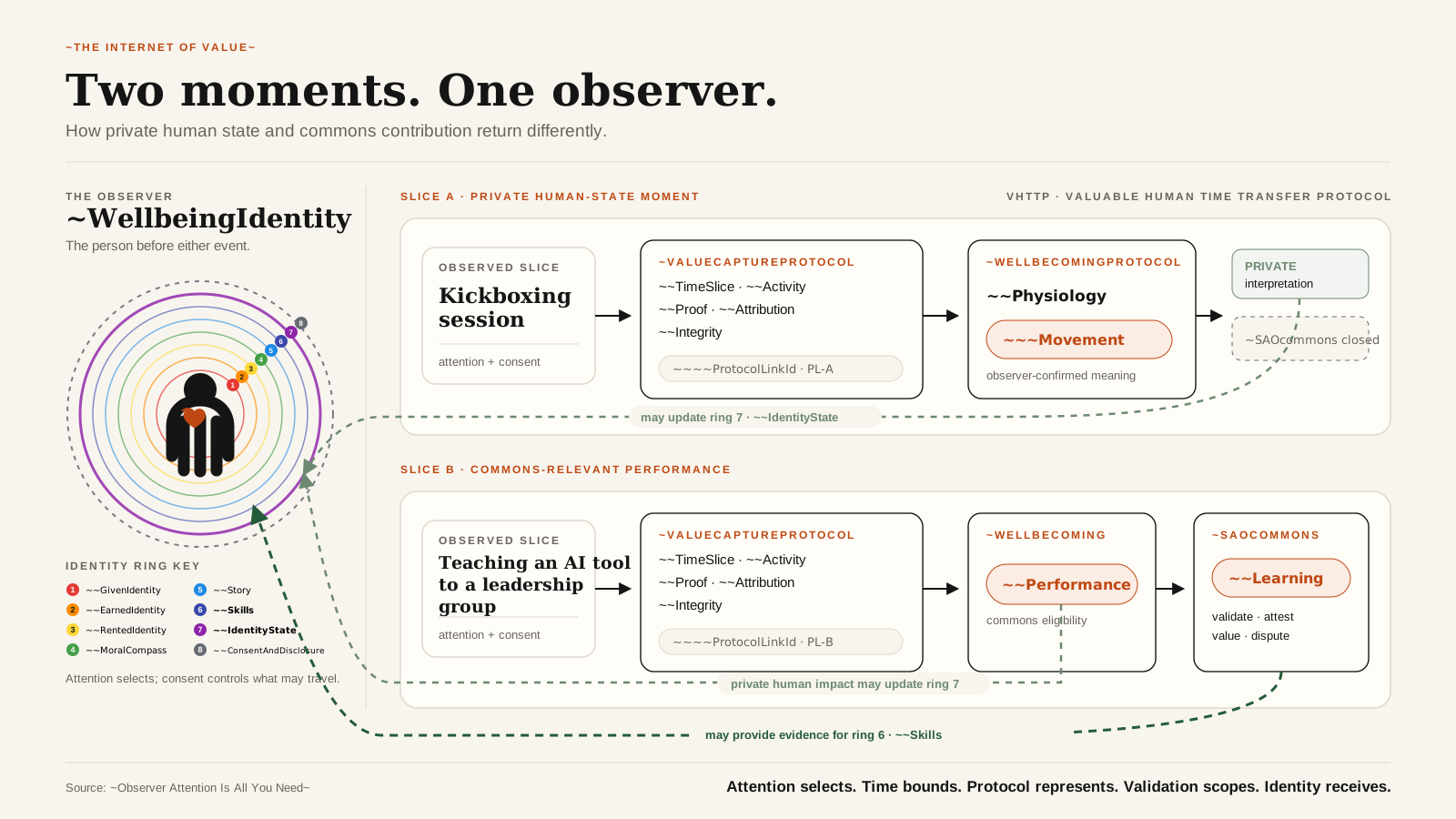
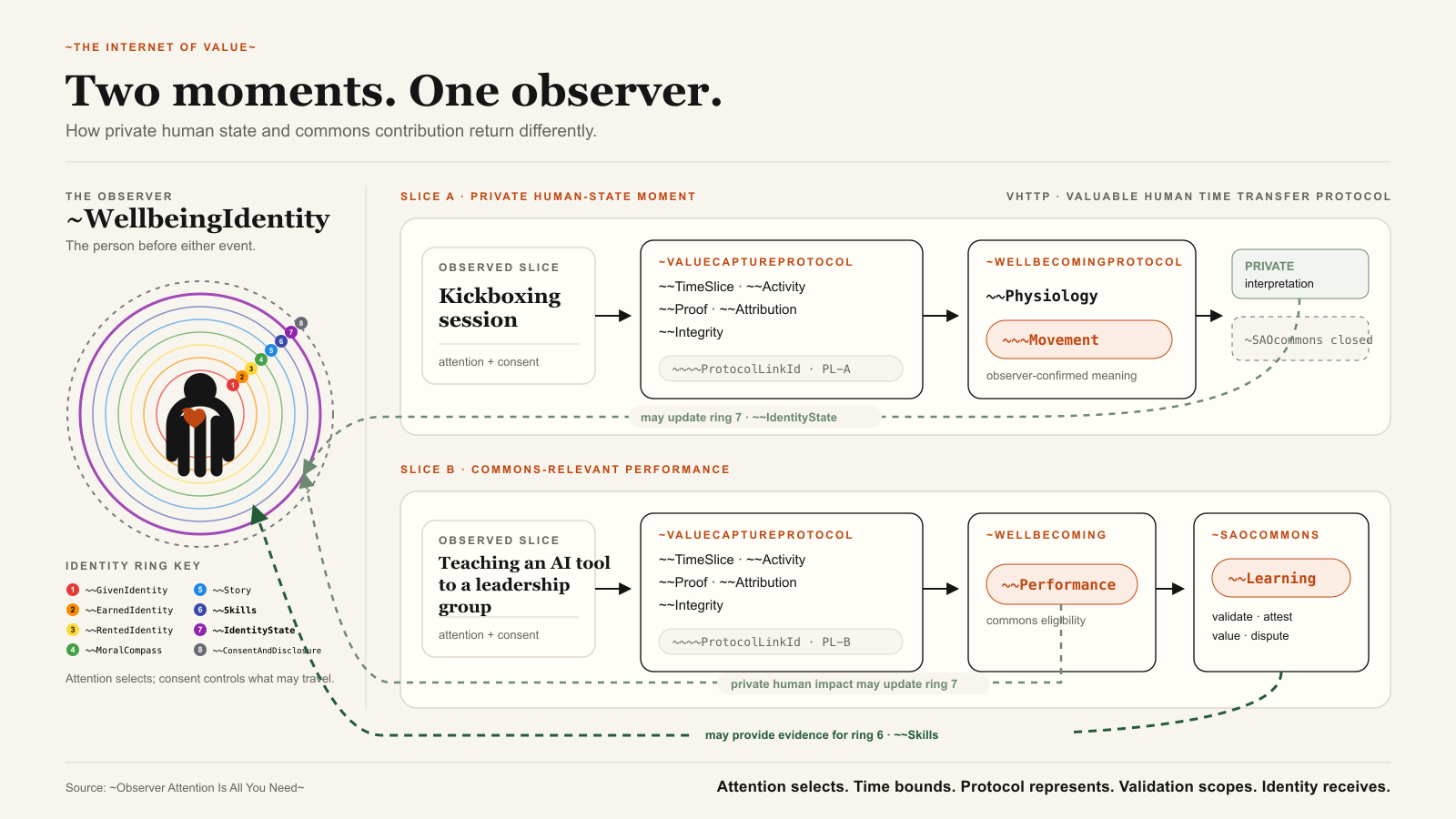
A worked day, not proof
The observer in this chapter is Moses Sam Paul . The three moments are deliberately redacted and simplified. They explain the routing architecture; they are not user research, independent validation, or a public disclosure of private identity values.
Morning: recovery
A recovery period is selected because fatigue and rest became meaningful to the observer. ~ValueCaptureProtocol gives the period a boundary. ~WellbecomingProtocol routes it through private human-state nodes such as Physiology, Feeling, or Habit.
No commons claim is required. The possible return is private: a revisable update that may change what the observer notices about energy, recurrence, or the need for rest later in the day.
Midday: shared learning
A facilitated learning session becomes an observed time slice with activity, evidence, attribution, and integrity context. ~~~~WellbecomingNodeTag routes it to ~~Performance.
Because the activity has a Learning output, it may enter ~SAOcommons. A community can review the claim, evidence, role, and outcome. If accepted, the validated return may update skill evidence or earned identity. The same event can also affect private state, but the two returns remain distinct.
Evening: reflection
A reflective writing period is captured because it changes how the day is understood. It may route through Thought, Feeling, Story, or Habit depending on what the observer confirms.
The value is not that the journal entry earns points. The value is that the observer can notice a pattern, preserve context, revise interpretation, and make a different choice tomorrow.
The loop closes
Observer → selected signals → time-bound capture → Wellbecoming vocabulary

→ scoped identity update → changed future attention
When Performance enters governed validation, a second return joins the loop:
Performance → commons claim → validation or dispute

→ attested identity update → changed future possibility
Observer attention therefore feeds back into the observer. The person who notices tomorrow is not entirely unchanged by what was represented today.
Evidence and limitation
The worked day shows causal ordering and privacy boundaries. It does not prove that any scoring model accurately measures wellbeing or contribution. Product evidence is available in the separate field note after the theory has been read on its own terms.